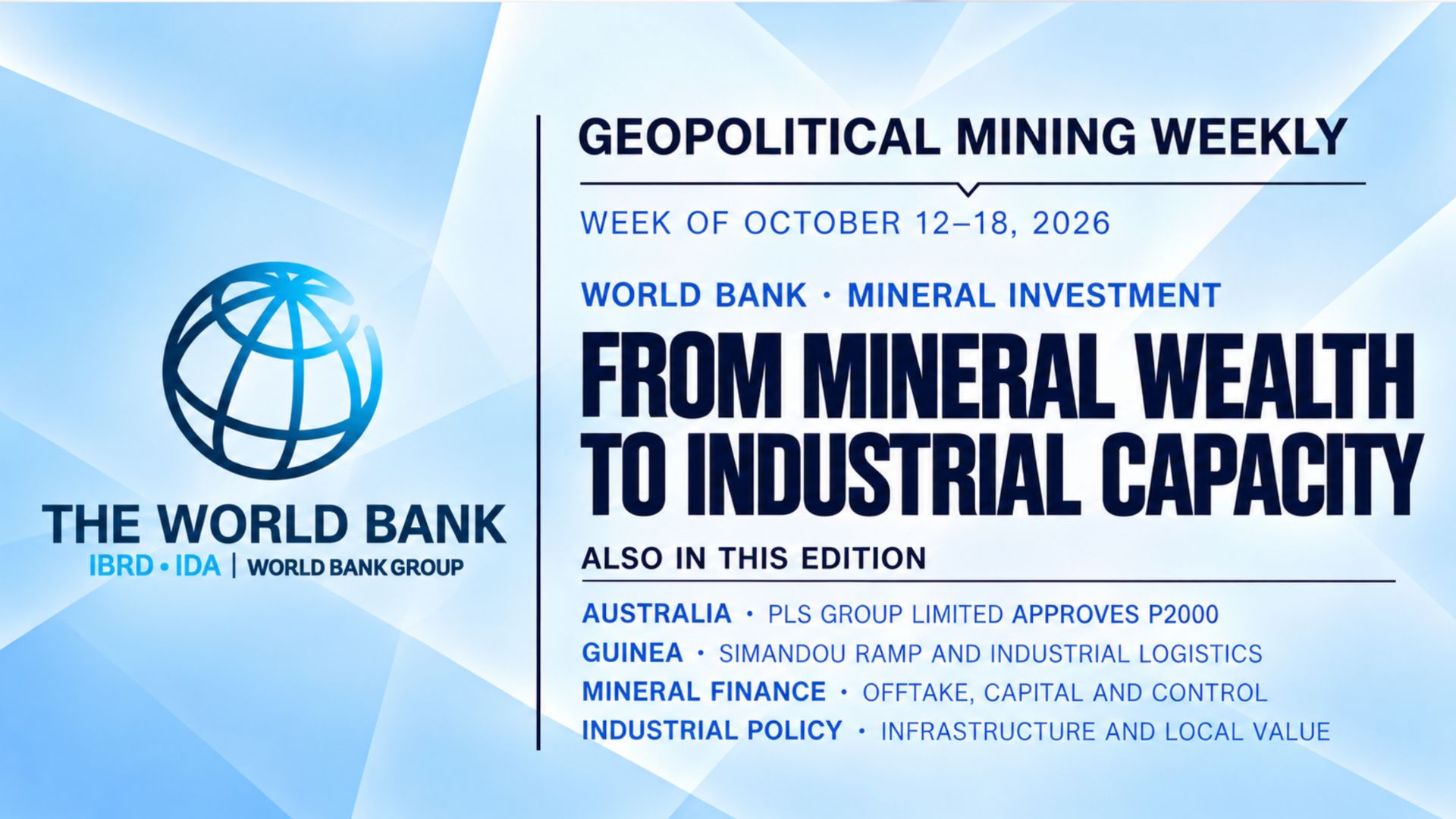

World Bank Mineral Compacts: From Resources to Industrial Capacity
The World Bank mineral compacts presented this week put industrial capacity at the centre of resource development. Corporate decisions across the sector show why an investment case can extend across the mine, infrastructure, processing knowledge and customers. They also expose a difficult bargain: who finances those connections, who controls the resulting flows, and how much value stays in producer economies?
The compacts could make complementary investments viable together. Their strategic value will depend on choosing the right industrial activities, distributing risk credibly and preserving the commercial discipline needed to deliver them.
A weekly analysis for senior executives, investors and policymakers, connecting mining developments with investment, industrial strategy and public policy.
Evidence base: five Daily editions (October 13–17) covering 30 developments, supplemented by official country compacts, company disclosures and policy documents.
Cover story · World Bank / Mineral economies
The October 16 announcement brought together eight governments in the World Bank Group’s expanded compact and partnership framework: Argentina, Bolivia, Egypt, India, Kazakhstan, Malawi, Mauritania and Zambia. The US$19 billion ambition combines planned financing from the Bank Group’s own resources with private capital mobilization. It is a programme objective.
The model already had a foundation: four initial compacts launched in April connected mineral development with jobs, infrastructure and institutional reform. The October expansion gives this approach greater geographic reach. Its economic proposition is important: coordinating several interdependent investments could unlock projects that remain difficult to finance separately.
The productive system behind the resource
Public instruments and private investment carry different risks.
Power, water and transport connect assets and markets.
Technology and customer qualification turn feedstock into saleable products.
Institutions shape access, participation and the distribution of returns.
The strategic question
Can coordinated investment create competitive industrial capacity while giving producer economies a durable share of its value?
World Bank mineral compacts and industrial coordination
Finance the connections
Kazakhstan’s compact targets roughly US$20 billion of domestic and foreign investment by 2031. It explicitly creates no automatic budget, debt or sovereign guarantee commitment. Its practical significance lies in how infrastructure could be financed: third-party power, rail and water providers may receive lending or guarantees supported by service undertakings. An anchor mining customer could therefore help make a wider infrastructure network investable, with benefits depending on who else can use it.
Build toward qualified demand
India’s partnership envisages US$5 billion of capital mobilization through 2031, combining public, private and partner resources. It connects feedstock and shared utilities with technology partners, laboratories, customer validation and aggregated offtake. That sequence treats industrial capability as a commercial system. Processing equipment creates value when operators can produce consistently and buyers accept the output; the partnership’s ambition extends to those interfaces.
Choose where value addition is competitive
The Bank’s June study of smelting and refining supplies the essential economic qualification. Secure feedstock, dependable power, capital cost and operating scale determine feasibility. Mineral availability and processing advantage may coincide more readily across a region than inside one country. The strongest compacts could connect complementary capabilities while resisting expensive commitments to activities that lack a durable cost advantage. National development can benefit from regional specialization.
Capital, capacity and commercial control
US$19 billion
World Bank Group ambition
Planned financing plus private capital mobilization across FY2026–2030.
US$20 billion
Kazakhstan investment target
Domestic and foreign investment sought by 2031; a mobilization target.
A$1.9 billion
PLS Group Limited P2000 project capital
Excludes A$600–650 million of enhancing infrastructure.
~10 Mtpa
Simandou annualised run rate
Reported on a 100% basis; distinct from quarterly shipments.
50% / 15 years
New NioCorp Developments Ltd. ferroniobium offtake
Traxys commitment covers half of planned ferroniobium output.
240,000 tonnes
Kipushi marketing volume
Up to this zinc concentrate volume over two years.
8 Mtpa
Gamsberg ore capacity
Phase II doubles annual ore processing capacity.
A$287 million
Savage River underground capital
Additional sustaining capital totals A$234 million over project life.
Six readings from the week
Infrastructure finance and institutional capacity determine how far public capital can reach.
Logistics can diversify supply while preserving dependence at other industrial stages.
Processing knowledge changes both recoverable resources and the geography of value.
The quality of an offtake contract determines which risks a buyer actually carries.
Producer participation gains substance through commercial rights and credible local agreements.
Capital discipline can favour staged development, preservation or delay over immediate expansion.
Public capital has to connect the whole investment case
The scale of the coordination problem is clearest in Zambia’s compact. Estimated investment requirements to 2040 total US$32.28 billion, including US$19.63 billion in mining, US$5.40 billion in electricity and US$7.05 billion in transport. Around 90% is expected from private investors. The same document identifies unreliable infrastructure and under-resourced regulatory and environmental institutions. Capital availability alone cannot resolve the resulting delays and interdependencies.
On October 17, development banks added an institutional response: a new collaboration framework provides for country teams, less duplicated assessment and coordinated financing. It also envisages instruments linked to offtake, early equity and construction risk. Cooperation remains voluntary and subject to each institution’s approvals. This could help align public support with industrial interdependence. A guarantee for power infrastructure may improve several mines’ economics; stronger regulatory capacity may make project risks easier to evaluate.
Malawi’s compact makes the development bargain tangible. It places electricity alongside model mining agreements, a dedicated mining tax unit and closure assurances. These functions determine whether a government can evaluate obligations, collect revenue and manage long-lived liabilities. A state shareholding offers one form of participation. Administrative capacity helps turn that participation, and the wider fiscal agreement, into durable public value. For investors, credible implementation can reduce uncertainty around the returns they retain.
Infrastructure can change the market without ending dependence
Rio Tinto’s third-quarter update put Simandou at an annualised run rate of roughly 10 million tonnes, on a 100% basis, with a target of 60 million tonnes a year in the second half of 2028. The commercial chain remains lengthy: production is counted when ore is ready for train loading at the mine gate, final crushing takes place in China, and full production is expected to involve roughly 75–90 days between mine production and recognized sales. Customer payment can follow later.
That sequence matters to the strategic reading. Additional Guinean supply can change buyers’ options and competing producers’ positions while relying on overseas processing and long transport cycles. Working capital, product handling and customer relationships become part of the asset’s competitive position. Mine output measures physical progress; the conversion of that output into revenue determines how the productive system funds itself.
Mauritania’s compact approaches the infrastructure question from another direction. It connects iron ore with renewable energy potential and a gradual route toward pellets and lower-emission iron. Planned third-party infrastructure access is particularly consequential. Shared rail, port and power arrangements could spread costs across users and let additional producers enter. The distribution of these gains depends on access terms, capacity allocation and pricing. A large anchor project can create the conditions for an industrial district, provided its surrounding infrastructure remains usable by others.
Process knowledge changes the resource and its industrial value
PLS Group Limited’s P2000 approval illustrates how technology changes the investable resource. Metallurgical improvements make 67 million tonnes previously classified as waste economically usable. The expansion targets around two million tonnes of total annual spodumene concentrate capacity, with first production in the September quarter of 2029. Its A$1.9 billion project estimate excludes A$600–650 million of enhancing infrastructure; cash and operating cash flow underpin the funding plan.
Process knowledge can change which tonnes carry value, extend the use of existing infrastructure and strengthen a resource already under company control. Established operators can therefore hold advantages that new deposits struggle to reproduce. For governments, technology and operating skills influence the value available to negotiate before ownership or tax terms change.
At Vedanta Zinc International’s Gamsberg Phase II inauguration, annual ore capacity doubled from four million to eight million tonnes. South Africa’s presidency tied the next smelting step to commercially viable electricity and reliable infrastructure. This is the same industrial problem at a different stage: more concentrate creates an opportunity for local conversion, while energy economics determine its feasibility. India’s emphasis on customer validation adds the final condition. The strongest location combines feedstock, cost, operating competence and access to buyers who will accept the product.
Offtake allocates risk according to its actual obligations
NioCorp Developments Ltd.’s new Traxys agreement commits Traxys North America LLC to a volumetric take-or-pay arrangement for 50% of planned ferroniobium production over the first fifteen production years. An existing ThyssenKrupp Metallurgical Products GmbH agreement covers the other half for ten years. Agreements covering other minerals give marketing or purchase rights without equivalent purchase obligations. The distinction affects how much future demand lenders can rely on.
EXIM’s separate support for Elk Creek retains a target of financing approximately 65% of upfront capital, subject to due diligence and approval. The contractual and financing strands could reinforce one another: firmer revenue commitments help assess debt service, while public credit could help fund the plant that makes deliveries possible. Construction, financing and commercial production remain prerequisites. The documents describe complementary steps, each carrying its own conditions.
Trafigura’s agreement with Energy Exploration Technologies, Inc. (EnergyX) commits to 100,000 tonnes of battery-grade lithium products over ten years from planned Chilean and U.S. projects. Separately, Mercuria agreed a gold prepayment with Heritage Minerals alongside a Mount Morgan offtake. Across these structures, buyers provide different combinations of demand visibility, market access and capital. The strategic issue is the price of that support: duration, delivery commitments and control over future sales. An offtake becomes valuable financing evidence when its obligations match the risks that investors need someone to bear.
National value depends on commercial rights and local delivery
The Gécamines–Mercuria joint venture will market up to 240,000 tonnes of Kipushi zinc concentrate over two years. Gécamines’ resource position is being connected with trading and market access. The arrangement changes who can place material with customers and participate in commercial value. Its significance therefore reaches beyond ownership percentages: producer agency also operates through sales rights, logistics and information about demand.
This is a useful test for the compact model. A producer country may gain through employment, procurement, infrastructure access, fiscal receipts or a stronger commercial position. Those gains arise at different points and on different timetables. An additional local processing stage can be valuable, but concentrating the entire development bargain on processing risks overlooking other routes to capability and income. Contracts determine how much commercial discretion remains available as the industry develops.
Territorial relationships are equally concrete. KEFI Gold and Copper plc restarted Tulu Kapi development after consultations following a fatal September security incident. The revised sequence puts electricity and roads ahead of replacement housing and land, followed by further construction; lenders were discussing revised drawdowns. In Chile, mediated talks produced an Escondida labour settlement. Both cases show how institutions and negotiated relationships affect operating continuity. National industrial ambitions acquire financial credibility through agreements that can be implemented at the project, community and workforce level.
A credible industrial strategy leaves room to stage or wait
Grange Resources Limited approved a staged underground development at Savage River after the larger block caving route could not secure funding at the required scale amid weaker prices, higher costs and changing investment conditions. The selected approach preserves production continuity toward 2035 and a future development option. This is an important qualification to the district-scale thesis: coordination may enlarge the viable investment boundary, while financial discipline can favour a smaller initial commitment.
Deep Yellow Limited withdrew its fourth-quarter 2026 investment-decision target for Tumas because of weak equity-market conditions. Funded civil and concrete works continue, with no replacement decision date. Strategic demand and regulatory progress do not settle the terms on which shareholders should fund construction. Waiting can preserve value when the available capital would transfer too much of the future return or leave too little resilience against adverse conditions.
The completed sale of Thompson Operations to Exiro Nickel Company Inc. offers a third response. The structure includes up to US$200 million of new investment capital, with up to US$85 million from Canada Growth Fund Inc.; Vale Base Metals retains an 18.9% interest and concentrate offtake. Here the immediate industrial value lies in sustaining an existing operating platform. Expansion, redesign and preservation can each advance supply security. The relevant test is whether the chosen structure keeps productive capability commercially viable across the cycle.
The compact succeeds when the connections become investable
The week’s strongest connection runs from public coordination to private capital discipline. Country compacts can identify investments that depend on one another and make responsibility for those connections more explicit. The corporate decisions show what follows: processing knowledge changes resource economics, logistics shape cash conversion, purchase obligations support credit analysis, and access arrangements distribute industrial value. Each mechanism contributes to a productive system; their alignment must still earn an economic return.
The central policy choice concerns where public effort creates the greatest additional capability. Shared infrastructure, regulatory competence and customer qualification may unlock several investments at once. Processing targets need a convincing advantage in energy, technology, scale or market access. This can justify cross-border specialization, with each national bargain built around capabilities the country can sustain competitively. Lasting advantage depends on how these connections are governed, including who carries public risk and who earns the resulting commercial margins.
Dates and decisions to watch
Within six months of the October compact
Kazakhstan implementation
Results framework and donor mapping are due; these should clarify responsibilities and measurable progress.
By the end of December 2026
Tumas funded works
Six leach-tank ring beams targeted; the broader investment decision has no replacement date.
Late 2026 / early 2027
Savage River execution
Contract awards and mobilization targeted in late 2026; underground development follows in early 2027.
Second half of 2028
Simandou ramp-up
Target of 60 million tonnes of annual capacity on a 100% basis.
September quarter 2029
PLS Group Limited P2000
First production targeted, followed by an approximately six-month ramp-up.
Five Daily editions behind this Weekly
Tuesday · October 13, 2026
EnergyX offtake, Tulu Kapi restart and financing constraints
Wednesday · October 14, 2026
NioCorp Developments Ltd. sales agreements, magnets and project readiness
Thursday · October 15, 2026
Simandou logistics, Savage River and commercial execution
Friday · October 16, 2026
Antofagasta guidance, financing and operating constraints
Saturday · October 17, 2026
PLS Group Limited expansion, Gamsberg and capital allocation
Documents behind the Weekly
The five Daily editions supply the weekly evidence trail. These primary documents underpin the comparisons and the distinction between investment ambitions, contractual commitments and operating capacity.
-
World Bank Group
October 16 compact and partnership launch
-
World Bank Group
April compact origins and the May implementation account
-
Multilateral development banks
October 17 collaboration framework and financing instruments
-
World Bank Group / Kazakhstan
Minerals compact and investment framework
-
World Bank Group / India
Critical minerals partnership and industrial roadmap
-
World Bank Group / Zambia
Mining, power, transport and institutional requirements
-
World Bank Group / Mauritania
Mining compact and infrastructure access
-
World Bank Group / Malawi
Electricity, fiscal capacity and mining institutions
-
World Bank / EGPS
Technical and economic feasibility of smelting and refining
-
PLS Group Limited
P2000 final investment decision
-
Rio Tinto
Third-quarter 2026 production results and Simandou logistics
-
NioCorp Developments Ltd.
Elk Creek commercial agreements
-
NioCorp Developments Ltd.
EXIM financing target and conditions
-
EXIM
Elk Creek financing letter of support
-
Trafigura
Ten-year lithium offtake with EnergyX
-
Mercuria
Gécamines joint venture and Kipushi marketing
-
South African Presidency
Gamsberg Phase II and the conditions for smelting
-
Grange Resources Limited
Savage River underground development decision
-
Deep Yellow Limited
Tumas financing and development update
-
Exiro Nickel Company Inc.
Completed Thompson acquisition and investment structure
-
KEFI Gold and Copper plc
Tulu Kapi development restart and sequencing
-
Chile Labour Directorate
Escondida mediated labour settlement
GM Signals provides the observation framework. The Daily records developments and their stage. The Weekly then compares the evidence. It identifies what changed across the mineral system.