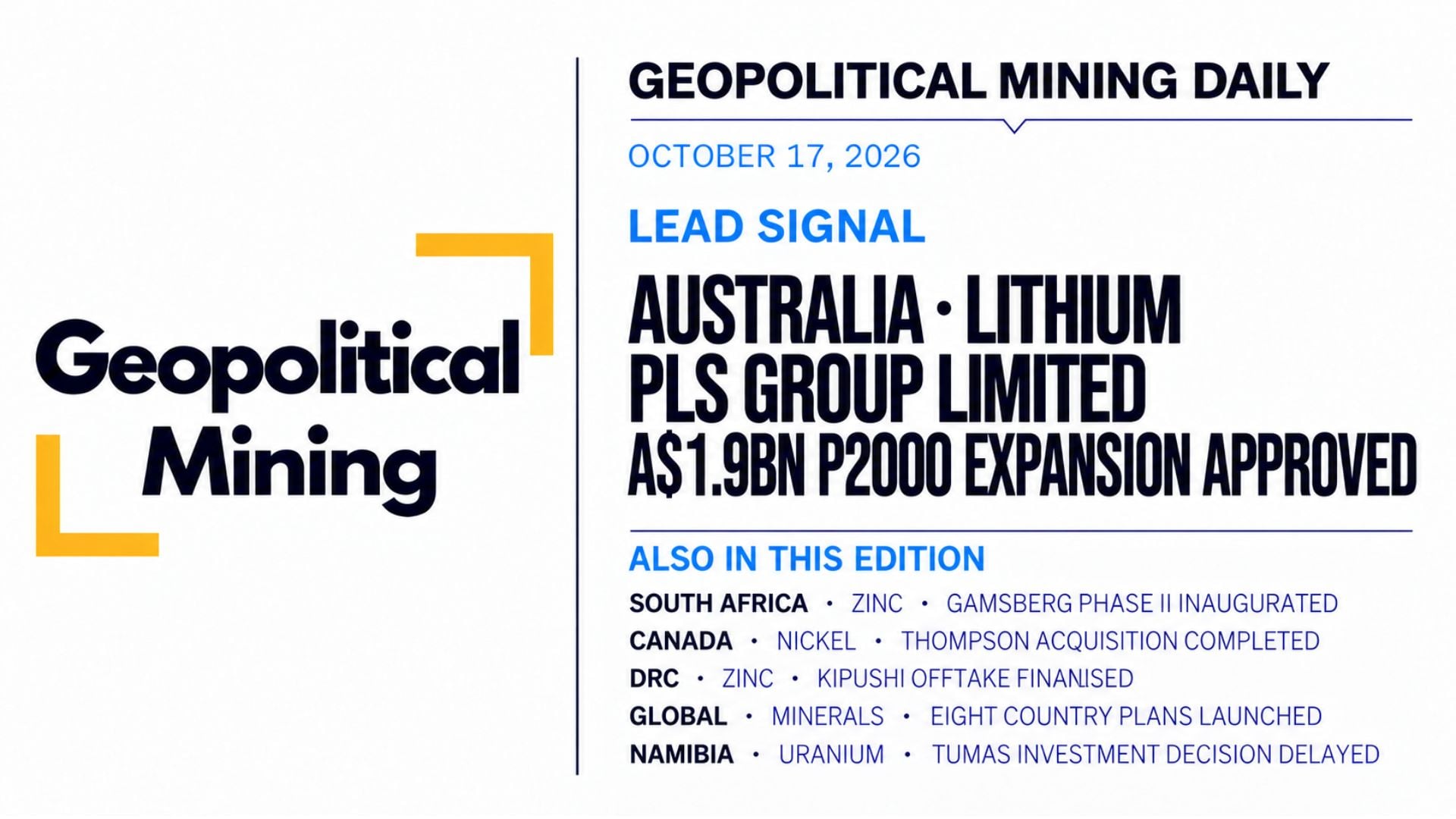

Geopolitical Mining Daily · October 17, 2026
PLS Group Limited Approves A$1.9 Billion Lithium Expansion
Geopolitical Mining Daily gives senior executives, investors and policymakers a concise record of mining, critical minerals and supply chain developments. PLS lithium expansion anchors this edition’s examination of how processing technology, financing terms and commercial agreements shape supply.
PLS lithium expansion leads six developments spanning zinc processing, nickel ownership, offtake, public finance and uranium investment.
PLS Group Limited commits to additional lithium capacity, while Gamsberg expands zinc concentration. A completed nickel acquisition and a zinc offtake agreement address ownership and market access. Meanwhile, minerals partnerships and compacts target investment barriers across eight countries. Deep Yellow Limited provides a counterpoint: site preparation continues, but equity conditions delay the capital decision.
The GM observation framework
The ten Signals
Each Daily uses the same ten strategic lenses. The highlighted dimensions classify the developments in this edition.
Australia · Lithium investment
PLS Group Limited: Lithium Expansion Approved at Pilgangoora
What happened
PLS Group Limited approved the A$1.9 billion P2000 expansion at its wholly owned Pilgangoora operation. The project targets approximately two million tonnes of annual spodumene concentrate capacity, including existing production. First production is expected during the September quarter of 2029, followed by a roughly six month ramp up.
The investment also changes which material the mine can process economically. Metallurgical improvements bring 67 million tonnes of contact material previously classified as waste into reserves, while reducing the stripping ratio. However, the expansion budget excludes a separate A$600–650 million infrastructure programme. Existing cash, together with future operating cash flow, underpins the investment plan.
For investors, the ore inventory matters because its usable size depends on processing performance. Better recovery can support scale while limiting reliance on a larger mining footprint. Nevertheless, construction spending precedes the additional sales by several years. The investment case therefore depends on delivering both the process improvements and the supporting infrastructure.
South Africa · Zinc processing
Vedanta Zinc International Inaugurates Gamsberg Phase II
What happened
Vedanta Zinc International inaugurated the Gamsberg Phase II concentrator in South Africa. The expansion doubles annual ore processing capacity from four million to eight million tonnes. Following the expansion, total capacity reaches 500,000 tonnes of zinc contained in concentrate annually. These figures describe installed capacity, rather than confirmed annual production.
The next industrial step would require a further investment decision. Although a zinc smelter remains an ambition, competitive electricity and supporting infrastructure still shape its economics. Concentration produces material for the next processing stage, whereas smelting would extend domestic participation into refined metal. The expansion therefore strengthens the upstream foundation for industrial development.
This distinction matters when assessing how much value the country can retain. A larger concentrator expands the material available for downstream processing, but refining requires its own assets and operating conditions. For policymakers, power economics therefore sit alongside mine investment in the industrial strategy. The route from mineral endowment to refined output depends on both.
Canada · Nickel ownership
Exiro Nickel Company Inc. Completes Thompson Acquisition
What happened
Exiro Nickel Company Inc. completed its acquisition of the Thompson Operations from Vale Base Metals. The Manitoba operation supports approximately 675 jobs while accounting for 10–15% of Canadian nickel production. The transfer therefore concerns an established source of national supply, with an existing workforce and processing infrastructure.
The structure provides up to US$200 million in new investment capital while preserving commercial links to the seller. Vale Base Metals retains an 18.9% interest as well as a multiyear concentrate offtake agreement. The buyer aims to achieve positive cash flow within two to three years, although that remains a target rather than an achieved result.
Because the assets already exist, recapitalization can support supply without waiting through a greenfield development cycle. The retained ownership also preserves a commercial connection between the operation and its former owner. However, the capital must translate into operating improvements. Cash generation will determine whether the new structure can sustain investment beyond the initial ownership transition.
Democratic Republic of the Congo · Zinc marketing
Gécamines Secures Kipushi Offtake for Mercuria Joint Venture
What happened
Gécamines finalized a multiyear offtake agreement with Kipushi for zinc concentrate. Initial marketing volume is up to 240,000 tonnes over the next two years, with potentially higher volumes thereafter. Gécamines will market the material through its joint venture with Mercuria, particularly targeting Western markets.
The agreement changes commercial access to output rather than announcing new mine capacity. Gécamines also plans to pursue germanium value and explore potential Project Vault financing. Those initiatives remain exploratory, while the zinc concentrate offtake provides the immediate commercial framework. Consequently, the marketing agreement and any future recovery investment represent different stages of value creation.
When compared with the Gamsberg inauguration, the agreement highlights another source of supply chain influence: control of sales. An offtake can direct material toward particular buyers, whereas a concentrator determines how much ore can be upgraded. Commercial partnerships therefore matter alongside processing assets when assessing access to mineral supply and the distribution of value.
Eight countries · Minerals policy
Eight Countries Launch Minerals Partnerships and Compacts
What happened
Argentina, Bolivia, Egypt, India, Kazakhstan, Malawi, Mauritania and Zambia launched country partnerships and compacts supported by the World Bank Group. The plans connect mineral development with national investment priorities. They sit within the previously outlined US$19 billion ambition for fiscal 2026–2030, combining institutional financing with private capital mobilization.
The instruments address different barriers to investment. For example, the World Bank supports public investment and policy reforms, while the International Finance Corporation provides private sector financing. The Multilateral Investment Guarantee Agency also offers guarantees. Zambia’s focus on energy and transport illustrates why mineral development depends on infrastructure beyond the mine itself.
Because infrastructure and country risk affect project economics, financing mineral extraction alone may leave important constraints unresolved. Coordinating public investment with private capital can therefore widen the range of viable projects. However, country plans must still become specific investments. Their supply impact will depend on implementing institutions, financing commitments and the delivery of shared infrastructure.
Namibia · Uranium financing
Deep Yellow Limited Defers Tumas Investment Decision
What happened
Deep Yellow Limited withdrew its target of taking a final investment decision on the Tumas uranium project during the fourth quarter of 2026. The company cited weak equity market conditions, while leaving the replacement date open. However, civil and concrete works continue, with those activities fully funded from existing cash.
Existing cash can support the limited early works programme while the larger development commitment depends on acceptable financing conditions. Continuing those activities preserves progress before the final capital decision. The company is also completing an updated project value case. Technical preparation and funding discussions therefore advance on different timelines, even within the same development.
For uranium supply forecasts, timing matters because prepared projects still need investment approval. Strategic interest in future fuel supply does not automatically produce equity on terms a developer will accept. As a result, early construction activity provides only part of the picture. The eventual capital decision must connect the technical plan with investors willing to fund its execution.
The Daily records verified changes. The Signals provide the classification map. The Weekly brings the developments together for the deeper system reading.