
Geopolitical Mining · Articles · Analysis
What Is APEC, and What Does Shenzhen Reveal About the Future of Globalization?
From decades of trade cooperation to the decisions taken in Shenzhen, APEC offers a view of how trade, industrial capacity and state coordination are shaping globalization.
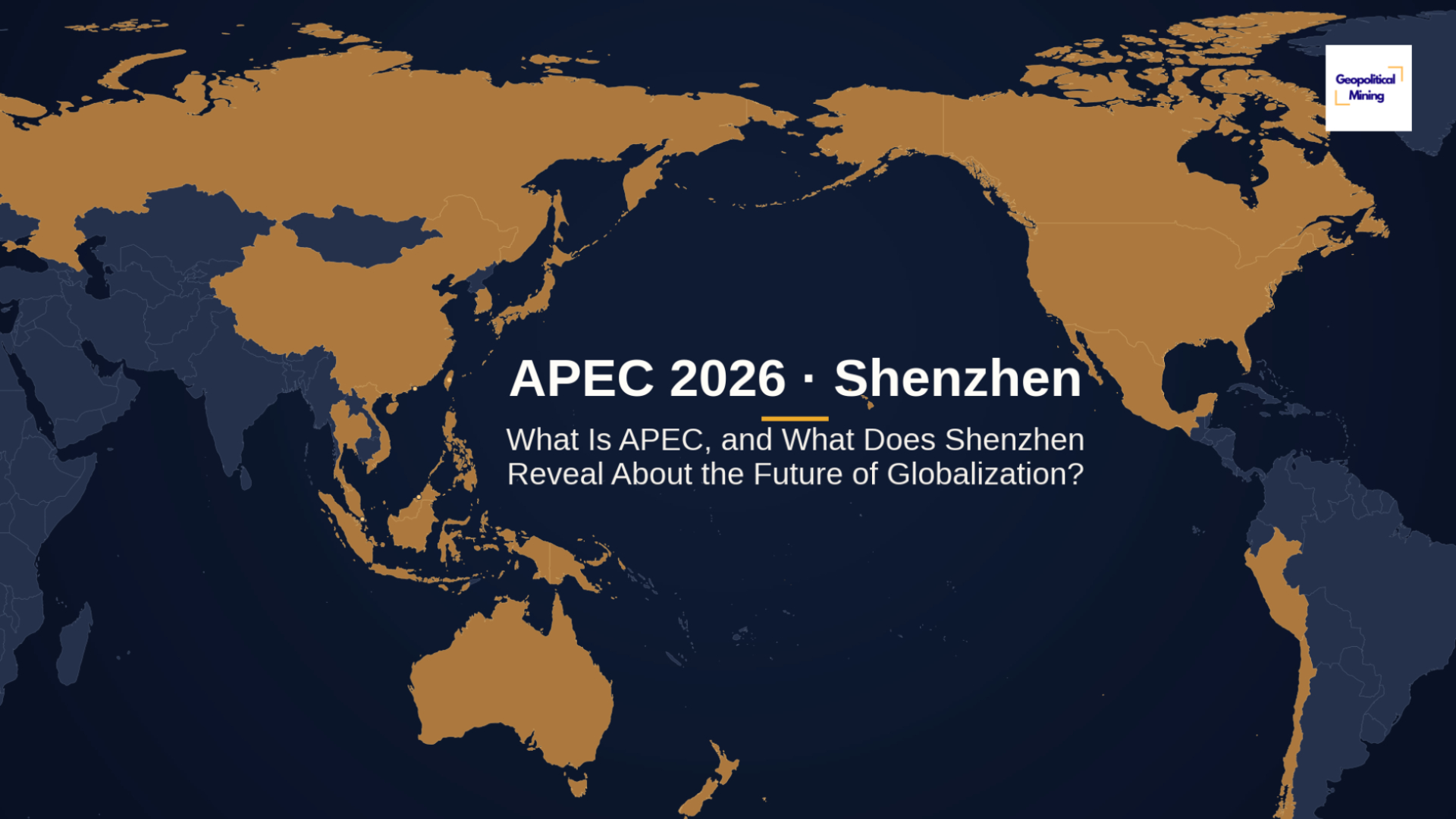
When the leaders of 21 Asia-Pacific economies met in Shenzhen, China, on November 18 and 19, 2026, much of the international attention focused on the presence of the presidents of China, the United States and Russia. Their meeting was unusual, and the discussions between Washington and Beijing were important in their own right. However, the purpose of the gathering was broader. The leaders had come together for the annual meeting of the Asia-Pacific Economic Cooperation forum, known as APEC. [9][16]
APEC has been operating since 1989. It brings together economies with different political systems, income levels and industrial structures, including major manufacturers, mineral producers, technology centres and some of the world’s largest consumer markets. Their governments continue to cooperate on trade, investment, customs, transport and other economic matters even when they disagree on issues outside the forum. [1][2]
Shenzhen provides a practical way to examine what is changing in globalization. Governments continue to develop trade and investment relationships while placing greater attention on the energy, infrastructure, industrial capacity and technology that support them. To understand what this meeting reveals, it helps first to understand APEC: why its members cooperate, what the forum has achieved and which commitments made in Shenzhen can lead to measurable results.
This analysis follows the approach developed in Mining Is Dead. Long Live Geopolitical Mining. In particular, it examines how trade, policy, industrial capabilities and the institutions that connect them affect the material economy.
Geopolitical Mining · Executive Snapshot
APEC in four figures
21 economies
Members of APEC, unchanged since the last enlargement in 1998.
3.0 billion
People living in APEC economies in 2025.
61.6%
Share of world real GDP represented by APEC economies in 2025.
17% → 5.3%
Change in average tariffs across member economies between 1989 and 2021.
Sources: APEC membership records, StatsAPEC 2025 data, and APEC’s historical achievements review. These indicators describe the region and its history; tariff reductions and economic growth cannot be attributed exclusively to APEC. [1][3][4]
1. What Is APEC, and Why Do These Economies Belong to It?
APEC was established in Canberra in 1989 by 12 founding economies: Australia, Brunei Darussalam, Canada, Indonesia, Japan, the Republic of Korea, Malaysia, New Zealand, the Philippines, Singapore, Thailand and the United States. At the time, trade and investment were expanding across the Pacific, and governments wanted a regular forum to improve their economic relationships. Initially, the initiative was a meeting of ministers and senior officials. Later, in 1993, annual meetings of economic leaders began. [1][21]
The membership grew in several stages. The People’s Republic of China; Hong Kong, China; and Chinese Taipei joined in 1991; Mexico and Papua New Guinea in 1993; Chile in 1994; and Peru, Russia and Viet Nam in 1998. No new member has joined since then. APEC uses the term economies because participation concerns commercial and economic cooperation. That designation allows Hong Kong, China, and Chinese Taipei to take part under their own names. [1]
APEC · Membership
From 12 founders to 21 economies
Membership expanded in five stages, with the last entrants joining in 1998.
| Year | Economies joining APEC |
|---|---|
| 1989 | Australia, Brunei Darussalam, Canada, Indonesia, Japan, Republic of Korea, Malaysia, New Zealand, Philippines, Singapore, Thailand, United States |
| 1991 | People’s Republic of China; Hong Kong, China; Chinese Taipei |
| 1993 | Mexico, Papua New Guinea |
| 1994 | Chile |
| 1998 | Peru, Russia, Viet Nam |
The geography is important. The forum connects the Asian and American sides of the Pacific with Oceania and Russia’s Pacific territory. Membership also reflects established commercial relationships. A country does not join automatically because it has a Pacific coastline. Admission requires agreement among existing members, and APEC has maintained its current membership of 21 for 28 years. [1][2]
Together, these economies represent an exceptionally large economic area. According to APEC’s statistics for 2025, they were home to approximately 3.0 billion people, accounted for 61.6% of world real GDP and represented 50.1% of world merchandise exports. Those figures refer to the combined economies, rather than to economic activity created by APEC. They explain why decisions concerning trade and transport across this region matter far beyond the Pacific. [3]
2. How Does APEC Work, and What Has It Actually Achieved?
APEC operates through voluntary cooperation and decisions adopted by consensus. It has no general power to impose tariffs, order investments or require member governments to change their laws. Its economic leaders set priorities, while ministers, officials, specialists and businesses develop practical initiatives over the course of the year. Each economy decides how to implement the commitments it has accepted. [2]
This arrangement has allowed the forum to continue for decades, but it also defines the limits of its achievements. APEC is a place where governments can develop common approaches and remove practical obstacles to commerce. However, it is not a free trade agreement among all 21 economies. The proposed Free Trade Area of the Asia-Pacific remains a long-term objective rather than an operating treaty. [2][9]
Lower barriers to trade
APEC reports that average tariffs across its member economies declined from approximately 17% in 1989 to 5.3% in 2021. Over the same period, the region’s merchandise trade grew more than ninefold. These figures describe important economic changes, although APEC cannot claim sole responsibility for them. National reforms, other trade agreements, industrial investment and growing demand also contributed to the expansion of trade. The forum’s contribution has been to support cooperation and provide a place to pursue those reforms over time. [4]
Customs and border procedures offer a more direct example of its work. Under APEC’s second Trade Facilitation Action Plan, an assessment found that trade transaction costs fell by 5% between 2007 and 2010, generating an estimated US$58.7 billion in savings for businesses. In particular, much of the improvement came from reducing the time needed to complete customs and other trade procedures. The study measured costs across the region; it did not suggest that every individual shipment or business experienced the same benefit. [5]
These improvements matter because a lower tariff is only one part of the cost of trade. A company also needs to prepare documents, comply with technical requirements, arrange shipping, clear customs and deliver products on time. APEC’s work on electronic documentation, border procedures and regulatory cooperation addresses those practical costs.
Business travel and environmental goods
The APEC Business Travel Card is another tangible result. Introduced as a pilot programme in 1997, it facilitates short business trips and access to expedited immigration lanes in participating economies. A 2025 review recorded more than 460,000 cardholders across APEC’s 21 members. The precise travel benefits vary by economy, including special arrangements for Canada and the United States. [6]
In 2012, members also endorsed a list of 54 environmental goods on which they committed to reduce applied tariffs to 5% or less. The list includes equipment used in renewable energy and environmental monitoring. This was a common trade policy initiative within a voluntary forum, with implementation depending on each economy’s tariff schedule. [7]
What remains unfinished
APEC’s record should also be measured against its original ambitions. In 1994, the leaders adopted the Bogor Goals, aiming for free and open trade and investment by 2010 for developed economies and 2020 for developing economies. Reviews documented significant progress, but restrictions affecting goods, services and investment remained. The region did not become a single area of unrestricted commerce. [8]
The record is therefore mixed in a useful, measurable sense. The gains include lower regional tariffs, better border procedures and more efficient business travel, as well as continued technical cooperation. Full regional trade integration is still unfinished. This history explains both APEC’s value and the need to read the Shenzhen commitments carefully.
3. What Did the 21 Leaders Agree in Shenzhen?
China hosted the 33rd APEC Economic Leaders’ Meeting under the theme Building an Asia-Pacific Community to Prosper Together. President Xi Jinping chaired the meeting on November 18 and 19. The main collective result was the 2026 APEC Leaders’ Shenzhen Outlook, adopted by the 21 economies and published by APEC on November 21. It is organised around four areas: trade and investment, connectivity, innovation and economic growth. [9]
APEC · Shenzhen 2026
The main commitments
The declaration is voluntary. Each participating economy determines how to act on these commitments.
| Area | What the Shenzhen declaration says | What it means in practice |
|---|---|---|
| Trade and investment | Continue work on regional economic integration and the Free Trade Area of the Asia-Pacific agenda. | A continuing objective, with no new region-wide free trade treaty signed in Shenzhen. |
| Digital trade | Welcome the APEC Trade Digitalization Cooperation Framework for 2027–2030 and further work on paperless trade. | A programme for cooperation on trade procedures and digital technologies. |
| Connectivity | Endorse an updated APEC Connectivity Blueprint and support resilient transport, infrastructure and open trade corridors. | Common priorities to be carried out through national and regional initiatives. |
| Innovation | Support the APEC AI Initiative for 2026–2030 and further cooperation on digital infrastructure, data and skills. | Cooperation between economies that continue to maintain their own technology policies. |
| Energy and growth | Support reliable, affordable energy, economic stability, workforce development and food security. | A wider economic agenda, without binding investment or energy supply quotas. |
Connectivity, technology and implementation
The declaration’s treatment of connectivity is particularly practical. Specifically, it refers to physical infrastructure, rules and procedures, and the movement of people. It also recognises that essential goods depend on reliable trade corridors, working transport networks and the continued operation of critical infrastructure. These are familiar concerns to any business that moves material or equipment between countries. [9]
Similarly, the technology provisions give direction to APEC’s work. The members committed to further cooperation on digital infrastructure, artificial intelligence, data protection and skills. They also recognised the role of energy in supporting economic growth. These commitments establish priorities and work programmes, while the financing, rules and projects needed to achieve them remain the responsibility of the participating economies. [9]
China also announced measures of its own, including US$20 million to support APEC cooperation projects and plans for new institutions focused on policy research, digital technology, cross-border data and clean energy. Those are initiatives announced by the host government and should be distinguished from the collective obligations of the 21 members. [10]
4. Which Agreements Were Reached Around the Summit?
An APEC leaders’ meeting also brings presidents, prime ministers and ministers into the same city. They can use that opportunity to discuss their bilateral relations and sign agreements that have been negotiated separately. Shenzhen, for example, produced several examples of bilateral diplomacy. The distinction matters because their legal status, commercial scope and implementation requirements differ. [11][12][13][14][15]
Shenzhen · Bilateral diplomacy
Agreements and negotiations around APEC
A signed treaty, a cooperation memorandum and a new negotiation are different kinds of outcomes.
| Economies | Development announced in Shenzhen | Stage and significance |
|---|---|---|
| Canada and China | Extended and expanded their bilateral trade arrangement until December 2028, with additional tariff relief affecting approximately C$400 million in Canadian exports. | Announced relief for selected agricultural and seafood products rather than an APEC-wide tariff decision. [11] |
| Chile and the Philippines | Signed a Comprehensive Economic Partnership Agreement on November 19, covering preferential access for products including copper, lithium products and agricultural exports. | A signed bilateral agreement. Preferential treatment depends on its entry into force and implementation. [12] |
| Peru and Thailand | Signed a free trade agreement on November 19, following negotiations that had reached substantial conclusion in 2025. | A signed bilateral treaty intended to expand market access, including for Peruvian mining products. [13] |
| Chile and China | Signed an economic and trade cooperation roadmap and a memorandum supporting free trade and multilateral cooperation. | Cooperation documents, alongside discussions on mining, infrastructure, energy and technology. [14][22] |
| China and Indonesia | Announced on November 20 the launch of negotiations for a comprehensive economic partnership agreement. | The start of negotiations, with energy, mineral resources and industrial development also discussed. [15] |
What the bilateral outcomes mean in practice
Canada’s announcement was among the more immediately measurable outcomes. The tariff relief covered identified Canadian goods, including pork and seafood, as part of an extension of an existing trade arrangement. The government also reported measures concerning selected Chinese steel and aluminium imports. That is a bilateral commercial arrangement with defined product categories, rather than the creation of a common tariff policy for APEC. [11]
For Chile and Peru, the agreements with the Philippines and Thailand show the value of the Pacific as a commercial route to Southeast Asia. Chile’s trade authorities indicated that its agreement with the Philippines would provide preferential access for approximately 90% of the value of its existing exports to that market. For example, the identified products include copper minerals and cathodes, molybdenum, lithium products and other industrial goods. The commercial effect will become clearer once the agreement enters into force and businesses begin using its provisions. [12]
The China–Indonesia announcement is different again. The governments opened negotiations on areas including industrial cooperation, energy, minerals and technology. However, the eventual content of a bilateral agreement has not yet been settled. The announcement is therefore an important diplomatic step, but it is premature to treat it as an implemented trade or investment programme. [15]
The meetings between China, the United States and Russia
Shenzhen also provided the setting for an unusual meeting between Xi Jinping, Donald Trump and Vladimir Putin on November 19. The three presidents issued a declaration addressing United Nations reform, the supply of refined petroleum products, principles relating to the jurisdiction of the International Criminal Court, and future dialogue on nuclear risks. The document sets out political commitments without detailed implementation arrangements or agreed production volumes. [16]
In addition, Xi and Trump met separately, discussing strategic stability and the bilateral relationship. These meetings attracted attention because of the standing of the three countries in international affairs. They were nevertheless diplomatic events held alongside APEC, and their declarations were not negotiated or adopted by the forum’s 21 members. The distinction is essential when evaluating what the Shenzhen APEC summit itself delivered. [16][17]
The wider diplomatic activity also continued after the APEC leaders’ meeting. The following day, November 20, Chile and Peru each held talks with Japan in Tokyo. The Japanese government highlighted cooperation on critical minerals and supply chains, including copper, as well as technology and economic security. These meetings formed part of the same week of Asia-Pacific diplomacy, although they took place outside APEC’s formal proceedings. [18][19]
5. What Does Shenzhen Reveal About the Material Economy?
APEC is often described through tariffs, trade flows and diplomatic meetings. Those measures tell an important part of the story. Every shipment of equipment, food, vehicles or industrial products also depends on physical production, energy, infrastructure, skilled workers and transport. Digital industries, including artificial intelligence, also depend on electricity, equipment and networks that must be built and maintained. This is the material economy: the productive foundation that makes trade, technology and economic growth possible. It has always existed, but it is receiving greater attention as governments reconsider the reliability of their supply chains and the capabilities needed to support them.
Across the Pacific, these systems extend through several economies. For example, a copper mine in Chile may depend on machinery made in Asia, energy and water infrastructure, specialised engineering and access to ports. Its output may then be processed and used by manufacturers in other countries. APEC's work on customs, connectivity and investment matters because those arrangements influence how reliably goods, capital and services move through that wider system.
The issue has also entered APEC's energy agenda more explicitly. At their 2026 meeting, energy ministers supported secure and resilient supply chains for critical minerals used in energy technologies, including attention to local value addition. This recognises that the location of processing, manufacturing and technical capabilities matters alongside the movement of raw materials. [20]
The State as a strategic enabler
The agreements discussed around Shenzhen also reveal the role of a State capable of understanding its productive system as a whole. A trade agreement can open access to a market, while the ability to use that access depends on businesses, financing, electricity, water, transport, technical knowledge and the rules governing investment and production. These responsibilities often sit with different ministries, regulators, companies and communities. As a result, their coordination becomes part of economic strategy.
In Geopolitical Mining, the strategic enabling State is one that can bring these elements together. It understands which capabilities already exist, where the constraints lie and which partnerships could help address them. Diplomacy, industrial policy, infrastructure planning and investment conditions work within the same economic system. The State provides direction and coordination while companies, investors, workers and technical institutions contribute the expertise and capital required to develop productive capacity.
For mineral projects, this understanding also includes permitting, environmental performance and relationships with the people and territories where operations take place. The ability to sustain an investment depends on the credibility of its technical and financial plans and the legitimacy of its development. A commercial opportunity becomes more valuable when the institutions responsible for these conditions can act in a coordinated way.
From market access to industrial capability
The bilateral agreements offer practical examples. Chile's agreement with the Philippines could expand market access for mineral and other products, while Indonesia's negotiations with China include industrial cooperation and mineral resources. Chile and Peru also discussed critical minerals and technology with Japan after the summit. Each relationship addresses a different part of the material economy, and each will require further decisions before its full economic contribution can be measured. [12][15][18][19]
A country with mineral resources has an opportunity to participate in industrial supply chains. The value it can create depends on its ability to develop viable mines, process materials where commercially justified, build infrastructure, acquire knowledge and reach customers. Those capabilities are built through investment and execution. They also determine how much of the economic activity associated with its resources can be sustained within the country.
This is why the wider network of agreements matters. Economies can develop relationships with several partners for trade, finance, technology and production. Such connections can expand their options and strengthen their ability to respond when commercial conditions change. The practical question for each government is which relationships create opportunities that its own productive system is capable of using.
6. What Does Shenzhen Reveal About Globalization’s Next Phase?
Shenzhen produced several kinds of commitments. APEC's 21 economies adopted a shared agenda for trade, connectivity and innovation. Individual governments signed commercial agreements or opened negotiations. Meanwhile, the leaders of major powers held separate diplomatic discussions. Each outcome has a different purpose, and its progress will have to be assessed on its own terms.
The distinction between stages is essential. An announcement may establish political interest. A signed agreement, by comparison, defines commitments, sometimes subject to ratification or other legal steps. Implementation requires institutions, companies and budgets to act. Later, productive results become visible through trade, investment, infrastructure, technology and the reliable delivery of goods and services. These stages provide a clearer measure of progress than the number of documents signed during a summit.
Sovereign speed and the ability to act
This is where sovereign speed becomes relevant. We use the term to describe a country's capacity to make technically sound, legitimate decisions and carry them through within a period that preserves their economic and strategic value. An opportunity to secure investment, enter a market or develop industrial capacity can change as prices, technology and competing projects evolve. The time between a commitment and its execution therefore matters.
The pace of negotiation matters as well. Governments that understand their industries, know what their partners can offer and arrive with clear objectives are better placed to reach credible agreements while opportunities remain available. The value of acting early depends on the terms secured and the country's capacity to deliver on them.
Sovereign speed depends on competent institutions, clear responsibilities and coordination across the productive system. Trade officials may negotiate market access while infrastructure agencies, regulators, financing institutions and businesses work on the conditions needed to use it. In mining, credible engineering, effective permitting, environmental performance and community relationships form part of the same capacity to execute. Speed therefore gains value when decisions are reliable and projects can be sustained.
The next test for APEC
APEC's own history offers a practical reference. Its members have documented reductions in trade costs, improvements in business mobility and progress on selected tariff commitments. However, other objectives, including full regional trade integration, remain unfinished. That experience suggests a useful way to follow Shenzhen: examine what procedures become simpler, which agreements enter into force, what investments are carried out and whether productive capability increases. [4][5][8]
Viet Nam will host APEC in 2027 and Mexico in 2028. The next meetings will offer opportunities to review progress on digital trade, connectivity, energy and the cooperation programmes approved in Shenzhen. The bilateral agreements can be followed through their legal implementation and commercial use, while newer negotiations can be assessed as their terms and proposed projects become clearer. [9]
These developments also help explain the reconfiguration of globalisation. Economies continue to depend on one another, while governments seek more choices over where they obtain inputs, how they build industrial capacity and which partners help them reach markets. As a result, their networks of trade, investment and technology are evolving alongside national priorities. Agreements such as those discussed in Shenzhen show this process taking shape through practical economic decisions.
For Geopolitical Mining, Shenzhen offers a way to examine the future of globalization through decisions that can be observed and measured. Governments are continuing to develop trade and investment relationships while placing greater attention on the material capabilities that support them. In particular, the next stage will be visible in how institutions coordinate, investments proceed, technologies are applied and projects produce reliably over time. APEC's contribution can be assessed through the same lens that has made its earlier achievements measurable.
Geopolitical Mining · Closing perspective
How to measure Shenzhen’s results
Start with what businesses can do differently. For example, check whether shipments clear customs faster, whether exporters can claim a new tariff preference and whether a plant has begun processing more material. These are practical ways to measure what followed Shenzhen.
Resources
Official APEC documents, institutional statistics and government statements, with supplementary reporting where relevant. Information reviewed through November 21, 2026.
[1] APEC Member economies and dates of accession.
[2] APEC How APEC operates: voluntary cooperation and consensus.
[3] StatsAPEC 2025 regional population, GDP and trade indicators.
[4] APEC Achievements and benefits: tariffs and growth in trade.
[5] APEC Policy Support Unit Trade transaction costs and estimated savings, 2007–2010.
[6] APEC 2025 performance review of the APEC Business Travel Card.
[7] APEC 2012 list of environmental goods.
[8] APEC Assessment of the Bogor Goals.
[9] APEC 2026 APEC Leaders' Shenzhen Outlook.
[10] Ministry of Foreign Affairs of China President Xi's remarks at the 33rd APEC Economic Leaders' Meeting, November 19, 2026.
[11] Prime Minister of Canada Canada–China bilateral trade arrangement, November 17, 2026.
[12] Government of Chile / SUBREI Chile–Philippines Comprehensive Economic Partnership Agreement, November 19, 2026.
[13] Agencia Andina, Peru Peru and Thailand sign a free trade agreement, November 19, 2026.
[14] Ministry of Foreign Affairs of China Xi Jinping meets President José Antonio Kast, November 17, 2026.
[15] Ministry of Foreign Affairs of China China and Indonesia launch comprehensive economic partnership negotiations, November 20, 2026.
[16] The White House U.S.–Russia–China Heads of State Declaration toward Peace, November 19, 2026.
[17] Ministry of Foreign Affairs of China Xi Jinping meets President Donald Trump, November 19, 2026.
[18] Ministry of Foreign Affairs of Japan Japan–Chile summit, November 20, 2026.
[19] Ministry of Foreign Affairs of Japan Japan–Peru summit, November 20, 2026.
[20] APEC 2026 APEC Energy Ministerial Meeting.
[21] APEC About APEC and its origins.
[22] Diario y Radio Universidad de Chile Foreign Minister confirms Chile–China cooperation documents, November 17, 2026.