Geopolitical Mining · Geopolitical Milestones
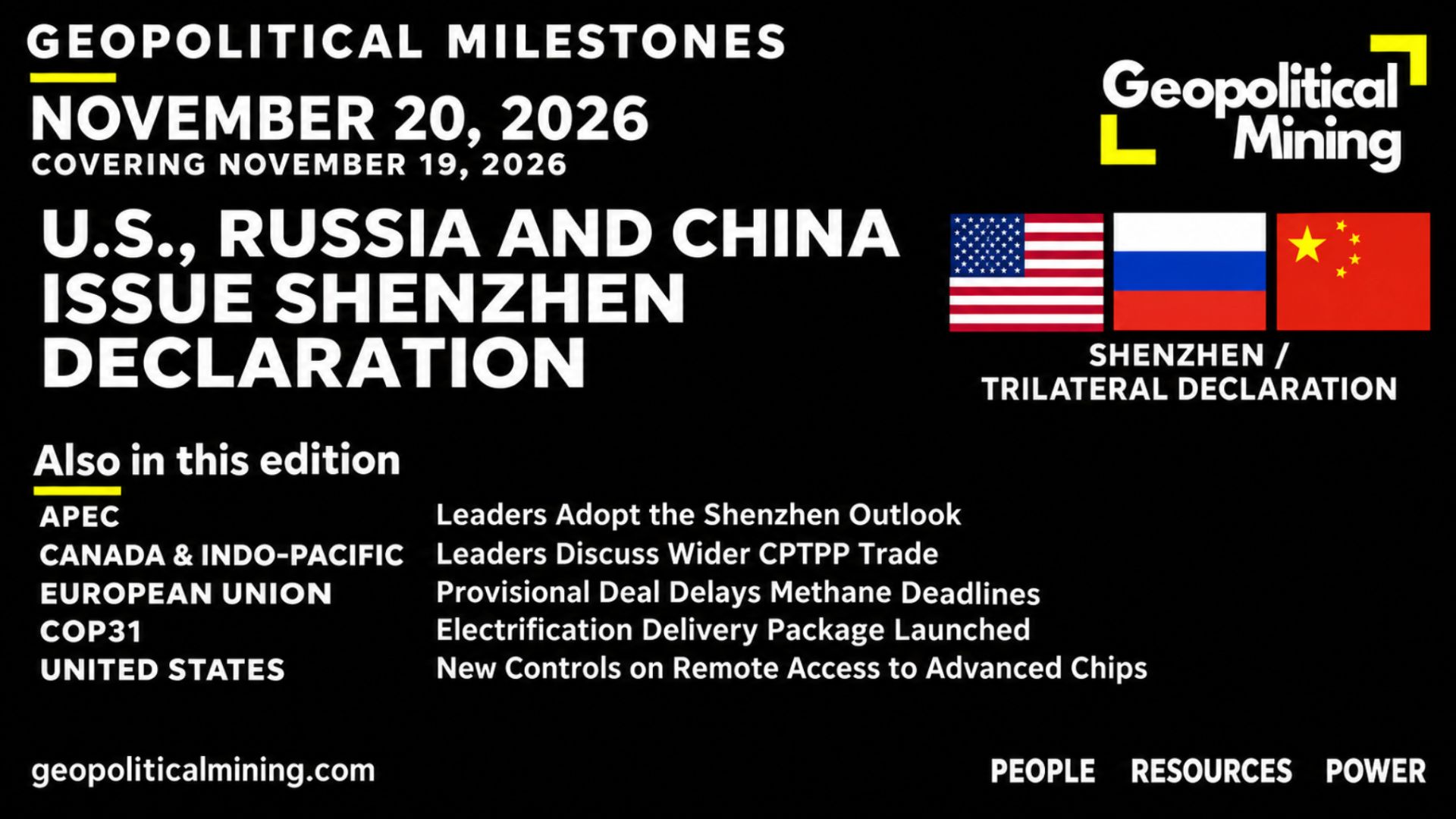
U.S., Russia and China Issue Shenzhen Declaration
The United States, Russia and China issue a declaration on nuclear risk and refined fuel supply. Meanwhile, APEC adopts its Shenzhen Outlook. The edition also covers talks among four Pacific partners, EU methane deadlines, electrification at COP31 and U.S. chip controls.
Geopolitical Milestones is a daily briefing for senior executives, investors and policymakers. It examines significant international developments and, in particular, their implications for investment, business strategy and public policy.
In focus: Shenzhen produced a declaration from three governments and a separate economic agenda for APEC. Elsewhere, EU negotiators proposed moving energy compliance deadlines, while a U.S. chip rule took effect.
Milestone 01
U.S., Russia and China Issue Shenzhen Declaration
Donald Trump, Vladimir Putin and Xi Jinping met in Shenzhen on November 19 and issued a joint declaration. According to the declaration, the three governments would hold talks on reducing nuclear risks and preventing the spread of nuclear weapons. They also said they planned to increase production and supply of refined fuels.
Beyond energy and nuclear risk, the leaders also called for reform of the United Nations. In addition, they stressed state consent and the immunity of officials in their remarks on the International Criminal Court. However, the text did not address the wars in Ukraine or Iran.
Geopolitical Mining reading:
For energy buyers, the practical questions are where extra refined fuel would come from and when it would reach the market. Until then, the declaration offers no basis for revising supply assumptions.
Milestone 02
APEC: Leaders Adopt the Shenzhen Outlook
Meanwhile, APEC’s 21 member economies adopted the Shenzhen Outlook by consensus. In particular, the leaders endorsed a new connectivity plan and backed a framework for digital trade from 2027 to 2030. For example, the framework advances paperless trade and work on electronic documents.
The leaders also adopted a statement on emerging and digital technologies. Meanwhile, Xi announced that China would provide US$20 million for APEC cooperation. He also announced plans for a research centre in Shenzhen and cooperation bodies covering areas such as clean energy and cross-border data.
Geopolitical Mining reading:
For exporters, the test will be whether customs authorities and trading partners accept the same electronic documents. If they do, businesses could reduce duplicate paperwork. However, firms should continue to use the requirements that apply in each market.
Milestone 03
Canada, Australia, New Zealand and Singapore Discuss Wider Pacific Trade
In Shenzhen, Mark Carney met Lawrence Wong, Anthony Albanese and Christopher Luxon on the margins of APEC. According to Ottawa, Canada’s combined goods trade with their three countries exceeded C$15 billion in 2025.
In particular, the leaders discussed expanding trade and investment through the existing CPTPP. In addition, they discussed supply chain resilience and agreed to deepen security and defence cooperation.
Geopolitical Mining reading:
For Canadian exporters, the existing trade agreement already provides a route into the three markets. Any additional benefit, however, would depend on later measures that reduce specific barriers or make supply routes more reliable.
Milestone 04
European Union: Negotiators Agree to Delay Methane Deadlines
EU Council and Parliament negotiators reached a provisional deal to delay two sets of methane requirements by two years. Specifically, monitoring, reporting and verification obligations for importers of natural gas, crude oil and coal would start on January 1, 2029.
Next, methane intensity reporting for importers and EU producers would start on August 5, 2030. Before then, the European Commission would review implementation by January 1, 2028. In particular, the review would assess whether enough independent verifiers are available.
Geopolitical Mining reading:
Importers would therefore have more time to build reporting and verification into procurement contracts. However, the deal leaves the requirements in place. Suppliers that can document their emissions may therefore be better prepared when the rules apply.
Milestone 05
COP31: Electrification Delivery Package Launches
At COP31 in Antalya, the Global Climate Action Agenda launched a package covering clean power, grids, storage and electrification. In particular, it brings together work by governments, businesses, investors and cities.
The Climate Investment Funds said its AMPLIFi financing mechanism was operational. The UK provided its first large donor contribution of £400 million, according to UN Climate Change. In total, the mechanism aims to mobilise up to £5 billion for projects in emerging markets and developing economies.
Geopolitical Mining reading:
For industrial users, access to reliable power depends on grid capacity as well as how much electricity a system generates. As a result, the projects to watch are those that can finance power, grid connections and storage together.
Milestone 06
United States: New Controls on Remote Access to Advanced Chips
An interim final rule on advanced semiconductors took effect on November 19. Specifically, it adds licensing requirements for certain chip transactions involving overseas data centres that supply substantial computing power remotely to specified entities.
In addition, the rule adds destination-based licensing requirements for covered chips in Brazil, Indonesia, Malaysia, Singapore and Thailand, subject to exceptions. It also rescinds the previous AI Diffusion Rule.
Geopolitical Mining reading:
For cloud operators and chip suppliers, who can use the computing capacity therefore matters more for compliance. As a result, equipment location alone cannot establish whether a project meets the licensing requirements.
Continue reading Geopolitical Mining. Explore our daily mining coverage, weekly reviews and country analysis.