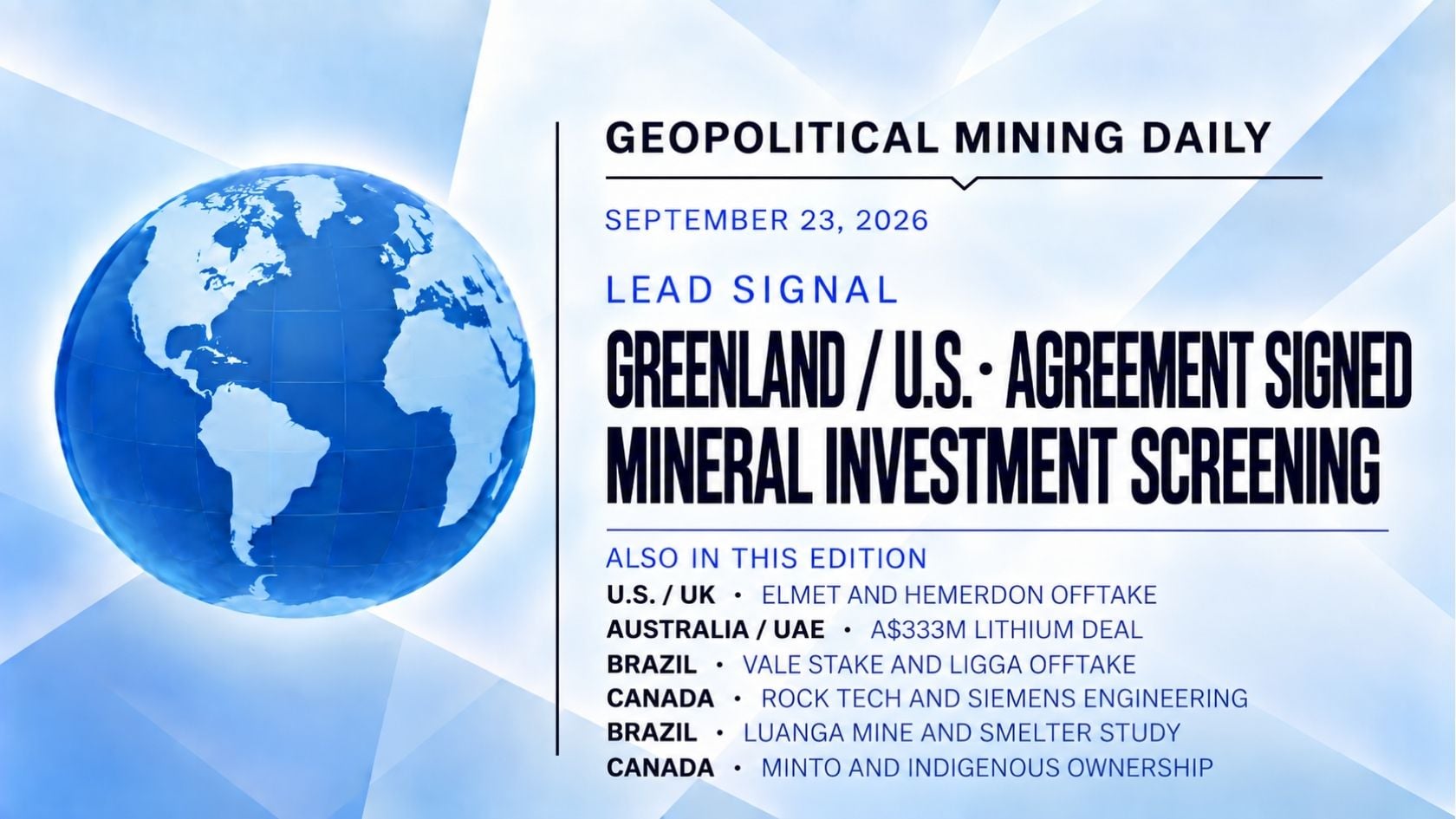
Geopolitical Mining Daily · September 23, 2026
Greenland Agreement Sets U.S. Role in Mineral Investment
The signed Greenland agreement defines a U.S. consultation role in sensitive investment screening, with resource extraction included in its scope. This edition asks how participation, access to production and technical capability are assembled through legal provisions, supply contracts, acquisitions, engineering and project studies. Minto adds the perspective of an Indigenous controlling owner to the financing and governance discussion. [1] [8]
Seven developments are examined through distinct questions: who may participate, who obtains product, what processing is available and how investment decisions are governed. The analysis follows Greenland, Elmet and Hemerdon, Titan and Global Lithium, Vale and Ligga, Rock Tech and Siemens, Luanga, and Minto. Announcements and study results are separated from closing, entry into force, construction and sustained operation.
The 2026 observation framework
The ten Signals for 2026
Each edition uses the same ten lenses. Highlighting identifies the dimensions examined in today’s seven developments; it is not a performance rating.
Today’s direction of travel
Authority, ownership and access to production are different relationships. A useful mineral strategy follows the rights attached to each, the capital needed to exercise them and the capability required to turn a resource into a product. Today’s edition asks how those elements connect without treating any single agreement as a complete industrial system.
Lead development
Greenland agreement sets investment and infrastructure provisions relevant to mining
What happened
Greenland, Denmark and the United States signed the agreement in New York on September 22. The White House published a signing announcement; the English text is available from Denmark’s Ministry of Foreign Affairs. [2]
Article III includes resource extraction and critical infrastructure among sensitive activities. Article X restricts control, significant influence and potentially threatening access to nonpublic information by states, or investors from states, outside NATO membership, NATO partnership or EU membership, unless the parties agree that their activities pose no security or public order threat. Greenland would implement the objective with Kingdom authorities through investment screening laws; consultation with U.S. authorities is required, with modalities still to be determined. [1]
Article VII lets the United States raise concerns about nearby construction or changes of use threatening a defense area; the parties would determine responses jointly. Under Article XI the agreement has no end date. Article XII requires diplomatic notification of completed parliamentary procedures for entry into force. Such notification was not located for this edition’s evidence cutoff. [1]
Signal reading · The GM questions
The GM question concerns how a developer would assemble an eligible financing and infrastructure package. Which rights attached to minority equity, lending, security over assets, offtake or technical information would need examination? How would authorities identify an investor’s origin through funds and intermediate companies? These are questions for transaction analysis, rather than reasons to assume that a familiar corporate address settles eligibility.
A second question concerns geography. What information would establish whether a proposed mine, port, power facility or communications installation raises a relevant security concern? How would that examination be coordinated with other project decisions, and when could a developer rely on the outcome? A project assessment would need to connect the parties’ respective roles to actual locations and procedures, rather than infer an effect on every Greenlandic asset.
Finally, what treatment would apply to existing licences, contracts and later changes in ownership or financing? What time, information and review procedures would counterparties need to allow for? An acceptable ownership structure would still leave the separate commercial task of securing capital, technology and customers. Following both questions would show whether the arrangement changes participation alone or also changes the practical route to development.
Next proof point: The entry into force notification, consultation modalities, relevant screening procedures and decisions showing how existing rights and new transactions are treated.
[1] Danish Ministry of Foreign Affairs · Published agreement · September 22, 2026
English agreement text: Articles III, VII, X, XI and XII (PDF pages 4, 6 and 7).[2] White House · Signing announcement · September 22, 2026
Official announcement confirming the September 22 signing in New York.Commercial and industrial development
Elmet signs Hemerdon tungsten offtake for processing and manufacturing
What happened
Elmet announced a long term Hemerdon offtake on September 22, expecting more than 1,000 metric tonnes annually expressed as WO₃ equivalent. The company intends to convert material through its allied refining network into ammonium paratungstate, or APT, and other tungsten intermediates for manufacturing. [3]
The announcement’s valuation above US$230 million annually uses current APT prices; it is not guaranteed contract revenue. The full refining route is not identified, and the proposed Schwabmünchen plant remains subject to acquisition closing. Previously announced public investments are background. The new event is the supply agreement, not evidence that these volumes have been delivered or converted. [3]
Signal reading · The GM questions
The GM question is what processing capability stands behind a contracted mining product. Where would each transformation occur, what capacity would be available when deliveries begin, and who carries the risk if mine output and conversion schedules diverge? An assessment would need to connect the commercial promise with a physical route and the requirements of the eventual manufacturer.
How are quality, recovery, price exposure and interruptions allocated between the counterparties? Would capacity be reserved, expanded or obtained from another operator? These questions would distinguish access to concentrate from dependable access to usable material. The relationship should therefore be followed through accepted shipments and completed processing, while keeping the value of the contract separate from an estimate based on a market quotation.
Next proof point: Disclosed delivery terms, accepted shipments, the identified refining route, capacity availability and completion of relevant asset acquisitions.
[3] Elmet Group · Company release filed with the SEC · September 22, 2026
Hemerdon offtake, expected WO₃ equivalent volume and planned conversion route.Ownership and development finance
Titan proposes A$333 million Global Lithium acquisition with a separate development facility
What happened
Global Lithium’s September 22 announcement proposes Titan’s acquisition of all shares at A$1.15 each, approximately A$333 million in fully diluted equity value. The attached deed is dated September 21. Titan belongs to a UAE group developing lithium processing in Abu Dhabi. Shareholder, court and regulatory approvals remain; the scheme has no financing condition. [4]
A separate facility of up to A$120 million would fund Manna development through conditional tranches at 7% annual interest. It is a loan, not additional acquisition consideration or cash already fully drawn. Schedule 5 also identifies an existing Canmax concentrate offtake, as amended, and a Jiangsu Lopal subscription, offtake and prepayment term sheet. Their inclusion does not demonstrate the detailed allocation of future production. [4]
Signal reading · The GM questions
The GM question is how a new owner’s processing strategy would fit the project’s existing commitments. What product remains available, which obligations are binding, and what consent or amendment would be necessary to change its destination? The appropriate analysis would trace rights to the material separately from ownership of the company. A proposed acquisition alone is insufficient to assign all future output to one refinery.
The bridging loan creates a second question about the transition. Which expenditures can be approved and drawn before closing, what security and repayment obligations attach to those funds, and what happens if the transaction does not complete? A funding review would connect those conditions to the works programme and remaining capital requirement. Money paid to selling shareholders and money available to build a project perform different functions.
Next proof point: Scheme documentation and approvals, actual facility drawings, treatment of existing commercial commitments, closing and the funded development schedule.
[4] Global Lithium · ASX announcement and attached deed · September 22, 2026
Acquisition terms and bridging facility: announcement pages 1 to 5; material contracts: Schedule 5, PDF page 117.Equity, product access and logistics
Vale confirms minority Ligga investment and exclusive iron ore offtake
What happened
Vale’s September 22 regulatory clarification confirms an agreement for a 30% Ligga interest through approximately US$190 million of capital and exclusive long term purchases of all Ligga sinter feed production. The event is disclosure of the terms, rather than confirmation that the agreement was signed that day or has closed. [5]
Vale describes Ferro Sul’s capacity at approximately two million tonnes annually and a planned expansion to eight million, targeting June 2028, with beneficiation and rail works. Shipment would use the Carajás Railroad and Ponta da Madeira terminal. Approvals remain outstanding. Vale does not confirm third party reserve estimates, further expansions or future pellet feed production reproduced elsewhere in the filing. [5]
Signal reading · The GM questions
The GM question is how ownership, product access and transport work together without assuming they confer identical control. What governance rights accompany the minority position, what investments must each party fund, and how do price and logistics terms divide the resulting value? A commercial assessment would need those answers before treating an exclusive buyer as equivalent to the owner of the entire operating business.
The corresponding development question is what makes the expansion executable. Who carries the cost and schedule risk of the plant and railway connection, and how do purchase obligations respond if capacity arrives later than planned? Following the equity subscription, infrastructure commitments and delivered tonnes separately would show whether the structure creates additional operating capability as well as a route to market.
Next proof point: Corporate and regulatory approvals, capital subscription, the defined expansion funding and construction programme, and operational evidence from processing and transport.
[5] Vale · Notice to the Market filed on Form 6-K · September 22, 2026
Vale’s own clarification: minority investment, exclusive sinter feed offtake, logistics and conditions.Engineering and industrial capability
Rock Tech and Siemens contract digital process engineering for Red Rock
What happened
Rock Tech announced September 22 agreements with Siemens Canada for a digital process model and support on control, instrumentation and automation at the proposed Red Rock lithium converter in Ontario. The company identifies this as the first implementation phase of the March memorandum. [6]
The work supports the definitive feasibility study, expected by mid December. Rock Tech describes a model of plant processes and material and energy flows to examine design decisions. Application to additional converters remains a possibility. These are engineering assignments, not demonstrated operating savings or a completed plant. [6]
Signal reading · The GM questions
The GM question is what evidence makes the digital representation useful for an investment decision. Which laboratory and pilot results will populate it, how will it represent feed variability, and what independent checks will test its predictions? A model should allow assumptions to be challenged and design choices to be compared; the assignment’s practical value would be visible in the resulting engineering decisions.
A second question concerns who can maintain and use that knowledge after construction. What access, training and update rights would the operator retain, and how would the model be reconciled with measured plant performance? These are questions about the lasting capability embedded in the project. Describing a facility as a potential blueprint should follow evidence that its design can be adapted and operated under another project’s conditions.
Next proof point: Completed engineering deliverables, validation against test data, incorporation into the feasibility study and clear responsibility for maintaining the model through operation.
[6] Rock Tech Lithium · Direct company announcement · September 22, 2026
Siemens agreements for digital process modelling and engineering support at Red Rock.Mine and processing development
Luanga study examines the capital required to add smelting in Brazil
What happened
Bravo’s September 22 Luanga prefeasibility results model a mine and concentrator alongside a smelter at Barcarena, producing a saleable alloy. An alternative at the same study level would sell concentrate first and add the smelter in year three. The base case estimates US$784.9 million of initial capital and a US$877 million peak funding requirement. [7]
The base case uses mineral reserves; separate preliminary economic scenarios should not be conflated with it. Its downstream assumptions include treatment by a European refiner, so domestic smelting does not establish a wholly domestic refining chain. Bravo says the full technical report will be filed within 45 days. The announcement reports modelled development cases, not closed financing or a construction decision. [7]
Signal reading · The GM questions
The GM question is what additional capital and capability are required to retain another transformation stage locally. How do electricity, fuel, transport, specialized personnel and product acceptance change when a developer sells alloy rather than concentrate? What contractual terms would confirm that the added facility can capture enough value to support its own investment and operating obligations?
The staged alternative creates a financing question rather than merely a different line in a schedule. What would commit funding for the later smelter, and how would interim concentrate contracts permit the transition? Conversely, what liquidity is needed to construct and commission both facilities together? Comparing those requirements would help distinguish an industrial ambition from an executable sequence, while identifying the refining relationships that would remain outside Brazil.
Next proof point: The complete technical report, assumptions and sensitivities for each case, permitting progress, validated treatment terms and a financed sequence for mine, concentrator and smelter.
[7] Bravo Mining · Detailed company announcement · September 22, 2026
Luanga study cases: pages 2 to 4; capital and funding: pages 12 and 14; refining assumptions: page 15 (PDF).Indigenous ownership and project finance
Selkirk Copper reports a Minto restart assessment under Indigenous ownership
What happened
Selkirk Copper published Minto restart PEA results on September 22. Selkirk First Nation indirectly holds a controlling equity interest through its wholly owned subsidiary. That ownership is context for the new assessment, not a new acquisition. The plan models a 13 year operation at 4,100 tonnes per day; the company envisages a restart decision after feasibility work and permit amendments. [8]
The PEA includes inferred resources and its outcomes are uncertain. Its economic analysis excludes expenditures before the modelled capital period, including underground rehabilitation, water treatment and equipment deposits, even where expenditure is still expected. Those exclusions mean the modelled capital figure cannot alone represent all cash needed to restart. The full technical report remains to be filed. [8]
Signal reading · The GM questions
The GM question places the First Nation within ownership and investment decisions, as well as within the territory affected by mining. How are company board responsibilities distinguished from the First Nation’s institutions, and how would decisions about new equity, debt and commercial commitments affect its controlling position? Examining that structure should preserve the distinction between corporate authority, collective interests and the views of individual members.
How would benefits, environmental responsibilities and accountability be organized over the operating and closure periods? What financing would protect the capacity to meet those obligations under less favourable operating conditions? Indigenous control does not, by itself, establish unanimous community support or demonstrate technical viability. The relevant assessment would examine the governance arrangements on their own terms, alongside a complete funding plan and the evidence required for a restart decision.
The financing question should begin with the entire route from present site care to reliable production. Which costs sit outside the economic model, when must they be paid and what source will cover them? That reconciliation would make the capital discussion more useful to all owners, while keeping the preliminary study distinct from a financed commitment to reopen.
Next proof point: The full PEA report, reconciliation of excluded expenditure, the feasibility study and permit amendments, disclosed financing and governance arrangements, and any formal restart decision.
[8] Selkirk Copper · Direct company announcement · September 22, 2026
Minto PEA, excluded preliminary expenditures, restart conditions and Indigenous ownership.The system reading
What today’s evidence tells us
The common question is how decisions distribute the ability to participate, invest, obtain product and retain value. That ability can be examined through the particular rights of a government, an owner, a lender, a buyer or a technology provider, rather than inferred from one label. Our reading of the seven developments therefore follows separate documents and stages: legal provisions and their implementation, commercial commitments and their performance, technical assumptions and the evidence needed to validate them. Indigenous ownership also requires attention to the relationship between company governance and the institutions and interests of the people concerned. The resulting assessment should identify what a decision actually enables, who carries its obligations and what remains necessary before dependable production and lasting benefits can be demonstrated.
Signals for 2026 gives the map. The Daily records new evidence against that map and asks how decisions change participation, capital, technical capability and the distribution of value.