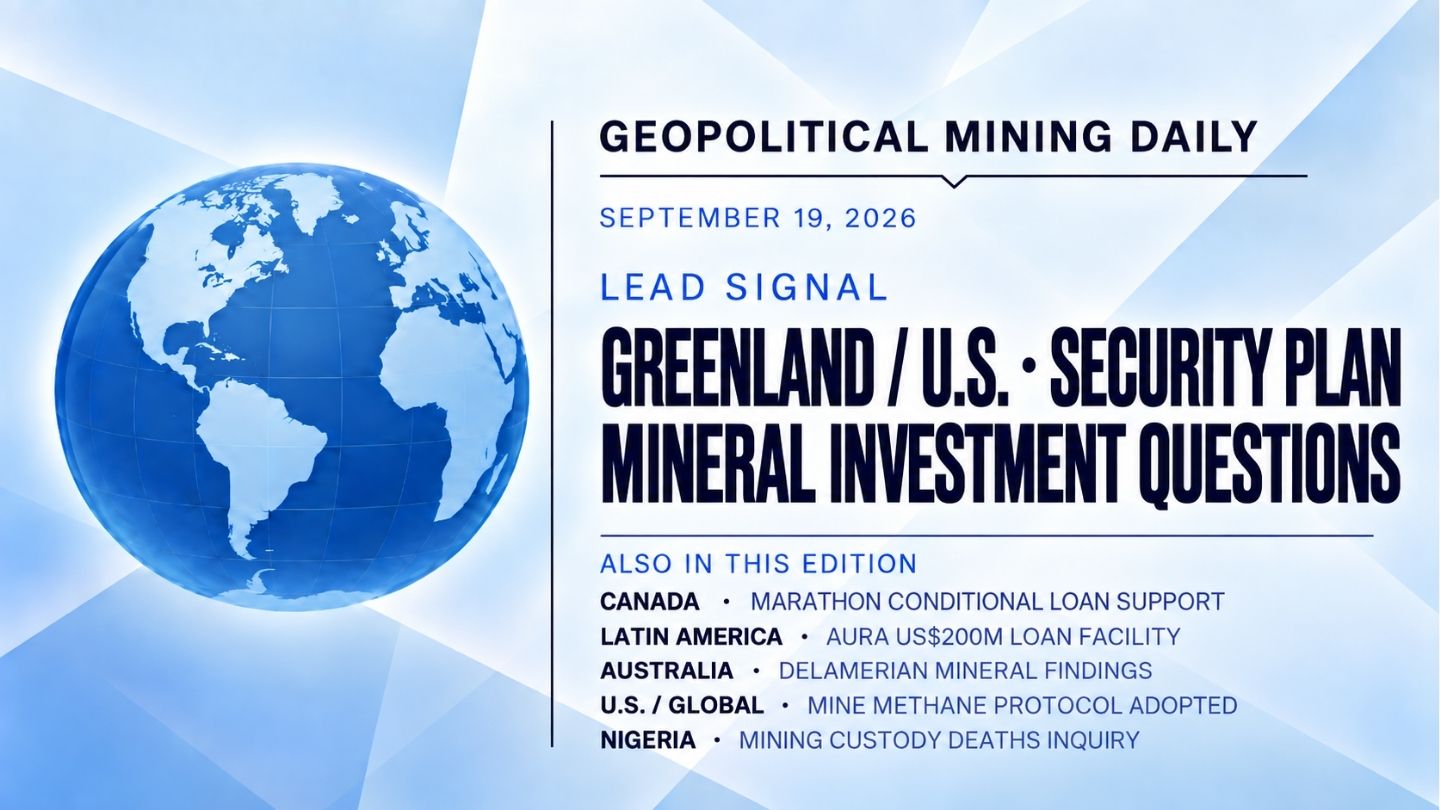

Geopolitical Mining Daily · September 19, 2026
Greenland Security Plan Raises Mineral Investment Questions
The Greenland security plan raises questions about the conditions for mineral investment, while its legal scope remains unexamined in this edition. The wider evidence follows financing for processing, corporate liquidity, public geoscience, methane accounting and an investigation into deaths after mining arrests. Each development changes a different part of the environment in which mining takes place.
The lead examines the proposed security arrangement around Greenland without inferring mineral rights or project approvals from public statements. Ontario outlines conditional support for Marathon, Aura contracts corporate borrowing, and Australia publishes Delamerian research findings. A new mine methane methodology broadens the route for project proposals, while Nigeria orders an investigation into deaths in custody. The analysis keeps announcements, implementation and demonstrated outcomes separate.
The 2026 observation framework
The ten Signals for 2026
Each Daily edition is read against the same ten strategic lenses. Signals used in today’s developments are highlighted below.
Today’s direction of travel
The conditions around a mineral project deserve the same scrutiny as the deposit itself. Legal authority determines who can participate, financing terms determine when funds are available, and technical evidence determines what can be developed. Institutions also shape how environmental results are verified and how people affected by mining enforcement are treated.
Lead development
Greenland, Denmark and the United States announce plans for a security agreement
What happened
On September 18, a statement published by the Danish Prime Minister’s Office said that Greenland, Denmark and the United States expected to sign a security agreement during the following week’s United Nations General Assembly. Parliamentary procedures would follow before entry into force. The Danish prime minister said the arrangement would recognise the Kingdom’s sovereignty and territorial integrity and the Greenlandic people’s right to self determination. [1]
Reuters reported that President Donald Trump said sensitive investments by U.S. adversaries would require American approval. That is his public description of the arrangement, rather than a finding established here from its legal provisions. [2]
Signal reading
The mining relevance lies in the conditions under which capital and industrial partners could participate. If investment provisions extend to mining or associated infrastructure, their scope could affect the structure of a transaction before a project reaches financing. That conditional relationship is the basis for examining the announcement through a mining lens; its application to particular assets remains to be established.
Questions for the legal text
Which transactions would be covered? Would the rules apply to mineral licences, company acquisitions, minority shareholdings, lending, offtake contracts or infrastructure such as ports, power and processing plants? Would they distinguish new investment from existing rights and commitments?
Who would make and implement the decisions? What authority would each government retain, how would consultation or approval work, and what review or dispute procedures would be available? The definition of sensitive investment is central to assessing any effect on a mining transaction.
What would change for an actual project? Would the arrangement create a financing instrument, procurement commitment or infrastructure programme, or would its effect be confined to security and investment screening? Project participation, funding and regulatory permissions need their own documentary evidence.
Next proof point: The signed text and any annexes, definitions of sensitive investment, the allocation of decision making authority, entry into force and project specific implementing measures.
[1] Official government statement · September 18, 2026
Danish Prime Minister’s Office: anticipated agreement, signature and parliamentary procedures (Danish).[2] Supplementary reporting · September 18, 2026
Reuters: President Trump’s public description of sensitive investment provisions.Project finance and processing development
Ontario outlines conditional loan support for Marathon’s processing facility
What happened
Generation Mining announced a non binding term sheet on September 18 for a loan of up to C$11 million through Ontario’s Critical Minerals Processing Fund. Invest Ontario confirmed the conditional support for the Marathon copper and palladium project. The proposed amount depends on eligible expenditure and employment requirements, with definitive documentation still outstanding. [3] [4]
The company identifies approximately C$410 million of processing, infrastructure and other eligible costs within its C$992 million total capital estimate. This is a new provincial component alongside the construction financing package announced on September 14; it is not evidence that the whole package has closed or been drawn. [3]
Signal reading
The focus on eligible processing expenditure shows where this instrument would enter the project budget. In a financing review, its contribution should be assessed alongside the conditions and timing of other funding sources. How much must first be spent, which expenditures qualify and when cash becomes available can matter as much as the headline amount. The proposed facility can be incorporated into a funding model once its terms are sufficiently defined; it should not be counted twice through overlapping announcements.
Next proof point: The definitive agreement, eligible cost calculations, conditions of funding and the timing of provincial funds within Marathon’s complete construction financing schedule.
[3] Direct company source · September 18, 2026
Generation Mining: non binding Ontario term sheet and funding conditions.[4] Direct provincial agency source · September 18, 2026
Invest Ontario: conditional support for the Marathon processing facility.Corporate finance development
Aura Minerals enters into a US$200 million syndicated loan facility
What happened
Aura Minerals announced on September 18 that it had entered into a US$200 million syndicated loan at holding company level. Citi and Itaú BBA acted as joint lead arrangers. The disclosed terms are a five year maturity, a two year grace period and interest at SOFR plus 2.70 percentage points annually. Intended uses include supplier payments and advance funding of production and selling costs. [5]
Management placed the facility within its growth programme, including Era Dorada in Guatemala and capacity expansion in Brazil. The announcement does not allocate the whole loan to a single mine or establish that all funds have been drawn. [5]
Signal reading
The financing question is how liquidity supports the timing of expenditure across a portfolio. Supplier payments and operating commitments may precede the revenue expected from expansion, so a review should connect the borrowing schedule with the underlying cash requirements. Facility size alone says little about headroom after existing obligations. The useful next assessment is the relationship between drawdowns, investment spending and operating cash generation, including the sensitivity of servicing costs to a floating reference rate.
Next proof point: Drawdown disclosures, the use of proceeds, debt and liquidity reconciliations, and progress against the capital programme supported by the company’s financing arrangements.
[5] Direct company announcement · September 18, 2026
Aura Minerals: US$200 million syndicated loan, pricing, maturity and intended use (PDF).Public geoscience development
Australia publishes Delamerian mineral and groundwater findings
What happened
Geoscience Australia’s September 18 update describes new Delamerian findings for critical minerals, copper, gold and groundwater. It reports a buried continental arc system extending about 1,000 kilometres across South Australia, New South Wales and Victoria, drawing on drilling, seismic, geochemical and groundwater investigations. [6]
The work forms part of Resourcing Australia’s Prosperity and connects deeper prospective geology with the study of shallower groundwater systems. These are regional research results. They do not establish a mineable reserve, commercial discovery or water allocation for a particular development. [6] [7]
Signal reading
Our reading is that the immediate value is better information for choosing where, and how, to investigate. A common geological dataset gives exploration teams a basis for comparing targets before committing to their own programmes. Integrating groundwater evidence also lets different land and water users examine relevant subsurface conditions earlier. Whether that information produces an economic discovery will depend on subsequent field results, deposit definition and project studies; the public research itself should be assessed by the uncertainty it helps resolve.
Next proof point: Use of the released datasets in target selection, follow up field programmes and deposit specific results that test the regional interpretations.
[6] Direct government science source · September 18, 2026
Geoscience Australia: Delamerian mineral and groundwater findings.[7] Supporting project documentation · Updated September 18, 2026
Geoscience Australia: Delamerian project and research publications.Environmental standard development
Mine Methane Protocol expands the framework for carbon credit projects
What happened
Climate Action Reserve adopted its modular Mine Methane Protocol and accompanying U.S. Module on September 18. It covers accounting and verification for methane destruction at active and abandoned underground coal mines and Category III gassy trona mines. The organisation is also accepting international project submissions and proposals for additional jurisdiction modules. [8]
The distinction between submission and registration is material. Reserve programme rules require an approved jurisdiction module before final listing and registration. A submission from elsewhere therefore does not by itself establish eligibility for issued credits. This is a carbon registry methodology, rather than a universally applicable legal requirement for mines. [9]
Signal reading
For a methane project, the commercial question is whether a verifiable reduction can support the cost of equipment, operation and monitoring. A wider methodological framework creates a route to examine that question, but revenue depends on meeting applicable requirements and obtaining credits that a buyer will purchase. A project assessment should therefore keep registration, verified reductions, issuance and sales as separate steps rather than assuming a financial return from the adoption of the protocol.
Next proof point: Additional jurisdiction modules, project registrations, monitored reductions, independent verification and credits actually issued and sold.
[8] Direct standard setter announcement · September 18, 2026
Climate Action Reserve: adoption of the modular Mine Methane Protocol and U.S. Module.[9] Supporting programme rules
Climate Action Reserve: submission, listing and registration under jurisdiction modules.Mining governance development
Nigeria orders inquiry into deaths in custody after mining arrests
What happened
Nigeria’s Presidency announced on September 18 that an investigation had been ordered into deaths of people detained on suspicion of illegal mining by the Nigeria Security and Civil Defence Corps in Minna, Niger State. Its scope includes the arrests, detention conditions, medical attention and events preceding the deaths. The statement distinguishes administrative suspension from a determination of criminal responsibility. [10]
The release does not establish a death toll, medical cause or finding of culpability. It records an investigation mandate. The mining allegations and the circumstances of the deaths both require evidence; suspicion does not amount to conviction. [10]
Signal reading
Deaths in custody raise questions about the safeguards governing detention, medical care and the use of enforcement powers. Establishing what happened matters first to the affected families and communities, while the investigation also concerns the distinction between suspected mining offences and failures in custody. Its conduct, public findings and subsequent proceedings will provide the evidence needed to assess those separate responsibilities. The investigation order establishes a mandate; its findings remain outstanding.
Next proof point: The investigation’s findings, evidence concerning the causes of death, information provided to affected families and any resulting judicial or administrative proceedings.
[10] Direct government source · September 18, 2026
Presidency of Nigeria: investigation mandate concerning deaths in custody in Minna.The system reading
What today’s evidence tells us
Read together, the developments show why mining analysis needs to identify the function of each document. A public security statement leaves questions for the agreement and its implementing rules. A financing announcement requires examination of terms, availability and intended use. Scientific findings provide a basis for further investigation, while a crediting methodology establishes a process for assessing environmental claims. An investigation mandate concerns the establishment of facts and responsibility, with people’s lives and rights at the centre of that process. For Greenland in particular, the next task is to examine whether the legal provisions change the terms of participation in mining and associated infrastructure. Until that examination is possible, the announcement supports questions about investment conditions, not conclusions about mineral ownership, project permissions or commercial access.
Signals for 2026 gives the map. The Daily records new evidence against that map, distinguishing announcements, implementation and demonstrated outcomes across the mining system.