
Geopolitical Mining · Country & Region Analysis
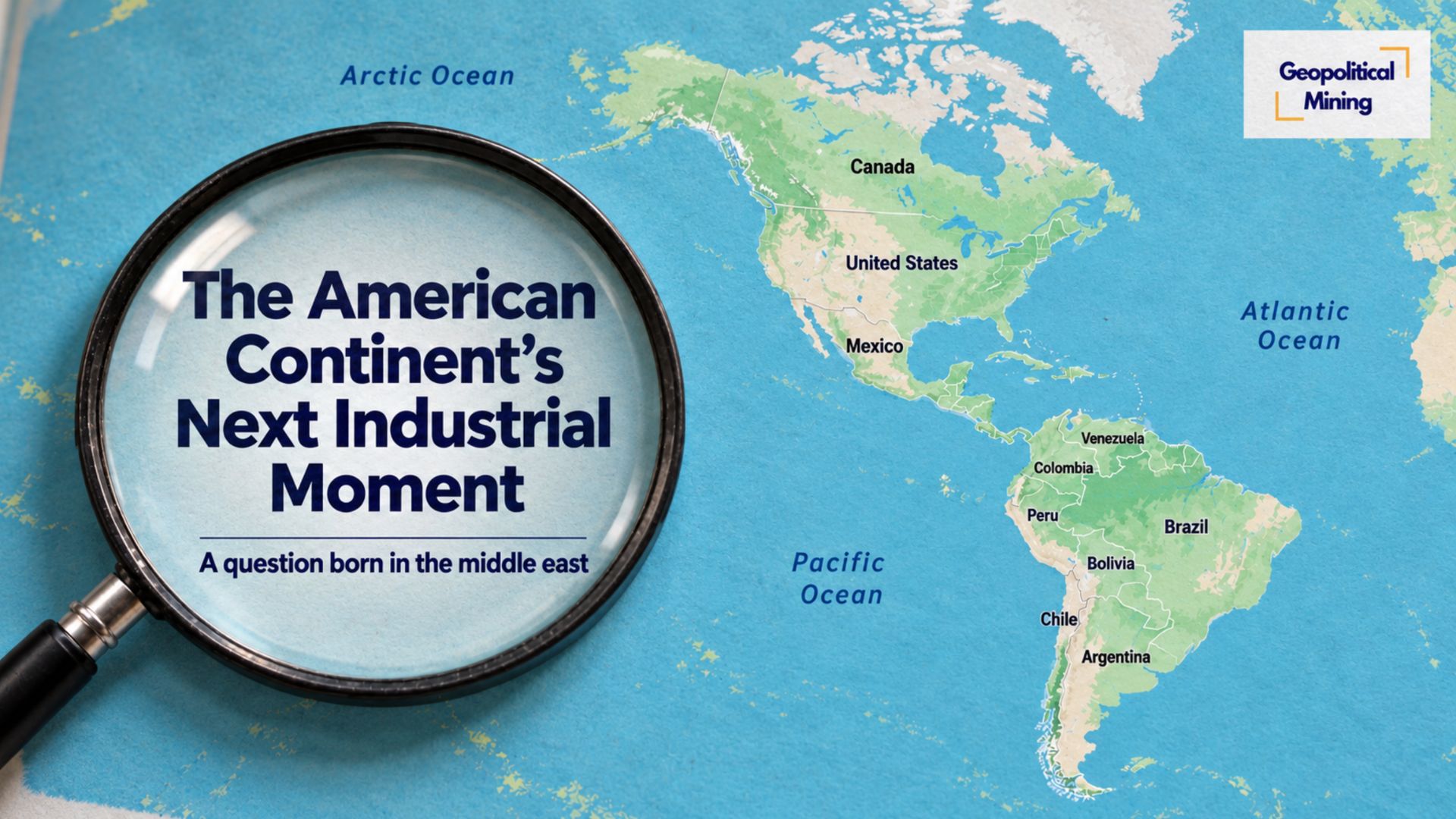
The American Continent’s Next Industrial Moment: A Question Born in the Middle East
How security concerns and the industrial ambitions of the United States and Asia could reshape mineral investment and productive capacity across the Americas through 2036.
When we published our analysis of Saudi Arabia’s mineral strategy last May, we were particularly interested in how the Kingdom’s industrial ambitions might endure in an increasingly difficult regional environment. Saudi Arabia had spent years assembling financial resources, energy infrastructure, institutional capabilities and international partnerships to support a transformation in which mining, processing and advanced materials were assuming a larger role. As we followed that strategy, we kept returning to the conditions necessary to sustain a complex industrial system when geopolitical circumstances become less predictable. The continuity of supply, which had long been integral to Saudi Arabia’s reputation in energy markets, seemed likely to acquire equal importance in the mineral economy it was seeking to develop. [1]
Recent events have brought us back to that reflection. On October 14, Singapore’s Maritime and Port Authority confirmed that two Singapore registered container vessels had been struck by projectiles of unknown origin while transiting the Strait of Hormuz. One vessel subsequently sank, with its crew evacuated safely. The incident added to the pressures affecting commercial navigation through a route whose reliability matters to industries far beyond the immediate region. [19]
A more revealing industrial example appeared in Vale’s second quarter reporting. The company disclosed that its pellet plants in Oman had temporarily suspended production because of the Middle East conflict and related logistical restrictions. Material previously intended for those facilities was redirected towards its Tubarão plants in Brazil and to other commercial outlets, while Oman production partially resumed towards the end of June. The significance of this adjustment lies in the capability that made it possible: Vale could draw upon established facilities, technical knowledge and market relationships in another geography. Such flexibility is built over years of investment and cannot be created simply because circumstances suddenly require it. [20]
These developments led us to consider a wider possibility. If the Middle East faces a prolonged period of instability, how might industrial economies respond when making decisions about materials and facilities that will remain important well into the next decade? The course of events cannot be established in advance, but the possibility of prolonged disruption warrants examining how governments, companies and investors may value alternative productive locations and more durable supply relationships.
It was through this line of thought that our attention gradually turned towards the Americas. Across the continent, from Canada and the United States through Mexico and the resource producing economies of South America, there is an extensive combination of minerals, energy, established operations, manufacturing, technology, capital and access to international markets. We see the possibility that these capabilities may acquire greater strategic significance over the decade ahead as the United States, China and other Asian economies reassess the security of their industrial relationships. The opportunity is continental in scope, although the conditions for realizing it differ sharply from one country and one mineral chain to another. That distinction will guide our analysis. We examine nine selected economies: Canada, the United States, Mexico, Colombia, Venezuela, Brazil, Peru, Chile and Argentina.
This essay follows the systemic perspective developed in Mining Is Dead. Long Live Geopolitical Mining, where mineral development is understood through its connections with security, capital, institutions, technology and the wider productive economy.
At a glance
Key Takeaways
- Our earlier concern about Saudi Arabia was the continuity of an interconnected industrial system under regional pressure. The response of internationally diversified operators has made that concern tangible.
- The United States, China and other industrial economies of Asia could deepen their resource and investment relationships with countries across the Americas as the cost of unreliable supply becomes more visible.
- The Americas offer significant existing productive capacity, yet Canada, the United States, Mexico, Colombia, Venezuela, Brazil, Peru, Chile and Argentina bring very different institutional, technical and industrial starting points.
- Chile and Peru supplied 34.4% of world mined copper in 2025, while China produced 45.3% of refined copper. The distinction reveals the economic importance of where processing capacity is located.
- The lasting opportunity for the American continent lies in turning greater international interest into viable operations, technological capabilities and domestic industry. Capital commitments must be distinguished from projects that are already producing.
When the Saudi question travels beyond Saudi Arabia
The industrial connection between Aramco and Ma’aden illustrates why our original question extends beyond the protection of individual facilities. In August 2026, the companies announced an agreement to establish a proposed copper exploration joint venture, combining Aramco’s subsurface information and technologies with Ma’aden’s mining experience, subject to regulatory approvals. That combination may accelerate the use of capabilities developed in the energy industry for a new mineral purpose. It also draws attention to the infrastructure, logistics, financing and security conditions upon which several activities within an economy can depend. Diversification can broaden a productive base without dispersing every risk to which that base remains exposed. [21]
Saudi Arabia’s international investments offer another connection. Manara Minerals, established by Ma’aden and the Public Investment Fund, completed its approximately US$2.5 billion investment for a 10% interest in Vale Base Metals in 2024. That transaction gave Saudi capital exposure to a mineral portfolio spanning, among other places, Canada, Brazil and Indonesia. It was undertaken before the present regional escalation and illustrates how mineral ambitions have already encouraged participation in productive assets across national boundaries. [22]
The consequence for future investment is subtle but important. An industrial customer evaluating a long-term relationship must consider the commercial performance of the supplier and the conditions under which its products can continue to arrive. Existing plants, alternate routes, qualified customers and dependable energy may therefore acquire greater value in investment decisions. This need not result in a general withdrawal from the Middle East. Rather, it could expand the importance of other geographies as additional points of production and as partners within industrial systems that increasingly require flexibility.
The industrial economies shaping the opportunity
The industrial economies most likely to influence this process do not share a single strategy. Their decisions nevertheless connect through the same material foundations of production: minerals, refined inputs, energy, manufacturing facilities, logistical networks and the technical capabilities required to keep them operating. For that reason, we believe the United States, China, the wider industrial economies of Asia and Europe deserve particular attention when considering the opportunities that may emerge for producers across the American continent.
The United States and the longer industrial horizon
U.S. mineral policy increasingly reaches across the conditions under which industrial supply is financed, produced and qualified for use. The Strategic Enabling State identified in our earlier work has since been examined through overseas investment, defence supply mapping and the interaction between industrial ambition and monetary restraint. Together, these perspectives reveal a strategy directed towards a more dependable system of production at home and in partner countries. Public finance, procurement and market instruments can improve the investment case, while project economics, technical performance and acceptance by industrial customers remain essential to its delivery. [3][23][15][16][17]
We expect the importance of that challenge to extend beyond an individual administration, even as the instruments chosen to pursue it may change. Industrial facilities, strategic inventories, supplier qualification and the investment cycles of major projects endure for years. Different governments may reach very different decisions about public finance, trade measures and international partners, but the underlying requirements of productive security are unlikely to disappear with the political cycle. The continental dimension is already visible. In August 2026, the U.S. Department of War announced a US$750 million investment within a wider US$1.55 billion structure associated with the supply of rare earth materials from Serra Verde’s Pela Ema operation in Brazil. The transaction links U.S. industrial and defence priorities to an existing productive asset in South America through financing and offtake arrangements. [24]
For neighbouring countries, the implications are not confined to additional mineral sales. Industrial partnerships may encompass refining, chemicals, components, engineering and logistics, although the location of those activities will be subject to commercial negotiation. The United States seeks to reinforce its own productive capabilities, and its partners will have their own economic aspirations. How those interests are reconciled could become an important determinant of the development generated across the continent.
China and the wider Asian industrial system
China’s position reflects decades of investment in manufacturing, processing and international commercial networks. Its December 2025 policy paper on Latin America and the Caribbean situates natural resources within a broader relationship involving infrastructure, finance, technology, trade and industrial cooperation. Our analysis of that document emphasized the connections among these fields and the importance of understanding them as elements of a longer term economic relationship. We believe prolonged uncertainty could reinforce China’s interest in securing raw materials and preserving the relationships that support its manufacturing base. [25][2]
Yet Asia must be considered in a more differentiated way. Japan brings technological capabilities and established industrial partnerships; Singapore has a distinctive financial and logistical role; South Korea is deeply engaged in advanced manufacturing; and the economies of Vietnam, Thailand, Malaysia and Indonesia participate in different combinations of manufacturing, processing and investment in supply chains. ASEAN’s own investment reporting documents the scale of international capital reaching the region and the differences in the industrial activities attracting it. These developments create a more varied field of potential buyers, investors and technology partners than a discussion centred solely on China would suggest. [26]
It would be premature to assume that stronger Asian demand will necessarily produce more processing across the American continent. An international customer may prefer to secure feedstock for an established refinery or manufacturing facility elsewhere. Another may find it commercially attractive to participate in production or processing closer to the source. For countries across the American continent, understanding the requirements and bargaining positions of these different partners will matter as much as the volume of resources available for export.
Europe’s industrial opportunity
Europe’s industrial expertise, scientific institutions and technological capabilities provide a substantial foundation for a new phase of industrial development. The European Commission’s Competitiveness Compass identifies the need to close innovation gaps and strengthen competitiveness. In our view, Europe’s opportunity lies in connecting those capabilities with reliable mineral supplies, affordable energy, processing capacity and investment. Environmental commitments and relationships with communities would need to form part of how that development is designed and delivered. The outcome remains open, shaped by the choices European governments and businesses make and their ability to turn them into viable projects. [27]
Canada offers a useful reference for this discussion. The parliamentary report Strengthening Canada’s Resilience on the Critical Mineral Front brings domestic processing, financing and Indigenous and local participation into a common discussion of mineral security. We see in this approach an opportunity to connect industrial development with environmental responsibility, respect for Indigenous rights and tangible benefits for communities. Its value as a reference for Europe will depend on how those priorities translate into projects and results. Europe could draw on that experience while developing a path consistent with its own institutions, values and industrial needs. [40]
For countries across the American continent, Europe could contribute as a buyer, investor and technology partner. Cooperation could extend from mineral supply to processing, equipment, engineering and industrial production. Its scope would depend on how Europe’s interest in strengthening its own industry aligns with its partners’ ambitions to develop productive capacity locally. A supply agreement may support an existing European factory, while investment in processing or technical capabilities in the country of origin could create a wider industrial relationship. The opportunity is to develop commercially viable projects that strengthen both sides, with the location of investment and the distribution of benefits negotiated rather than assumed.
The Americas: different starting points, different industrial tests
The countries considered here bring different forms of mineral and industrial strength to the same international moment. Their prospects emerge from the relationship between the assets already in operation, the institutions governing investment and the markets that make further production worthwhile. The conclusions developed in our country analyses allow those differences to be examined without reducing the Americas to an inventory of deposits or a single development model.
Our comparison covers Canada, the United States, Mexico, Colombia, Venezuela, Brazil, Peru, Chile and Argentina. It brings together established processing and manufacturing economies, major mining exporters and jurisdictions where the conditions for dependable formal production remain more difficult to sustain. These distinctions explain why greater international interest may produce different economic results across the continent.
Country perspectives
The Americas: different foundations of mineral and industrial power
National conclusions drawn from our published analyses, and their implications for the continent’s industrial prospects through 2036.
| Country | Mineral and industrial position | Implications for the next decade |
|---|---|---|
| Canada | Canada’s mineral strength rests on established operations, technical expertise and access to capital, yet its ability to turn that strength into broader commercial choice remains uneven. The U.S. relationship provides depth and scale; European and Asian partnerships become significant when they bring repeatable investment, processing and purchase commitments. Indigenous Nations increasingly shape the ownership, financing and governance through which projects proceed. The October 2026 parliamentary report on critical mineral resilience places domestic processing, financing and Indigenous and local participation within the work still needed to strengthen mineral security. [40] [8][9] | A more diversified customer base will strengthen Canada when power, transport, approvals and viable projects develop alongside it. Indigenous economic participation is part of that investment structure, with implications for who makes decisions and how returns support future development. The report provides a parliamentary agenda for further action, whose contribution will depend on implementation and viable projects. |
| United States | The emerging Strategic Enabling State brings mineral supply within a wider industrial strategy, coordinating public finance, procurement, market instruments, processing and overseas partnerships. Its ambition is to reduce vulnerable dependencies across the production system, including intermediate materials and qualified components, while retaining access to resources and capabilities that cannot all be supplied domestically. [3][15][16][17] | Success requires strategic demand to become financeable, operating capacity under prevailing capital-market conditions and across political cycles. U.S. decisions will also influence where partner countries process their minerals and how much industrial activity they retain. |
| Mexico | Mexico already combines mineral extraction with smelting, refining and manufacturing, giving it an industrial position that extends well beyond the mine. The United States anchors its commercial relationships, while Canada, the European Union and Asian partners offer additional channels for investment, technology and markets. Mexico is therefore both a supplier of industrial materials and a customer whose own factories require secure inputs. [11][14][36][37][38][39] | Strengthening the connections between these activities would deepen Mexico’s industrial position. Mining policy, concession and permitting rules, territorial security and investment predictability will shape how much of that possibility becomes new domestic production. |
| Colombia | Colombia’s mineral potential is constrained by the difficulty of sustaining a viable formal economy in territories where state authority, security and legitimacy remain fragmented. Anomic Mining describes this separation between continuing extraction and a functioning institutional order. Environmental legitimacy, economic viability and credible enforcement therefore have to be addressed together. [6] | Making lawful production predictable and investable would give international demand a durable domestic foundation. Enforcement needs to be accompanied by practical routes to formalisation, traceability and community participation, with clear distinctions between artisanal, informal and criminal activity. |
| Venezuela | Venezuela’s resource endowment remains separated from dependable supply by weaknesses in territorial governance, institutional continuity and supporting energy and transport systems. Its evolving relationship with the United States introduces a further dimension: commercial access can shape counterparties, traceability and the location of processing, alongside the availability of capital and technology. [12][18] | Reconstruction and external market access must develop together. The terms of that access matter because they can enable production while also influencing which industrial functions Venezuela retains and where the resulting economic value is realised. |
| Brazil | CBMM’s development of Brazil’s niobium industry demonstrates how sustained private investment can turn geological advantage into processing expertise, products and durable markets. Extending that experience into other minerals brings decisions over ownership, public finance and policy continuity into focus. Relations with China, the United States and other partners also influence where new processing capacity is built and how technology and commercial relationships are organised. [4][13] | Brazil can extend its industrial depth beyond selected mineral chains while preserving room for independent commercial decisions. Implementation of its mineral framework and the terms of financing and technology partnerships will shape how much additional production and expertise remain within the country. |
| Peru | Peru’s mining economy has maintained productive continuity through repeated political disruption, supported by established operations and credible macroeconomic institutions. Central bank independence and policy continuity help explain why long-term investment has remained possible. Territorial conflict and illegal extraction expose a different weakness: national financial credibility does not ensure that formal mining can operate securely in every locality. [7] | Preserving that macroeconomic foundation while strengthening territorial governance would support both existing production and new investment. Additional mineral exports would carry greater developmental weight where they deepen local suppliers, infrastructure and technical expertise. |
| Chile | Chile’s mineral leadership rests on operating experience, technical competence and access to capital, but its investment position also depends on the durability of institutional decisions. Rigorous environmental and territorial assessment, reliable operating information and predictable approvals belong to the same investment framework. A national commitment to mining must endure beyond changes of government. [10] | Chile can build on its copper and lithium position by improving execution and extending technical and industrial capability. Faster procedures have lasting value when decisions are sufficiently robust to support financing, construction and operation under credible environmental and social standards. |
| Argentina | Argentina’s capital-activation model uses RIGI to reduce the legal and financial uncertainty surrounding large investments. Mineral development nevertheless takes place through provincial jurisdictions, infrastructure networks and territories with their own institutions and expectations. The relationship between national investment incentives and provincial execution is central to whether renewed capital interest becomes a durable productive economy. [5] | Construction, reliable infrastructure and legitimate territorial agreements will determine how far the investment framework reaches. Domestic suppliers and technical capabilities need to develop alongside the projects for their contribution to extend beyond resource exports. |
The country perspectives synthesise our signed analyses. Corporate and official commercial records supplement the discussion of Mexico. The final column develops the authors’ interpretation for this essay; it is neither a ranking nor a forecast of national outcomes.
The Shield of the Americas: A Developing Dimension
The industrial opportunity described in the tables is also taking shape within a changing hemispheric political framework. The Shield of the Americas adds a further dimension to consider. The joint statement of September 22 connects critical mineral supply chains, the exploration of investment screening mechanisms and trusted suppliers with a broader agenda of economic cooperation and security. Its scope differs from the continent examined here: Canada, Mexico, Brazil and Venezuela were not among the fifteen governments issuing that statement. How these commitments develop within national institutions will shape their practical significance.
In our view, this raises questions about the conditions under which greater international interest could become productive investment. The origin of capital, the choice of commercial partners and the security of supply routes could become more influential in project decisions. For producing countries, an important question is how those relationships would support domestic processing, technical capabilities and employment. Their effects could vary considerably across countries and projects, including through commercial relationships extending beyond the participating governments.
The Shield remains a developing initiative that we are following through our dedicated analysis. Its relevance to the industrial future of the American continent will become clearer as shared commitments translate into national decisions and investment arrangements. We are examining how this process could affect access to capital, technology and markets, and the scope countries retain to pursue their own industrial priorities. These open questions form part of the changing conditions surrounding the opportunity explored in this article.
The Paradoxes of Industrial Opportunity
The industrial opportunity facing the American continent raises a practical question: which activities can its countries develop and sustain around their mineral resources? Processing is one possibility, alongside equipment, technology, specialised services and other productive capabilities. Their viability depends on how markets, infrastructure, energy, finance and institutions come together. This section examines the distance between resource production, investment interest and operating capacity, and the conditions under which that distance could be narrowed.
Copper provides a useful starting point because extraction and transformation have different geographical concentrations. According to Cochilco’s 2025 statistics, Chile accounted for 22.9% of world mined copper production and Peru for another 11.5%, giving the two countries a combined share of 34.4%. During the same year, China accounted for 45.3% of world refined copper production, while Chile represented 6.4%. These measures describe different stages of the copper chain and different global production totals; the contrast cannot be read as a direct transfer of tonnage between countries. It nevertheless reveals how strongly industrial capacity may be concentrated in geographies other than those responsible for extracting the original resource. [28][29]
This difference should not be reduced to an argument that every tonne of mined copper ought to be refined in the country where it originates. Metallurgical technology, energy prices, environmental requirements, feedstock mixes, plant scale, financing and the location of customers all influence where processing is economically viable. It does, however, oblige us to examine what industrial capabilities might be developed competitively in the Americas and which relationships could support them. The same questions arise in other mineral chains, though their technical and commercial characteristics differ.
The second set of figures concerns capital. UN Trade and Development reported that foreign direct investment inflows into Latin America and the Caribbean, excluding offshore financial centres, rose 14% to US$188 billion in 2025. Over that same year, the value of newly announced greenfield projects fell by approximately one third. These indicators measure different things: recorded investment inflows may include acquisitions, reinvested earnings and other forms of capital, whereas greenfield announcements concern intentions to establish new facilities. The divergence nevertheless raises a consequential issue for the coming decade, namely whether stronger international financial interest is translating into a sufficient pipeline of new productive capabilities. The regional figures are economy wide and should not be mistaken for mining only statistics. [30]
Financial announcements must consequently be interpreted in relation to their contractual stage and the productive activity they may eventually support. A portfolio of proposed investments is a measure of possible development, whereas a signed financing agreement or a completed capital transaction refers to a different degree of financial commitment. None of these figures, on its own, establishes that a new mine or processing facility has achieved operating capacity. These distinctions are especially important when estimates of future supply are drawn from national project pipelines.
Evidence and scale
Seven figures that clarify the opportunity
Production, investment and project figures answer different questions. Their status and units remain explicit.
| Evidence | 2025 to 2026 figure | What the figure actually measures |
|---|---|---|
| Chile + Peru | 34.4% | Combined share of world mined copper in 2025 (22.9% and 11.5%, respectively). [28] |
| China | 45.3% | Share of world refined copper production in 2025; a different stage and denominator from mined copper. [29] |
| Latin America & Caribbean | US$188bn | FDI inflows in 2025, up 14%, excluding offshore Caribbean financial centres. Economy wide measure. [30] |
| Regional greenfield announcements | ≈ −33% | Change in the announced value of new greenfield projects in 2025, not a fall in actual industrial output. [30] |
| Peru | US$64.1bn | Estimated cost of 66 projects in the official 2026 mining pipeline, not committed spending. [31] |
| Brazil | R$45.8bn | Value of 56 industrial proposals selected for further review by BNDES and Finep, not approved finance. [32] |
| Canada | C$28.8bn | Value of 2025 Canadian critical mineral exports, including reexports, sent to the United States; approximately 57% of the C$50.6bn total. [33] |
Copper mining and copper refining use different production denominators. FDI inflows and greenfield announcements are different investment measures. Project pipelines, selected proposals, conditional credit facilities and completed financing must not be added together or treated as operating production.
Taken together, these figures suggest a more demanding interpretation of the opportunity facing countries across the Americas. The continent already has a major position in the extraction of some materials, while significant transformation capacity is located elsewhere. Capital continues to reach Latin America, but some of the indicators associated with new productive projects have weakened. Within the same region, announcements encompass everything from exploratory proposals to operating facilities and transactions whose legal and commercial conditions have been substantially completed. A prospective increase in demand cannot erase these distinctions.
We are especially interested in whether new international relationships can help address them. Japan’s cooperation with Codelco on technologies to reduce impurities in copper raw materials is one example of a buyer and producer seeking to develop a technical solution with an industrial purpose. The U.S. financial arrangement involving Serra Verde in Brazil offers another example, with supply security and capital tied to an existing mineral operation. In our view, the strongest opportunities will emerge where a country’s industrial ambitions and its partners’ commercial requirements can be reconciled in projects with credible customers, reliable energy, competitive costs and sound execution. [35][24]
For Latin America, this opens a broad industrial agenda. Competitive processing can contribute to it, alongside mining technology, equipment, specialised services, metallurgy, chemicals, engineering and logistics. Choosing which capabilities to develop requires an understanding of customers, technical requirements, infrastructure and the conditions under which investment can be sustained. Governments can help coordinate these elements through public planning, regulation, infrastructure and partnerships, while ownership and operation introduce additional responsibilities.
Our analysis of Codelco brings those responsibilities into focus. The case examines the institutional demands of combining fiscal contributions, capital renewal and technical execution within a state operator. It invites a wider question for countries considering new processing and industrial capacity: under what conditions can the State create lasting national value by coordinating investment and infrastructure without necessarily owning the assets, and when would direct ownership strengthen that contribution? Any answer would need to consider financing, technical competence, accountability and the ability to sustain operations over time.
A concluding perspective
We began this reflection with a question about Saudi Arabia’s capacity to sustain an expanding mineral industry under regional pressure. Following the implications of that question brought us to a wider view of industrial investment, commercial dependence and the possibility that established productive locations may acquire additional value in an uncertain world. The experience of Vale, drawing upon its Brazilian facilities while addressing disruption in Oman, was a particularly tangible illustration of the flexibility that international operating capabilities can provide.
Our perspective is that the American continent could become more important to the world’s principal industrial economies during the decade ahead. The significance of that possibility will be determined in different ways across the countries we have examined. For some, established production and industrial experience offer a basis for expansion. Others will need to demonstrate that legal frameworks, financial commitments, territorial legitimacy and infrastructure can bring new projects into operation. The continental opportunity should be evaluated through these national realities, with attention to the conditions that allow resources to become dependable production.
What makes this period especially interesting is that the need for greater supply security may bring international buyers, capital and technical partners into closer contact with producers across the American continent at a time when several countries are reconsidering their own productive ambitions. Those relationships could remain concentrated on access to raw materials, or they could help develop processing, technology, specialised services and other capabilities within the producing countries. Their contribution to development will depend on the knowledge, productive capacity, employment and commercial options that take root locally, alongside tangible benefits for communities.
The role of the State forms part of this discussion. Coordinating infrastructure, energy, investment conditions and credible institutions can help countries pursue industrial ambitions consistent with their resources and capabilities. Direct ownership introduces further choices about financing, technical responsibility and accountability. The appropriate combination will depend on national circumstances and on the ability to sustain viable operations over time. International partnerships will also need to leave room for countries to shape their own industrial priorities.
Sustaining that opportunity raises further questions about territorial governance and international cooperation. Addressing illegal extraction and criminal networks requires community protection, credible enforcement and viable routes to formalisation, with careful distinctions between artisanal, informal and criminal activity. Greater strategic interest also brings diplomatic choices about how to preserve cooperation where commercial competition and territorial sensitivities intersect. These remain open considerations for the continent’s industrial future, whose implications will differ across countries and projects.
The question that began in the Middle East therefore remains open in a new geography: if the world’s major industrial economies increasingly look towards the American continent for dependable resources and productive capacity, how much of that opportunity will its countries be able to transform into their own lasting industrial development?
A second question concerns the conditions and purpose of that development: how can countries across the American continent ensure that greater strategic importance produces tangible benefits for their communities, while strengthening legitimate mining and preventing criminal activity and geopolitical tensions from undermining the cooperation needed to sustain it?
Resources
Original evidence review through October 16, 2026, with a targeted update on October 22, 2026 to incorporate the Canadian parliamentary report on critical mineral resilience. Official statistics, original corporate communications and government publications support the factual claims. Related Geopolitical Mining articles provide the authors’ previously published interpretations; the prospective reading through 2036 is the present authors’ analysis.