
Geopolitical Mining · Country & Region Analysis
Brazil’s 2026 Election: Critical Minerals, a New Mining Framework and the Shield of the Americas
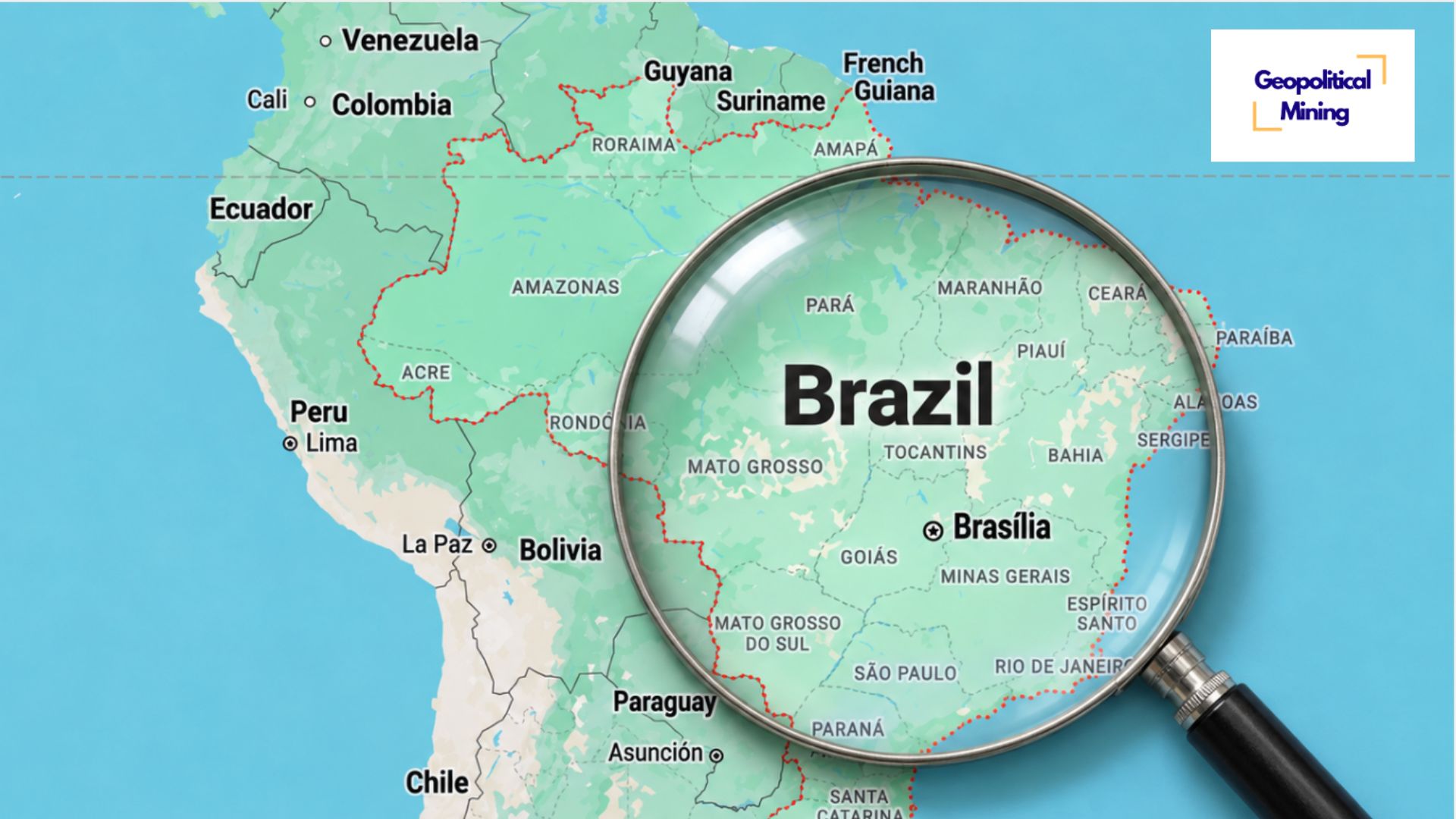
Brazil enters its 2026 election with an established mining economy, a new critical minerals framework and a new regional question: how the next government will position the country as the Shield of the Americas begins to connect economic security, investment screening and critical mineral supply chains.
By Marta Rivera Muñoz and Eduardo Zamanillo
September 28, 2026
Brazil enters its presidential election as an established mining economy with decades of industrial experience. Its capabilities already extend from extraction into processing, metallurgy and technological development in particular chains. CBMM integrates niobium production with product development and technical support for industrial customers. In Pará, Alunorte converts bauxite into alumina, supplying international markets and the neighbouring Albras aluminium smelter. These operations provide an existing base of engineering, industrial knowledge and commercial relationships from which additional mineral industries can develop.
For the next administration, the challenge is to extend that experience into additional mineral chains while deciding how foreign capital, technology and purchasing agreements contribute to development inside Brazil. Industrial expansion, the terms of international partnerships and the administration of mineral policy form a connected agenda.
The election also takes place as Brazil introduces a broader framework for supporting and supervising critical and strategic minerals. President Luiz Inácio Lula da Silva sanctioned Law 15.506 on September 16, establishing the National Policy for Critical and Strategic Minerals and creating new incentives, corporate obligations and arrangements for government coordination. Decree 13.118, issued on the same date, organizes the National Council for the Industrialization of Critical and Strategic Minerals, the CIMCE. Much of their implementation will extend into the next administration.
Voting begins on October 4, with a presidential runoff scheduled for October 25 if required. The mining implications concern four connected challenges: extending Brazilian capabilities into additional mineral chains, diversifying commercial and technological relationships, implementing the new framework predictably, and defining Brazil’s relationship with the United States and the emerging Shield of the Americas architecture. The Superior Electoral Court, TSE, has confirmed twelve valid presidential candidacies for the first round.
An Industrial Base with Concentrated Export Exposure
Brazil’s industrial capabilities coexist with concentrated mineral exports. Iron ore remains the largest contributor to export receipts, while China dominates shipments measured by weight. The distinction between these measures matters when assessing commercial dependence.
Mineral economy
Brazil’s Mineral Exports: First Half of 2026
| Indicator | Reported result |
|---|---|
| Total mineral sector export value | US$25.1 billion |
| Total mineral sector export volume | 196.2 million tonnes |
| Iron ore export value | US$13.4 billion |
| Gold export value | US$4.6 billion |
| Copper export value | US$3.87 billion |
| Niobium export value | US$1.40 billion |
| China’s share of mineral exports, measured by volume | 70.1% |
Source: IBRAM, using Comex Stat. Figures cover January to June 2026 and are rounded. The table follows IBRAM’s sector classifications, which do not encompass all mineral based manufacturing. China’s share is measured in tonnes, not revenue. Gold volumes are omitted because IBRAM identified inconsistencies in the underlying data.
The export figures identify a commercial concentration that varies by mineral; they do not describe every relationship in the same way. For the next government, the industrial question is which additional products Brazil can competitively supply from its existing resource and operating base. Developing those products will also require decisions about foreign capital, technology and customers, linking industrial expansion to the terms of Brazil’s international partnerships.
1. Decide Which Mineral Chains Brazil Can Build at Home
Brazil’s industrial experience provides a starting point for expansion, but the next step will differ by mineral. The practical policy choice is where an additional processing or manufacturing stage has a viable market and what support, infrastructure or technology would allow it to operate in Brazil.
CBMM’s collaboration with Toshiba and Sojitz illustrates one route. Their work on niobium based battery technology connects an established Brazilian mineral business with research and product development through foreign technology partners. The location of subsequent manufacturing and the rights to use or develop the technology remain separate commercial questions.
AMG illustrates a different configuration. Its Brazilian mineral operations form part of an international lithium business whose later conversion stages include Bitterfeld, Germany. Its second quarter disclosure reported lithium hydroxide production and sales there while customer qualification and the production ramp continued. The resource and that processing stage therefore sit in different jurisdictions within the same corporate group.
The next administration’s task is to assess such opportunities chain by chain, connecting feedstock characteristics, energy, infrastructure and technology with product specifications and identifiable customers. Public support can then be evaluated against commissioning, consistent product quality and commercial sales at a sustainable cost. Technology partnerships can be assessed through the engineering knowledge, training and operating capabilities established in Brazil.
These considerations give industrial policy a concrete objective: additional Brazilian operations capable of serving a market and sustaining the knowledge needed to do so. Achieving that objective also depends on the partners that finance projects, provide technology and purchase production.
2. Diversify Markets, Capital and Technology on Clear Terms
China, the United States and Europe already participate in different parts of Brazil’s mineral economy as customers, investors, processors and technology partners. For the next administration, diversification needs to be assessed through what each relationship contributes to domestic operations and what obligations accompany that contribution.
Commercial comparison
China, the United States and Europe: The Same Commercial Questions
| Question | China | United States | Europe |
|---|---|---|---|
| Trade: which markets are available? | Principal destination for mineral shipments by volume, with substantial exposure to iron ore. | An established destination for products including niobium and natural stone. | European destinations appear in copper and niobium trade, among other chains. Customs destinations should be distinguished from final customers. |
| Investment: which Brazilian assets are involved? | CMOC owns Brazilian niobium and phosphate businesses with local industrial operations. | USA Rare Earth completed its combination with Serra Verde in September. | Hydro participates in Brazil’s bauxite, alumina and aluminium chain. AMG connects Brazilian mineral operations with an international processing business. |
| Technology: what capability is located in Brazil? | CMOC documents process improvements in its Brazilian operations. Its public operational description does not establish comprehensive technology transfer rights for Brazilian third parties. | Serra Verde brings Brazilian mining and processing into a group with existing and planned downstream capabilities abroad. Corporate integration does not locate every technological stage in Brazil. | Hydro’s Brazilian operations and AMG’s German refinery illustrate different locations for industrial expertise within European linked investments. |
| Processing: which products are made locally? | CMOC produces ferroniobium and phosphate chain products in Brazil. | Serra Verde produces mixed rare earth carbonate in Brazil. Subsequent separation and manufacturing require their own location analysis. | Alumina and aluminium are produced in Brazil, while AMG also operates lithium hydroxide refining in Germany. |
| Contracts: how much production is committed? | The CMOC operational disclosure reviewed does not publish complete offtake terms. | Serra Verde disclosed a 15 year agreement covering 100% of Phase I production, with take or pay provisions and price floors for neodymium, praseodymium, dysprosium and terbium. The purchasing vehicle combines US government support with private capital. | The Hydro and AMG disclosures reviewed do not establish an equivalent comprehensive offtake structure. |
These are documented examples rather than an exhaustive account of bilateral investment. Europe includes countries outside the European Union, notably Norway. The absence of published contractual terms does not establish that supply commitments are absent. Sources include IBRAM, CMOC, USA Rare Earth, Hydro and AMG.
Serra Verde illustrates the connection between financing and future supply. Its combination with USA Rare Earth places a Brazilian mining and processing operation inside an international group, while its disclosed purchase agreement commits Phase I output to a particular purchasing structure for many years. That arrangement can reduce uncertainty over demand and support financing. Its effects on the location of subsequent processing and the availability of production for other buyers must be considered separately.
Corporate ownership, industrial location, technological capability and the destination of production are separate measures of diversification. Applying them consistently to Chinese, US, European and other partnerships means examining the product made locally, the technology available to the operation and the volume, duration and pricing terms of supply commitments. These are also the commercial arrangements that the new domestic framework will help govern.
For the full Geopolitical Mining framework behind this article, see our book Mining Is Dead. Long Live Geopolitical Mining.
3. Turn the New Framework into Predictable Administration
The new framework brings industrial incentives and the supervision of strategic transactions into the same policy agenda. Law 15.506, sanctioned on September 16, establishes the National Policy for Critical and Strategic Minerals, while Decree 13.118, issued on the same date, organizes the CIMCE. Their financial instruments, corporate obligations and administrative powers now require implementing rules and procedures that the next administration will help put into operation.
New minerals framework
Principal Financial Provisions
| Instrument or obligation | Statutory terms | Implementation significance |
|---|---|---|
| Processing and transformation tax credits, PFMCE | Up to 20% of eligible expenditure, with an aggregate ceiling of R$1 billion annually, approximately US$193.8 million, from 2030 to 2034. | Projects require prior qualification and a competitive procedure. The percentage is linked to domestic value addition. |
| Mineral Activity Guarantee Fund, FGAM | Federal participation authorized up to R$2 billion, approximately US$387.6 million. | Provides a mechanism for guarantees. The statutory authorization should be distinguished from capital actually contributed and guarantees available to individual projects. |
| Initial corporate funding obligations | For the first six years from the relevant regulation, covered companies must allocate at least 0.3% of the defined revenue base to research, development and technological innovation, plus 0.2% to FGAM fund units. | These are obligations attached to covered mineral activities, rather than conditions applying only to companies receiving tax incentives. |
| Subsequent research obligation | After the initial six year period, the minimum allocation to research, development and technological innovation becomes 0.5%. | Establishes an ongoing funding obligation after the initial contribution structure changes. |
| Failure to fulfil a tax supported project | Recovery or reversal of improperly used credits and a fine of up to 20% of the credit that would have been allocated to the project. | Beneficiaries must account for compliance and potential recovery of benefits. |
Revenue base: gross operating revenue from covered activities, less taxes levied on that revenue. The corporate contributions are activity based obligations, distinct from conditions attached to receiving tax incentives.
The timing creates a financing question for projects seeking to advance before the tax credit window begins. The statute establishes annual credit ceilings from 2030 through 2034, rather than an immediately available subsidy pool. Development plans advancing earlier will need to address their financing, construction and operating risks during the intervening period.
For PFMCE eligibility, companies must be constituted under Brazilian law with headquarters and administration in Brazil. Regulations may attach domestic procurement, supply and expenditure conditions to benefits. These provisions create local establishment and value addition requirements without constituting an exclusively Brazilian ownership requirement.
The institutional structure separates strategic policy direction from individual administrative decisions. The CIMCE provides coordination, planning and monitoring for the national policy, while the decree establishes its internal organs and responsibilities. The National Mining Agency, ANM, retains its statutory functions.
The framework also extends beyond financial support. Screening provisions cover specified changes in control, foreign participation or influence, strategic geological information, mineral rights transactions and international supply arrangements that may affect economic or geopolitical security. The legislation provides for information on export destinations, beneficial ownership, processing and economic use, and allows regulated value addition commitments in connection with exports. Operational thresholds and procedures remain dependent on further rules.
The practical issue for companies and financiers will be administrative predictability. They need to know when notification is required, which documents must accompany a filing, how long review can take, how a transaction timetable interacts with the process and which institution is responsible at each stage. Conditions affecting the destination of production, the structure of a partnership or the timing of a transaction can alter project financing as well as regulatory compliance.
The next administration will therefore inherit more than a set of incentives. It will inherit the task of converting a new statutory framework into procedures that companies, investors, communities and government agencies can understand and apply consistently.
Traceability as Part of Industrial Governance
Legal supply verification belongs within the same implementation agenda. The framework envisages traceability covering origin, environmental licences, mineral authorizations, transport and recycling. Establishing these requirements is distinct from demonstrating that records can already be verified throughout every affected chain.
Existing cooperation provides a starting point for gold. In April, the Federal Police and IBRAM signed an agreement supporting information sharing, the national database of gold profiles and the Ouro Alvo programme. These initiatives connect forensic identification with efforts to establish mineral origin. The agreement documents institutional capacity under development rather than universal control of the gold supply chain.
Effective traceability requires more than a declaration at the point of sale. A functioning system must be capable of comparing declared production with an authorized operation, following material through successive transactions and identifying responsibility when origin cannot be substantiated. Physical verification, administrative records, transport documentation, beneficial ownership information and financial investigation perform different but complementary roles.
Illegal mining also raises questions about territorial protection and the boundary between lawful small scale activity and extraction that cannot legally be authorized. These governance questions form part of the domestic agenda alongside industrial incentives and investment review. The external counterpart is how Brazil will relate to regional initiatives that connect minerals with wider economic and security cooperation.
4. Brazil, the United States and the Shield of the Americas
Brazil’s domestic rules will operate alongside a changing regional agenda. The Shield of the Americas introduces a separate question about cooperation between governments. On September 22, participating governments issued a joint statement organized around economic cooperation, security and multilateral coordination. Its economic pillar includes exploring investment screening mechanisms, safeguarding critical mineral supply chains through diversified and reliable sourcing, and developing trusted supplier rules for digital infrastructure.
The statement lists the United States, Argentina, Bolivia, Chile, Colombia, Costa Rica, the Dominican Republic, Ecuador, El Salvador, Guyana, Honduras, Panama, Paraguay, Peru and Trinidad and Tobago. Brazil was not among the participating governments listed in the statement. Its provisions therefore provide a regional reference for the next administration, rather than a statement of Brazilian commitments.
The mineral provisions sit inside a broader security framework. The same statement addresses coordinated sanctions, designations and financial actions against specified transnational criminal organizations, expanded civilian law enforcement, intelligence sharing, access to security technologies and training, and coordination through regional and multilateral institutions. The White House event on September 22 presented the Shield as a hemispheric initiative rather than a stand alone minerals arrangement.
A bilateral example provides additional context. The agreement signed by the United States and Argentina in February addresses investment in mineral exploration, extraction, refining and processing within a wider economic security structure that includes export controls, sanctions and investment screening, subject in several provisions to domestic law or other qualifications. That agreement concerns Argentina; it illustrates the range of subjects that can accompany mineral cooperation with Washington.
For Brazil, the relationship between these initiatives and its domestic framework requires specific examination. Brazil’s legislation and the Shield are legally distinct, although both address investment screening and strategic supply. How any future arrangement would interact with domestic review procedures, existing commercial contracts and relationships with China, Europe and other partners would depend on the terms actually agreed.
Bilateral mineral cooperation, project financing and participation in the Shield would also require separate decisions. A future government could consider investment or technology partnerships with the United States without treating those arrangements as acceptance of every element of the wider initiative. The question is which economic, security or multilateral commitments accompany each instrument and how those commitments affect Brazil’s industrial and commercial objectives.
These questions connect the regional discussion to the election. The registered programmes can be compared for what they say about industrial development, international relationships and governance, without assuming that they already address every recent legal or diplomatic development.
What All Twelve Presidential Candidates Have Documented
The comparison below covers the twelve valid presidential candidacies identified by the TSE and uses proposals contained in their formally registered government programmes. The programmes vary substantially in their level of mining specific detail. Where the material reviewed does not identify a dedicated critical minerals, processing, traceability or illegal mining proposal, the table records that limitation rather than inferring a policy from unrelated positions.
Election programmes
Registered Programmes and the Mineral Economy
| Candidate | Industrial development and international relationships | Governance, traceability and illegal mining |
|---|---|---|
| Augusto Cury, Avante | The PETRA BR proposal (PETRA BR: Terras Raras e Minerais Estratégicos do Brasil) addresses rare earths and strategic minerals, while the wider programme includes export processing zones, strategic corridors, global commercial integration and protection of national strategic interests. The proposal supports domestic processing and advanced materials where technically, economically and environmentally viable, together with research, technology transfer, joint development and professional training. | The PETRA BR section does not establish a specific gold traceability mechanism. Its industrial proposals retain explicit technical, economic and environmental viability conditions. |
| Clariana Barão, DC | The programme emphasizes a simple and predictable business environment, productive credit, infrastructure, logistics and energy security. The TSE thematic index does not identify a dedicated critical minerals, mineral processing or international mineral partnership programme. | The TSE thematic index does not identify a mining specific illegal mining or mineral traceability mechanism. The broader programme includes monitored borders, asset tracing against organized crime and traceable public procurement. |
| Edmilson Costa, PCB | Proposes a strongly state led economic model, including a fully state owned Petrobras, and an external policy centred on opposition to what the programme describes as imperialism and on stronger sovereign regional integration through institutions such as ALBA and UNASUL. The TSE thematic index does not identify a separate critical mineral industrialization programme. | Explicitly calls for rigorous action against deforestation and illegal garimpo, alongside protection of the Amazon, Cerrado and Pantanal and full demarcation and titling of Indigenous and quilombola territories. |
| Flávio Bolsonaro, PL | Identifies critical minerals within the economic programme and combines them with trade opening, participation in global value chains, domestic competitiveness, transition energy policy and proposed accession to the OECD. The registered programme supports domestic value addition through private investment, regulatory stability, technology partnerships and market incentives for industrial integration. | The programme includes environmental enforcement and traceability of production chains. Its mining proposals address unauthorized extraction and environmental crime while distinguishing enforcement against organized structures from support and guidance for lawful small producers and Amazonian populations. |
| Hertz Dias, PSTU | Proposes expropriation of major strategic companies including Vale and advocates national sovereignty over strategic resources. In international policy, the programme rejects what it describes as agreements of subordination involving major powers and opposes arrangements that would leave Brazil as an exclusive commodity exporter. | The TSE thematic index does not identify a separate gold traceability mechanism. Its mineral implications arise principally from proposed state control of strategic companies, resource sovereignty and positions on territorial and environmental protection. |
| Lula, PT | Proposes continued neoindustrialization through Nova Indústria Brasil and the ecological transformation agenda, together with differentiated development of critical mineral and rare earth chains according to technological uses and regional processing opportunities. Internationally, the programme supports South American integration, multilateralism, BRICS and diversified relationships across Africa, Asia, the Middle East and the Global South. | Includes stronger inspection, traceability and due diligence in production chains together with territorial and environmental protection. A further Lula administration would also inherit implementation of the minerals framework enacted during the current government. |
| Renan Santos, Missão | Proposes special economic zones for rare earths, the green transition, semiconductors and defence, as well as accelerated licensing for strategic minerals and fertilizer security. The programme also proposes purchase arrangements with US and European partners connected to technology transfer and specialized industrial development, within a foreign policy described as institutionally pragmatic rather than based on automatic alignment. | Proposes legislation for controlled phosphate and potash extraction on Indigenous lands. Such a change to the legal framework is distinct from measures directed at unauthorized extraction. |
| Romeu Zema, NOVO | Supports private investment in rare earth exploration and processing, reduction of ANM backlogs and administrative deadlines. Internationally, the programme proposes withdrawal from BRICS, accession to the OECD and transformation of Mercosur into a free trade area while preserving commercial relationships with individual markets. | Proposes verification of gold origin, accountability for purchasers of illegally sourced minerals and coordination between policing, regulatory enforcement and financial intelligence. |
| Ronaldo Caiado, PSD | Explicitly identifies strategic mining within a wider strategy of reindustrialization and investment. The programme supports processing and advanced materials, stronger administrative capacity and incentives linked to industrial and technological objectives. Foreign partnerships are connected to training, research, technology transfer, local suppliers and diversified markets. | Proposes traceability for gold and other high risk minerals, integration of administrative records with financial intelligence and responsibility extending to buyers and financiers. Its treatment of small scale mining distinguishes formalization in locations where mining can legally operate from unauthorized extraction. |
| Rui Costa Pimenta, PCO | Proposes reestatization of Vale alongside other previously privatized companies and a wider expansion of state ownership. Its foreign policy calls for opposition to US and OAS influence in Latin America. The TSE thematic index does not identify a separate critical mineral processing or buyer diversification programme. | The thematic index does not identify a specific gold traceability or illegal mining mechanism. The programme would substantially alter the ownership structure of major mineral assets through the proposed reestatization of Vale. |
| Samara Martins, UP | Proposes reestatization of Vale and other privatized companies and greater state control of strategic sectors, together with investment in science, technology and national sovereignty. Internationally, the programme proposes breaking what it defines as treaties of subordination involving the United States, NATO or China. | Explicitly proposes action against illegal garimpo and deforestation, together with protection and immediate demarcation of Indigenous and quilombola territories. |
| Wilson Grassi, Democrata | The TSE thematic index does not identify a dedicated critical mineral industrial strategy. It does include defined environmental licensing timelines, public monitoring, freight railway corridors, sectoral regulatory predictability and a proposed legal regime for mining on Indigenous land under ILO Convention 169. | Proposes intelligence and traceability tools against illegal deforestation. A mining specific gold traceability mechanism is not identified in the TSE thematic index. The proposed Indigenous land mining regime would concern legally authorized extraction and should be distinguished from illegal mining. |
Candidates are presented alphabetically by the names used above. The summaries describe proposals contained in registered programmes rather than implemented policy. Several programmes were prepared before Law 15.506 was sanctioned on September 16 and therefore should not automatically be interpreted as responses to every provision of the enacted framework. Mining specific details are drawn from the registered programme documents; the TSE thematic index is used where it provides the relevant classification.
The programmes can be read against the same questions developed above: ownership and financing, the location of industrial activity, international relationships and lawful supply.
One concerns ownership and the role of the state. Some programmes emphasize private capital, regulatory conditions and market incentives. Others propose a larger coordinating and financing role for public institutions. Hertz Dias, Rui Costa Pimenta and Samara Martins go further by proposing changes in ownership of major strategic companies, including Vale. These approaches would produce different structures for investment and corporate control, although ownership alone would still not determine where processing, technology or sales are located.
A second distinction concerns international institutions and commercial alignment. Lula proposes continued participation in BRICS and wider South South and multilateral relationships. Zema proposes leaving BRICS while continuing commerce with its members and seeking OECD accession. Other programmes frame external relationships through different combinations of sovereignty, trade opening, regional integration or institutional pragmatism. These positions should not automatically be translated into assumptions about mineral trade. Membership in or withdrawal from an international grouping does not itself determine company ownership, contractual destinations or commodity flows.
A third distinction concerns industrialization. Cury’s PETRA BR, Caiado’s strategic mining agenda, Renan Santos’s rare earth and strategic mineral zones, Lula’s industrial policy, Flávio Bolsonaro’s critical mineral and global value chain proposals and Zema’s private investment approach all envisage some form of additional domestic economic activity around minerals. Their instruments, ownership assumptions and role for the state differ. Several other programmes approach the sector mainly through questions of sovereignty, ownership, territorial protection or general economic policy rather than through a detailed mineral processing strategy.
This matters because the next government will not begin with an empty policy framework. Law 15.506 and Decree 13.118 already exist. A Lula victory would place implementation within a further term of the administration that enacted the framework. That provides an identifiable basis for policy continuity, while leaving the actual outcome dependent on regulations, budget execution, administrative decisions and projects. A different administration would inherit the same statute at the outset and would need to determine how to implement it, whether to modify regulations and whether to seek legislative amendments where its own programme diverges from the enacted structure.
Illegal mining provides another distinction. Some programmes connect enforcement to traceability, buyers, financial flows or supply chain responsibility. Others emphasize territorial protection and environmental enforcement. For several others, no mining specific traceability mechanism is identified in the material reviewed. Those differences are relevant because the new framework increasingly links mineral governance to information about origin, ownership, processing and destination.
The electoral comparison therefore goes beyond whether candidates support mining or industrialization. The more useful questions are how they propose to organize ownership, how domestic processing would be supported, which international relationships they would prioritize, how contractual commitments would be treated and how lawful mineral production would be distinguished from unauthorized supply.
What the Next Administration Will Inherit
The next administration will inherit an established mining economy together with new responsibilities for supporting industry, supervising strategic transactions and verifying lawful supply. Its choices will connect the development of additional mineral chains with the practical operation of the new framework and the terms of external cooperation.
That places implementation at the centre of the agenda. Companies and agencies will need workable procedures for incentives, guarantees, corporate contributions, transaction review and traceability. Foreign partnerships will need to be assessed for the capabilities established in Brazil and the commercial or institutional commitments that accompany them.
The evidence of progress will be tangible: projects reaching construction and operation, products meeting customer specifications, technical capabilities established inside Brazil and supply records that withstand verification. Contracts will need to identify what production is committed and under which terms. The regional discussion, including the Shield of the Americas, adds a further question about how economic and security cooperation fits with these domestic objectives.
Brazil enters the 2026 election with mining scale already established and a new critical minerals framework already in law.
The next government will decide how industrial expansion, foreign partnerships and the emerging Shield of the Americas fit together, and under what terms.
Resources
Geopolitical Mining Framework
Mineral Economy, Industrial Capacity and Technology
CBMM. Niobium products, technology and industrial applications.
AMG Critical Materials. Lithium business and international processing chain.
AMG Critical Materials. Second Quarter 2026 Results. Published July 29, 2026.
Legislation, Institutions and Traceability
Chamber of Deputies. New law establishing the National Policy for Critical and Strategic Minerals.
Ministry of Finance. Financial instruments and corporate obligations under the minerals framework.
IBRAM. Cooperation agreement with the Federal Police to combat illegal mining.
International Investment, Supply Commitments and Regional Agreements
USA Rare Earth and Serra Verde. Regulatory filing and offtake disclosures, August 24, 2026.
Office of the United States Trade Representative. Full English text of the U.S.–Argentina agreement.
The White House. President Trump Participates in a Shield of the Americas Event, September 22, 2026.
Election Documents
Superior Electoral Court. Official collection of presidential government programmes.
Clariana Barão, DC. Registered government programme.
Edmilson Costa, PCB. Registered government programme.
Augusto Cury, Avante. Registered government programme.
Flávio Bolsonaro, PL. Registered government programme.
Hertz Dias, PSTU. Registered government programme.
Lula, PT. Registered government programme.
Renan Santos, Missão. Registered government programme.
Ronaldo Caiado, PSD. Registered government programme.
Rui Costa Pimenta, PCO. Registered government programme.
Samara Martins, UP. Registered government programme.
Wilson Grassi, Democrata. Registered government programme.
Romeu Zema, NOVO. Registered government programme.
Exchange Rate Reference
Source note: Information is assessed as of September 28, 2026. Candidate programmes document stated proposals rather than implemented measures. Corporate disclosures reflect the reporting companies’ statements and distinguish existing operations from plans and targets. Law 15.506 and Decree 13.118 are the primary references for the new minerals framework. The Shield of the Americas discussion is based on the September 22 joint statement and the White House event; Brazil is not listed among the fifteen participating governments in that statement. Several registered electoral programmes predate enactment of Brazil’s minerals framework and the September Shield statement and should not be interpreted as responses to provisions adopted or announced after they were prepared.