
Geopolitical Mining · Article
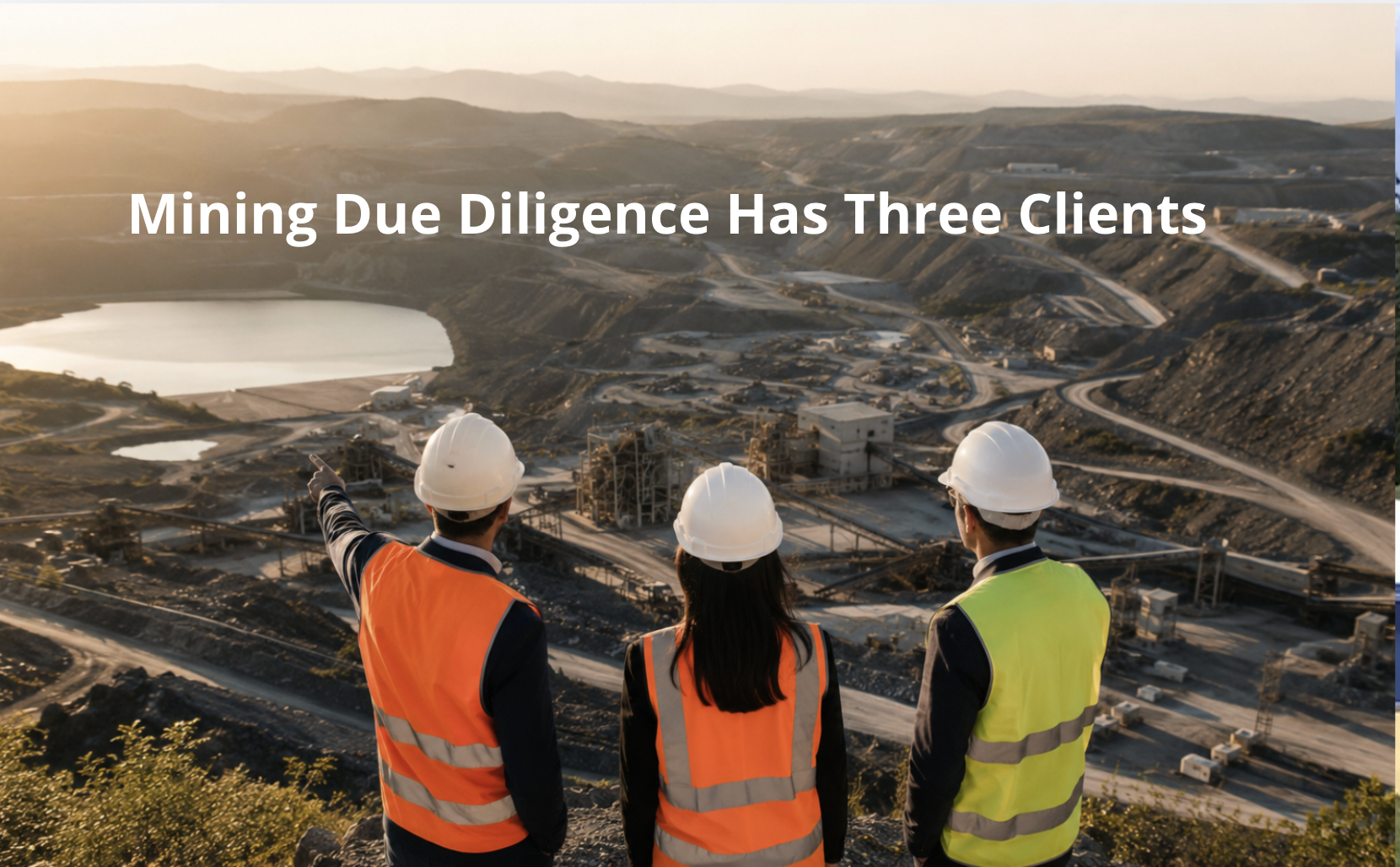
Mining Due Diligence Has Three Clients
The investor asks whether value is real. The operator asks whether the plan can work. The State asks whether the project can be governed.
By Marta Rivera & Eduardo Zamanillo
June 25, 2026
The strongest mining due diligence does more than confirm that a data room is complete. It determines whether the geological, technical, financial, legal, environmental, social and institutional representations of a project describe the same mine.
A mining data room may contain independently reviewed resource and reserve statements, a financial model that reconciles, a complete permit register, indexed contracts and a carefully prepared summary of environmental and social commitments. Each specialist workstream may be rigorous within its own field. Even so, the decision can remain exposed if those workstreams rely on different assumptions about schedule, infrastructure, water, metallurgy, operating capability, land access, regulatory timing or public authority.
The opportunity is therefore to organise due diligence not simply as a collection of professional reviews, but as an integrated test of the mine that must exist in reality. Technical, financial, legal, tax, environmental, social and integrity reviews remain indispensable. Their full value is realised when they are connected through a common set of assumptions and when the implications of uncertainty are carried consistently into valuation, execution planning, transaction structure and public decision-making.
The economic significance of those connections is measurable. A 2024 McKinsey analysis, based on 80 mining projects across regions, commodities and mining methods, found average real cost overruns of approximately 40% and schedule delays of around 25% over the preceding decade, after adjusting for inflation, foreign exchange movements and COVID-19 disruption. For projects with capital expenditure of US$1 billion or more, average cost overruns reached at least 79%, while schedule delays averaged 52%. The analysis further attributed approximately two thirds of cost and schedule deviations to weaknesses in initial assessments and the remaining third to execution, reinforcing the importance of testing the project logic before capital is committed (Mencarini et al., 2024).
The value of continuity is equally visible in the relationship between projects and communities. A 2014 study by Harvard Kennedy School and the University of Queensland combined 50 documented cases of sustained company community conflict with more than 45 confidential interviews, most of them conducted in 2010 and 2011. The report offered an illustrative estimate that a major mining project with capital expenditure of US$3-5 billion could lose roughly US$20 million for each week of delayed production in net present value terms, principally through foregone sales. That figure should not be read as an industry wide average, but it demonstrates the scale of value that can depend on maintaining the conditions for uninterrupted project delivery (Davis and Franks, 2014).
These studies examine different periods and different sources of risk. They do not suggest that every delay results from social conflict or that every cost increase can be avoided through better diligence. They support a broader principle: mining risk migrates. A permitting uncertainty can become a schedule issue; a schedule issue can become a capital requirement; a technical constraint can become an operating shortfall; a weakness in engagement can become lost production; and an inadequately secured closure obligation can become a public liability.
The public-private interface is also visible in the ICSID caseload. Of the 63 new cases registered under the ICSID Convention and Additional Facility Rules in calendar year 2025, 15 concerned mining, equivalent to 24% of the total. This statistic describes the ICSID caseload rather than the full universe of international disputes, and it does not establish that inadequate due diligence caused those cases. It does, however, illustrate how frequently mining value is situated at the intersection of private capital, public authority and commitments that extend over decades (ICSID, 2026).
For the full Geopolitical Mining framework behind this article, see our book Mining Is Dead. Long Live Geopolitical Mining.
Three clients, three accountable decisions
A serious mining due diligence should therefore serve three functional clients: the investor or wider capital provider, the operator and the State. The term client is used in a decision making rather than a strictly contractual sense. A buyer, lender, company, development institution or government may formally commission the work, but the evidence must ultimately support three distinct judgements. The capital provider must decide whether value is real and whether the expected return or credit profile compensates for the risk. The operator must decide whether the project can be built, commissioned and sustained under actual conditions. Public authorities must decide whether the project can be authorised and supervised, and whether its obligations can be enforced while protecting rights, revenues, the environment and the public balance sheet.
These are complementary forms of accountability, not interchangeable versions of the same question. In practice, transaction due diligence, operational readiness review and regulatory appraisal may be conducted under separate mandates, with different confidentiality obligations, legal duties, timetables and standards of proof. They should share a reconciled evidence base, but they do not need to be collapsed into a single report or a single institutional decision. Integration is achieved when each decision maker can see how the same assumption affects the others and when no material dependency disappears at the boundary between mandates.
Materiality also changes with the client. For a capital provider, a matter is material when it can alter value, financing, risk adjusted return or the ability to exit. For an operator, materiality is expressed through safety, production, reliability, continuity and the practical ability to execute. For public authorities, materiality includes the severity of impacts on people and the environment, the integrity of public revenues, compliance with law and the risk of inheriting long term obligations. A matter that is modest in relation to project NPV may still be critical to a community, a regulator or the long-term stability of the operation. Integrated diligence should make these different standards visible rather than averaging them into a single financial threshold.
The framework is not intended to reduce communities, Indigenous peoples, workers, local authorities or other affected groups to secondary variables. Communities and Indigenous peoples are rights holders whose knowledge, exposure, participation and legal entitlements must inform all three tests. Their role includes contributing evidence about territorial conditions and cumulative impacts, participating in consultation and, where applicable, consent processes, shaping mitigation and monitoring arrangements, and having access to credible grievance and remedy mechanisms. Meaningful engagement is therefore part of the project evidence, not merely a measure of social acceptance or a technique for avoiding delay. The OECD’s extractive-sector guidance reinforces this connection between stakeholder engagement, the prevention of adverse impacts and stronger project outcomes (OECD, 2017).
Due diligence is a conversion test
Due diligence is commonly described as verification. It verifies ownership, resources, reserves, costs, contracts, permits, obligations and representations. Its deeper function is conversion. It tests whether a geological model can be converted into mineable inventory, whether that inventory can support a practical mine plan, whether the mine plan can be delivered by a capable operating organisation, whether authorisations can become durable operating permissions, whether technical assumptions can become dependable cash flow, and whether closure commitments can become funded and enforceable obligations.
This distinction matters because a mine is not a collection of separate assets and approvals. It is a system of physical, financial, legal, organisational, territorial and institutional dependencies. The wider capacity of that system can be described as mining viability: the ability of a technically and economically feasible project to become sustained production under real conditions of capital, operating capability, legitimate and durable access to land, water and affected territories, infrastructure, institutional durability and public authority. Due diligence is one of the principal mechanisms through which that viability should be tested before capital, organisations and institutions become irreversibly committed.
The central question is therefore not whether every discipline has produced a report. It is whether the relationships among the disciplines are coherent enough to support the mine that the valuation, operating plan and public authorisation all assume.
The first client: the capital provider
The first client is broader than the equity investor. It includes the wider capital community: commercial banks, development finance institutions, export credit agencies, joint venture partners, bondholders and providers of streaming or royalty capital. Insurers apply a closely related risk lens. Their instruments and risk appetites differ, but they share a central concern: is the value proposition supported by evidence, and are the expected return, security and contractual protections appropriate to the risks being assumed?
The answer begins with geology, resource confidence, mineralogy, metallurgy, mining method, recoveries and production profile. It extends through infrastructure, capital expenditure, operating costs, construction schedule, ramp up, working capital, taxation, royalties, financing, market access, closure and residual liability. A lender may focus on completion risk, debt service capacity, security, covenant headroom and enforceable remedies, while an equity investor may place greater weight on NPV, optionality and portfolio fit. Streaming, royalty and offtake-linked finance may read the same evidence through production deliverability, reserve life, product quality, logistics, contractual priority and market access. The same project risk can therefore produce different capital consequences: a recovery uncertainty may reduce equity value, constrain leverage, delay drawdown, alter completion tests or affect the availability of offtake-linked support. In each case, the quality of the decision depends less on the number of assumptions in the model than on knowing which assumptions create value, what evidence supports them and how the economics change when they do not hold.
A base-case NPV is useful, but it is not the final product of investment due diligence. A stronger output distinguishes value that is supported by mature evidence from value that depends on execution, value that depends on external institutions and value that remains largely untested optionality. This produces a decision range rather than a single point estimate and allows the capital provider to see which elements of value can be relied upon, which require protection and which should be deferred until the evidence matures.
The same discipline applies to strategic fit. A technically attractive deposit is not automatically an appropriate acquisition or financing. Its scale, development stage, commodity exposure, capital intensity, jurisdiction, infrastructure burden, organisational demands and stakeholder context must fit the capabilities and portfolio objectives of the prospective owner or capital provider. An asset can be attractive in isolation and still be the wrong transaction for a particular company. Conversely, an apparently complex asset may create exceptional value for an owner with existing infrastructure, regional experience, operating systems or commercial relationships.
Capital provider diligence must also examine the integrity of the rights and counterparties behind the project. In most jurisdictions, a mining licence or concession is a public law right granted and governed by the State rather than an ordinary commercial asset. The history of its allocation, compliance status, ownership changes, contractual commitments, partners and beneficial owners can therefore be central to the durability and financeability of the investment.
This information should not remain in an isolated compliance appendix. A weakness in title, an undisclosed beneficial owner, an irregular allocation process or a misaligned partner can affect transaction structure, financing access, political durability, governance rights and ultimate asset value. Capital provider diligence has succeeded when the evidence changes the decision: the price, the financing terms, the conditions precedent, the risk allocation, the governance structure or, when necessary, the willingness to proceed.
The second client: the operator
The operator asks a different question: can the organisation actually build, control, sustain and eventually close what the investment case assumes?
A buyer may acquire shares, mineral rights, studies, permits, contracts and technical information. It does not automatically acquire a functioning operating system. Operating capability must be assembled by connecting the geological model to mine sequencing, mine sequencing to the processing plant, the plant to actual mineralogical variability, and the entire production system to water, power, tailings, geotechnical conditions, transport, maintenance, labour, contractors, consumables, spare parts, digital systems and management capability.
The most consequential risks often sit at the interfaces. A process plant may be technically appropriate but dependent on water quality that has not been demonstrated through seasonal data. A mine plan may deliver the modelled feed only if pre-stripping, fleet availability and grade control remain aligned. A transport route may be legally available but operationally exposed to extreme weather, community disruption or a single infrastructure provider. A tailings design may satisfy the selected technical criteria but still depend on governance, monitoring, emergency preparedness and long term institutional arrangements that are not yet mature. A commissioning plan may be credible but only if the owner’s team is recruited early enough to absorb knowledge from the EPCM contractor and assume control as contractors demobilise.
Operational due diligence should therefore read the project backwards from stable production. It should establish what must be true before construction begins, what must be ready before first ore, what systems and people must be in place for commissioning, which constraints are most likely to emerge during ramp up, which capabilities must remain after contractors leave and how the operation will continue through periods of weak prices, climate stress, infrastructure disruption or constrained liquidity. This approach converts the production profile from a modelling assumption into a sequence of physical and organisational conditions.
Technical diligence can validate a design. Operational diligence tests whether the organisation, people, systems, controls and dependencies required to deliver that design will exist when needed. This distinction is especially important in acquisitions because a project may be executable under the seller’s operating model but not under the buyer’s. The reverse can also be true: a buyer with regional infrastructure, experienced teams or established supply chains may be able to realise value that was unavailable to the previous owner. Operating capability is therefore not merely an implementation matter; it is part of asset value.
The emphasis also changes with the type and stage of the asset. For a development project, construction readiness, commissioning, ramp up and organisational build out may dominate the review. For an operating or brownfield acquisition, due diligence must compare actual performance with the resource model and operating plan, examine deferred maintenance, asset integrity, tailings and geotechnical history, environmental legacies, incidents, labour relations, permit compliance, contractor dependence and obligations that survive a change of control. A mature operation can carry historical liabilities and embedded practices that are less visible than the risks in a new design.
The operator’s output should therefore extend beyond a register of technical issues. It should include a credible operating model, an integrated schedule, an owner’s team plan, a commissioning and ramp up strategy, a capital contingency philosophy, a clear approach to operational resilience and assigned accountability for the interfaces most likely to underperform. The capital provider may ask whether a delay can be absorbed financially. The operator must determine how disruption will be prevented where possible, detected early, mitigated and recovered in practice.
The third client: the State and public authorities
The State asks the broadest institutional question: can public authorities authorise, supervise and enforce the project in a way that protects rights, revenues, the environment and long-term public interests, while ensuring that eventual closure is adequately funded and does not transfer hidden liabilities to the public balance sheet?
The State is not a single institution. Depending on the jurisdiction, the relevant decision system can include national ministries, provincial or regional governments, municipalities, mining, environmental and water regulators, tax administrations, courts, State owned enterprises and, where recognised, Indigenous governments or authorities. These institutions may have different mandates, information systems and time horizons. The State may also act simultaneously as regulator, shareholder, infrastructure provider, revenue recipient and promoter of investment. Good public-sector due diligence makes these roles explicit and manages the institutional tensions among them.
Public appraisal must consider the integrity of mineral rights and licensing procedures, beneficial ownership, fiscal terms, land and water access, environmental and social obligations, community and Indigenous rights, infrastructure commitments, emergency response, institutional monitoring capacity, financial assurance and the socioeconomic consequences of eventual closure. It must also ask whether the legal framework can be implemented in practice, not merely whether the applicant has submitted the required documents.
The World Bank’s Mining Sector Diagnostic offers a useful institutional analogy, although it is a country and sector level diagnostic rather than a project due diligence tool. It combines analysis of documented laws, rules and regulations with evidence from government, industry and civil society to identify the difference between formal frameworks and actual sector performance (World Bank, Mining Sector Diagnostic). The same distinction is essential at project level. A well designed law does not implement itself. Effective oversight requires technical personnel, reliable data, inter agency coordination, legal authority, continuity and the ability to respond when project conditions change.
Closure makes the State’s distinct exposure particularly clear. The World Bank’s Mine Closure: A Toolbox for Governments recommends that closure planning begin during project development and be supported by cost estimates, financial assurance, periodic updates, stakeholder participation, socioeconomic transition planning and sufficient institutional capacity to review and enforce the obligations. The guidance also recognises that mines often evolve significantly from the design originally permitted, which makes regular reassessment essential (World Bank, 2021).
For the purpose of regulatory closure financial assurance, the World Bank guidance recommends calculating closure and near term post closure obligations at current cost rather than net present value. The reason is practical: financial assurance is intended to protect the government if closure occurs earlier than planned, the operation is abandoned or the owner becomes insolvent. An investor may legitimately recognise or model a discounted future closure liability for financial purposes, while the State may require security based on the amount it would need to execute the obligation under current conditions. The calculations are not contradictory; they answer different exposures. The same guidance identifies 100% financial assurance for closure obligations as international good practice prior to closure and notes that it is often required before a mining permit is issued, while recognising that implementation varies across jurisdictions.
Strong public sector diligence should not be understood as anti-investment. Capable institutions can improve the quality of investment by clarifying requirements, coordinating agencies, applying rules consistently, identifying constraints early and ensuring that obligations remain credible throughout the mine life. Predictability is not created by the absence of regulation. It is created by regulation that is coherent, implementable and supported by institutions able to exercise public authority with continuity.
One project, three risk languages
The difference among the three clients becomes clearer when they examine the same issue. Consider water. For the capital provider, water affects value and exposure: the infrastructure required, the capital and operating costs, the probability of delay, the risk of constrained throughput and the potential effect on mine life. For the operator, water is a physical system that must balance seasonal availability, process quality requirements, storage, transport, recycling, treatment and contingency supply. For public authorities and rights holders, water is also a matter of allocation, ecosystems, competing uses, cumulative impact, public health, territorial development and the obligations that remain after production ends.
Each perspective is legitimate and none is sufficient on its own. A financial model may include the cost of a pipeline without reflecting the institutional probability of obtaining the necessary rights. A technical study may demonstrate an engineering solution without resolving competing claims or cumulative regional demand. A permit may contain conditions without showing that the regulator has the information and capacity to monitor them. Climate variability can intensify every part of this chain, making historical averages less reliable and strengthening the need for scenarios, operating contingencies and adaptive public oversight.
Tailings provide a second example. For the capital provider, tailings integrity can affect capital, insurance, contingent liability, financing access and the value of the entire enterprise. For the operator, it requires sound design, construction quality, governance, surveillance, competent personnel, emergency preparedness and disciplined management of change. For public authorities and affected communities, it concerns safety, environmental protection, transparency, emergency response, long term stewardship and confidence that responsibility will remain clear throughout operation and closure. The same facility therefore carries three risk languages that must be reconciled before the project can be considered viable.
Risk migration begins when one of these perspectives is absent. Water uncertainty becomes redesign; redesign becomes additional capital; additional capital creates schedule and financing pressure; financing pressure weakens operational resilience; and weakened resilience can increase both social and public exposure. Once risk begins to migrate, no single discipline owns it. This is why due diligence cannot be integrated merely by placing separate reports in the same virtual folder.
From parallel review to reconciled project logic
Many due diligence processes are multidisciplinary but remain parallel. An engineering team may assume that a transmission line will be available before commissioning. The legal team may correctly record that the relevant agreement remains conditional. The financial model may nevertheless retain the original production date, while the land and community review identifies unresolved access and the transaction documents allocate none of the resulting delay risk. No individual report necessarily contains a technical error, yet the collective decision is still weaker than the sum of the work performed.
Integrated diligence requires a common assumption base. For every material assumption, the process should record the evidence that supports it, the level of confidence attached to that evidence, the dependencies that rely on it, the financial, operating and public consequence if it changes, the party best placed to manage the risk and the decision or trigger required before the next commitment is made. This common assumption register is not an administrative appendix. It is the point at which specialist analysis becomes decision architecture.
Consider the transmission line example. A reconciled process would not merely note that the agreement is conditional. It would determine whether construction notice to proceed, financing drawdown, commissioning or production guidance should depend on a specified milestone; who is responsible for monitoring it; what temporary power solution is technically and financially viable; how delay risk is allocated; and what public approvals or land arrangements remain outstanding. The output is not simply a consolidated report. It is a project logic in which evidence, dependencies and decisions are aligned.
From red flags to decision responses
The value of due diligence should be measured by the decisions it improves rather than by the number of risks it records. Material findings should lead to one of five broad responses, translated appropriately for each client.
The first response is to decline or withhold commitment. A capital provider may withdraw when title is unreliable, metallurgy remains fundamentally unproven, integrity concerns are unacceptable or a critical land, water or rights constraint has no credible pathway. An operator may reject an execution case that it cannot safely or reliably deliver. A public authority may withhold or deny authorisation when legal requirements, rights protections or environmental conditions cannot be met. The discipline to stop is not a failure of business development or public policy; it protects capital, institutions and communities from a commitment that the evidence cannot support.
The second response is to reprice, rebudget or recalibrate. Additional capital, higher operating costs, a slower ramp up, revised tax assumptions, infrastructure upgrades, stronger tailings controls or increased closure obligations may reduce value without eliminating viability. The investor can adjust price and return expectations, the operator can revise the budget and design basis, and the State can recalculate fiscal expectations, financial assurance or the resources required for oversight. Quantifiable uncertainty belongs in the economics and implementation plan, not only in the narrative risk section.
The third response is to restructure. Transaction terms can use contingent consideration, earn ins, escrow, indemnities, guarantees, conditions precedent, staged ownership or carefully designed joint venture rights to align control with risk. The operator may change the contracting strategy, execution model, organisation or technical design. Public authorities may impose conditions, clarify institutional responsibilities or require specific monitoring and assurance mechanisms. Structure cannot transform a fundamentally weak project, but it can ensure that responsibility sits with the party able to manage it.
The fourth response is to sequence. Additional drilling, metallurgical testwork, pilot operations, geotechnical investigation, seasonal water studies, infrastructure agreements, engagement processes or permit milestones can reduce uncertainty before the next irreversible commitment. Capital providers can stage ownership or funding, operators can phase engineering and construction, and public authorities can sequence authorisations as evidence and institutional capacity mature. Sequencing is disciplined decision-making because it matches the scale of commitment to the maturity of the evidence.
The fifth response is to govern. Some risks cannot be eliminated, fully priced or permanently transferred because geology, stakeholder expectations, operating performance, regulation, climate exposure and closure conditions evolve over time. These risks require board and joint venture rights, independent technical review, reporting covenants, transparent monitoring, grievance and remedy systems, updated financial assurance, public sector coordination and clearly defined escalation procedures. Public or development-finance support can be appropriate where a constraint has genuine public good characteristics, such as shared infrastructure, geoscience data, institutional capacity or regional workforce development. It should strengthen the system around a viable project rather than conceal weak fundamentals or transfer private downside to the public balance sheet.
Due diligence does not end at closing
Transactional due diligence is concentrated before an acquisition, financing or investment decision, but mining risk does not follow the transaction calendar. The orebody becomes better understood, engineering changes, permits acquire new conditions, governments and institutions evolve, infrastructure is delayed, community expectations develop, operating performance diverges from study assumptions and closure liabilities change with the physical footprint.
Although the OECD’s Due Diligence Guidance for Responsible Business Conduct was developed for responsible business conduct rather than mining transactions alone, it provides a valuable process principle: due diligence should be risk based, ongoing, iterative and responsive, with feedback loops rather than a static or purely sequential checklist (OECD, 2018). Applied to mining, this means that the assumptions established during transaction diligence should become part of post-transaction governance.
If the investment case depended on a specific recovery, ramp up period, permit date, water solution, infrastructure commitment, stakeholder agreement or closure cost, that assumption should have an accountable owner, a monitoring method, a defined threshold and a predetermined response when reality diverges. The handover from the due diligence team to the operating organisation and governance bodies is therefore as important as the final report. Continuity preserves the knowledge created during diligence and makes it available precisely when the underlying risks begin to change.
Conclusion: one reconciled project logic
Mining due diligence has traditionally been organised around technical, financial, legal, environmental and social disciplines. Those disciplines remain essential. The opportunity is to connect them around the interfaces at which value is either secured or lost. A technically credible mine can underperform if its schedule is unrealistic. An economically attractive project can exceed the capabilities of a particular owner. A formally permitted mine can remain institutionally fragile. A profitable operation can still create an unfunded public liability if closure obligations are not kept current and secured.
The investor or capital provider, the operator and the State therefore require different answers from the same evidence. The capital provider must know whether value is real and whether the risk is appropriately compensated and protected. The operator must know whether the mine can be built, commissioned and sustained under real operating conditions. Public authorities must know whether the project can be authorised and monitored, whether its obligations can be enforced and whether eventual closure can be secured while protecting rights, institutional credibility and the public balance sheet.
The three tests may not produce the same decision at the same time. An investor may proceed only at a lower price or with staged capital. An operator may require redesign, additional capability or a different execution model. Public authorities may authorise the project only after stronger conditions, coordination arrangements or financial security are established. This divergence is not a weakness in the process. It is evidence that each institution is exercising its own accountability while working from a common understanding of the project.
At its highest level, mining business development is not simply the identification of deposits or the negotiation of access to them. It is the disciplined assessment of whether an opportunity fits the strategy, whether its risks can be understood and allocated, whether the operating organisation can assume responsibility and whether public authority can be exercised and rights protected over the full mine life. Due diligence has completed its work when each client can make an accountable decision from a shared and reconciled project logic.