Geopolitical Mining · Weekly
Geopolitical Mining Weekly
Week of June 29–July 5, 2026
Authors: Marta Rivera & Eduardo Zamanillo
July 6, 2026
What this week really tells us
What stood out this week is that mineral security is moving from strategic recognition into the harder work of making supply usable.
The signals were not only about new funding, new agreements or new project milestones. They were about the practical conditions that determine whether mineral supply can actually be built: feedstocks, infrastructure, geological capability, processing, market qualification, environmental review and the ability to bring existing assets back into credible operation.
In the United States, the Department of Energy awarded US$75 million to projects designed to recover rare earths and other critical materials from coal and coal-based feedstocks. The signal is important because it widens the resource conversation. Mineral security is no longer only about new mines. It is also about waste streams, industrial residues, legacy materials and unconventional feedstocks that may become part of the supply base if technology, economics and permitting align.
Canada and British Columbia moved in a different but connected direction. Their cooperative agreement links Red Chris, transmission infrastructure, port corridors, First Nations partnerships and critical minerals into one strategic package. That matters because copper supply is not only a mine question. It is also a power, infrastructure and corridor question.
India and Japan showed that mineral security begins before extraction, through geological cooperation and exploration systems. South Korea’s Sangdong tungsten project showed the importance of moving from development into processing. India’s Adani Copper received LME approval for delivery against the exchange’s Grade A copper contract, reminding us that market recognition is also part of supply security. Chile, meanwhile, showed the challenge of reactivating copper capacity when BHP moved Cerro Colorado back into the environmental evaluation process.
The week’s message is direct: mineral security is not built by naming minerals as strategic. It is built by the ability to turn resources into usable supply. That means recovering value from unconventional feedstocks, connecting mines to power and ports, building geological knowledge before projects exist, proving that processing plants can operate, producing metal that trusted markets will accept, and bringing suspended assets back only when water, permits and environmental credibility can support them. The deeper signal is that countries are no longer only asking where the minerals are. They are asking whether the system around those minerals is strong enough to produce them.
For the full Geopolitical Mining framework behind this note, read our book Mining Is Dead. Long Live Geopolitical Mining.
Signals of the week
Signal 1: The United States is turning coal waste into critical minerals feedstock
What happened
On July 1, the U.S. Department of Energy’s Office of Critical Minerals and Energy Innovation announced US$75 million for five projects to accelerate the recovery of critical minerals and materials from coal and coal based feedstocks. The projects were selected under DOE’s Mines & Metals Capacity Expansion initiative. They are expected to use domestic coal and coal-based materials to produce rare earth elements and other critical materials, including germanium, gallium and aluminum.
The selected projects involve the University of North Dakota, Valor Metals, CONSOL Innovations, American Resources Corporation and Peabody Energy. DOE said the facilities are intended to produce market-ready critical materials from domestic industrial sources. The Department also made clear that the selections are for award negotiations and do not guarantee final funding. The projects still need to move through negotiation, technical and execution requirements before becoming operating capacity.
Why it matters
This matters because the United States is expanding the definition of critical mineral supply. The resource base is no longer only a deposit in the ground. It can also be a coal waste stream, an industrial byproduct, a legacy material, a tailings pile or an existing facility that can be converted into a source of critical materials. That is important for rare earths and other strategic inputs because the bottleneck is not only mining. It is recovery, separation, processing and the ability to produce material that can actually enter industrial supply chains.
The coal signal also has a regional and political dimension. It connects critical minerals to existing industrial communities, legacy energy regions and domestic processing infrastructure. That could make mineral security more practical if the technology, economics and permitting work. But the qualification is important. These are not yet commercial supply chains. They are selected projects entering award negotiations. The strategic value will depend on whether the facilities can move from pilot and demonstration stages into reliable production.
Implications for capital and strategy
For capital, the signal is that unconventional feedstock projects may become more relevant if they can show technical credibility, recovery efficiency, processing capacity and a clear path to market-ready materials. For strategy, the deeper message is that mineral security requires looking beyond the mine. Countries that understand waste streams, industrial residues and byproduct recovery may find supply options that are invisible in a traditional mining map.
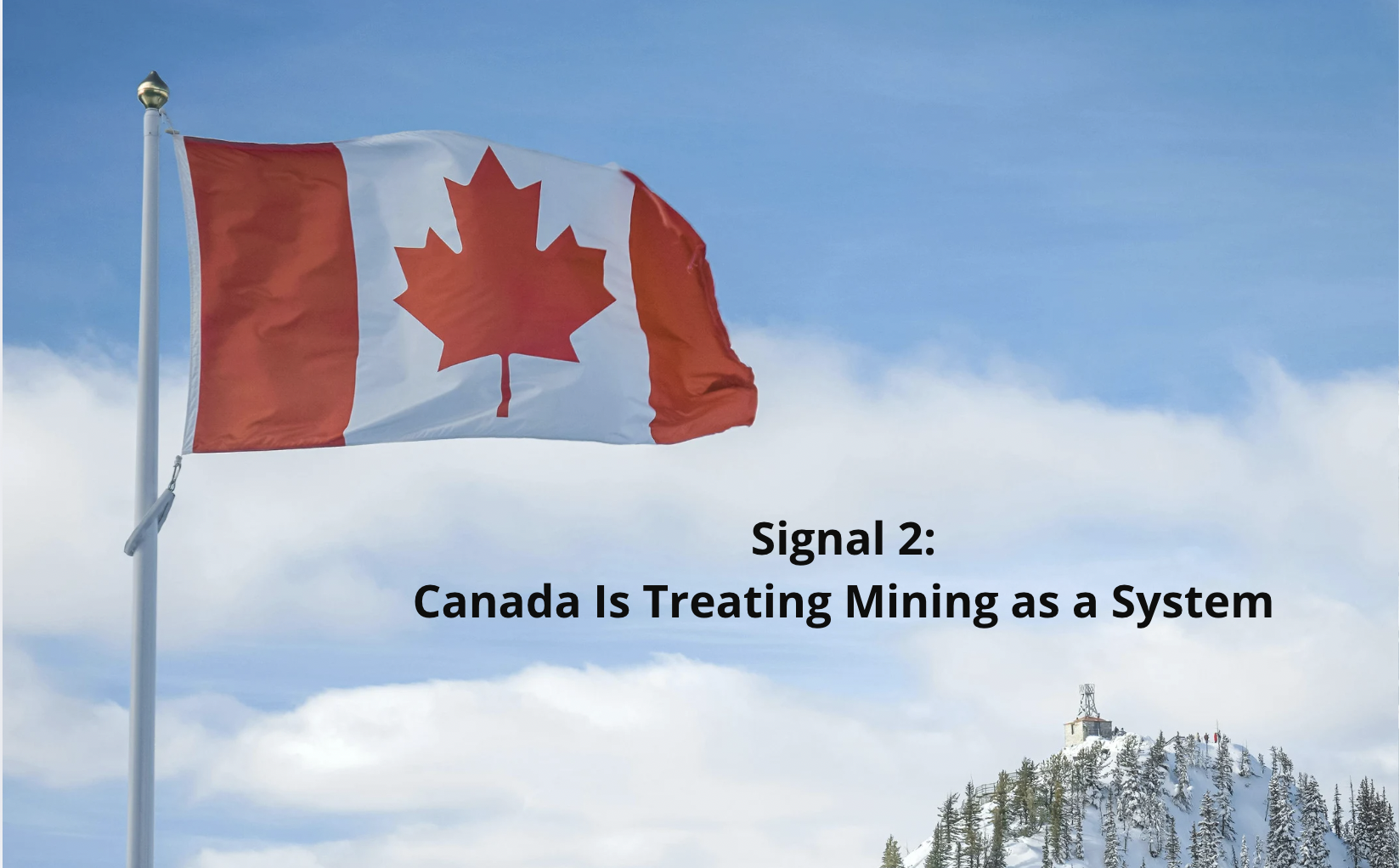
Signal 2: Canada and British Columbia are linking copper supply to corridors, power and ports
What happened
On July 2, Canada and British Columbia signed the Canada–British Columbia Cooperative Prosperity Agreement. The agreement identifies a package of projects and infrastructure priorities connected to critical minerals, clean power, trade corridors, ports and First Nations partnerships. One of the central mining related elements is the Red Chris Mine Expansion. Canada said it will invest C$500 million in the project, which is expected to increase Canada’s annual copper production by more than 15% and reduce greenhouse gas emissions by more than 70% once operating.
The agreement also includes up to C$3.9 billion for phases of the North Coast Transmission Line and related clean energy infrastructure, including potential grid connections involving Yukon, British Columbia and Alberta. Port infrastructure is also part of the package, including the Port of Vancouver–Roberts Bank trade corridor and the ports of Prince Rupert and Stewart. The agreement frames these corridors as important for Canadian trade, energy and critical minerals supply chains. The federal and provincial governments also emphasized that the projects are being advanced in consultation and partnership with First Nations, including opportunities for co-ownership and economic benefits.
Why it matters
This matters because copper supply is not built by the mine alone. A copper project needs electricity, roads, ports, transmission lines, permits, Indigenous partnerships, capital and market access. If those pieces are missing, the deposit does not become strategic supply. The Canada–British Columbia agreement is important because it treats critical minerals as part of a wider infrastructure system. Red Chris is not isolated from power corridors or ports. It sits inside a regional development and export architecture.
That is especially relevant for copper. Demand is driven by electrification, grid expansion, clean energy, defence, construction and manufacturing. But new copper supply is difficult to build, and brownfield or expansion projects still need infrastructure around them. The agreement also shows how Indigenous participation is becoming part of project structure, not just consultation. If co-ownership and economic participation become real, they can strengthen the durability of the project system.
Implications for capital and strategy
For capital, the signal is that copper projects tied to public infrastructure, power corridors, port access and Indigenous partnerships may be evaluated differently from standalone mine developments. For strategy, the deeper message is that mineral security is also corridor security. Countries that want strategic supply need to build the infrastructure that allows minerals to move from mine to market.
Signal 3: India and Japan are moving critical minerals cooperation upstream into geological capability
What happened
During the India–Japan Annual Summit held from July 1 to 3, critical minerals appeared as part of the wider economic security and industrial cooperation agenda. On June 30, shortly before the summit, Japan’s JOGMEC and the Geological Survey of India signed a Memorandum of Cooperation to promote cooperation in mineral resource exploration, including critical minerals. JOGMEC announced the agreement on July 3 in connection with the summit. India and Japan also released documents around the summit that placed critical minerals within economic security cooperation, alongside battery manufacturing, supply chains and industrial resilience.
Why it matters
This matters because mineral security does not begin at the offtake agreement. It begins much earlier, with geological knowledge, exploration systems, data quality and the institutional capacity to identify viable deposits. The India–Japan signal is not only about access to minerals. It is about building the upstream intelligence required to support future supply chains.
Japan brings long standing experience in resource diplomacy, industrial supply chains and downstream demand. India brings geological scale, industrial ambition and a growing need for secure inputs across batteries, electronics, defence, renewable energy and advanced manufacturing. The cooperation is therefore relevant because it connects exploration capability to industrial strategy. A country cannot build secure mineral supply chains if it does not know what it has, where it is, how it can be developed and what technical challenges are involved.
Implications for capital and strategy
For capital, the signal is that exploration data, geological cooperation and early-stage technical credibility can become strategic assets, especially when they are connected to downstream industrial partners. For strategy, the deeper message is that critical minerals diplomacy is moving upstream. Countries are not only seeking offtake. They are trying to shape the knowledge base from which future projects will emerge.
Signal 4: South Korea’s Sangdong tungsten project shows why processing milestones matter
What happened
On July 1, Almonty Industries announced that it had commenced processing plant throughput operations at the Sangdong tungsten mine in Gangwon Province, South Korea. The company said that during June 2026 it began feeding stockpiled run of mine ore through the newly commissioned processing plant to produce saleable tungsten concentrate. Almonty described the milestone as the transition of Sangdong from mine development into active revenue generating operations.
Why it matters
This matters because strategic mineral supply is not proven when a project is announced. It is proven when material starts moving through the plant. Tungsten is important for defence, industrial tooling, electronics and high performance applications. But the strategic value of a tungsten project depends on more than the presence of ore. It depends on mining, processing, concentrate quality, customer acceptance, operating reliability and the ability to deliver at scale. Sangdong is a useful signal because it shows the operational step that every strategic mineral project must eventually face: the move from development into processing. A mineral project becomes more credible when it can demonstrate that the processing system works.
Implications for capital and strategy
For capital, the signal is that processing milestones can materially change how a strategic mineral project is valued. Execution reduces a different kind of risk than resource size. For strategy, the deeper message is that supply security depends on operating capacity. Announcements matter less than the ability to produce qualified material that industrial customers can use.
Signal 5: Adani Copper’s LME approval shows that market qualification is part of mineral security
What happened
On July 3, the London Metal Exchange approved the listing of the Adani Copper Grade A brand for delivery against the LME Copper Grade A contract. The approval applies with immediate effect, and LME warrants for the brand can be issued from July 10, 2026. The producer is Kutch Copper Limited, with the plant located in Mundra, Gujarat, India. The LME notice lists the plant’s annual capacity at 500,000 tonnes.
Why it matters
This matters because supply security is not only about producing metal. It is also about producing metal that trusted markets recognize. LME approval is a market qualification signal. It tells buyers, traders, financiers and industrial users that a product meets exchange standards and can be delivered into one of the world’s central metals market systems. For India, the signal is important because it reflects the country’s growing role in refined copper capacity and industrial supply chains. It is not only about domestic demand. It is also about whether Indian metal can participate in global pricing, inventory and delivery systems. This is a different layer of mineral security. It is not the mine, not the smelter and not the policy framework. It is the market interface where metal becomes tradable, financeable and globally visible.
Implications for capital and strategy
For capital, LME deliverability can support liquidity, customer confidence, financing options and market access. It can make refined output easier to price, hedge and integrate into global supply chains. For strategy, the deeper message is that market infrastructure matters. Mineral security depends not only on producing minerals, but on producing materials that can enter trusted commercial systems.
Signal 6: Cerro Colorado shows that copper reactivation depends on water, permits and environmental credibility
What happened
During the week, BHP submitted a project to Chile’s environmental evaluation system to support the restart and operational extension of the Cerro Colorado copper mine. Mining.com and industry reports said the proposed investment is around US$1.5 billion and would seek to extend operations for approximately 20 years. The project includes improvements and expansions to mining facilities and the implementation of a new water supply system. Cerro Colorado has been under temporary closure conditions, and the proposed restart now needs to move through Chile’s environmental evaluation process before any return to long-term operation.
Why it matters
This matters because copper supply does not only come from new discoveries. It can also come from reactivating existing assets. But reactivation is not simple. A suspended or closed mine does not return to production just because copper demand is strong or because the world needs more supply. It needs permits, water solutions, environmental credibility, community acceptance, capital and a viable operating plan. Cerro Colorado is especially useful as a signal because it shows the centrality of water in Chilean copper. In arid mining regions, the water system can determine whether a project is viable.
It also shows why copper security is a delivery question. Governments and companies may want more copper, but each asset must still pass through environmental and institutional gates.
Implications for capital and strategy
For capital, the signal is that restart projects should not be valued only as existing infrastructure. Investors need to assess permitting risk, water risk, environmental obligations, social licence and the cost of bringing the asset back into credible operation. For strategy, the deeper message is that copper security depends on reactivation capability as much as exploration. Countries with existing assets may have an advantage, but only if they can resolve the environmental and infrastructure conditions around them.
Signals to watch
- Whether the DOE coal based feedstock projects move from award negotiations into final awards and operating pilot capacity.
- Whether Canada’s C$500 million support for Red Chris helps move the project closer to final investment decision and whether the North Coast Transmission Line advances on a timeline that supports critical minerals development.
- Whether the India–Japan JOGMEC Geological Survey of India cooperation leads to specific exploration programs, data sharing mechanisms or project level critical minerals work.
- Whether Sangdong’s processing ramp up produces consistent saleable tungsten concentrate and moves into stable commercial operation.
- Whether Adani Copper’s LME approval leads to warrants being issued after July 10 and strengthens India’s position in refined copper markets.
- Whether BHP’s Cerro Colorado submission advances through Chile’s environmental evaluation system and whether the proposed water supply system becomes the central issue in the review.
- Whether the European Commission’s Raw Materials Mechanism moves smoothly into the supplier submission phase beginning July 13, after its first diversification round completed offtaker aggregation during this period.
- Whether the rebound in U.S. uranium production continues after the Energy Information Administration reported a major increase in 2025 production and more than one million pounds of U3O8 produced in the first quarter of 2026.
- Whether Canada’s expected July 7 critical minerals announcement in Trail, British Columbia, adds another project level signal to the federal critical minerals agenda.
Three strategic questions for this week
- What counts as real mineral supply: a deposit, a processing facility, a qualified product, or a market-deliverable material?
- Where is the most important conversion point now: feedstock recovery, infrastructure, permitting, processing, water, market qualification or project finance?
- How should investors value projects when strategic importance depends on whether the material can actually become usable, tradable and politically durable supply?
Resources
Signal 1
Signal 2
Signal 3
- JOGMEC — Signing of Memorandum of Cooperation with Geological Survey of India
- Ministry of External Affairs, Government of India — Fact Sheet 2.0: India-Japan Economic Security Cooperation
- Ministry of External Affairs, Government of India — India-Japan Joint Declaration on Economic Security Cooperation
Signal 4
Signal 5
Signal 6
- Mining.com — BHP seeks to restart Cerro Colorado with US$1.5 billion investment
- International Mining — BHP submits Cerro Colorado operational extension project to Chile’s environmental evaluation system
Signals to watch