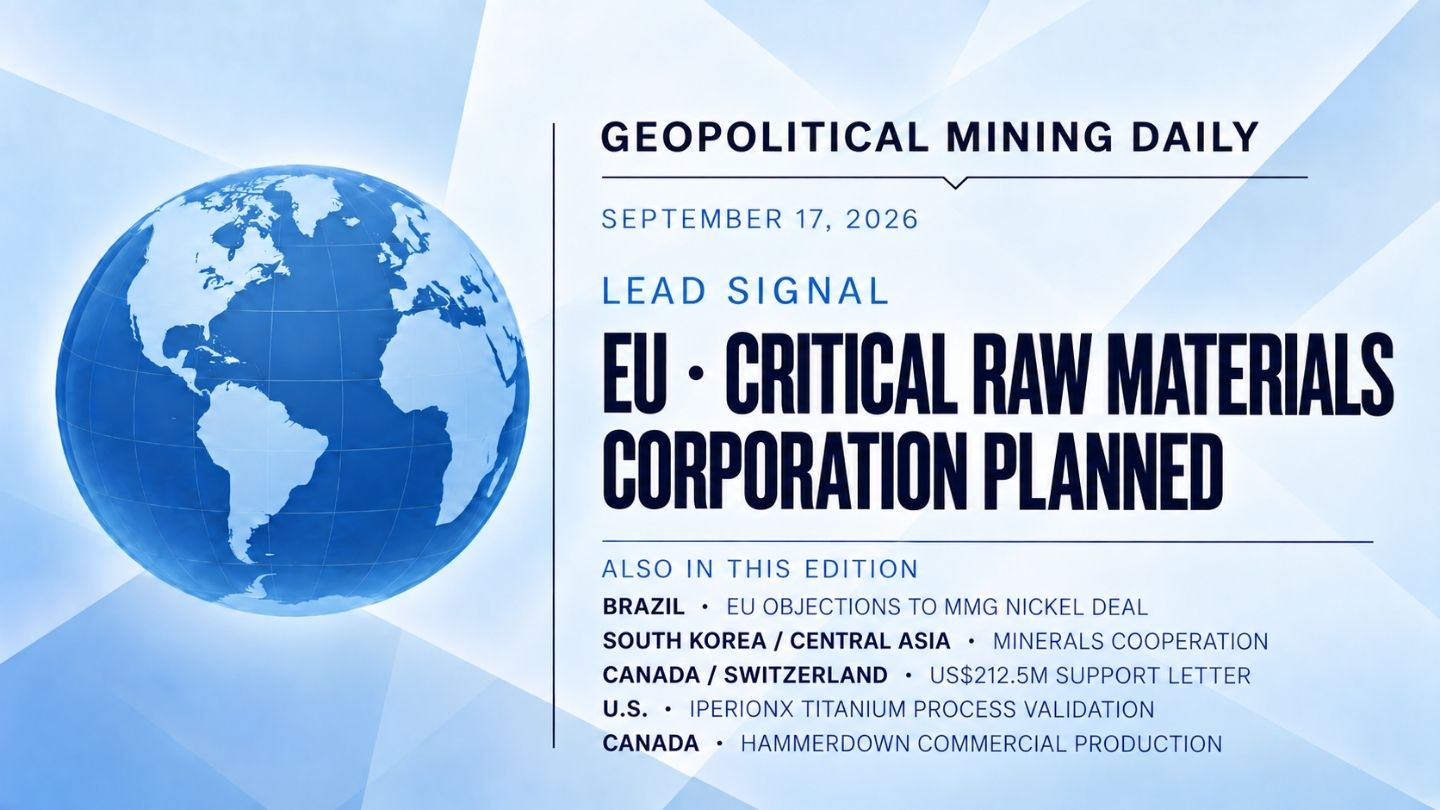
Geopolitical Mining Daily · September 17, 2026
EU Plans Critical Raw Materials Corporation to Secure Supply
Europe’s proposed raw materials corporation puts procurement and reserves at the centre of industrial security. The wider edition follows control over Brazilian nickel assets, Korean and Central Asian cooperation, a potential phosphate financing route, titanium process validation and a declared gold production milestone. The common question is how access becomes dependable supply.
The EU announced plans for a raw materials corporation, while its competition authority issued objections to MMG’s proposed nickel acquisition. The Seoul summit advanced mineral cooperation between South Korea and Central Asia. First Phosphate received a preliminary Swiss export credit support letter. IperionX reported titanium process validation, and New Found Gold declared commercial production at Hammerdown, effective August 19. Together, these announcements span access, ownership, partnerships, finance, processing and operating delivery.
The 2026 observation framework
The ten Signals for 2026
Every Daily edition is read against the same ten strategic lenses. Signals activated by today’s verified developments are highlighted below.
Today’s direction of travel
Mineral security is being built through institutions and commercial arrangements as well as mines. The strategic test is not whether another initiative has been announced, but whether it creates a credible route from demand and capital to material that industry can actually use.
Lead development
EU plans a corporation to procure and stockpile critical raw materials
What happened
In her September 16 State of the Union address, European Commission President Ursula von der Leyen announced plans for a European Corporation on Critical Raw Materials. Its stated purpose is to help obtain and stockpile materials for industrial and security needs.
The speech establishes a political commitment, not evidence of an operating corporation. Its raw materials passage does not specify the legal structure, capitalisation or procurement timetable.
Signal reading
Our reading is that Europe is putting institutional purchasing capacity closer to the centre of mineral strategy. A credible buyer can do more than accumulate inventory: it can give suppliers a clearer view of future demand. That opportunity depends on design. Spot purchases, longer term supply contracts and support for new capacity would have different effects on availability, prices and project finance.
Next proof point: a formal mandate, funding, governance, eligible materials, purchasing rules and the first enforceable supply arrangements.
Direct European Commission source
European Commission: State of the Union address, September 16, 2026.Regulatory and control development
EU issues objections to MMG acquisition of Anglo American’s Brazilian nickel business
What happened
The European Commission’s September 16 competition notice records a Statement of Objections concerning MMG’s proposed acquisition of Anglo American’s nickel business. This is an objection stage, not a final prohibition or clearance.
For transaction context, Anglo American’s original February 18, 2025 announcement identified the Brazilian Barro Alto and Codemin ferronickel operations and two development projects, Jacaré and Morro Sem Boné. The agreed consideration was up to US$500 million, including contingent payments. That earlier contract is background; the new event is the Commission’s formal intervention.
Signal reading
The analytical distinction is between the location of a resource and control over its commercial destination. A mine need not move for its strategic significance to change. For suppliers, industrial customers and investors, the relevant questions are who controls production, how sales commitments are structured and whether a proposed ownership change can satisfy the applicable regulatory tests.
Next proof point: the parties’ response, any proposed remedies and the Commission’s final decision before a completed transfer can be assessed.
Direct regulatory notice
European Commission: Statement of Objections, September 16, 2026.Official dated listing
Directorate General for Competition: September 16 announcement listing.Transaction background, not today’s event
Anglo American: original transaction scope and consideration, February 18, 2025.Diplomacy and industrial development
South Korea and Central Asia advance a mineral processing agenda at the Seoul summit
What happened
The first Central Asia and Republic of Korea leaders’ summit took place in Seoul on September 16 and adopted the Seoul Declaration. Uzbekistan’s official account records President Shavkat Mirziyoyev’s proposal for a Regional Investment Alliance for Critical Minerals, with processing clusters extending from exploration to higher value products.
Kazakhstan separately reported an agreement during the visit to establish a joint rare and rare earth metals centre in Almaty with the Korea Institute of Industrial Technology. President Kassym Jomart Tokayev also proposed a joint Kazakh and Korean company. The centre agreement, regional alliance proposal and proposed company are distinct instruments, not a single completed investment package.
Signal reading
The opportunity is to connect a resource partnership with the industrial capabilities needed to make its output useful. For Central Asian hosts, the quality of cooperation will be visible in the activities retained locally. For Korean participants, access will depend on workable projects and commercial terms, not the breadth of a summit declaration alone.
Next proof point: the centre’s implementation arrangements, named investment partners, project selection, processing scope, financing and binding commercial agreements.
Direct government sources
President of Uzbekistan: summit outcomes and proposed minerals alliance, September 16, 2026.Direct government sources
President of Kazakhstan: metals centre agreement and proposed joint company, September 16, 2026.Project finance development
First Phosphate receives SERV support letter for a potential US$212.5 million financing
What happened
First Phosphate announced a September 16 support letter from Swiss Export Risk Insurance, or SERV, for its Quebec mine and processing development. SERV would consider supporting approximately US$212.5 million of buyer credit financing, based on an assumed US$250 million eligible Swiss export contract.
The contemplated financing represents 85% of that contract value. The letter indicates willingness to consider insurance or guarantees; it is not a loan disbursement or definitive insurance commitment. Procurement eligibility and further assessment therefore remain material to the financing route.
Signal reading
This illustrates how equipment sourcing can influence the structure of mine finance. A procurement package may open access to export credit risk cover, but the benefit has to be tested against the complete project funding requirement. A supported equipment tranche does not by itself settle equity, remaining debt, working capital or construction risk.
Next proof point: an eligible procurement package, definitive risk cover, participating lenders, loan terms and an integrated funding plan with clear drawdown conditions.
Direct company source
First Phosphate: SERV support letter and indicative financing basis, September 16, 2026.Technology and processing development
IperionX validates continuous titanium processing through four GenX campaigns
What happened
IperionX reported on September 16 that its Virginia GenX system processed more than 500 kilograms of titanium powder across four separate continuous runs totalling 41 hours. It reported power consumption more than 75% below its batch HAMR reference, not an industry wide benchmark.
The announced product validation concerns oxygen limits, not complete customer qualification. The company’s next phase includes integration into a full powder production line and engineering evaluation for an industrial GenX line.
Signal reading
The strategic opportunity lies in making a production route economically repeatable, not merely technically possible. Lower measured input use can support that case, but equipment availability, total conversion cost and product acceptance must also hold at sustained scale. The results are useful engineering evidence; a cost competitive industrial supply platform requires the rest of that operating system.
Next proof point: longer campaigns, full line integration, customer qualification and an industrial design supported by complete cost and reliability data.
Primary company distribution
IperionX: GenX validation results and next engineering stage, September 16, 2026.Operating development
New Found Gold declares commercial production at Hammerdown in Canada
What happened
New Found Gold’s September 16 announcement declared commercial production at Hammerdown in Newfoundland, effective August 19, 2026. The declaration followed a 60 day performance test, with average throughput of approximately 748 tonnes a day, gold recovery of 87.7% and feed grade of 2.92 grams per tonne.
The publication date and operating milestone are different: the new evidence in this edition is the company’s declaration. Commercial production is also not a guarantee of future margins or the completion of every planned improvement.
Signal reading
This is the operating counterpart to the institutional and financing announcements elsewhere in the edition. A defined period of demonstrated performance is more informative than a first processing event. The next question is durability: whether grade reconciliation, recovery, availability and spending combine to generate repeatable cash flow rather than a short period of successful ramp up.
Next proof point: quarterly operating and financial results, cost reconciliation, sustained recovery and throughput, and the performance of planned plant improvements.
Direct company source
New Found Gold: Hammerdown commercial production declaration, September 16, 2026.The system reading
What today’s evidence tells us
Read together, today’s developments suggest that material security has three distinct tests: access, conversion and continuity. Access concerns who can purchase or control supply and under what conditions. Conversion concerns whether a project can secure finance and turn a technical process into accepted product. Continuity concerns whether operations can sustain delivery at an economic cost. A policy initiative may improve the first test without satisfying the other two. Equally, a successful operating milestone does not resolve the whole supply chain. The useful strategic question is where each development removes a specific constraint, what it leaves unresolved and which subsequent evidence would demonstrate that the improvement is durable.
Signals for 2026 gives the map. The Daily records new evidence against that map. This edition follows the institutional, regulatory, commercial and operating conditions through which mineral access can become dependable industrial supply.