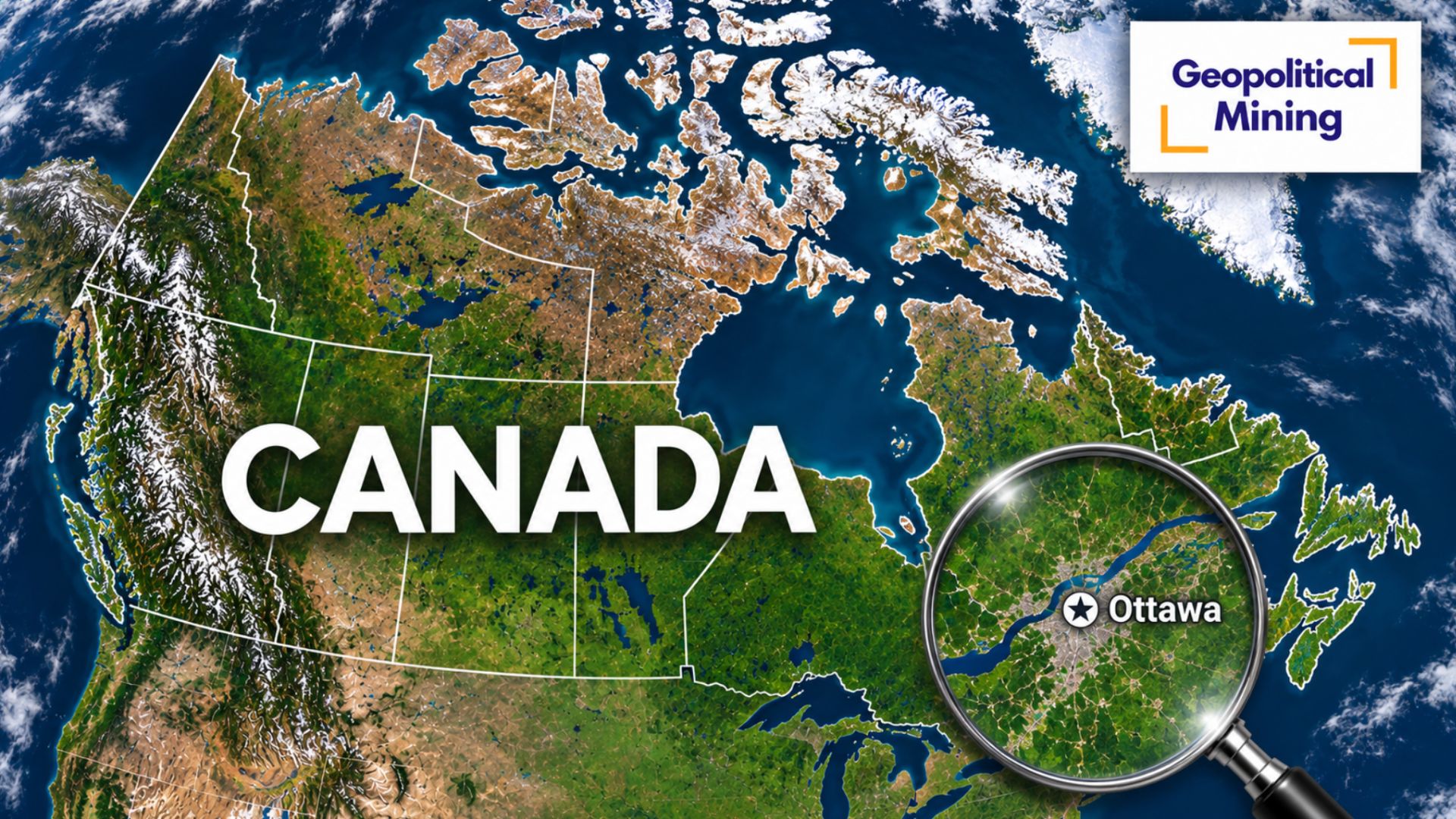

GEOPOLITICAL MINING · CANADA · GLOBAL ECONOMY · INDUSTRIAL STRATEGY
Canada After the U.S. Midterms: Can Prime Minister Carney Turn a Geopolitical Opening into Economic Power?
The U.S. midterm elections may give Canada more room to negotiate with Washington. The greater opportunity is to use that opening to strengthen an economy that can prosper through a broader network of markets, productive capabilities and international partnerships.
The November 3, 2026, U.S. midterm elections have created a new political environment for Canada. Democrats secured control of both chambers of Congress and will take office in January 2027, while President Donald Trump remains in the White House. The change could provide Canadian negotiators with additional opportunities to engage with lawmakers concerned about tariffs, investment and the economic consequences of trade uncertainty. However, congressional control does not automatically change American trade policy or guarantee a more favourable agreement.[1]
For Canada, the possibility comes at an important moment. The trade confrontation with Washington has exposed vulnerabilities in an economy that has benefited enormously from decades of North American integration. The United States remains Canada’s principal commercial partner, and that relationship continues to support industries, employment and investment on both sides of the border.
Yet recent events have also encouraged Canada to reconsider how much of its economic future should depend on the decisions of a single partner. Prime Minister Mark Carney has responded by placing greater emphasis on domestic investment, industrial development and international diversification. These priorities build on capabilities accumulated over many years, but the current geopolitical environment has made their development more urgent.
The central issue is whether Canada can use a potentially improved relationship with Washington to advance that transformation. A more predictable trading environment would be valuable in itself. It could also provide the stability needed to develop new industries, strengthen existing businesses and establish commercial relationships that offer greater flexibility when international conditions change again.
GEOPOLITICAL MINING · EXECUTIVE SNAPSHOT
What Matters for Canada After the U.S. Midterms?
72%
Of Canadian goods exports went to the U.S. in 2025.
56 + 31
Active critical-mineral mines and processing facilities, respectively, as of March 2025.
~C$500B
Investment and financing commitments announced in September 2026.
A New Negotiating Environment
The next U.S. Congress may create additional channels for trade discussions. However, the election does not itself change tariffs or remove the president’s executive powers.
Canada Is Not Starting From Zero
Minerals, processing, technical expertise and finance provide a substantial foundation. Building on it requires selecting industrial activities that can compete commercially.
Execution Will Determine the Outcome
Canada must turn announced investment into operating projects, viable customers and broader economic opportunities, while preserving the benefits of North American integration.
Sources: Global Affairs Canada [4], Natural Resources Canada [7] and the Prime Minister of Canada [8]. Different dates and measures are shown. Nearly C$500 billion refers to announced investment and financing commitments, not capital already deployed.
1. What Could the U.S. Midterms Really Change for Canada?
The new congressional majority could influence the political environment surrounding the next review of the United States–Mexico–Canada Agreement, known in Canada as CUSMA. During the July 2026 review, the United States declined to extend the agreement for another sixteen-year term. The agreement remains in force, with its current term running to 2036 unless the parties agree to an extension. Annual reviews will continue, and the U.S. Trade Representative has already opened consultations for 2027.[2]
Congress has the authority to scrutinise trade policy, consider legislation and influence the conditions under which commercial agreements operate. The political change could therefore give greater influence to American businesses and lawmakers seeking predictable arrangements for North American trade. Nevertheless, Trump retains significant executive powers, while Democrats have their own priorities concerning manufacturing, employment and economic security.
There is a relevant precedent from Trump’s first presidency. In 2019, negotiations between the administration and Congress led to changes in the USMCA before its final approval. Those amendments addressed concerns over matters including labour and enforcement. The experience demonstrates that Congress can influence the terms of a trade agreement, although it does not establish that the negotiations scheduled for 2027 will follow the same path.[3]
Canada has considerable reasons to seek a more stable relationship. According to Global Affairs Canada’s State of Trade 2026, approximately 72% of Canadian goods exports went to the United States in 2025. Services were more diversified, with 53% directed toward the American market. These figures reflect different economic activities, but they also illustrate the importance of a relationship built through decades of infrastructure investment, industrial cooperation and commercial integration.[4]
That integration remains a Canadian advantage. Its vulnerability became more visible when political decisions began changing the conditions under which companies operate. In August 2026, Carney suspended negotiations after his government rejected the terms then offered by Washington. In his subsequent public remarks, he linked the decision to protecting Canadian sovereignty and key industries while continuing to pursue development at home and diversification abroad. This was a documented negotiating choice, although its economic consequences remain part of the broader assessment.[6]
A more receptive Congress may provide Canada with additional room to defend its interests, but the country’s negotiating position also depends on the alternatives available to its businesses. Greater access to other customers, investment partners and productive facilities would give Canada more options without diminishing the importance of its relationship with the United States. In that sense, a better negotiating environment could support a wider economic strategy rather than become a reason to abandon it.
2. What Did Carney Understand About the Changing International Order?
Carney’s speech at the World Economic Forum in Davos on January 20, 2026, provided a clear explanation of how he understood Canada’s position. He argued that the previous international order could no longer be relied upon to provide the same degree of stability and protection. At the same time, he maintained that middle powers were not powerless. They could strengthen their economies and work together to develop new forms of cooperation.[5]
His argument was particularly relevant because it went beyond the immediate confrontation with Washington. Carney recognised that economic relationships could become instruments of geopolitical pressure and that countries needed to reconsider the conditions under which they exercised autonomy. For Canada, this meant developing its domestic economy while expanding relationships with partners that could contribute investment, technology, industrial demand and market access.
In our January analysis of Davos, we examined Carney’s use of value-based realism, a concept articulated by Finnish President Alexander Stubb and explicitly cited by Carney in his speech. Carney’s approach recognised the realities of international competition while maintaining that principles should inform the agreements, alliances and institutions countries develop. It also acknowledged that middle powers could achieve more through cooperation than through isolated attempts to negotiate with larger economies.[5][14]
This interpretation connects with a broader idea that Geopolitical Mining has been developing. Although Carney described a rupture in the international order, we understand the wider economic process as a reconfiguration of globalization. Political arrangements can change profoundly while the knowledge, technologies, industrial capabilities and commercial relationships accumulated through international integration continue to evolve.
Globalization has been part of a much longer process of human development and learning. During recent decades, it helped expand markets, improve access to technologies and create opportunities for industrial specialisation. Countries and businesses were able to benefit from capabilities developed elsewhere, while international cooperation supported economic growth and new forms of production.
That experience also revealed limitations. Some industrial activities became heavily concentrated in particular countries, while others developed significant dependencies on external processing, manufacturing and technology. These arrangements often supported efficient production, but they also created vulnerabilities that became more visible when geopolitical conditions changed.
Trade geography · Canada · 2025
Canada’s Critical Mineral Export Geography, 2025
Extending the table first published in our September Canada analysis, this breakdown shows the individual markets behind the United States’ 57% share and the remaining 43%.
| Destination | Export value (C$M) | Share |
|---|---|---|
| United States | 28,832 | 56.9% |
| China | 4,464 | 8.8% |
| Netherlands | 2,650 | 5.2% |
| Germany | 1,772 | 3.5% |
| Brazil | 1,663 | 3.3% |
| Japan | 1,383 | 2.7% |
| Norway | 1,377 | 2.7% |
| South Korea | 1,092 | 2.2% |
| United Kingdom | 795 | 1.6% |
| All other destinations | 6,611 | 13.1% |
| Total | 50,639 | 100.0% |
Source: Natural Resources Canada, Mineral Trade, May 2026, Table 4, using Statistics Canada data for 2025. Values are in C$ millions and include re-exports. Shares and the residual “All other destinations” are Geopolitical Mining calculations from the reported values; percentages are rounded. This expands the United States / all other markets table previously published by GM. These are critical mineral exports, not all Canadian goods or all mineral and metal exports; destinations are not necessarily the markets where final products are consumed.
Canada’s critical mineral exports illustrate why these lessons matter. Almost 57% go to the United States, while other countries already represent important markets. However, export destinations tell us only part of the story. They do not reveal where minerals are processed, who controls the technology or where the final products are used. These distinctions matter because having natural resources and international customers does not necessarily mean having the industrial capabilities or commercial alternatives needed to respond when conditions change.
The lesson from globalization is not that Canada should produce everything domestically or move away from international cooperation. It is to understand where developing competitive capabilities makes economic sense and where stronger partnerships can provide greater flexibility. New relationships should expand economic choices rather than reproduce the same dependencies under different arrangements. This is how the experience accumulated through globalization can inform better industrial and economic decisions.
Carney’s approach appears consistent with this interpretation. He has articulated a strategy in which Canada seeks greater economic autonomy through domestic development and international cooperation. The importance of that direction will depend on whether the country can turn it into productive capabilities and relationships that remain valuable beyond the present political circumstances.
This article builds on the systemic perspective developed in Mining Is Dead. Long Live Geopolitical Mining, connecting mineral resources with capital, institutions, technology and industrial development.
3. What Does Canada Already Have, and What Could It Build?
Canada possesses substantial natural and economic advantages. Its mineral resources, energy potential, water systems, technical expertise and financial institutions provide an established foundation for development. The country also has decades of experience in mining, processing, engineering and international investment.
This foundation matters because Canada is not beginning its industrial transformation from zero. Its mining regions, financial markets, geological institutions and processing facilities were established long before critical minerals became a central issue in international industrial policy.
Natural Resources Canada’s latest progress update illustrates the scale of that existing system. As of March 2025, Canada had 56 active mines producing critical minerals, 31 processing facilities and 171 advanced critical mineral projects, including 28 processing projects. These figures demonstrate both an established operating base and opportunities for additional development, although projects at different stages cannot be treated as equivalent productive capacity.[7]
The opportunity becomes clearer when these resources are considered within the material economy. Modern life depends on extensive physical systems, including electricity, transportation, housing, healthcare, food production, manufacturing and digital infrastructure. Even technologies associated with an increasingly digital economy require minerals, equipment, energy and industrial processes to operate.
For Canada, the renewed importance of these foundations creates opportunities beyond mineral extraction. Processing, specialised engineering, industrial services, advanced materials and technology can generate additional value when they are supported by competitive costs, reliable infrastructure and customers.
However, not every mineral or industrial activity needs to be developed domestically. Canada already possesses meaningful processing capacity in some sectors, while other stages of production remain concentrated abroad. The challenge is to identify where additional investment can strengthen its industrial position and where international cooperation offers a more viable route to development.
This is also why international diversification should be understood more broadly than exporting to additional countries. European companies already participate in Canadian mineral projects through investment, industrial technology and commercial agreements. Japan, South Korea and other partners contribute different combinations of demand, expertise and financing. These relationships can become more valuable as Canada develops specialised capabilities that complement those of other economies.[16]
Developing those opportunities requires capital. The Canada Investment Summit held in Toronto in September 2026 brought together institutional investors, financial institutions and companies around opportunities in productive sectors. Following the event, the federal government announced nearly C$500 billion in investment and financing commitments across the economy. The figure includes different forms of announced participation and should not be interpreted as money already deployed or facilities already operating.[8]
Budget 2026 introduced further measures aimed at strengthening productive investment, including C$2.3 billion in additional support for the Critical Minerals Strategy. These initiatives provide financial instruments and policy support for selected activities, but their economic value will depend on whether they help businesses develop competitive projects.[9]
The availability of capital is therefore one part of a wider development challenge. Industrial projects also require electricity, transportation, engineering, technology, skilled workers and institutions capable of coordinating the decisions involved.
Canada’s demographic circumstances make the human dimension particularly important. Compared with countries such as Brazil, Canada has a smaller population and domestic market. Population alone does not explain industrial development, but the availability of people, technical knowledge and experienced businesses influences what an economy can build.
Immigration can contribute to Canada’s development by expanding access to skills and experience. However, its effectiveness depends on professional recognition, education, employment opportunities, housing and the ability to retain workers in the regions where projects are being developed. Canada’s 2027–2029 Immigration Levels Plan explicitly connects immigration with labour needs and major investments, although admissions targets should not be interpreted as an equivalent number of additional workers entering the economy.[13]
These considerations illustrate why the transformation of natural resources into economic strength requires more than identifying promising deposits or attracting investors. Canada needs to connect its material advantages with the people, infrastructure and commercial relationships necessary to develop them.
The country’s financial and institutional experience provides an important starting point. What remains to be demonstrated is how effectively these elements can work together to produce competitive businesses, productive employment and economic opportunities that extend beyond individual projects.
4. What Must Canada Demonstrate Now?
Canada’s next challenge is to show that its economic strategy can produce results that endure beyond announcements and political commitments. The country has established priorities, introduced investment measures and advanced projects, but these developments represent different stages in the process of creating productive capacity.
The distinction matters because industrial development takes time. A mining project may require years of engineering, environmental assessment, consultation, financing and construction before production begins. Processing facilities must also demonstrate technical performance, meet customer specifications and achieve economically viable operating conditions.
At the same time, geopolitical circumstances can change much more quickly. Tariffs can be introduced or modified, commercial relationships can deteriorate, and competing countries can develop alternative sources of supply before a project reaches operation.
In our earlier analysis of Canada’s mineral economy, we described this difference through two timelines: the industrial clock and the geopolitical clock. The first reflects the time required to develop productive assets, while the second reflects the changing international conditions in which those assets must compete.
Canada’s challenge is to coordinate these timelines as effectively as possible. This is what we mean by sovereign speed: the capacity to organise institutions, investment, infrastructure and technical processes so that development can progress while an economic opportunity remains relevant.
From strategy to execution
The Labrador Trough Clean Power, Critical Minerals and Infrastructure Corridor illustrates the importance of coordination. The initiative seeks to connect mineral development with electricity generation, transmission, transportation and export infrastructure across Quebec and Newfoundland and Labrador. Referred to the Major Projects Office in August 2026, it brings several interdependent activities into a common development framework. However, coordination remains an early stage, and the productive benefits will depend on the decisions and investments that follow.[12]
For Canada, improving execution does not simply mean reducing the time required for individual permits. Projects need infrastructure at the right moment, financing under viable conditions and technical capabilities that allow them to reach operation. Faster administrative decisions provide limited value when electricity, transportation or other essential elements remain unresolved.
Institutional legitimacy also belongs within this process. Mining and infrastructure projects operate in territories where Indigenous rights, environmental responsibilities and community relationships influence the conditions for development. These responsibilities should be integrated into project planning rather than treated as obstacles to be addressed after investment decisions have been made.
Canada has developed significant experience in this area, including Indigenous participation in project assessment, environmental oversight, commercial agreements, financing and ownership. These arrangements differ across territories, and none guarantees that a particular project should proceed. Their importance lies in providing institutional mechanisms through which development can be assessed, negotiated and governed over time.[17]
For executives, investors and public institutions, the central question is how to assess whether the strategy is working. The following distinctions provide a practical basis for evaluating progress without confusing investment intentions with productive results.
Industrial delivery
Canada’s economic transformation: what would demonstrate progress?
| Area | Current direction | Evidence that would demonstrate progress |
|---|---|---|
| Industrial investment | Capital mobilisation and government support | Binding financing, investment decisions and projects entering construction |
| Infrastructure and execution | Coordination of electricity, transport and major projects | Approved investments, completed infrastructure and realistic project schedules |
| Productive capacity | Expansion of mining, processing and industrial capabilities | Facilities operating competitively, qualified products and reliable customer deliveries |
| Economic development and legitimacy | Workforce development, institutional participation and regional investment | Sustainable employment, productivity improvements, accountable project governance and benefits that communities can recognise |
Geopolitical Mining analytical framework. These are criteria for assessing implementation, not claims that the outcomes have already been achieved.
The economic context reinforces the need for this distinction. In its October 2026 outlook, the Bank of Canada projected GDP growth of 1% for 2026 and 2% for both 2027 and 2028. The outlook anticipated stronger investment and activity, but continued to identify tariffs and trade uncertainty as constraints. Statistics Canada also reported unemployment of 6.7% in October. These indicators describe an economy adjusting to difficult conditions, rather than one whose transformation can already be considered complete.[10][11]
Assessing Carney’s leadership therefore requires separating his strategic direction from the results already achieved. His government has pursued domestic development, financial mobilisation and international diversification while maintaining defined negotiating positions with Washington. Those choices provide evidence of a policy approach, but the country’s economic performance also depends on corporate decisions, provincial policies, international markets and projects initiated over previous years.
The next phase will make the results easier to evaluate. Canada will need to demonstrate that investment can be converted into operating capacity, that projects can advance through complex institutional processes and that industrial development can generate competitive activity within realistic costs and schedules.
The benefits also need to become visible beyond the projects themselves. A successful economic strategy should contribute to productivity, employment, opportunities for businesses and the prosperity of the population. Without those outcomes, even a well-articulated national strategy may struggle to sustain public confidence over time.
5. What Happens if Canada’s Relationship With Washington Improves?
A more constructive relationship with the United States would create important opportunities for Canada. Greater commercial predictability could support investment, reduce uncertainty and improve conditions for industries whose production systems depend on North American integration.
Canada has strong reasons to pursue those benefits. The United States will remain its most important trading partner, and the economic advantages developed through decades of cooperation should not be underestimated.
However, an improvement in bilateral relations could also reduce the urgency that has encouraged Canada to reconsider its dependencies. If businesses regain confidence in access to the American market, the political and economic incentives to develop alternatives may become less immediate.
This is where the lessons of globalization become particularly relevant.
Canada has benefited enormously from international integration, especially through its relationship with the United States. That experience helped develop industries, investment, technological expertise and commercial relationships that remain central to its economy. The difficulties of recent years have revealed vulnerabilities within the same system, encouraging the country to reconsider how its economic opportunities are organised.
Both experiences should inform future decisions. Preserving the advantages of North American integration does not require abandoning diversification, just as expanding international partnerships does not require weakening existing economic relationships.
The objective should be to create additional choices. Canada can strengthen its position within North America while developing industrial capabilities and commercial partnerships that connect it more deeply with Europe, Asia and other regions. Those relationships will be most useful when they are supported by competitive production, reliable infrastructure, financing and customers.
Diversification should also remain selective. Not every dependency is harmful, and not every industrial activity needs to be located domestically. International specialisation has generated substantial economic benefits, and cooperation will continue to be essential. The challenge is to recognise where excessive concentration limits economic choices and where additional capabilities can create meaningful alternatives.
For Prime Minister Carney, the potential opening created by the midterms provides a different environment in which to continue pursuing that strategy. His interpretation of the changing international order has placed domestic development and international cooperation at the centre of Canada’s response. The next challenge is to ensure that these priorities translate into productive capabilities and relationships that can be sustained beyond the current political circumstances.
From the perspective of Geopolitical Mining, Canada’s experience offers a way to understand the broader reconfiguration of globalization. Economic integration has generated achievements that should be preserved, while the vulnerabilities revealed by experience provide reasons to reconsider how productive capacity, institutions and international partnerships are organised.
The most significant result of the current period may therefore become visible when the pressure begins to ease. If Canada continues developing its industrial capabilities, expanding its commercial options and strengthening its institutions under more favourable conditions, it will have demonstrated that the experience influenced more than its negotiating position with Washington. It will have contributed to a lasting change in how the country approaches economic development.
Resources
Official and institutional sources
[1] Ballotpedia. Democrats Win U.S. House and Senate Majorities. November 4, 2026. Results of the U.S. midterm elections.
[2] U.S. Trade Representative / Federal Register. Request for Public Comments and Notice of Public Hearing Relating to USMCA. October 5, 2026. The 2027 review procedure and the July decision not to extend the agreement.
[3] U.S. International Trade Commission. The Year in Trade 2019. August 2020. Historical account of congressional negotiations and amendments to USMCA.
[4] Global Affairs Canada. State of Trade 2026. Canadian trade, export destinations and the importance of services.
[5] Prime Minister of Canada. Principled and Pragmatic: Canada’s Path. January 20, 2026. Carney’s official Davos address.
[6] Prime Minister of Canada. Remarks on Canada–U.S. Trade Negotiations. August 22, 2026. The government’s position following the suspension of bilateral negotiations.
[7] Natural Resources Canada. Canada’s Critical Minerals Strategy: Progress Update. Existing mining and processing capacity and advanced projects.
[8] Prime Minister of Canada. First Canada Investment Summit. September 15, 2026. Announced investment and financing commitments.
[9] Department of Finance Canada. Budget 2026: Key Measures. November 2026. Critical minerals, electricity and productive investment.
[10] Bank of Canada. Monetary Policy Report: Canadian Outlook. October 28, 2026.
[11] Statistics Canada. Labour Force Survey, October 2026. November 6, 2026.
[12] Major Projects Office. Labrador Trough Clean Power, Critical Minerals and Infrastructure Corridor. Regional mining, energy and transportation development.
[13] Immigration, Refugees and Citizenship Canada. 2027–2029 Immigration Levels Plan. Labour market and economic immigration priorities.
Related Geopolitical Mining research
[14] Rivera, M., & Zamanillo, E. Davos 2026: Fifth Axis of Analysis. Milei and Carney: Values, Order and the West’s Internal Conversation. January 25, 2026.
[15] Rivera, M., & Zamanillo, E. The Return of the Material Economy. April 17, 2026.
[16] Rivera Muñoz, M., & Zamanillo, E. Can Europe Become a Major Market for Canadian Minerals?. September 2026.
[17] Rivera Muñoz, M., & Zamanillo, E. Canada: How Indigenous Nations Are Rewriting the Terms of Mining. August 19, 2026.
[18] Rivera, M., & Zamanillo, E. The Mining Paradox: The Legitimacy Gap Behind Modern Life. May 8, 2026.
[19] Rivera, M., & Zamanillo, E. Mining Is Dead. Long Live Geopolitical Mining. QM Books, 2025.