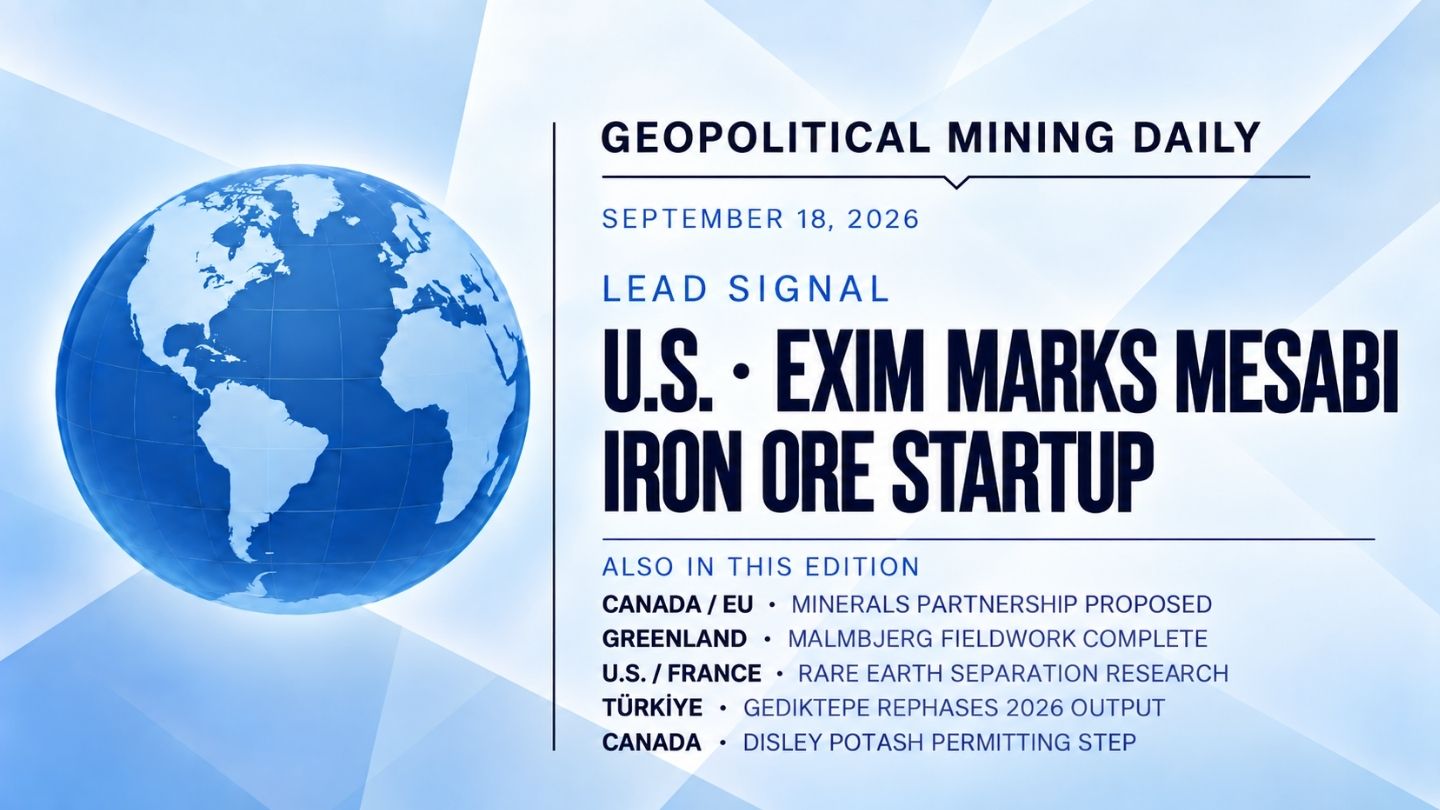

Geopolitical Mining Daily · September 18, 2026
EXIM Marks U.S. Mesabi Metallics Iron Ore Startup
EXIM’s visit to Mesabi Metallics brings a new iron ore and pellet operation into the industrial security debate. Across this edition, the practical work of supplying industry takes several forms: processing partnerships, engineering, separation chemistry, revised mine plans and a project specific environmental assessment decision.
Mesabi’s startup leads an edition focused on the steps between mineral resources and usable supply. Canada sets out a processing dimension to cooperation with Europe, while Malmbjerg completes fieldwork for engineering. USA Rare Earth and its partners announce a research programme. Gediktepe revises its production schedule, and Disley receives an environmental screening determination. The evidence distinguishes physical progress from proposals, technical assumptions and regulatory decisions.
The 2026 observation framework
The ten Signals for 2026
Every Daily edition is read against the same ten strategic lenses. Signals activated by today’s verified developments are highlighted below.
Today’s direction of travel
The industrial value of a mineral project depends on the connection between its deposit, processing route, infrastructure and customer. Today’s developments make those connections more visible, while showing how much depends on the terms of financing, the sequence of approvals and the reliability of actual plant performance.
Lead development
EXIM marks startup at Mesabi Metallics in Minnesota
What happened
On September 17, EXIM reported that its chairman, John Jovanovic, visited Mesabi Metallics in Nashwauk as the operation began startup. The agency describes it as the first new iron ore mine and pellet plant to start up in the United States in 50 years. That historical description is attributed to EXIM.
The chronology matters. Mesabi, an Essar Group company, had announced its first production blast on July 13. September’s official update therefore sits within an existing mobilisation and startup sequence. The intended product is direct reduction grade pellets for steelmaking; the sources reviewed do not establish sustained commercial pellet output.
EXIM’s March 17 announcement had already identified potential support of up to US$10 billion and approximately seven million tons of annual pellet capacity. The September visit should not be presented as a newly closed financing of that amount. It does not disclose loan closing terms or disbursements.
Signal reading
The strategic significance lies in the product specification and its place in an industrial system. Additional ore becomes more useful to steelmakers when the processing route delivers the grade, consistency and volume they can incorporate into their operations. Public financing support can help assemble that system, but its contribution to supply security ultimately has to be measured through dependable deliveries. For project assessment, the relevant questions now move into the plant, the product and the commercial arrangements connecting them.
Next proof point: First pellet production evidence, product specifications, sustained throughput and recovery, customer acceptance, commercial shipments and precise disclosure of financing commitments and drawdowns.
Direct government source · September 17, 2026
EXIM: site visit and reported startup.Earlier company milestone · July 13, 2026
Mesabi Metallics: first production blast.Earlier financing announcement · March 17, 2026
EXIM: potential financing support and intended capacity.Diplomacy and industrial development
Canada proposes a minerals and processing partnership with Europe
What happened
Addressing the European Parliament in Strasbourg on September 17, Prime Minister Mark Carney proposed deeper cooperation across strategic capabilities, including critical minerals. He explicitly connected Europe’s need for reliable mineral supply with Canada’s need for advanced processing capabilities and the development of complete value chains.
The address responded to the European raw materials corporation proposed a day earlier. The new evidence is Canada’s articulation of what it could contribute and what it seeks from the partnership. The speech does not establish mineral purchase contracts, processing investments or a completed bilateral minerals agreement.
Signal reading
A partnership built around complementary capabilities raises a different set of commercial questions from a simple export campaign. Which processing stages would be located on each side of the Atlantic? Who would own the facilities, provide technology and commit to purchasing the output? Our reading is that these choices would determine how value, dependence and execution risk are distributed. The proposal creates a basis for that discussion; individual projects still need a commercial structure that can survive beyond diplomatic alignment.
Next proof point: Named projects, processing locations, participating firms, technology agreements, purchase commitments and the financing structures attached to any subsequent bilateral implementation programme.
Direct government source · September 17, 2026
Prime Minister of Canada: address to the European Parliament.Engineering and project development
Malmbjerg completes fieldwork for molybdenum project engineering
What happened
Greenland Resources announced on September 17 that the summer field programme at Malmbjerg had been completed on schedule. The work supports detailed engineering, equipment procurement and construction contracting for the proposed molybdenum operation.
Activities included surveying, glacier and geotechnical investigations, and optimisation of the Doppelmayr RopeCon route to the planned concentrator at tidewater. The team also collected eight tonnes of drill core and 14 tonnes of saline and fresh water for a planned metallurgical pilot programme. These are inputs to subsequent testing and design; the announcement does not establish a construction start.
Signal reading
For this project, the practical connection between the deposit and the coast deserves as much scrutiny as the mineral inventory. Better ground and route information can change infrastructure design, construction quantities and the allocation of contractor risk. From a development perspective, the value of the field season will become visible when its findings are incorporated into engineering deliverables and priced contracts. A completed campaign reduces specific information gaps, while leaving financing, construction execution and operating performance to later stages.
Next proof point: Pilot results, revised engineering packages, quantified infrastructure requirements, priced equipment and construction contracts, and a funded execution schedule.
Direct company source · September 17, 2026
Greenland Resources: completed field programme and next engineering work (PDF).Technology and processing development
USA Rare Earth, Pasqal and Riven target separation chemistry
What happened
USA Rare Earth, Pasqal and Riven Systems announced a September 17 partnership to investigate improved rare earth separation molecules. The proposed programme combines automated chemical experiments with machine learning and quantum computing.
Riven would generate experimental data, and Pasqal would benchmark quantum models against classical models trained on the same data. The partners envisage subsequent validation at USA Rare Earth’s Wheat Ridge research facility. Reduced processing complexity and costs are objectives, rather than demonstrated results of this announcement.
Signal reading
The most useful feature of the proposal is its comparative test: a new computational method must show an advantage against a credible alternative using comparable evidence. For mining and processing businesses, that advantage would still need to survive contact with real feed variability, reagent stability, product purity and waste management. Our interpretation is that the partnership addresses a potentially important design problem, but an improved prediction model and an economically superior industrial process remain separate achievements.
Next proof point: Published benchmark methodology, reproducible experimental results, selectivity and purity data, reagent performance and an independently assessable case for integration into a processing flowsheet.
Direct company source · September 17, 2026
USA Rare Earth: partnership scope, planned experiments and benchmarking.Mine plan and operating development
Gediktepe updates its mine plan and rephases sulphide production
What happened
ACG Metals released updated Gediktepe resource and reserve estimates on September 17, together with results underpinning a revised Competent Person’s Report. The company reported a modelled after tax net present value of approximately US$1.2 billion at an 8% discount rate, with projected average output of about 36,000 tonnes of copper equivalent annually during 2027 to 2031.
It also revised 2026 guidance to approximately 12,000 to 14,000 tonnes of copper equivalent, rephasing three months of sulphide production into 2027 during commissioning. Copper equivalent aggregates several metals and is not copper tonnage. The full report is expected within 30 days. Comparisons with the 2024 valuation require care because scope and discount rates differ.
Signal reading
This update places a larger future production plan alongside a near term scheduling constraint. For capital providers, the distinction matters: a revised model may increase estimated value while slower commissioning changes when cash is generated and how much liquidity is needed along the way. An assessment should therefore examine the mine plan, commodity assumptions and operating transition together. The economics become more persuasive as the production sequence is reconciled against measured plant results and the funding required to maintain it.
Next proof point: Publication of the full technical report, reconciliation of valuation assumptions, quarterly throughput and recoveries, commissioning progress, working capital needs and the resulting production profile.
Direct company exchange announcement · September 17, 2026
ACG Metals: updated estimates, valuation assumptions and production guidance.Regulatory and project development
Disley potash module receives environmental screening determination
What happened
Buffalo Potash reported on September 17 that Saskatchewan’s Ministry of Environment had determined that the initial Disley production module does not require an Environmental Impact Assessment under the provincial screening criteria. The determination is conditional on the proposal as described; other regulatory requirements continue to apply.
The module is designed for 125,000 tonnes of potash annually, with first production targeted for the first quarter of 2027. Buffalo also cautioned that its production decision is not supported by a feasibility study establishing mineral reserves and economic and technical viability. The regulatory outcome therefore leaves important technical and commercial questions unresolved.
Signal reading
A screening determination clarifies which assessment route applies to a defined project. It should be read at that scale, rather than extended automatically to a larger development. For a modular approach, the next analytical question is whether the first installation can demonstrate performance that supports further investment. Regulatory progress may simplify one part of the execution sequence, while process reliability, cost and the strength of the underlying technical evidence continue to determine whether the development case holds.
Next proof point: Remaining permits, adherence to the screened design, completion of the module, measured brine and processing performance, and further technical work supporting economic viability.
Primary company distribution · September 17, 2026
Buffalo Potash via Newsfile: determination, scope, development plan and technical cautions.The system reading
What today’s evidence tells us
Taken together, these developments support a practical way to read mineral strategy: ask which constraint has actually changed. A government visit, a cooperation proposal, completed fieldwork, a research agreement, a revised technical model and an assessment determination answer different questions. Their value cannot be measured on a single scale of announcements. For an industrial customer, the decisive combination is a dependable product, available when required and on workable commercial terms. For a developer or capital provider, the task is to understand the sequence that produces that outcome and the risks still carried between its stages. Today’s evidence points toward closer links between mining and industrial policy, with processing capability and execution remaining central to whether those links produce usable supply.
Signals for 2026 gives the map. The Daily records new evidence against that map. This edition examines the links between mine development, industrial capability and the conditions required for dependable material supply.