Geopolitical Mining · Weekly
Geopolitical Mining Weekly
Week of July 13–19, 2026
Authors: Marta Rivera | Eduardo Zamanillo
July 19, 2026
What this week really tells us
What stood out this week is that mineral security is moving into the architecture of access. The signals were not only about finding minerals, financing projects or expanding processing capacity. They were about the rules, facilities, permits, laws and market mechanisms that decide how strategic minerals become available, who can use them, and under what conditions.
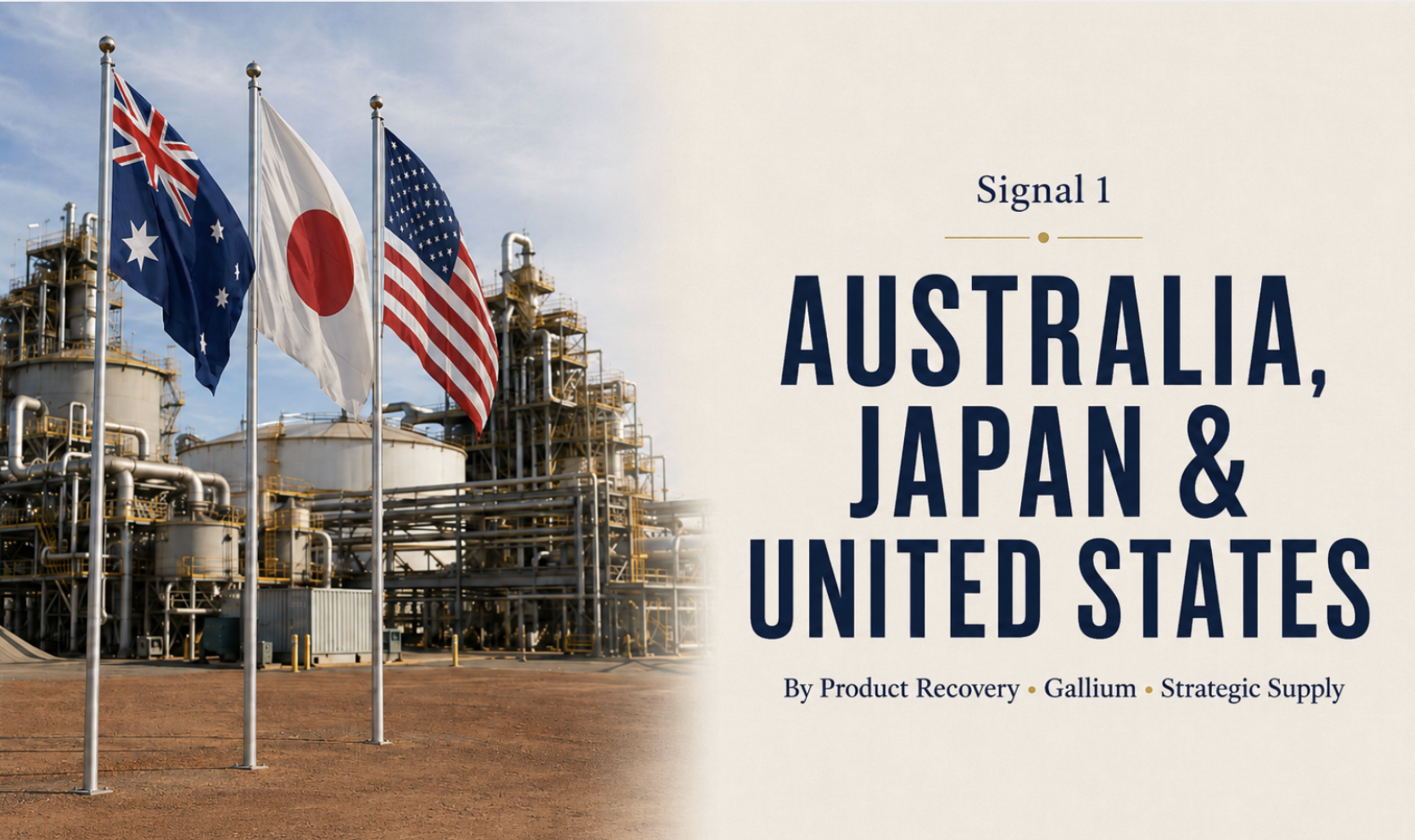
Australia, Japan, the United States and Alcoa reached a final investment decision for a gallium facility at the Wagerup alumina refinery in Western Australia. The signal is important because gallium supply can be built from an existing industrial system, not only from a new mine. A by product stream inside alumina refining is being turned into a strategic supply source for semiconductors, advanced electronics and defence applications.
In the United States, two mining projects gained FAST-41 Transparency status: the Golden Gate Project in Idaho and the Bend Project in Wisconsin. That matters because mineral access is not only about deposits. It is also about whether projects can enter a visible permitting pathway, with clearer expectations for environmental review, agencies, timelines and next steps.
Chile moved on a different but connected front. The Senate approved in particular the Proyecto de Ley de Reconstrucción Nacional y Desarrollo Económico y Social, sending it back to the Chamber of Deputies for third trámite. The bill is not mining specific, but it matters for mining and energy projects because it addresses investment conditions, tax competitiveness, regulatory streamlining and legal certainty around project delivery.
The United States also advanced the proposed leasing process for offshore critical minerals near American Samoa. Europe moved its Raw Materials Mechanism from demand aggregation into supplier submissions. Ghana, meanwhile, advanced a mining law overhaul that would strengthen licensing discipline, local content, community development agreements, value addition and oversight of the mineral sector.
The week’s message is direct: access to minerals is becoming a designed outcome. It depends on industrial recovery, permitting transparency, investment certainty, leasing rules, market coordination, local content, community legitimacy and institutional capacity. The deeper signal is that countries and companies are no longer only asking where the minerals are. They are asking who controls access, who captures value, who carries risk, and which systems can actually deliver the material.
For the full Geopolitical Mining framework behind this note, read our book Mining Is Dead. Long Live Geopolitical Mining.
Signals of the week
Signal 1: Wagerup shows how by product recovery is becoming strategic supply
What happened
On July 14, Alcoa announced that the governments and industry partners of Australia, Japan and the United States, together with Alcoa, had reached a final investment decision for a gallium production plant to be co-located at Alcoa’s Wagerup alumina refinery in Western Australia.
JOGMEC also announced the final investment decision on July 15, framing the project as part of building a new critical minerals supply chain and ensuring stable supply through diversification. The facility will be constructed and operated by Alcoa, using the company’s existing alumina refining and mineral processing base. Australia’s government said the project is expected to produce 100 tonnes of gallium per year, representing about 10% of global demand. Gallium is used in semiconductors, advanced electronics and defence related applications.
Why it matters
This matters because strategic mineral supply does not always come from a new mine. Sometimes it comes from recognizing that an existing industrial process already contains strategic value. Gallium can be recovered from bauxite and alumina refining systems. That makes Wagerup a useful signal: the strategic resource is not only the orebody, but the industrial facility capable of recovering and qualifying the material.
The project also shows how governments and companies are trying to build supply through by products. These materials are often small in volume but large in strategic importance. They do not always justify a standalone mining project, but they can become highly relevant when recovered from existing industrial streams.
The partnership structure matters too. Australia, Japan and the United States are not only talking about diversification. They are backing a specific facility, in a specific refinery, for a specific material.
Implications for capital and strategy
For capital, the signal is that by product recovery can create strategic value inside existing industrial assets. Refineries, smelters and processing complexes may carry more critical minerals optionality than traditional valuation models recognize. For strategy, the deeper message is that supply security requires looking inside the industrial base. Some critical minerals may be unlocked not by opening a new mine, but by redesigning how existing facilities recover value.
Signal 2: The United States is moving critical minerals projects into permitting transparency
What happened
On July 17, the Federal Permitting Improvement Steering Council announced that two mining projects had gained FAST-41 Transparency status: the Golden Gate Project in Idaho and the Bend Project in Wisconsin. The Permitting Council said the projects were added in response to the executive order on increasing American mineral production and are expected to support critical mineral supply.
The Golden Gate Project is located in the Boise National Forest near Yellow Pine, Idaho. It seeks to further develop a tungsten and gold deposit, restart the past-producing Golden Gate Tungsten Mine and commercialize an existing tungsten ore stockpile. Planned work includes prospect trenching, core drilling, metallurgical test work, a pre-feasibility study and offsite processing of previously mined tungsten ore stockpile. The Bend Project in Wisconsin is an exploration drilling program to evaluate a copper-gold volcanogenic massive sulfide system with tellurium in the Chequamegon Nicolet National Forest. The project is being advanced through a Bureau of Land Management prospecting permit application.
Why it matters
This matters because the United States is treating permitting visibility as part of the mineral supply chain. Golden Gate and Bend are not operating mines. They are still early stage projects. But that is exactly why the signal matters. Critical mineral supply does not appear only at construction or production. It begins much earlier, when projects enter a permitting pathway, when review steps become visible, and when investors, regulators, communities and project sponsors can track the process.
The minerals also matter. Tungsten, copper, gold and tellurium sit in different parts of the strategic materials system: defence, industrial tooling, electrification, energy technologies and advanced manufacturing. FAST-41 Transparency status does not guarantee supply. It does not turn an exploration project into a mine. But it can reduce uncertainty around the path from mineral potential to possible production.
Implications for capital and strategy
For capital, the signal is that early stage U.S. mining projects may gain value when they enter a clearer permitting and review framework, even before construction decisions are made. For strategy, the deeper message is that mineral security depends on project pathways. A country can identify critical minerals, but supply only becomes plausible when projects can move through exploration, review, permitting, technical studies and eventually development.
Signal 3: Chile is trying to rebuild investment certainty around project delivery
What happened
On July 16, Chile’s Senate approved in particular the Proyecto de Ley de Reconstrucción Nacional y Desarrollo Económico y Social, completing the bill’s second constitutional stage and sending it back to the Chamber of Deputies for third trámite.
The bill is not mining specific, but it matters for the mining and energy project pipeline because it includes measures aimed at improving investment conditions, tax competitiveness and regulatory timelines. According to Chile’s Ministry of Finance, the project is structured around five axes: reconstruction, construction sector reactivation, recovery of tax competitiveness, regulatory streamlining to unlock stalled investment projects, and fiscal responsibility.
The Senate also approved a tax invariability mechanism for investment projects. Reporting on the Senate vote described a structure with different stability periods depending on investment size, including longer periods for larger investments. Because the bill still needs to complete its next legislative stage, the signal is not final law. It is an important legislative advance in Chile’s broader effort to improve investment certainty.
Why it matters
This matters because Chile’s mineral position is not limited by geology. Chile has world scale copper, lithium and mining capability. The harder question is whether the country can create the investment, permitting and institutional conditions needed to convert that position into new supply. That is why this legislative signal matters. It does not approve a mine. It does not finance a project. But it speaks directly to the conditions around project delivery: tax stability, regulatory timing and legal certainty.
For mining, that distinction is important. Investors do not only evaluate ore bodies. They evaluate the fiscal regime, permitting pathway, environmental risk, political durability and the probability that capital can move from announcement to construction. The caution is also important. A pro-investment law does not automatically create mining supply. If the framework becomes too contested, or if legal challenges weaken its legitimacy, it may create uncertainty rather than reduce it.
Implications for capital and strategy
For capital, the signal is that Chile is trying to improve the investment environment at a moment when copper and lithium project delivery matter globally. For strategy, the deeper message is that mineral security depends on the state’s ability to facilitate investment without losing institutional trust. In Chile, the next question is not only whether incentives are approved, but whether they become a credible and durable framework for projects.
Signal 4: American Samoa shows that offshore critical minerals are moving into the leasing stage
What happened
On July 16, the Marine Minerals Administration announced the availability of a Proposed Leasing Notice for a potential American Samoa Outer Continental Shelf mineral lease sale. The notice outlines proposed terms and conditions for a possible sale and advances the leasing process for offshore critical minerals.
BOEM, the Bureau of Ocean Energy Management within the U.S. Department of the Interior, states on its American Samoa offshore minerals page that the proposed leasing notice outlines the terms and conditions for the potential sale, including blocks under consideration, information to lessees and proposed lease stipulations. If the process moves forward, BOEM would complete the remaining pre-sale requirements, including publishing a final Leasing Notice in the Federal Register at least 30 days before any sale date. The agency also emphasized that issuance of the proposed leasing notice does not guarantee that a lease sale will be held, nor that exploration or collection activities will occur.
Why it matters
This matters because mineral security is moving offshore, but not without major institutional and environmental questions. Deep sea and offshore critical minerals are often presented as future supply options. But supply does not begin with geology alone. It begins with legal authority, leasing processes, environmental assessment, public consultation, territorial concerns, technology and operational control.
American Samoa is especially sensitive because offshore minerals raise questions that are different from traditional mining. The resource is under the sea. The environmental baseline is limited. Local communities and territorial interests matter. The regulatory system is still being tested. The signal is not that offshore mining is imminent. The signal is that the United States is moving from mapping and interest-gathering into proposed lease terms. That is a different stage of institutional seriousness.
Implications for capital and strategy
For capital, the signal is that offshore mineral projects remain high risk, long horizon opportunities. Legal process, environmental data, technology, local legitimacy and political durability will matter as much as mineral prospectivity. For strategy, the deeper message is that countries are beginning to treat seabed minerals as part of mineral security architecture. But the path from leasing to supply will be slow, contested and institutionally demanding.
Signal 5: Europe’s Raw Materials Mechanism is moving from demand aggregation into supplier matching
What happened
On July 13, the supplier submission phase opened for the European Commission’s Raw Materials Mechanism first Diversification Round. This phase runs from July 13 to September 9, 2026, after the offtaker submission and aggregation phases earlier in the process. The mechanism is designed to connect European offtakers with suppliers, financial institutions and storage providers. The first diversification round covers the 17 strategic raw materials identified under the Critical Raw Materials Act, with a focus on rare earths, battery materials and defence raw materials. Results are expected to be communicated on September 23.
Why it matters
This matters because Europe is trying to turn mineral demand into a more organized market signal. One of the recurring problems in critical minerals is that everyone says demand is strategic, but individual buyers often struggle to provide the long term commitments that projects need. Demand can look large in policy documents and still remain fragmented in the market.
The Raw Materials Mechanism tries to reduce that gap. By aggregating offtaker demand and then matching it with suppliers, Europe is creating a structured process for visibility, coordination and commercial engagement. This is not a state purchase program. It does not guarantee supply. But it is a practical tool for making demand more legible to suppliers and investors.
Implications for capital and strategy
For capital, the signal is that projects connected to organized demand platforms may gain visibility with buyers, financiers and strategic partners. For strategy, the deeper message is that mineral security is not only a supply side problem. Demand must also be organized, credible and visible enough to support investment.
Signal 6: Ghana is rewriting mining governance around local content, licensing discipline and community agreements
What happened
On July 15, Ghana’s Ministry of Lands and Natural Resources announced that Cabinet had endorsed a comprehensive review of the Minerals and Mining Act, 2006, and forwarded it to Parliament for approval. Reuters also reported that the amendments were approved by Cabinet for submission to Parliament as part of efforts to strengthen oversight and curb illegal mining.
The revised bill introduces district mining committees as the entry point for licensing, creates a new medium scale mining category, abolishes the reconnaissance licence in favour of a single prospecting licence capped at five years, fixes mining leases at a maximum of 20 years and requires every lease to carry a mandatory community development agreement.
The Ministry also said Cabinet had approved a revised Minerals and Mining Policy, first developed in 2014, to strengthen local content and domestic value addition in the sector. Separately, the Ministry referred to the Minerals and Mining (Royalties) Regulations, 2025, which introduced a sliding-scale royalty regime tied to commodity price cycles. That royalty framework is therefore part of the broader reform context, rather than the specific new bill sent to Parliament this week. The same reform agenda is linked to stronger enforcement, environmental protection and action against illegal mining.
Why it matters
This matters because resource governance is becoming more assertive. Ghana is not a critical minerals story in the narrow rare earths or battery metals sense. It is a mining governance signal. The same questions appearing in critical minerals are also appearing in gold and broader mineral policy: who participates, who captures value, who has a say in licensing, and how long companies can hold rights without advancing real work.
The reform targets several issues at once: speculative licensing, local participation, community development, value addition, state revenue and illegal mining. That makes it part of a wider pattern across resource rich countries. Governments are trying to move from resource extraction toward resource control, value capture and community legitimacy. For investors, that creates both opportunity and risk. Clearer rules can improve durability, but tighter terms can change project economics.
Implications for capital and strategy
For capital, the signal is that Ghanaian mining projects will need to be read through a more state and community centered framework. Licensing discipline, community agreements, royalties and local content will matter more. For strategy, the deeper message is that mineral access is increasingly negotiated through governance. Resource ownership, community legitimacy and value retention are becoming central to the mining equation.
Signals to watch
- Whether Wagerup’s gallium project moves from final investment decision into construction, and whether the 100 tonne annual capacity becomes a model for recovering strategic minerals from existing industrial processes.
- Whether the Golden Gate and Bend projects move through the FAST-41 Transparency process with clearer review timelines, agency coordination and permitting milestones.
- Whether Chile’s Proyecto de Ley de Reconstrucción Nacional y Desarrollo Económico y Social completes its next legislative stage, and whether its investment and regulatory measures become a credible framework for project delivery.
- Whether the American Samoa proposed offshore leasing process advances toward a final leasing notice, and how territorial, environmental and public consultation concerns shape the process.
- Whether the EU Raw Materials Mechanism attracts enough credible suppliers during the July 13 – September 9 submission phase to make demand aggregation commercially useful.
- Whether Ghana’s revised Minerals and Mining Bill passes Parliament and how investors respond to shorter lease terms, district mining committees, community development agreements and the broader royalty framework.
- Whether the UN critical energy transition minerals process expands its governance work in a way that connects more directly with broader mining risks, including artisanal and illegal mining. The July 14 UN meeting was focused specifically on critical energy transition minerals, which makes it relevant but narrower than the full mining governance question.
- Whether the July 22 close of expressions of interest for the United Kingdom’s Magnet Hub shows meaningful industrial interest in rare earth magnet capacity.
Three strategic questions for this week
- Which form of access matters most now: by product recovery, permitting transparency, investment certainty, leasing authority, demand aggregation or community legitimacy?
- Are governments becoming better at turning existing industrial assets and institutional tools into critical mineral supply?
- How should investors value mining projects when access increasingly depends on governance, processing, local value capture and market structure?
Resources
Signal 1
- Alcoa — Australia, Japan, the United States and Alcoa announce final investment decision for gallium project in Western Australia.
- JOGMEC — Final Investment Decision for Gallium Production Project in Australia.
Signal 2
Signal 3
- Ministerio de Hacienda de Chile — Ministro Quiroz y aprobación en particular del proyecto de Reconstrucción Nacional en el Senado.
- Senado de Chile — Proyecto de reconstrucción nacional avanza a su tercer trámite.
- Emol — Reconstrucción: Senado aprueba fórmula de invariabilidad tributaria.
Signal 4
- BOEM / Marine Minerals Administration — MMA drives next step in America’s offshore critical mineral strategy.
- BOEM — Potential American Samoa Offshore Minerals Lease Sale.
Signal 5
Signal 6
- Ghana Ministry of Lands and Natural Resources / Ghana News Agency — Cabinet revises and approves Minerals and Mining Policy of 2014.
- Reuters — Ghana approves revised mining law to strengthen oversight.
- Ghana News Agency — Ghana gets enhanced lithium agreement with automatic sliding scale up to 12% royalty.
Signals to watch