
Geopolitical Mining · Article
Mineral Security Is Built, Not Declared
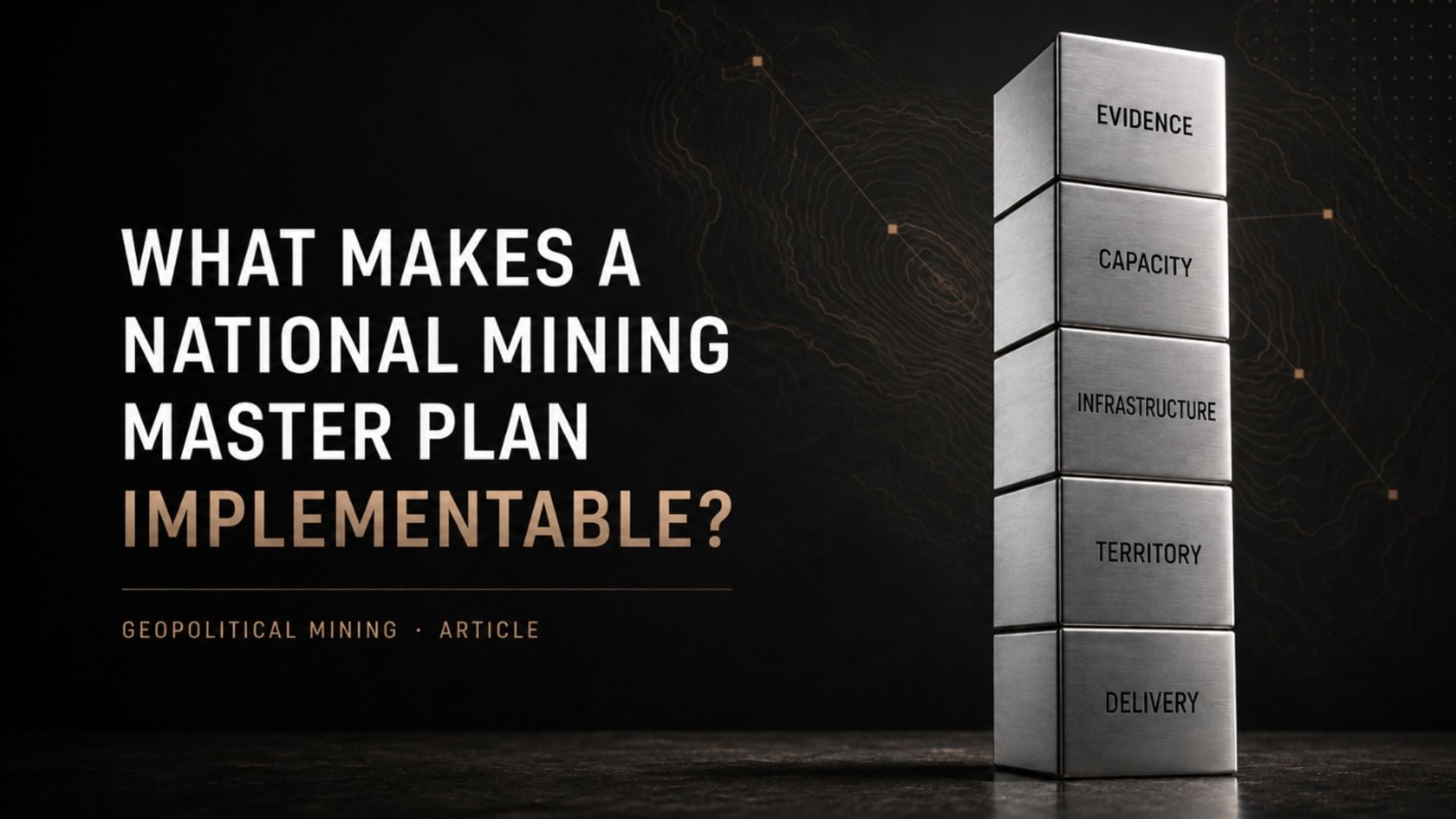
What Makes a National Mining Master Plan Implementable?
Author: Marta Rivera & Eduardo Zamanillo
August 28, 2026
Critical minerals are increasingly framed through national security and industrial policy. Yet declaring minerals strategic does not create mines or productive capability. A mining master plan can catalogue a country’s mineral endowment and still fail to create a mining future. It may identify prospective districts, priority minerals, infrastructure corridors, regulatory reforms, investment targets and downstream ambitions, yet leave unresolved the more difficult question of whether the country can organise these elements into projects that can actually be evaluated, financed, permitted, built, operated and sustained. The problem is rarely a lack of ambition. More often, it is the absence of a credible sequence connecting mineral potential with institutional capability, public investment, private capital, infrastructure and territory. A plan may describe the sector that a government would like to have without explaining what must happen first, which institutions must act, what evidence is required before public resources are committed and how the programme should change when its original assumptions no longer hold.
In Geopolitical Mining, we argued that the old extractive model was no longer sufficient to explain the place of mining in the twenty first century. Geology now sits inside a wider system of technology, capital, industrial policy, legitimacy and State power. This changes the purpose of a mining master plan. It cannot be treated simply as an inventory of resources or as a sector document operating at the margins of national economic policy. It must become part of the architecture through which a country organises its material economy.
This article develops the institutional dimension of the framework introduced in Mining Is Dead. Long Live Geopolitical Mining.
This question has become more important as industrial policy has returned to the centre of government strategy. The World Bank’s 2026 Industrial Policy for Development: Approaches in the 21st Century report reviewed national development plans across 183 economies and found that all 183 economies reviewed targeted growth in at least one industry. Low income economies targeted an average of 13 industries, compared with five in high income economies. The figures demonstrate how widely governments are attempting to influence what their economies produce, but they also reveal the scale of the implementation challenge. Declaring industries strategic is far easier than building the institutions, infrastructure and productive capabilities required to make them competitive. Mining master plans sit directly inside that challenge. They must connect geology with the public and private systems through which geological potential can become productive capacity.
At Geopolitical Mining, we define mining viability as the systemic capacity of a formal mining project to move from technical and economic possibility to sustained production, supported by territorial legitimacy, institutional durability, capital confidence, operational continuity and public authority. Feasibility studies test whether a specific project can be technically and economically justified within a defined project framework, including the relevant modifying factors. Mining viability asks a wider public policy question: whether the national and territorial system around that project can keep those conditions credible and executable through permitting, financing, construction, operation and closure. A national mining master plan cannot declare an individual project viable, nor can it replace feasibility studies, environmental assessments, due diligence or investment decisions. Its role is different. It must build the public conditions through which credible projects can emerge, be tested against progressively stronger evidence and, where justified, cross the threshold from geological possibility to sustained formal production.
Conceptual architecture
The concepts are connected, but they are not interchangeable
The table below shows how the principal concepts used in this article fit together and what each one contributes to implementation.
| Concept | Meaning in this article | Role in implementation |
|---|---|---|
| National mining vision | The long term role that mining should play in national development and in the country’s material economy. | Sets direction. |
| National mining strategy | The choices, priorities and policy instruments through which the country will pursue that vision. | Determines where the State will act, and where it will not. |
| Mining master plan | The sequenced architecture connecting evidence, institutions, public investment, private capital, infrastructure and territory. | Translates strategy into decisions, dependencies and responsibilities. |
| Mining viability | The systemic capacity for credible projects to move from technical and economic possibility to sustained formal production. | Defines the condition the plan is trying to create. |
| Practitioner gap | The distance between the complexity of the mineral system and the practical knowledge reaching policy, regulatory and investment decisions. | Tests whether decisions are informed by operating reality. |
| Territorial legitimacy | The conditions under which mining is credible where its impacts, rights, benefits and responsibilities are experienced. | Connects national ambition with territorial reality. |
| Sovereign speed | The State’s capacity to move from geology to durable decisions and productive capability within a strategically relevant timeframe. | Measures whether the system can act without institutional shortcuts. |
| Delivery system | A rolling portfolio of actions, owners, budgets, milestones, dependencies and review mechanisms. | Turns a long term plan into annual implementation. |
From mineral endowment to a credible project pipeline
A country does not possess an investable mining pipeline merely because it has mineral occurrences, geological prospectivity or exploration licences. Regional geological potential, an identified occurrence, an exploration target, a defined mineral resource, an advanced technical study, a permitted project and a mine under construction represent fundamentally different levels of evidence and readiness. Combining them within a single national project list can create an inflated impression of sector maturity and encourage governments to plan infrastructure, fiscal revenues or industrial facilities around projects that remain highly uncertain. An implementable master plan must therefore classify mineral opportunities according to their actual stage of development. It should state what is known, what remains uncertain, what evidence is required next and which public or private decision that evidence is intended to support. These distinctions should be consistent with recognised reporting frameworks, including CRIRSCO terminology for Exploration Targets, Exploration Results, Mineral Resources and Mineral Reserves, while also extending beyond reporting categories to permitting, financing, construction and operational readiness.
At an early stage, the most valuable public intervention may be better geological information, a transparent cadastre or a clearer exploration regime. As a project advances, the constraint may shift towards metallurgical knowledge, environmental baselines, coordinated permitting, fiscal clarity, infrastructure planning or access to capital. A project approaching development may justify detailed work on power, water, transport or shared facilities. A highly speculative occurrence generally does not. The African Minerals Development Centre and UNECA’s Country Mining Vision Guidebook provides a useful foundation for this approach. It treats a national mining vision as both a process and a product, grounded in political economy analysis, stakeholder participation, an explicit theory of how change will occur and a logical sequence connecting inputs with long term outcomes. It calls for a delivery roadmap, defined responsibilities, mutual accountability and an outcome oriented monitoring framework.
This is a more demanding standard than producing a comprehensive strategy document. It requires the master plan to function as a decision system. A practical national pipeline should be stage gated. At every stage, the question should be whether the available evidence is sufficient to justify the next commitment. That commitment may involve additional exploration, technical studies, environmental work, institutional resources, infrastructure preparation or public expenditure. Project specific public support should increase only as the quality of the evidence and project maturity improve. A practical pipeline should also distinguish announced capacity from technically supported capacity, permitted capacity, financed capacity and production that can reasonably be expected within a defined period. These categories should not be aggregated as if they had the same probability of materialising. This is especially important for infrastructure and revenue planning, where the nominal capacity of all projects in a database can easily exceed the capacity that is likely to become operational within the planning horizon.
This protects the State from committing public resources prematurely, while also providing investors with greater clarity. Companies can see which information and milestones are required to move from one stage to the next. Governments can distinguish genuine sector constraints from project specific weaknesses that should remain the responsibility of the investor. Geological information remains an essential public input, but the objective should not simply be to produce more maps or accumulate larger databases. Geological programmes should be designed around decisions. Governments should be able to explain where modern baseline coverage is most valuable, which datasets could reduce exploration uncertainty, how information generated by licence holders will be returned to the State and how geological knowledge will be connected with water, infrastructure, environmental and land use planning. The relevant measure of success is not the volume of data collected. It is whether the information is accessible, reliable and produced in time to improve public and private decisions.
Decision rule
Public support should follow evidence
Early public investment is justified where it creates broad public goods, such as geological information, cadastral systems and territorial baselines. Project specific support should increase only as evidence, maturity and a defensible public rationale improve.
Prioritisation is where strategy begins
A master plan that declares every mineral strategic, every mineralised region prospective and every identified project a national priority has not established a strategy. It has avoided making choices. Geoscience budgets, regulatory attention, infrastructure funding and project preparation capacity are limited. An implementable plan must therefore establish transparent criteria for determining where public action is justified and where government should wait for stronger evidence. Project maturity and geological confidence are part of this assessment, but they are not sufficient. The State must also consider infrastructure requirements, potential scale, environmental and territorial constraints, institutional burden, access to markets and capital, the demonstrated technical, financial and governance capacity of the project sponsor and the time required to reach the next meaningful decision.
The purpose is not for government to select corporate winners. It is to ensure that scarce public resources are directed towards interventions with a defensible public rationale. A geological survey may be justified because it creates information that multiple investors can use. A shared power system may merit public participation because it supports several projects and communities. By contrast, a dedicated road or processing facility serving one commercially weak project should not automatically be transferred to the public balance sheet. This requires the mining master plan to connect with the country’s wider public investment system. An IMF analysis drawing on Public Investment Management Assessments in 37 low income developing countries found that five institutional areas had the strongest correlation with public investment efficiency: project appraisal, project selection, the availability of funding, procurement and project management. These disciplines apply directly to mining related public investment. A proposed railway, geological programme, technical laboratory, training centre or industrial park does not become implementable because it appears in a national strategy. It must be appraised, selected against alternatives, financed, procured and managed.
Prioritisation should also include the fiscal architecture through which mineral development will be converted into public value. A master plan should not only project future revenues; it should consider the stability and competitiveness of the fiscal regime, the administrative capacity required to audit mining taxpayers, the cost of incentives, the distribution of revenues across levels of government and the contingent liabilities that may arise from guarantees, infrastructure commitments or State participation. A national project list is not yet an investment pipeline. A project becomes part of an implementable pipeline when its evidence, ownership, next decision, financing route, public rationale and institutional requirements are understood.
State capacity and the practitioner gap
Mining master plans are often written as though they will be implemented by a single entity called “the government.” In practice, responsibility is distributed across mining ministries, geological surveys, cadastre authorities, environmental and water regulators, finance ministries, tax administrations, infrastructure agencies, local governments, investment bodies and State owned companies. Giving an institution a formal responsibility does not mean it can perform that responsibility.
A regulator may have the legal mandate to review mine plans, water management systems, environmental obligations, tailings facilities and closure provisions. The practical issue is whether it has enough qualified personnel, information, authority and operating budget to conduct those reviews properly and within a commercially relevant timeframe. A mining cadastre may be established in law while still experiencing incomplete records, overlapping titles or long processing delays. Institutional capacity must therefore be assessed through operational throughput rather than organisational charts. A master plan should examine how many technically complex applications an authority can evaluate, how frequently mines can be inspected, whether specialist positions can be filled and retained, how information moves between agencies and what happens when responsibilities overlap or decisions stall.
Capacity is not simply a matter of headcount. It also depends on whether the appropriate combination of practical knowledge reaches a decision while it can still influence the outcome. At Geopolitical Mining, we describe this as the practitioner gap: the distance between the complexity of the mineral system and the practical knowledge available to the institutions shaping policy, regulation and investment decisions. Mining strategies may include strong economists, lawyers, policy specialists and geologists while still lacking timely input from metallurgy, mineral processing, water, geotechnics, infrastructure, operations, maintenance, mine closure or project execution. Those areas cannot be added only after the strategy has been designed. A policy may appear coherent until an experienced operator explains that its infrastructure sequence is unrealistic, a metallurgist questions the assumed product route or a water specialist identifies a constraint that changes the economics of an entire district.
Closing the practitioner gap does not mean transferring public authority to industry. It means creating institutional channels through which operating reality, technical knowledge, territorial information and policy objectives can influence one another before commitments become difficult to reverse. The World Bank’s May 2025 Mining Sector Diagnostic: Malawi illustrates the difference between formal architecture and effective delivery. The country received an overall mining sector management score of 2.87 out of 4. Roles and responsibilities received a comparatively strong score of 3.35, while coordination across government received 2.45. The diagnostic also found the largest gaps between formal rules and implementation in mining operations, mining taxation and local impact, while noting that, at the time of the assessment, several systems remained largely untested because no large scale mines were in production. The significance of the example is not the ranking of one jurisdiction. It is the pattern it exposes. A country may have legislation, assigned responsibilities and organisational structures while still lacking the coordination and practical experience needed to administer an expanding project pipeline.
An implementable master plan should anticipate this pressure. If the plan expects exploration activity, permitting applications and operating mines to increase, it should estimate the additional workload this will create for the cadastre, environmental authority, tax administration, water agencies, local governments and mining regulator. For every major action, the plan should identify one accountable institutional owner, the supporting agencies, the legal authority required, the necessary technical skills, the source of information, the operating budget and the mechanism for escalating unresolved decisions. Capacity building should then be attached to specific functions and expected workloads rather than presented as a general training programme.
Implementation reality
Coordination is also a question of political economy
Agencies protect mandates, budgets shape behaviour, State owned companies may pursue institutional interests, and electoral cycles can reorder priorities. An implementable master plan therefore needs authority to resolve disagreements, maintain continuity and escalate decisions, not only mechanisms for coordination.
Infrastructure and industrial ambition must follow a viable sequence
Infrastructure corridors are among the most visible components of mining master plans. Railways, roads, ports, transmission lines, water systems and industrial zones can make a national strategy appear concrete long before its commercial foundations have been established. A corridor on a map is not yet an infrastructure project. Its viability depends on the reliability and timing of anchor demand, the maturity of the mining projects it is expected to serve, the initial capacity required, the possibility of future expansion and the arrangements governing ownership, access, tariffs, finance and operation.
The Columbia Center on Sustainable Investment’s 2014 framework, A Framework to Approach Shared Use of Mining Related Infrastructure, examines railways, ports, power, water and telecommunications. It emphasises that shared use involves economic, legal, regulatory and operational trade offs that must be addressed during project design and negotiation, rather than after infrastructure has already been built around the requirements of one operator. A practical master plan should distinguish among mine specific infrastructure, shared infrastructure serving several mining projects and multipurpose public infrastructure intended to support broader economic and social activity. These categories may overlap, but they involve different financing and risk allocation models.
Infrastructure dedicated to one mine should generally remain within that project’s commercial structure. Shared systems may justify coordination among companies, development institutions and government. Multipurpose infrastructure may require a larger public role where mining can provide anchor demand while the asset also supports communities, agriculture, industry or regional connectivity. The timing of public involvement is critical. Building too early can expose the State to projects that never mature. Beginning too late can delay infrastructure that may take years to prepare and construct. The solution is to link infrastructure expenditure to defined project milestones and progressively stronger evidence.
The same discipline should govern downstream industrial ambitions. Processing, smelting, refining, chemical production, component manufacturing and mining related services have different requirements. They depend on varying combinations of mineral feed, energy, water, logistics, technology, standards, customers, capital and specialised skills. A country should not assume that the highest theoretical level of domestic processing is automatically the best economic outcome. A processing facility can increase domestic transformation while also creating new exposure to power costs, environmental liabilities, imported technology or insufficient feed. Manufacturing may be strategically desirable but commercially fragile if it is disconnected from customers, standards and wider supply chains. This is where the return of the material economy requires realism as well as ambition. The objective is not simply to move further downstream, but to build activities that can become productive, competitive and durable. In some cases, the strongest near term opportunity may lie in engineering, maintenance, environmental services, geology, logistics, mine technology or supplier development rather than in a capital intensive processing facility.
Industrial ambition should also be read through market access and geopolitical resilience. A processing or manufacturing strategy is stronger when it understands product qualification, buyer concentration, standards, traceability, carbon intensity, sanctions exposure, export controls and regional infrastructure dependencies. Value addition is not only a question of building the next facility; it is a question of whether that facility can enter a durable market position. An implementable master plan should identify what can be developed now, what requires several mines or regional integration, and what depends on capabilities that must first be built. Industrial ambition becomes credible when it is sequenced.
Every public commitment also needs a financing route. Geological information, regulatory systems, cadastral platforms and territorial baselines are public goods and will generally require government or development partner funding. Shared infrastructure may combine public investment, development finance and private anchor users. Project specific assets should normally remain within the project economics. Commercial industrial ventures should demonstrate a viable market and financial case rather than depend indefinitely on public support. Recurrent expenditure is just as important as construction capital. A geological database, laboratory or regulatory platform will not remain functional without trained staff, maintenance, fieldwork, software and operating budgets. Institutional infrastructure is not complete when equipment is delivered. It is complete when the responsible institution can continue to operate it after external funding ends.
Territory, legitimacy and sovereign speed
Mineral strategies are developed nationally, but mining is experienced in particular territories. A national government may evaluate a project through investment, exports, employment and fiscal revenue. Communities and local authorities experience changes in land use, water availability, population, public services, infrastructure, livelihoods and environmental exposure. A master plan that aggregates national benefits while failing to map the distribution of local impacts and responsibilities is incomplete.
Territorial analysis should be incorporated from the beginning. It should consider existing land uses, settlements, water systems, biodiversity, Indigenous Peoples and their rights where applicable, artisanal and small scale mining, local infrastructure, subnational institutional capacity and eventual closure. Where artisanal and small scale mining is significant, the master plan should treat it as part of the mineral economy rather than only as a constraint to be mapped. Formalisation, legal access to areas, safety, environmental improvement, traceability, marketing and coexistence with industrial projects may all affect whether a mining district can develop with stability and legitimacy.
Closure should also be present from the beginning of the planning sequence. Closure planning influences project design, financial assurance, water management, land restoration, infrastructure decisions and the long term future of the mining territory. It should not be treated as a technical issue reserved for the final years of production.
This becomes particularly important where several projects may develop within the same district or corridor. Project level assessments may not capture cumulative pressure on water, housing, roads, services and local labour markets. In those settings, the relevant unit of public planning may be the mining district rather than the individual mine. Geopolitical Mining distinguishes between broad social legitimacy and territorial legitimacy. Social legitimacy concerns whether society understands why formal mining belongs within the national development model. Territorial legitimacy is built where mining is lived, through land, water, environmental performance, community relationships, rights, public services and the visible distribution of benefits and responsibilities.
A government can declare mining strategically important at the national level and still fail to make individual projects credible in the territories that will experience their consequences. Stakeholder participation should therefore not be treated as the final validation stage of a completed master plan. It is part of the evidence through which government determines where development is possible, under what conditions and with which public responsibilities. The Country Mining Vision framework similarly places stakeholder participation throughout the process and calls for implementable actions, responsible agencies, timelines and milestones, rather than limiting engagement to communication after the plan has been adopted.
Legitimacy is also connected to time. In our work, we use sovereign speed to describe a country’s capacity to move from geology to decisions, from decisions to projects and from projects to productive capability within a strategically relevant timeframe. Mining jurisdictions increasingly compete not only through the quality of their geology but also through their ability to align regulation, infrastructure, capital, technical capacity and territorial legitimacy. Sovereign speed should not be confused with institutional shortcuts. A project that moves rapidly through a weak process may later lose its permit, financing or territorial credibility. Real speed comes from clear mandates, competent institutions, reliable information, early participation and decisions that can withstand scrutiny.
The alternative is often institutional delay followed by political urgency. Decisions are postponed while responsibilities remain fragmented, only for government to demand rapid approval once investment, fiscal or geopolitical pressure increases. That sequence does not produce durable acceleration. It transfers unresolved uncertainty into construction, financing and operation. An implementable master plan should therefore identify the critical path through public institutions as carefully as a mine plan identifies the critical path through engineering and construction. It should also measure the time required to reach key decisions, distinguish delay attributable to public authorities from delay attributable to applicants, and track whether decisions remain durable after review, challenge or appeal.
Core distinction
Sovereign speed is not deregulation
Real speed comes from competent institutions, reliable information, early participation and decisions that remain durable after scrutiny. A weak process may move quickly at first and fail later in permitting, financing, construction or operation.
Turning a strategy into a delivery system
A national mining strategy may have a horizon of ten or fifteen years, but implementation cannot be managed on that timescale alone. The long term direction should be translated into a rolling three to five year portfolio of institutional reforms, public investments, geological programmes, infrastructure studies and project preparation activities. That portfolio should then be converted into annual delivery commitments with named owners, budgets, milestones, dependencies and defined decisions.
The long term vision should remain relatively stable. The implementation portfolio must be adaptable because geology, projects, markets, financing conditions and political priorities will change. Monitoring should therefore be designed to influence decisions rather than simply report activity. Production, exports, investment and tax revenues are important outcomes, but they are lagging indicators and may take many years to materialise. A master plan also needs leading indicators that show whether the national mineral system is becoming more capable.
These indicators might include the quality and release of geological datasets, licence processing times, cadastral backlogs, regulatory staffing, inspection capacity, mining tax audits, closure reviews, the progression of projects through evidence gates, the readiness of infrastructure studies, the appraisal of proposed public investments and the establishment of district level planning mechanisms. The objective is not to create the largest possible dashboard. It is to identify a limited set of measures that reveal whether implementation is advancing, where it is blocked and which decision is required next.
Governance of the master plan is equally important. A coordinating body should not become another committee without authority. It needs a clear mandate, access to decision makers, reliable information and the ability to bring together mining, finance, infrastructure, environment, water, local government and investment institutions. It should also have structured access to practitioner knowledge so that policy choices remain connected to operating and commercial reality. Development institutions can support this process through geological information, regulatory systems, public investment management, infrastructure preparation, institutional capability, fiscal expertise and territorial planning. Their most valuable contribution, however, is not the production of a longer strategy document. It is helping government connect diagnosis, sequencing, financing and institutional responsibility within a delivery system that the country can ultimately operate itself. External support should strengthen national institutions rather than create a parallel structure that disappears when a programme ends.
Implementation test
Six questions an implementable mining master plan must answer
The plan becomes credible when each question produces a decision, an institutional owner and a clear next step.
What remains uncertain, and which evidence is required before the next commitment?
Is the intervention a public good, a shared constraint or a project specific commercial responsibility?
Which institution has the mandate, knowledge, information, budget and authority?
Which demand, financing route, market position and operating model justify the commitment?
How will rights, cumulative impacts, public services, benefits, responsibilities and closure be addressed?
Who owns the action, how is it financed, what is the milestone, and when must the plan be revised?
An implementable mining master plan
An implementable mining master plan does not promise that every identified deposit will become a mine. It does not declare every mineral strategic, assume that every infrastructure constraint should be resolved by the State or treat every downstream ambition as immediately achievable. Its purpose is to create disciplined choices. It distinguishes mineral potential from project maturity and links public support to progressively stronger evidence. It connects institutional mandates with real capability, infrastructure with commercially credible demand and industrial ambition with the skills, capital and markets required to sustain it. It incorporates territorial legitimacy into national planning and builds speed through institutional competence rather than through shortcuts.
Most importantly, it converts a long term vision into a sequence of decisions that can be financed, assigned, monitored and revised. Technical and economic studies determine whether an individual project can be justified under a defined set of assumptions. A mining master plan must address the broader national question: whether the surrounding system can identify, evaluate, enable and govern a portfolio of projects through exploration, investment, production and closure. Its quality should not be judged by the number of priority minerals, prospective projects or infrastructure corridors it includes. It should be judged by whether institutions know what must happen next, whether resources and authority have been assigned to make it happen and whether the State can recognise when the evidence is not yet sufficient to proceed. Mineral endowment is geological, but mining viability is systemic. An implementable mining master plan is the institutional bridge between the two.
Resources
External references
World Bank. Mining Sector Diagnostic: Malawi. May 2025.
Related Geopolitical Mining analysis
Rivera Muñoz, Marta, and Eduardo Zamanillo. Mining Is Dead. Long Live Geopolitical Mining.
Rivera Muñoz, Marta, and Eduardo Zamanillo. Mining Viability.
Rivera Muñoz, Marta, and Eduardo Zamanillo. The Practitioner Gap.
Rivera Muñoz, Marta, and Eduardo Zamanillo. The Return of the Material Economy.
Rivera Muñoz, Marta, and Eduardo Zamanillo. Rare Earths Are Becoming a Talent War.