Geopolitical Mining · Article
Mining Viability
Why technical and economic feasibility does not guarantee production
Authors: Marta Rivera | Eduardo Zamanillo
May 17, 2026
The critical minerals debate has made one point visible: modern economies depend on mining more deeply than they often acknowledge. Energy systems, defence capacity, digital infrastructure, data centres, industrial policy, food security, transportation and national competitiveness all rest on mineral inputs. This is the foundation of the material economy. Yet mineral dependence creates a harder question: how does mineral potential become formal, sustained and legitimate production? That question is becoming more difficult to avoid. Across jurisdictions, projects are being delayed, challenged, suspended or reconfigured after passing milestones once treated as signs of progress: technical studies, environmental approvals, financing structures, construction decisions and even commercial operation. A project can be studied, modelled, permitted, financed or built, and still fail to deliver the mineral output for which it was created.
This is where Geopolitical Mining proposes a distinction between technical economic feasibility and mining viability. In mining, the word feasibility has a precise technical meaning. It can refer to a formal Feasibility Study, one of the recognized stages in the engineering and evaluation pathway of a project. But the feasibility logic begins earlier and continues across the development cycle. From early studies and pre-feasibility work to detailed engineering, permitting, financing, due diligence and investment decisions, the project is repeatedly assessed against a core question: can this mine be technically designed, economically justified and advanced under defined assumptions? That work is indispensable. Serious mining requires disciplined feasibility analysis. Mining viability asks the wider question: can a technically and economically feasible project become sustained production under the real conditions of the system in which it must operate?
From the perspective of Geopolitical Mining, we define mining viability as the systemic capacity of a formal mining project to move from technical and economic possibility to sustained production, supported by territorial legitimacy, institutional durability, capital confidence, operational continuity and public authority. In practical terms, feasibility establishes whether a project can be justified within a technical and economic framework. Mining viability asks whether that framework can survive reality long enough to become production.
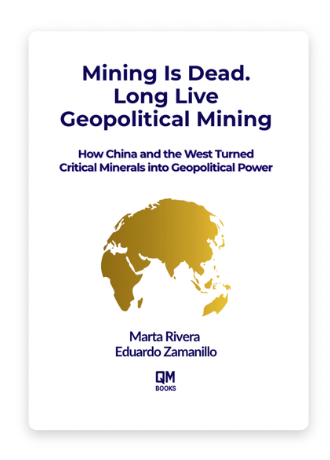
For the full Geopolitical Mining framework behind this article, see our book Mining Is Dead. Long Live Geopolitical Mining.
The mine as a system
Formal mining is one of the most complex forms of economic organization in the material economy. A mine is built over geology, but it operates through a system: engineering, metallurgy, infrastructure, water, energy, capital, labour, law, environmental assessment, public participation, community legitimacy, political continuity, market access and time. Each component can be reviewed separately. Production depends on whether the system can hold together. This is what makes formal mining valuable. It is also what makes it vulnerable. Unlike informal or illegal extraction, formal mining operates under law, public scrutiny, environmental obligations, fiscal commitments, labour standards, financial discipline and long term social expectation. It must be governed, audited, taxed, permitted, challenged, financed, improved and eventually closed.
Formal mining includes extraction, but its value lies in the system that organizes extraction. It is the capacity to transform mineralized rock into production through engineering, law, capital, environmental discipline, fiscal responsibility, labour standards and territorial legitimacy. A formal mine must remain coherent before revenue begins. It must remain coherent through permitting, construction, ramp-up, operation, expansion and closure. It must withstand commodity cycles, judicial review, environmental pressure, changing governments, community expectations, financing conditions and geopolitical shifts. This is why mining viability deserves its own language. The critical minerals debate has already established that modern economies are becoming more mineral intensive. Energy systems, defence capacity, digital infrastructure, data centres, industrial policy and national competitiveness increasingly assume the future availability of minerals. The harder question sits beneath that assumption: which mineral projects can actually become formal production?
Mineral potential becomes economically relevant when it crosses the productive threshold. A deposit must be engineered, permitted, financed, built, socially sustained, operated and connected to a market. Each stage requires confidence: technical confidence, institutional confidence, territorial confidence, financial confidence and political confidence. The central issue is the capacity to organize mineral endowment into production. That is the viability question.
The boundary of feasibility
The mining industry already has a disciplined technical language for project evaluation. Feasibility studies, pre-feasibility studies, mine plans, reserve statements, metallurgical models, CAPEX, OPEX, NPV, IRR and due diligence processes are essential. Reporting standards also recognize that geology alone does not create a mine. CRIRSCO defines Modifying Factors as the considerations used to convert Mineral Resources into Mineral Reserves, including mining, processing, metallurgical, infrastructure, economic, marketing, legal, environmental, social and governmental factors. CRIRSCO also states that a feasibility study should include detailed assessments of applicable Modifying Factors and financial analysis sufficient to demonstrate that extraction is reasonably justified.
That language matters because the technical world already contains the vocabulary of conversion. The challenge is that recent mining history has made the conversion problem broader. A project may satisfy formal technical requirements and still remain vulnerable at the level of territory, legitimacy, litigation, political continuity or institutional trust. It may be strong in engineering terms and fragile in social terms. It may carry an approval and still lack the legitimacy required to endure. Mining viability gives feasibility a wider system to live inside. It asks whether the conditions around the project are strong enough to carry production.
Legitimacy as part of production
Mining is one of the industries where legality and legitimacy must remain closely aligned. This is where sociology becomes useful. Max Weber’s work on legitimacy helps explain why formal authority depends on more than procedure alone. In Weber’s account, people may accept a social order because they trust its legality and the rationality of the rule of law; legitimacy produces more stable social regularities than self interest or habitual compliance alone. Applied to mining, this means that a permit gains strength when the process behind it is trusted. A contract becomes more durable when the public can understand why it is legitimate. A State decision becomes more resilient when the affected territory recognizes the process as credible.
Mark Suchman’s work on organizational legitimacy adds another layer. His distinction between pragmatic, moral and cognitive legitimacy is especially useful for mining because the sector operates at all three levels: benefits must be visible, conduct must be responsible, and formal mining must make sense as part of the normal architecture of modern life. This connects directly with what we have described elsewhere as the mining paradox: modern life depends on formal mining, while modern societies have not yet built a stable language to legitimize it. In that framework, legitimacy is not a soft variable. It is strategic infrastructure.
Mining viability extends that argument. Legitimacy is part of whether a project can produce. A mine operates in a territory, not in an abstract legal environment. It modifies water systems, landscapes, labour markets, local economies, expectations, identities and the distribution of risk. The quality of the procedure matters because the procedure is one of the ways society processes that complexity.
Niklas Luhmann helps frame this point. Complex societies rely on trust and procedures to reduce uncertainty and organize expectations. Environmental assessment, public participation, Indigenous consultation, permitting and judicial review are therefore more than administrative steps. In mining, they are part of the production system because they help determine whether a decision can endure. A procedure that advances formally while leaving the territory unconvinced may still leave the project unstable.
When feasibility meets the territory
The recent Collahuasi case in Chile shows why mining viability cannot be reduced to technical maturity, investment scale or formal approval. This was not an early stage project waiting for initial validation. The Development of Infrastructure and Productive Capacity Improvement project had received a favourable environmental approval at the end of 2021. It was designed to extend Collahuasi’s operational continuity for another 20 years, with an investment of approximately US$3.2 billion. After obtaining the RCA, the company advanced major works linked to its C20+ project, including its first desalination plant. According to company statements cited by Ex-Ante, the project had a favourable RCA obtained five years earlier, an executed investment of approximately US$3.2 billion, and a desalination plant in its final stage of construction. Industry sources cited in the same report estimated that close to 90% of the total investment had already been executed.
In May 2026, Chile’s Second Environmental Tribunal annulled the RCA and ordered the Environmental Assessment Service to reopen the evaluation before the Consolidated Evaluation Report stage, requiring a new analysis focused on the human baseline and marine environment impacts. The ruling followed a claim filed by the Wilamasi Indigenous Association of Fishermen Mamq’uta Caleta Chanavaya and Aymara of Caleta Chanavaya, and required the company to address observations related to the use of the coastal territory around Punta Patache and Puerto Collahuasi, as well as impacts on the marine environment.
The relevance of the case is conceptual. Collahuasi did not become vulnerable because the project lacked engineering, investment or formal environmental approval. Its vulnerability emerged from the way the territory had been read: human baseline, Indigenous associations, coastal use, marine impacts and the procedural strength of the environmental evaluation. That is mining viability in practice. A project can be approved, capital intensive, technically sophisticated and already largely executed, while still carrying a weakness in the social and procedural foundations that sustain it. The issue is not whether the project had passed a formal milestone. The issue is whether that milestone was supported by a system strong enough to carry production.
When production does not settle the viability question
Cobre Panamá shows why mining viability cannot be treated as a question that ends once a mine enters production. This was not a deposit waiting for development, nor a project still moving through feasibility, permitting or construction. Cobre Panamá was already an operating mine. It had crossed the formal thresholds that usually define mining success: the project had been built, capital had been deployed, production had started, exports were moving and the mine had become economically material for Panama and relevant for global copper supply. Reuters has reported that the mine contributed about 1% of global copper output before its shutdown. That is precisely why the case matters.
The rupture did not come from the disappearance of the orebody, the collapse of the processing plant or the absence of market demand. It came from the institutional and social architecture around the mine. In November 2023, Panama’s Supreme Court declared Law 406 unconstitutional; that law had approved the mining concession contract linked to Cobre Panamá. The decision followed weeks of national protest and turned the mine from an operating copper asset into a suspended operation. Cobre Panamá therefore reveals one of the most important dimensions of mining viability: production itself does not eliminate viability risk. A mine may operate physically while its legal, political and social foundations remain exposed. A contract may be signed, a mine may be built, and production may begin; yet the project can still lose the institutional durability required to continue operating.
The economic cost of that rupture has been significant. In May 2026, MINING.COM reported that First Quantum estimated Panama had lost around US$3.5 billion in economic contribution over two years from the suspension, including roughly US$1.1 billion in taxes and royalties. First Quantum’s 2025 Tax Transparency and Economic Contributions Report also states that, had the mine been operating, Cobre Panamá would have contributed at least US$3.5 billion to the Panamanian economy over the period. The mine has not disappeared. Panama approved a maintenance and environmental safety plan in 2025, while clarifying that the plan was not a restart. The asset remains physically present, but its productive future depends on a new institutional, social and political settlement around the project.
That is the viability question. Cobre Panamá shows that a mine can be technically real, economically relevant and operationally proven, while still becoming non productive when the system around it fractures. The mine remains there. The infrastructure remains there. The copper remains there. The demand remains there. What broke was the viability architecture. For Geopolitical Mining, this is the central lesson: mining viability does not end at production. It must be sustained through the life of the mine. A producing asset still depends on legal durability, public legitimacy, environmental credibility, political continuity and institutional trust. When those conditions fail, even production can become temporary.
Criticality and viability
The same distinction matters for critical minerals. Rio Tinto’s Jadar lithium-borates project in Serbia shows how a mineral can be strategically important and still remain constrained by the conditions of territorial viability. Rio Tinto describes Jadar as a high quality lithium and boron deposit with the potential to support long term lithium supply for decades. In July 2024, the Serbian government reinstated the Jadar Project Spatial Plan of the Special Purpose Area, and the project has since been granted Strategic Project status by the European Union because of its importance for Europe’s critical raw materials supply and energy transition.
Yet this strategic recognition has not translated into construction. Rio Tinto states that Jadar is being transitioned into care and maintenance while the company preserves future development options, continues to meet legal obligations, manages land and assets safely, and maintains engagement with stakeholders. The company’s own language is important: Jadar has potential to play a significant role in Serbia and Europe’s energy transition “when conditions allow.”
Those conditions remain contested. Reuters reported that Serbia’s Energy Minister said in August 2024 that Rio Tinto could need up to 24 months to obtain the approvals required before construction could begin, with those approvals depending on the environmental impact study. The same report noted continuing protests and environmental concerns around soil and water impacts. In 2025, Reuters also reported that farmers in the Jadar region vowed to oppose the project even after the European Commission identified it as strategic, citing concerns about pollution of farmland in an agricultural region. This is the viability question in the critical minerals era. Jadar has geological relevance. It has strategic relevance. It has political relevance for Europe’s battery and industrial ambitions. But the project still depends on local legitimacy, environmental credibility, permitting durability, capital discipline and the ability to move from strategic designation to construction and production. Criticality creates urgency. Viability determines whether that urgency can become supply.
Mining viability and the State
Mining viability is also a State capacity question. The State organizes the legal and institutional space where formal mining can exist. It grants permits, defines environmental rules, recognizes Indigenous rights, manages public participation, coordinates infrastructure, supervises compliance, collects fiscal revenues, resolves disputes and, in some jurisdictions, connects mining to industrial strategy. A mineral rich country does not become a strategic supplier automatically. Geological endowment becomes supply when institutions can process complexity, defend legitimate decisions, coordinate infrastructure, protect environmental standards, sustain public trust and provide enough continuity for long-cycle investment.
This is where Geopolitical Mining becomes useful as a lens. Mineral power is the capacity to organize the conditions under which minerals become production, supply and industrial relevance. The State’s role is central. Its task is to build decisions that are technically sound, legally durable, socially defensible and strategically coherent. A State that wants mineral supply while struggling to coordinate territory, permitting, legitimacy and long term policy will struggle to convert endowment into production. That is why mining viability cannot be left only to the company. It belongs to the wider institutional system.
Anomic mining and failed formal viability
The concept also clarifies the relationship between formal mining and anomic mining. Durkheim’s concept of anomie refers to instability produced by the breakdown of standards and values or by the absence of shared purpose. In mining, anomic extraction appears when the formal system loses authority, legitimacy or enforceability over the mineral economy. Demand remains. Prices remain. Local livelihoods remain. Mineral incentives remain. The activity may reorganize through informal, illegal or semi-tolerated channels. This is why formal mining viability matters beyond companies and investors.
A country that cannot make formal mining viable may still experience extraction, but in forms that are less traceable, less taxable, less environmentally controlled, less safe and more vulnerable to capture. The opposite of viable formal mining is often disorder. This point is central. A society that weakens formal mining while maintaining mineral demand does not become post extractive. It risks displacing extraction into weaker, more opaque or less governable systems. Mining viability is therefore a condition of territorial order.
Capital and the viability test
For investors, the distinction between feasibility and mining viability is becoming more important. A traditional due diligence process can examine resource quality, reserves, permits, economics, contracts, debt structure, ESG commitments, construction risk and projected returns. Those elements remain essential. The cases above point to another layer: the ability of the project’s social, institutional and territorial foundations to hold. This is where bankability and viability begin to converge. The World Economic Forum and Columbia SIPA report Making Critical Minerals Bankable focuses on the policy tools required to unlock investment in critical minerals. Its title itself reflects a central problem of the current mineral cycle: projects must become bankable, with risk allocation, revenue certainty and delivery confidence strong enough to attract mainstream private finance.
From a Geopolitical Mining perspective, bankability is one expression of viability. Capital finances the probability that geology can become durable production. It reads the orebody, but it also reads the State, the territory, the permitting path, the legal environment, the social contract, the infrastructure plan and the credibility of execution. A project becomes financeable when the system around it can hold.
A systemic definition of mining viability
This is the core of the concept. Mining viability is the condition that allows formal mining to remain organized across time. It connects technical feasibility with institutional durability. It connects territorial legitimacy with capital confidence. It connects State capacity with production continuity. It connects the material economy’s demand for minerals with the real world conditions required to produce them. The concept is relational. It depends on the quality of the connections among geology, engineering, finance, law, territory, communities, institutions and markets.
A project may look strong when each part is reviewed separately. The orebody may be attractive. The engineering may be credible. The financial model may work. The permits may exist. The market may need the mineral. But if the relations among those elements are fragile, production remains exposed.
Maturana and Varela offer a useful systemic intuition here. Their work on autopoiesis emphasized systems capable of reproducing the conditions of their own operation. Applied carefully to mining, the point is organizational: a formal mine must continuously reproduce the conditions that allow it to operate. It needs legal continuity, social trust, environmental control, labour, capital, infrastructure, institutional support and market access over time. Mining viability is therefore a continuing condition. It is the capacity of the project system to keep producing the conditions that allow production itself.
Conclusion: The Viability Threshold
The next mineral era will place a premium on production that can endure. This is the reason the distinction between feasibility and mining viability matters. Feasibility can demonstrate that a mining project is technically and economically possible. Mining viability asks whether that possibility can become production inside a real system of law, territory, capital, institutions and trust.
For companies, this means that legitimacy, procedure, territory and political durability belong inside the project’s strategic architecture. For investors, it means that value depends on the probability that geology can become sustained production. For States, it means that mineral endowment becomes strategic when institutions can convert it into legitimate and reliable supply.
The material economy will require more than resources, announcements and approvals. It will require formal mining systems capable of producing. That is the viability threshold. And in the era of Geopolitical Mining, it may become one of the defining tests of mineral power.
Resources
Geopolitical Mining. The Mining Paradox: The Legitimacy Gap Behind Modern Life.
Geopolitical Mining. The Return of the Material Economy.
Collahuasi. C20+ Project Information.
Supreme Court of Justice of Panama. Official Announcement Declaring Law 406 Unconstitutional.
First Quantum Minerals. Update on Cobre Panamá Following Panama Supreme Court Decision.
First Quantum Minerals. 2025 Tax Transparency and Economic Contributions Report.
MINING.COM. First Quantum Says Panama Has Lost $3.5B from Mine Halt.
Reuters. First Quantum to Discontinue Two Cobre Panamá Arbitration Proceedings.
Reuters. Panama Says First Quantum Copper Mine Maintenance Plan Is Not a Restart.
Reuters. Rio Tinto’s Serbia Lithium Project Could Take Two Years to Approve, Minister Says.
Reuters. Serbian Farmers Vow to Oppose Rio Tinto Lithium Project Even After EU Labels It Strategic.
Mark C. Suchman. Managing Legitimacy: Strategic and Institutional Approaches.
Niklas Luhmann. Legitimation by Procedure.
Émile Durkheim. The Division of Labor in Society.
Humberto Maturana and Francisco Varela. Autopoiesis and Cognition: The Realization of the Living.