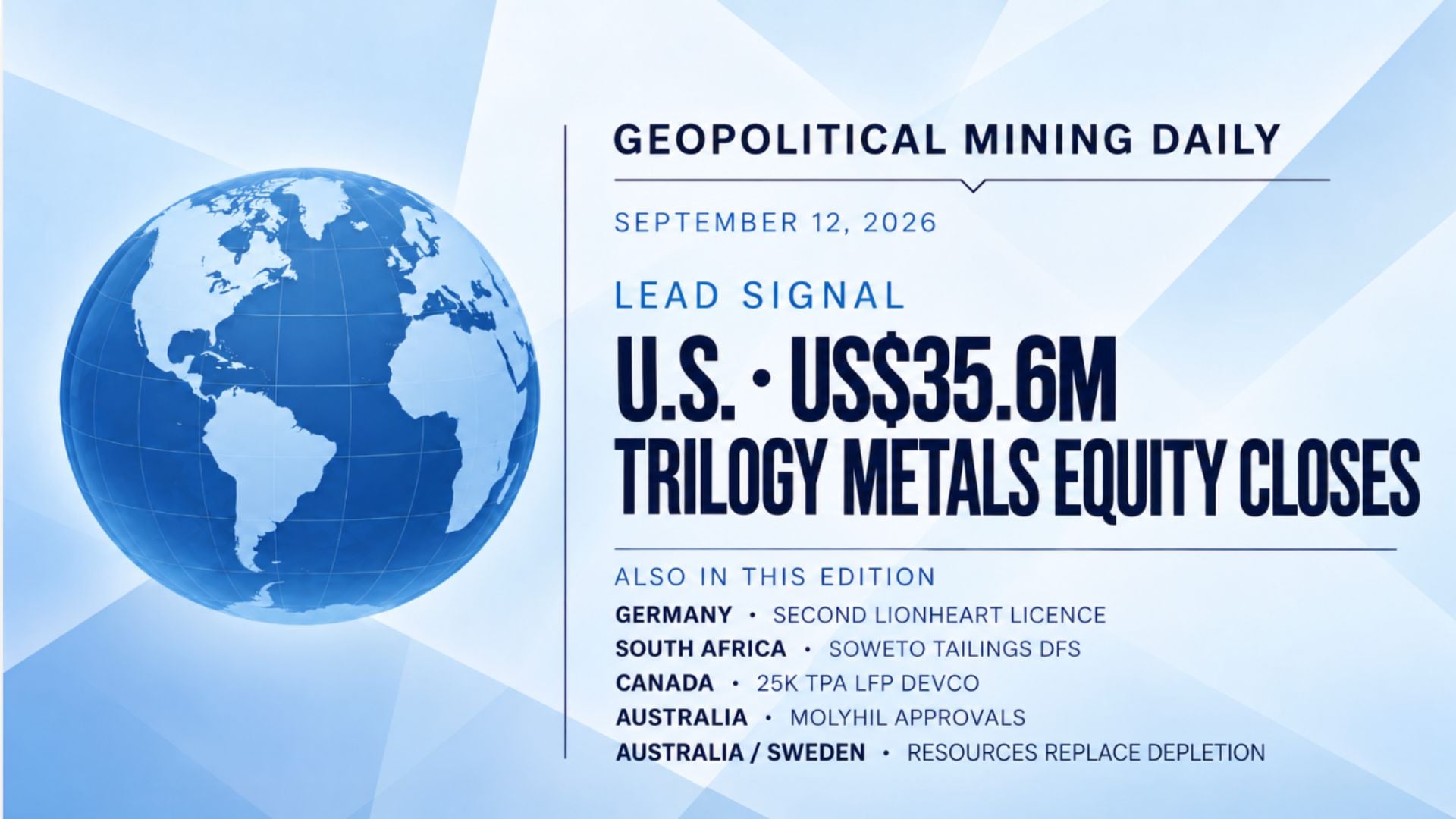

Geopolitical Mining Daily · September 12, 2026
U.S. Department of War Closes US$35.6 Million Trilogy Metals Investment
The U.S. Department of War has converted a previously signed investment into ownership, becoming an approximately 10% Trilogy Metals shareholder while the full US$35.6 million package is directed to the Upper Kobuk Mineral Projects in Alaska. Germany adds a lithium production licence, South Africa defines tailings economics, Canada advances LFP site development, Australia clears tungsten drilling and operating mines replace depletion across Australia and Sweden.
Trilogy Metals closed the approximately US$35.6 million U.S. Department of War strategic equity investment, making the U.S. Government an approximately 10% shareholder and directing the full package to Ambler Metals. Germany granted Vulcan Energy a second Lionheart lithium production licence. Pan African completed the Soweto Tailings Retreatment Definitive Feasibility Study. Nano One advanced its first Canada DevCo for a proposed 25,000 tonne LFP cathode plant. Tivan secured regulatory and cultural heritage approvals for Molyhil development drilling. Alkane reported resource growth across each producing asset and a Costerfield Ore Reserve containing approximately 15,000 tonnes of antimony.
The 2026 observation framework
The ten Signals for 2026
Every Daily edition is read against the same ten strategic lenses. Signals activated by today’s verified developments are highlighted below.
Today’s direction of travel
Strategic mineral policy is moving through increasingly concrete execution layers. Washington has moved from an agreed investment into actual ownership. Germany has added a production licence to a lithium project under construction. South Africa has moved tailings retreatment to DFS definition. Canada is testing a domestic LFP plant configuration. Australia has cleared development drilling at a tungsten project. Existing Australian and Swedish mines are replenishing resources as they produce.
Lead development
U.S. Department of War closes US$35.6 million Trilogy Metals strategic equity investment
What happened
On September 11, Trilogy Metals completed the previously announced strategic equity investment by the U.S. Department of War. The package totals approximately US$35.6 million across transactions with Trilogy and South32, and the U.S. Government has become an approximately 10% shareholder of Trilogy.
Trilogy and South32 have committed the full proceeds to Ambler Metals, their 50/50 joint venture advancing the Upper Kobuk Mineral Projects in northwestern Alaska. The portfolio covers approximately 190,929 hectares and includes the Arctic polymetallic deposit and the Bornite copper cobalt deposit.
The closing converts a structure that was still conditional when definitive agreements were signed on August 28 into actual government ownership. The Department has also committed to work in good faith to help facilitate financing for the proposed 211 mile Ambler Access Project. Arctic entered federal mine permitting in April and was accepted into the FAST 41 program in May, but the access road, mine permits, technical work and full development capital remain separate requirements.
Signal reading
The significance lies in the change of instrument and status. The United States is now using direct ownership alongside permitting coordination and potential infrastructure finance to shape a domestic critical minerals project. Public capital can strengthen the project pathway and influence future control, but it does not make the district financeable or productive by itself. The next strategic test is whether ownership is followed by the access, permits, engineering and capital needed to build.
Next proof point: deployment of the proceeds into Ambler Metals, a credible financing structure for the Ambler Access Project, continued Arctic permitting, updated technical work, construction finance and evidence that the projects can move toward a formal investment decision.
Major development
Germany grants Vulcan a second lithium production licence for Lionheart
What happened
On September 11, the Mining Authority of Rhineland Palatinate granted Vulcan Energy a second lithium production licence for its Lionheart Project in the Upper Rhine Valley Brine Field. The Ilka licence covers the Landau geothermal production permit area, where renewable heat is already being produced.
Ilka follows the earlier LiThermEx licence and is valid until September 9, 2032. Vulcan says it intends eventually to combine the two licences into a permit with a minimum 30 year duration consistent with the Lionheart Field Development Plan.
Lionheart is under construction and targets first production in 2028. The first phase is designed for 24,000 tonnes a year of lithium hydroxide monohydrate, alongside approximately 275 GWh of renewable power and 560 GWh of heat a year. Those figures remain production targets rather than operating results.
Signal reading
The licence matters because regulatory authority is being attached to a project that has already moved into construction. Germany is therefore progressing one of the institutional steps required to turn a domestic brine resource into integrated lithium and geothermal output. The remaining test is execution across wells, processing, commissioning and product qualification before the 2028 production target can become supply.
Next proof point: continued construction performance, field development, combination or extension of the production licences, commissioning of extraction and conversion systems, qualification of lithium hydroxide and first sustained commercial output in 2028.
Major development
Pan African completes DFS for the Soweto Tailings Retreatment Project
What happened
Pan African Resources completed the Definitive Feasibility Study for the Soweto Tailings Retreatment Project adjacent to its Mogale Tailings Retreatment operations on the West Rand of Gauteng. The project contains Mineral Reserves of approximately 108 million tonnes grading 0.28 grams per tonne and containing approximately 0.98 million ounces of gold.
The study evaluates a 600,000 tonne per month retreatment operation designed to use existing Mogale elution, carbon regeneration, electrowinning and smelting infrastructure. It models annual production of 35,000 to 40,000 ounces, approximately 561,000 ounces over about 15 years, and project capital of approximately ZAR3.68 billion, equivalent to about US$216 million at the study exchange rate.
At a study gold price of US$3,550 an ounce, Pan African estimates a post tax NPV at a 13% discount rate of approximately ZAR1.85 billion and a real ungeared IRR of approximately 29.55%. These are modeled outcomes. Principal environmental authorisations are expected during FY27, and a Final Investment Decision is targeted for December 2026 subject to board approval, financing and statutory authorisations.
Signal reading
The DFS converts an adjacent historical tailings resource into a defined development case that can share infrastructure with an operating complex. That can lower incremental capital intensity while also accelerating rehabilitation of legacy tailings areas. The economics are still conditional on gold price, permits, finance and construction delivery, so the study establishes a decision basis rather than a commitment to build.
Next proof point: receipt of principal environmental authorisations, completion of financing, board approval, a December 2026 Final Investment Decision, construction against the 28 month schedule and operating performance against recovery and cost assumptions.
Major development
Nano One advances first Canada DevCo for a proposed 25,000 tonne LFP cathode plant
What happened
Nano One began advancing its first Development Company project in Canada, with a site evaluation study for a proposed 25,000 tonne per year lithium iron phosphate cathode active material facility and potential expansion to as much as 100,000 tonnes per year.
Early work includes assessment of utilities, infrastructure and permitting pathways, alongside discussions with potential customers and strategic partners. Nano One is also engaging Canadian suppliers of lithium carbonate, phosphoric acid, iron feedstock and key plant equipment, with material qualification and testing continuing through its Burnaby and Candiac facilities.
The standardized 25,000 tonne per year plant engineering is based on Nano One’s One Pot LFP CAM package and is supported in part by Natural Resources Canada funding. The project does not yet have a selected site, committed construction capital or a Final Investment Decision. Nano One says each DevCo is intended to be financed on its own merits through a combination of government and private investment.
Signal reading
This development moves Nano One’s licensing strategy from a general DevCo model into a specific Canadian project workstream. The strategic value lies in connecting domestic mineral inputs to cathode manufacturing, the midstream layer where North American battery chains remain comparatively thin. Site selection, qualified feedstock, partners, offtake and project capital now become the proof points that determine whether the concept turns into industrial capacity.
Next proof point: selection and control of a site, completed infrastructure and permitting studies, qualified Canadian feedstocks, customer and strategic partner commitments, a funded project vehicle, a Final Investment Decision and construction.
Major development
Tivan clears regulatory and cultural heritage approvals for Molyhil development drilling
What happened
Tivan secured the final regulatory and cultural heritage approvals required to plan and mobilise an approximately 8,000 metre development drilling program at the Molyhil Tungsten Project in the Northern Territory. The approvals include a variation under the Territory’s Environment Mining Licence framework and a Sacred Site Clearance Certificate following a work area clearance process with the Central Land Council.
The planned Stage 2 program comprises approximately 50 holes across the existing Mineral Resource and wider project area. The campaign is designed to generate geological, metallurgical, geotechnical and hydrogeological information for the Pre Feasibility Study, environmental approvals and development planning.
Molyhil has a reported Measured, Indicated and Inferred Mineral Resource of approximately 4.647 million tonnes grading 0.26% tungsten trioxide and 0.09% molybdenum, containing about 12,100 tonnes of tungsten trioxide and 4,400 tonnes of molybdenum. The new approvals authorize the drilling program. They do not constitute a mine development approval, project finance or a Final Investment Decision.
Signal reading
The milestone is important because technical definition and cultural heritage clearance are progressing together rather than as separate late stage workstreams. The drilling can now generate the data needed to reduce geological, metallurgical and engineering uncertainty, while the heritage approval establishes the territorial conditions for that field program. Project viability will still depend on the PFS, mine approvals, definitive financing arrangements and a construction decision.
Next proof point: mobilisation and completion of the 8,000 metre program, updated resource confidence, metallurgical and geotechnical results, PFS completion, further environmental and mine approvals, definitive investment agreements and a Final Investment Decision.
Major development
Alkane reports resource growth across producing mines and 15,000 tonnes of antimony in Costerfield reserves
What happened
Alkane Resources published updated Mineral Resource and Ore Reserve estimates for its producing assets in Australia and Sweden as at June 30, 2026. Management said each producing asset recorded resource growth and replaced depletion through continued exploration and resource extension.
Costerfield in Victoria reports Measured and Indicated Mineral Resources of approximately 1.993 million tonnes grading 6.0 grams per tonne gold and 2.1% antimony, containing about 387,000 ounces of gold and 42,000 tonnes of antimony. Its Ore Reserve stands at approximately 960,000 tonnes grading 5.5 grams per tonne gold and 1.6% antimony, containing about 170,000 ounces of gold and 15,000 tonnes of antimony.
Across Alkane’s producing gold assets, Björkdal in Sweden reports Ore Reserves containing approximately 563,000 ounces of gold and Tomingley in New South Wales approximately 641,000 ounces. Resource and reserve replacement supports future mine planning, but it does not itself increase annual production or guarantee conversion of all Mineral Resources into mineable reserves.
Signal reading
Operating supply chains depend on mines replacing the material they deplete, not only on discovering new deposits elsewhere. Alkane’s update is therefore a useful counterpoint to the earlier stage projects in this edition. At Costerfield it also preserves a quantified antimony reserve inside an operating Australian mine, giving resource replacement a strategic dimension beyond gold.
Next proof point: annual mine plans, reserve conversion from the larger resource base, reconciliation against mined grades, sustained production at Björkdal, Tomingley and Costerfield, and realized antimony output and recoveries from Costerfield.
The system reading
What today’s evidence tells us
The distance between strategic intention and physical supply is narrowing through different instruments, but the six developments remain on different execution rungs. Trilogy now has the U.S. Government inside its ownership structure, while access infrastructure, permitting and full development capital remain ahead. Vulcan has another production licence and active construction, but first lithium output is targeted for 2028. Pan African has feasibility level economics, yet still requires authorisations, finance and a Final Investment Decision. Nano One has moved a Canadian LFP concept into site and supply chain work without selecting a location or committing construction capital. Tivan can mobilise development drilling after regulatory and cultural heritage clearance, while mine approval remains separate. Alkane is closest to durable supply because Björkdal, Tomingley and Costerfield already operate and are replacing depletion. Across the edition, the relevant question is not whether a strategic mineral exists, but which institutional, capital and physical barriers have actually been removed.
Signals for 2026 gives the map. The Daily records new evidence against that map. Today’s lead shows state mineral strategy becoming balance sheet ownership, while the wider edition tests whether licences, feasibility, midstream engineering, territorial approvals and reserve replacement can convert into durable supply.