Geopolitical Mining · Geopolitical Milestones
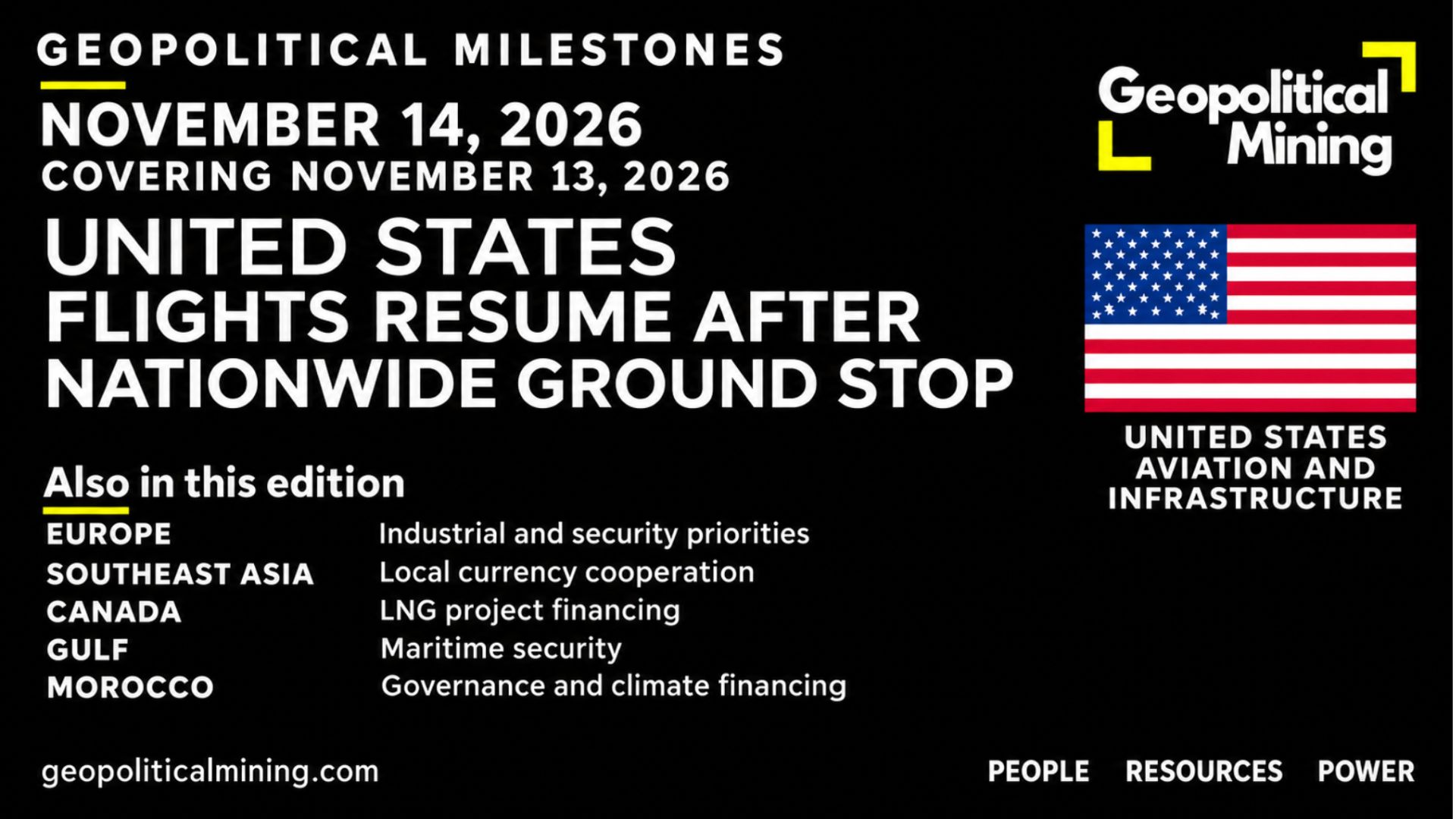
United States: Nationwide Flight Ground Stop Lifted After Communications Outage
A nationwide flight ground stop in the United States leads this edition. European leaders set out AI investment priorities and agree a negotiating team for Ukraine, while four Southeast Asian central banks expand local currency cooperation. Canada backs an LNG expansion, the UN assesses maritime risks in the Gulf and Red Sea, and Morocco signs financing for economic and energy reforms.
Geopolitical Milestones is a daily briefing for senior executives, investors and policymakers. Each edition examines significant international developments and their implications for investment, business strategy and public policy.
In focus: The infrastructure and institutions behind transport, energy supply, digital investment and regional trade, alongside Europe’s coordination on Ukraine.
Milestone 01
United States: Nationwide Flight Ground Stop Lifted After Communications Outage
The Federal Aviation Administration imposed a nationwide ground stop on November 13 after communications problems affected several air traffic control centres. The order held departures while controllers continued to manage aircraft already in the air. It was a restriction on takeoffs, not a closure of US airspace or every airport.
The Department of Transportation said instability in radar and communications systems began at 15:36 Eastern Time. Transportation Secretary Sean Duffy attributed the disruption to overloaded older equipment. That was the department’s initial explanation, rather than a completed technical investigation.
The department announced that the ground stop had been lifted at 20:15 Eastern Time. Local authorities also reported exceptions during the disruption, including some international services and flights between the Hawaiian islands. However, permission to depart did not immediately restore normal schedules: airlines still had to reposition aircraft and crews.
Geopolitical Mining perspective
Air transport depends on communications networks as well as airports and aircraft. A failure in that shared infrastructure can interrupt movements across the country, even where terminals and runways remain available. Its maintenance and replacement are therefore part of the capacity on which businesses and passengers rely.
Recovery also takes place at two levels. Restoring air traffic systems allows departures to resume; restoring airline schedules depends on where aircraft and crews have ended up. The distinction helps explain why disruption can continue after the original restriction is lifted.
Milestone 02
Europe: Leaders Set Out AI Investment Priorities and Agree Ukraine Negotiating Team
European Union leaders met in Dublin on November 13 for an informal European Council focused on artificial intelligence and Ukraine. The meeting followed the European Political Community gathering the previous day, but brought a separate discussion of EU investment priorities and diplomatic coordination.
Following exchanges with Arthur Mensch and Geoffrey Hinton, leaders discussed European AI models, infrastructure, public and private investment, and dependence on external technology. European Council President António Costa identified affordable clean energy as an essential part of building AI capacity. He also pointed to the next EU budget and the European Competitiveness Fund as financing instruments. The remarks did not announce a new funding allocation.
On Ukraine, Costa said leaders had agreed on a European negotiating team bringing together EU institutions and the E5 countries of the Coalition of the Willing: France, Germany, Italy, Poland and the United Kingdom. The agreement concerns European representation in negotiations, not a peace settlement. Further discussion of Ukraine’s financing is scheduled for the European Council on November 26 and 27.
Geopolitical Mining perspective
Europe’s AI ambitions reach beyond software. Computing infrastructure needs electricity, capital and access to technology, which connects the digital agenda to energy and industrial investment. The budget choices that follow will determine how much of that capacity Europe can build and finance.
The Ukraine decision addresses a different institutional question: who represents Europe in negotiations. An agreed team provides a channel for that work, while decisions on financing and the terms of any settlement remain separate.
Milestone 03
Indonesia, Malaysia, Thailand and the Philippines: Central Banks Expand Local Currency Cooperation
The central banks of Indonesia, Malaysia, Thailand and the Philippines signed a memorandum on November 13 to expand cooperation under the Local Currency Transaction Framework. The arrangement covers the use of local currencies in bilateral trade, investment and other eligible transactions.
The new memorandum replaces the bilateral agreements signed in 2023 between Bank Indonesia, Bank Negara Malaysia and the Bank of Thailand, and brings the Philippine central bank into the four party framework. Practical implementation will be developed in stages. The agreement does not create a common currency or require businesses to abandon existing settlement currencies.
Geopolitical Mining perspective
Regional trade depends on the financial channels through which firms receive and make payments. Local currency arrangements can offer another route for settling transactions, particularly where revenues and costs arise in neighbouring markets.
Their commercial usefulness rests on the banking services, liquidity and hedging options available to businesses. The memorandum extends the institutional framework; those practical conditions will determine how widely companies use it.
Milestone 04
Canada: C$200 Million Investment Supports Woodfibre LNG Expansion
Canada announced a C$200 million investment on November 13 to expand the Woodfibre LNG project in British Columbia. Natural Resources Canada said the investment would support an increase in annual capacity from 2.1 million tonnes to between 2.5 million and 2.6 million tonnes.
The project is expected to begin operations at the end of 2027. A second phase is also being explored, but the announcement does not establish approval for that further development. The government presented the investment as part of its effort to diversify export markets and expand Canadian LNG supply.
Geopolitical Mining perspective
Access to overseas gas markets requires export infrastructure, not just a resource base. Increasing terminal capacity gives Canada more room to sell into those markets, while tying the export strategy to construction schedules and the capital needed to complete the facilities.
The distinction between the funded expansion and a possible second phase matters. They represent different levels of commitment, and only the announced capacity increase belongs in the project’s current development outlook.
Milestone 05
Gulf and Red Sea: UN Warns of Continuing Shipping Risks Despite Energy Export Recovery
In a November 13 Security Council briefing, UN Assistant Secretary-General Khaled Khiari said Gulf energy export volumes had largely recovered, helped in part by alternative routes. Maritime shipments nevertheless remained below their levels before the conflict.
Khiari said October had recorded the highest monthly number of incidents involving commercial shipping since February in the Strait of Hormuz and the wider Middle East maritime area. He also drew attention to the consequences for transport, insurance, energy and fertiliser supply.
The briefing distinguished those incidents from conditions in the Red Sea. Khiari reported no recent attacks on commercial vessels there, while warning that risks around the Bab al Mandab persisted.
Geopolitical Mining perspective
Export volumes and reliable shipping conditions are not the same measure. Alternative routes can restore supply while vessels, cargo owners and insurers continue to face disruption or higher costs. Recovery in volumes alone does not describe the full commercial position.
Hormuz and the Bab al Mandab serve different routes. Keeping those geographies distinct is essential to understanding the disruption to energy and commodity movements.
Milestone 06
Morocco: €434.4 Million Financing Agreement Supports Economic and Energy Reforms
Morocco and the African Development Bank signed a €434.4 million financing agreement in Rabat on November 13. The agreement supports the third phase of the Economic Governance and Climate Change Resilience Support Programme.
The programme covers public enterprise reform, the framework for public private partnerships, the business environment, and governance of water and electricity services. It seeks to strengthen private investment while supporting the state’s strategic role. The bank also placed the financing in the context of higher energy and transport costs associated with the Middle East crisis.
The agreement supports policy reforms rather than announcing funding for individual construction projects.
Geopolitical Mining perspective
Water and electricity services connect institutional reform to the operating conditions of industry. How these services are governed affects the reliability of supply and the ability to finance new capacity.
Public enterprise and partnership reforms also shape how the state and private investors share responsibilities. The programme’s importance lies in that combination: financing supports changes to the institutions through which infrastructure and industrial investment take place.
Continue reading Geopolitical Mining. Explore our daily mining coverage, weekly reviews and country analysis.