Geopolitical Mining · Geopolitical Milestones
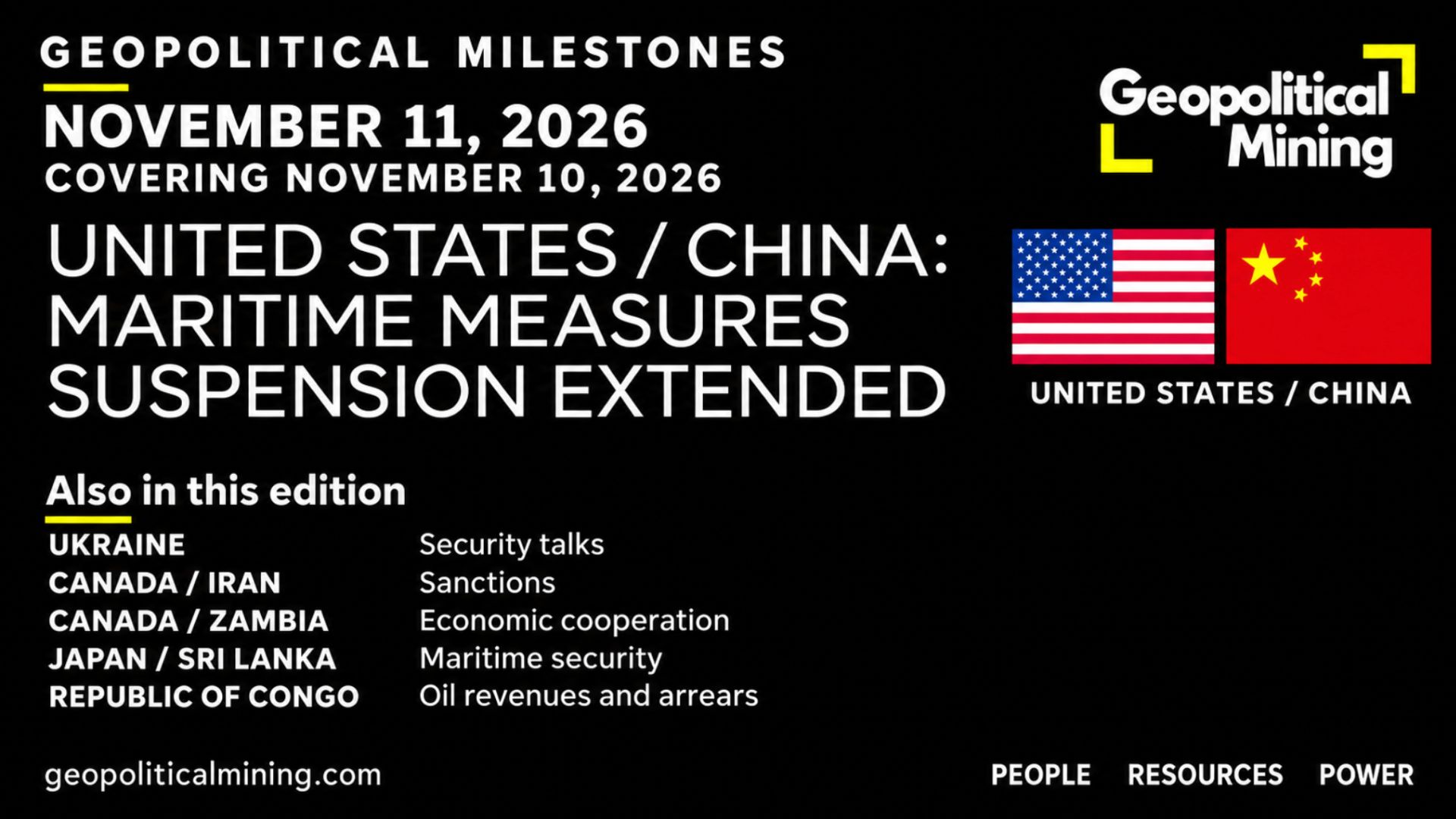
United States Extends Suspension of China Maritime Measures
The United States has extended its suspension of measures affecting Chinese shipping and port equipment. The decision preserves a period of commercial continuity while negotiations continue. Elsewhere, Ukraine’s security talks, Canada’s Iran sanctions and partnerships involving Zambia and Sri Lanka show how institutions shape investment conditions. The Republic of Congo’s economic update examines the link between oil revenues and public payment obligations.
Geopolitical Milestones is a daily briefing for senior executives, investors and policymakers. Each edition examines significant international developments and their implications for investment, business strategy and public policy.
Also in this edition: Ukraine’s security talks; Canada’s Iran sanctions; Canada and Zambia’s economic cooperation; Japan’s maritime security grant to Sri Lanka; and the Republic of Congo’s oil revenues and public payment arrears.
Milestone 01
United States Extends Suspension of China Maritime Measures
A USTR notice carrying a November 10 publication date extends the suspension of measures arising from its Section 301 investigation into China’s maritime, logistics and shipbuilding practices. Effective November 9, the extension runs through 11:59 p.m. Eastern Time on January 9, 2027.
The suspension covers specified maritime service fees and duties on Chinese ship-to-shore cranes and cargo-handling equipment. Liability for those charges does not accrue during the suspension. USTR says discussions with China continue and that it will review the position before the January deadline.
Geopolitical Mining reading:
Shipping policy reaches into the costs of moving materials and equipping ports. Extending the suspension preserves current operating conditions while negotiations continue, giving commercial activity a further period of continuity. The short duration also keeps policy uncertainty close to procurement and transport decisions. This illustrates the different time horizons involved: trade negotiations can advance through brief extensions, while vessels and port infrastructure require commitments lasting many years.
Milestone 02
Ukraine, United States and European Partners Discuss Security Guarantees
Representatives of Ukraine, the United States and European partners met in Abu Dhabi on November 10 to coordinate their approach to negotiations involving Russia. The European Council’s account places credible security guarantees, sovereignty and territorial integrity among the principles for a negotiated settlement.
Later that day, Ukraine’s presidency reported that Volodymyr Zelenskyy briefed Nordic leaders in Copenhagen on the Abu Dhabi talks. Their discussion linked the diplomatic process with support for Ukraine’s energy system. Neither account announced a ceasefire or final security guarantees.
Geopolitical Mining reading:
The credibility of a security framework would influence how governments and private capital assess commitments extending beyond an initial settlement. Reconstruction, industrial capacity and transport infrastructure require confidence that assets can remain operational over time. The discussion therefore matters for the conditions surrounding future investment. Its practical significance will depend on the responsibilities, resources and enforcement arrangements that emerge from negotiations.
Milestone 03
Canada Restores Sanctions on Iranian Oil, Banking and Nuclear Entities
Canada announced on November 10 that it was reimposing sanctions on 11 Iranian entities previously delisted in 2016 following progress under the nuclear agreement. The list includes the National Iranian Oil Company, National Iranian Tanker Company, several banks, Iran Insurance Company and nuclear-sector organisations.
Global Affairs Canada linked the decision to concerns over Iran’s nuclear activities and cooperation with the International Atomic Energy Agency. The measures prohibit specified financial and property transactions involving listed entities by persons in Canada and Canadians abroad.
Geopolitical Mining reading:
The composition of the list shows how economic pressure operates through the institutions connecting production to international commerce. Oil companies, shipping, banking and insurance form part of the same commercial network. Restrictions across those channels can complicate transactions beyond the physical movement of a commodity. The announcement adds to the institutional constraints surrounding Iranian trade, while any effect on export volumes remains a separate question.
Milestone 04
Canada and Zambia Sign Economic Cooperation Memorandum
Canada reported on November 10 that a visit to Zambia from November 8 to 10 included the signing of a memorandum on economic and development cooperation. It covers trade, investment, critical minerals and economic growth. Canada also inaugurated its High Commission in Lusaka.
The visit brought more than C$10.5 million in announced support. This includes C$7.5 million for local economic opportunities along the Lobito Corridor, C$2 million for financial-sector supervision and capital markets, and technical assistance for electricity transmission. A FinDev Canada loan of approximately C$50 million mentioned in the release had been announced earlier this month.
Geopolitical Mining reading:
The package connects diplomatic presence with some of the practical conditions supporting investment. A transport corridor can carry wider economic value when local businesses have access to markets, finance and reliable electricity. Canada’s engagement therefore extends beyond mineral resources to the institutions and services around production. The funding is modest in relation to major infrastructure needs, but its allocation shows where the partnership is seeking to strengthen those connections.
Milestone 05
Japan and Sri Lanka Sign ¥1 Billion Maritime Security Grant
Japan and Sri Lanka signed and exchanged notes in Colombo on November 10 for a ¥1 billion Official Security Assistance project. The grant will provide the Sri Lanka Navy with rigid-hull inflatable boats for monitoring and surveillance.
Japan’s foreign ministry says the assistance is intended to strengthen maritime law enforcement, search and rescue, and disaster response. It identifies Sri Lanka’s position along Indian Ocean sea lanes connecting Asia, the Middle East and Africa as the strategic context. The announcement concerns the agreement; it does not report delivery of the boats.
Geopolitical Mining reading:
Maritime security depends partly on the capabilities of states situated along important commercial routes. This agreement gives Japan’s regional diplomacy a practical equipment component and strengthens its security relationship with Sri Lanka. For the material economy, the connection lies in the local capacity supporting maritime activity. Its contribution will develop through delivery, training and sustained operations, rather than through the financial size of the grant alone.
Milestone 06
Republic of Congo: World Bank Calls for Action on Arrears
The World Bank released its latest Republic of Congo Economic Update on November 10, identifying higher oil revenues as an opportunity to reduce payment arrears and strengthen public finances. It projects economic growth of 4.4% in 2026 and a fiscal balance of 3.7% of GDP, compared with 0.6% in 2025.
The report anticipates weaker fiscal conditions as oil prices normalise in 2027 and 2028. It recommends stronger cash management, debt management and measures to prevent new arrears. These are the institution’s projections and recommendations, rather than reforms announced as completed.
Geopolitical Mining reading:
Resource revenues influence the wider economy through the state’s ability to meet its obligations. When public payments are delayed, the pressure reaches suppliers, business liquidity and investment. A period of stronger oil income can therefore have significance beyond the fiscal balance if it improves payment continuity. The report highlights the institutional work required to turn a favourable commodity cycle into more dependable operating conditions.
Continue reading Geopolitical Mining. Explore our daily mining coverage, weekly reviews and country analysis.