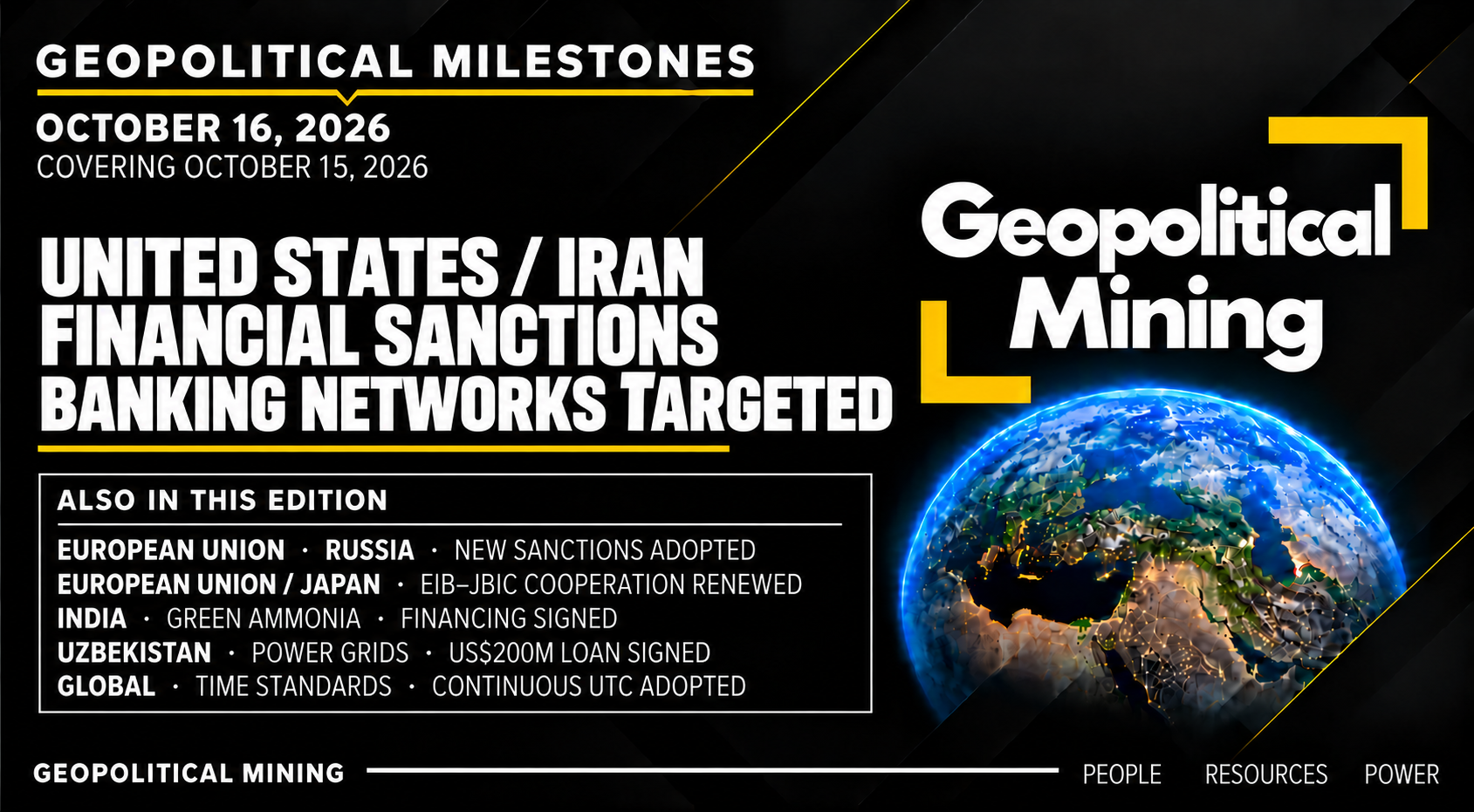

Geopolitical Mining · Geopolitical Milestones
U.S. Sanctions Target Iran’s Financial Networks
Iran financial sanctions lead a day of decisions affecting cross-border payments, project financing and technical standards. European sanctions listings also widen counterparty checks, while signed agreements advance investment cooperation and energy infrastructure.
Geopolitical Milestones is a daily briefing for senior executives, investors and policymakers. Each edition examines significant international developments and their implications for investment, business strategy and public policy.
Also in this edition: European anti-circumvention listings; investment cooperation between Europe and Japan; green ammonia financing in India; an electricity distribution loan for Uzbekistan; and a decision on continuous Coordinated Universal Time.
Financial sanctions and international payments
U.S. expands Iran financial sanctions across banking networks
The United States Department of the Treasury announced Iran financial sanctions on October 15 targeting banks and financial operatives. Its Office of Foreign Assets Control designated Iraq-based International Development Bank for Investment and Finance under Executive Order 13902. The action also names Jazireh International Bank Company and Chabahar International Bank Overseas Company. Treasury alleges that the targets facilitated Iranian financial activity and sanctions evasion; these are administrative designations, not court verdicts.
Banks and corporate treasurers should review payment chains because the exposure extends beyond Iranian counterparties. The measures block designated parties’ property and interests in property in the United States. They also cover such property in the possession or control of United States persons. United States persons generally cannot transact in blocked property, subject to applicable licences or exemptions. Screening should therefore address intermediaries as well as direct customers, rather than relying solely on the destination country.
United States Department of the Treasury
Sanctions enforcement
Council of the European Union adds twelve sanctions listings
The Council of the European Union listed three individuals and nine entities on October 15 for circumventing sanctions against Russia. The measures cover sanctioned-goods imports as well as oil transactions and financial channels. The listings also cover shipping and oil-trading intermediaries. Asset freezes apply, as does a ban on providing funds or economic resources. Listed individuals additionally face European Union travel bans.
For banks and trading companies, intermediary exposure matters because payment and trading chains can extend beyond the direct customer. Counterparty reviews should therefore cover ownership and payment routes as well as the immediate buyer. The adopted listings change the screening perimeter, but they do not impose a general embargo on every jurisdiction in a transaction chain.
Council of the European Union
International investment cooperation
European Investment Bank renews cooperation with Japan Bank for International Cooperation
The European Investment Bank and Japan Bank for International Cooperation renewed their memorandum of understanding in Bangkok on October 15. Cooperation will therefore continue for another five years, extending a relationship established in 2018. It focuses on critical minerals and resilient supply chains, while supporting opportunities across Europe, Asia, Africa and neighbouring regions. The institutions will also explore cofinancing.
For project sponsors, the renewal provides a framework for approaching two public financing institutions with complementary interests. It does not, however, approve an individual investment or create a disclosed new funding pool. Sponsors therefore still need to establish project eligibility, risk allocation and financing terms. Existing joint activity demonstrates the relationship, but historical commitments should not be counted as fresh capital under this memorandum.
European Investment Bank
Industrial decarbonisation
Asian Development Bank and Japan back India’s green ammonia conversion
The Asian Development Bank announced signed financing agreements with AM Green Ammonia (India) Private Limited on October 15. The package includes a US$100 million loan from Leading Asia’s Private Infrastructure Fund 2. Japan International Cooperation Agency finances that fund, while the Asian Development Bank administers it. The project will convert a former gas-based ammonia and urea facility to renewable ammonia, with planned annual capacity of about 1.1 million tonnes.
This is the first investment under Action for Creating Energy Security for Long-term Resilience. For industrial buyers, the project could expand lower-carbon supply, but the announced capacity is still prospective. Procurement plans should therefore distinguish the financing milestone from construction progress and commercial availability. Signed agreements also do not establish that lenders have disbursed the funds.
Asian Development Bank
Electricity distribution
Asian Development Bank signs US$200 million electricity loan with Uzbekistan
The Asian Development Bank and Uzbekistan signed a US$200 million loan on October 15 to modernise electricity distribution. The programme covers 60 substations as well as digital network systems. It also marks the country’s first results-based energy lending operation. The Full Mutual Reliance Framework supports cooperation with the World Bank. That institution expects to seek Board approval later in October for a separate US$100 million contribution, so this financing remains prospective.
Grid investment matters because generation additions need distribution capacity to reach customers. The programme is expected to enable at least 3.3 gigawatts of renewable capacity; that figure describes an intended result, not completed connections. Investors should therefore track implementation alongside new generating projects. The signed loan advances financing, while equipment upgrades and network performance remain delivery milestones.
Asian Development Bank
International technical standards
General Conference on Weights and Measures adopts continuous Coordinated Universal Time
The General Conference on Weights and Measures adopted continuous Coordinated Universal Time on October 15, effective May 20, 2027. Resolution 5 sets the maximum absolute difference between Earth-rotation time and Coordinated Universal Time at 3,600 seconds. This tolerance is one hour, but it does not instruct users to move clocks forward or backward by an hour.
The decision matters for telecommunications, energy networks, transport and space systems because they depend on interoperable timing. Operators should therefore assess how suppliers and infrastructure will handle the transition. The International Bureau of Weights and Measures will support implementation, while the conference remains the adopting authority. The immediate milestone is the decision; operational changes follow the future effective date.
Primary decision and adoption record
International Bureau of Weights and Measures · October 15, 2026
Adoption record · International Bureau of Weights and Measures · October 15, 2026
Continue reading Geopolitical Mining. Explore our daily mining coverage, weekly reviews and country analysis.