Geopolitical Mining · Geopolitical Milestones
U.S.-Canada Procurement Restrictions, Canada-EU Strategic Alliance Talks and China-Iran Hormuz Diplomacy
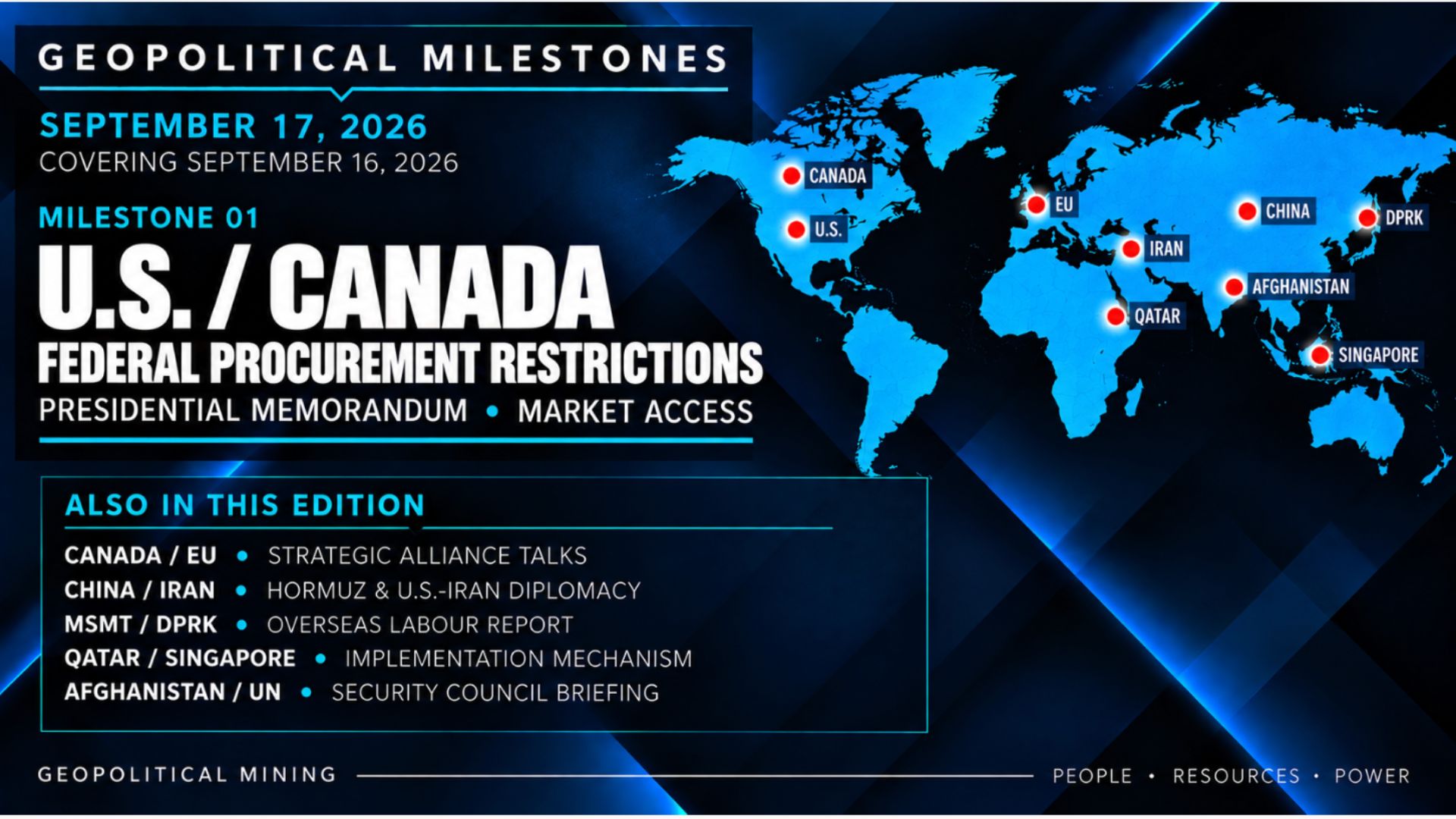
September 16 combined a U.S. procurement memorandum targeting Canadian-origin goods with Canada-EU talks on a broader strategic alliance, while China and Iran addressed the U.S.-Iran conflict and the Strait of Hormuz, a multilateral sanctions group released a new DPRK labour report, Qatar and Singapore reviewed implementation mechanisms, and the UN Security Council assessed Afghanistan.
Also in this edition: Canada-EU strategic capabilities, China-Iran talks on Hormuz, the MSMT report on DPRK overseas labour, Qatar-Singapore implementation cooperation and the UN Security Council briefing on Afghanistan.
Trade policy and government procurement
U.S. directs agencies to identify Canadian-origin goods for possible removal from federal civil procurement
President Donald Trump issued a memorandum on September 16 directing the Office of Management and Budget and the U.S. Trade Representative, working with the Federal Acquisition Regulatory Council, to identify Canadian-origin items in the federal civil procurement system that could, where warranted and permitted by law, be removed or made unavailable for purchase.
The memorandum said the action responded to Canadian federal and provincial procurement preferences and directed officials to identify domestic alternatives, monitor Canada’s treatment of U.S.-origin goods and report circumstances that could justify additional action or restoration of access.
White House · Presidential memorandum
Restoring Reciprocity in Government Procurement · September 16, 2026Strategic autonomy and economic security
Canada and EU discuss moving beyond CETA toward broader strategic alliance
Prime Minister Mark Carney met European Commission President Ursula von der Leyen in Strasbourg on September 16 and welcomed her proposal for Canada and the European Union to move beyond CETA toward what the Canadian readout described as a stronger and more ambitious alliance.
The leaders discussed strategic capabilities including critical minerals, defence industrial capacity, artificial intelligence and compute, energy security, space, financial services and payments, alongside the possibility of more seamless digital trade in non-agricultural goods and services.
Prime Minister of Canada · Readout
Prime Minister Carney meets European Commission President Ursula von der Leyen · September 16, 2026Middle East diplomacy and energy security
China and Iran discuss return to negotiations and reopening Strait of Hormuz
Chinese Foreign Minister Wang Yi met Iranian Foreign Minister Seyyed Abbas Araghchi in Beijing on September 16. China called for Iran and the United States to return to diplomatic negotiations and said all parties should work toward reopening the Strait of Hormuz and safeguarding international navigation, energy transport and production and supply chains.
China’s official account said Araghchi stated that Iran did not want the conflict to continue, considered the U.S.-Iran memorandum of understanding still valid and had reached a plan with Oman concerning the opening of the Strait of Hormuz.
Ministry of Foreign Affairs of China · Ministerial talks
Wang Yi holds talks with Iranian Foreign Minister Seyyed Abbas Araghchi · September 16, 2026Sanctions monitoring and security financing
Multilateral sanctions team releases report on DPRK overseas labour network
The Multilateral Sanctions Monitoring Team released its third report on September 16, examining overseas North Korean labour and alleged violations and evasions of UN Security Council sanctions. The participating governments said the DPRK continued to deploy an estimated 35,600 to 101,280 workers, with most located in China and Russia.
The joint statement said at least 17 countries were suspected of continuing to host labourers and estimated that overseas workers generated between US$450 million and US$800 million in 2025. The participating states called for full implementation of existing UN resolutions and for the Security Council to re-establish the former Panel of Experts.
Global Affairs Canada · MSMT joint statement
Joint statement on the MSMT report covering DPRK overseas labour · September 16, 2026Bilateral implementation and regional trade
Qatar and Singapore review implementation mechanism across security, business and energy resilience
Qatar and Singapore held the third meeting of their Implementation Monitoring Mechanism in Doha on September 16. The mechanism reviewed work across six technical committees covering information and communications technology, security, business, legal affairs, sustainability and social development.
The joint statement called for accelerated work on deliverables including energy resilience and sustainable development, supported an upgrade of the GCC-Singapore Free Trade Agreement, referred to continuing ASEAN-GCC FTA discussions, and stressed the importance of safe and continuous transit through the Strait of Hormuz.
Singapore Ministry of Foreign Affairs · Joint statement
Qatar-Singapore Implementation Monitoring Mechanism · September 16, 2026Afghanistan and multilateral security
UN Security Council reviews Afghanistan as UNAMA warns of accumulating stability risks
The UN Security Council met on Afghanistan on September 16 to consider the Secretary-General’s latest report. Georgette Gagnon, Deputy Special Representative and Officer-in-Charge of UNAMA, said that risks to Afghanistan’s stability were accumulating despite signs of improved security, infrastructure development and economic stabilization efforts.
The UN briefing highlighted continuing restrictions on women and girls, exclusionary governance, humanitarian and economic pressures and the continued presence of terrorist groups. Gagnon also stressed the importance of sustained international engagement, including through the Doha Process.
United Nations DPPA / UNAMA · Security Council briefing
Deputy Special Representative for Afghanistan remarks to the Security Council · September 16, 2026Continue reading Geopolitical Mining. Explore our daily mining coverage, weekly reviews and country analysis.