Geopolitical Mining · Geopolitical Milestones
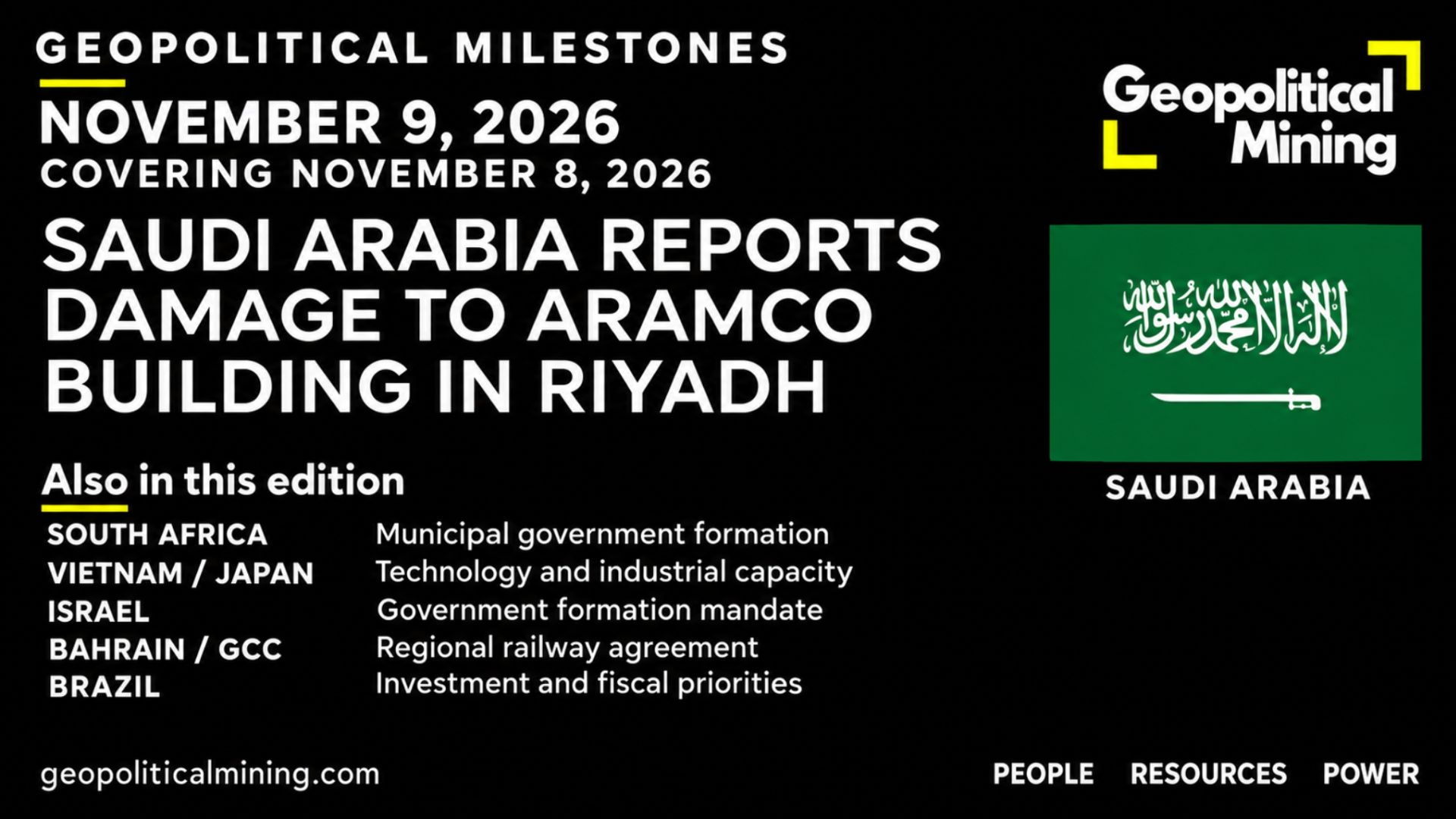
Saudi Arabia Reports Limited Damage to Aramco Building in Riyadh
Saudi Arabia’s account of damage to an Aramco building leads six developments connecting regional security, public institutions and investment. Municipal government in South Africa, technology links between Vietnam and Japan, Israel’s government formation, the Gulf railway agreement and Brazil’s economic priorities complete the edition.
Geopolitical Milestones is a daily briefing for senior executives, investors and policymakers. Each edition examines significant international developments and their implications for investment, business strategy and public policy.
Also in this edition: South African municipal governments; Vietnam and Japan’s technology connections; Israel’s government formation; the Gulf railway agreement; and Brazil’s investment and fiscal priorities.
Milestone 01
Saudi Arabia Reports Limited Damage to Aramco Building in Riyadh
Saudi Arabia’s Ministry of Energy reported on November 8 that falling fragments caused limited damage to an administrative building belonging to Saudi Aramco in Riyadh after an attempted attack. According to the ministry, there were no injuries or fatalities. The building is separate from Aramco’s headquarters in Dhahran.
Houthi authorities claimed four operations that day and described them as a response to strikes they attributed to Saudi Arabia in Yemen. A late November 8 statement by the health ministry in Houthi controlled Sanaa reported 44 deaths and 40 injuries in Al Shariya, Bani Hushaysh. Those figures, the attribution of the strikes and the Houthi claims of wider damage have not been independently verified here.
Geopolitical Mining reading:
Energy networks extend beyond wells, refineries and ports to the administrative and technical services that coordinate production and trade. Security incidents at these facilities therefore raise questions about the resilience of the wider system. In this case, however, the Saudi account describes limited damage to one building, not an interruption to oil production or exports. That distinction separates the significance of regional escalation from its demonstrated effect on energy supply.
Milestone 02
South Africa Moves to Municipal Government Formation After Election Results
South Africa’s Electoral Commission declared the local government election results on November 8. At the announcement, President Cyril Ramaphosa urged parties to establish municipal councils promptly and put service delivery ahead of political interests.
His address linked the next stage of local government to timely budgets, reliable water and electricity, and infrastructure maintenance. Negotiations over municipal leadership now form part of the transition from the election result to the administration of local services.
Geopolitical Mining reading:
Municipal institutions connect political representation with the water, electricity and local infrastructure that sustain economic activity. Council formation therefore matters to industrial investment as well as local politics. Budgets, technical capacity and maintenance determine whether that infrastructure remains reliable through the transition. For mining and industry, the economic significance lies in the continuity of these services, not simply in which parties control the councils.
Milestone 03
Vietnam Seeks Stronger Technology Links with Experts in Japan
Vietnamese President To Lam met Vietnamese experts and intellectuals in Japan on November 8. He called for stronger connections between public institutions, businesses and universities to attract technological investment, develop skills and transfer knowledge.
In particular, the discussion included semiconductors, artificial intelligence, space and rare earth development. Together, these priorities describe areas in which Vietnam wants to strengthen its capabilities and international connections. However, the meeting did not announce a signed mining investment agreement.
Geopolitical Mining reading:
Vietnam’s technology agenda connects its resource ambitions with the skills and industrial capabilities needed to develop them. Links with experts, universities and companies in Japan could help bridge research and production, particularly where mineral processing requires specialised knowledge. However, these relationships are one part of a wider investment process. Their commercial value depends on how knowledge transfer combines with finance and domestic capacity to support viable projects.
Milestone 04
Israel Gives Gadi Eisenkot the Mandate to Form a Government
President Isaac Herzog tasked Gadi Eisenkot with forming a government on November 8, according to the Israeli presidency. The decision follows consultations with political parties and opens a period of negotiations over a governing coalition.
At this stage, the mandate identifies who will lead the effort to assemble a government. Its practical consequences will depend on the coalition that emerges, its programme and the allocation of responsibilities within it.
Geopolitical Mining reading:
Government formation connects electoral representation with authority over budgets, security and economic policy. Coalition negotiations will therefore shape both Israel’s domestic priorities and its approach to regional relationships. Those choices matter for investment in a region where conflict affects energy and transport networks. For now, the mandate advances the institutional process; the coalition’s composition and programme will provide the basis for assessing its policy direction.
Milestone 05
Bahrain Hosts Signing of GCC Railway Agreement
Gulf Cooperation Council countries signed a general agreement for their regional railway project in Bahrain on November 8. Oman’s Ministry of Foreign Affairs described the agreement as a step towards a unified and interoperable railway network connecting the member states.
In this way, the project links regional transport integration with the movement of goods and people. The GCC Secretariat identifies the end of 2030 as a target for completion, while implementation requires coordination across national railway systems and institutions.
Geopolitical Mining reading:
The railway agreement connects Gulf integration with the infrastructure needed to move goods between ports, industrial centres and markets. Common technical arrangements and coordination across borders are therefore as important as track construction. As national sections develop, their links could widen access to regional markets and influence industrial locations. The investment significance lies in how this shared framework translates into a connected network, rather than a collection of separate national projects.
Milestone 06
Brazil Links Investment Ambitions to Fiscal Responsibility
In a national address on November 8, President Luiz Inacio Lula da Silva linked economic growth and investment with respect for Brazil’s fiscal rules. He set an ambition to raise national investment above 20% of GDP in partnership with the private sector.
The address also discussed debt, interest costs, domestic industry and access to international markets. Specifically, the investment objective concerns the economy as a whole, rather than a public spending allocation. It sets political direction rather than approving a new financed programme.
Geopolitical Mining reading:
Brazil’s investment ambition brings fiscal policy and industrial development into the same discussion. Borrowing costs and public finances shape the conditions under which private capital can support new production. Accordingly, the relevance for mining and industry lies in how these conditions combine with access to markets and support for productive capacity. The address sets a direction; the financing instruments that follow will determine how that ambition translates into investment.
Continue reading Geopolitical Mining. Explore our daily mining coverage, weekly reviews and country analysis.