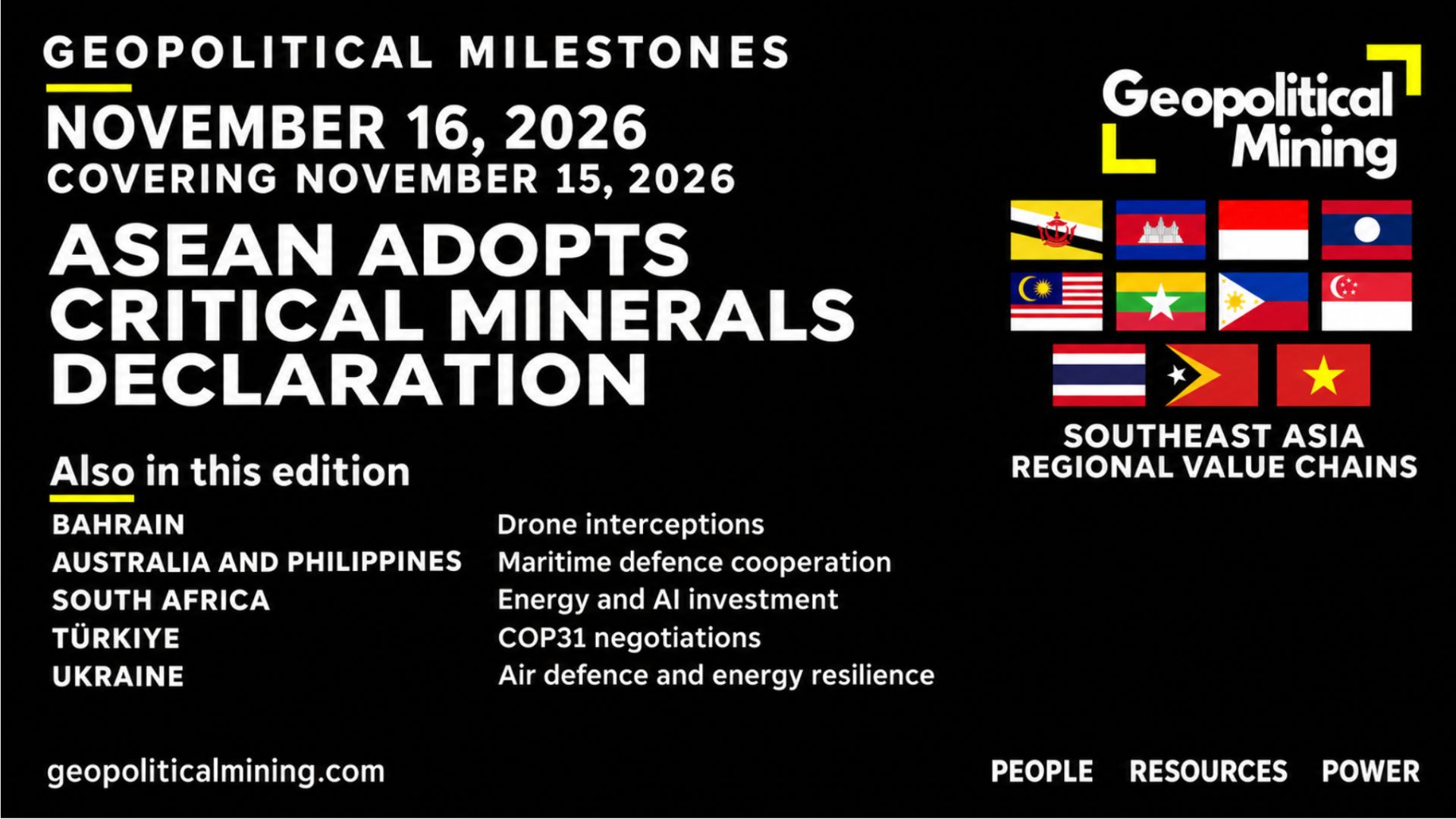

Geopolitical Mining · Geopolitical Milestones
Philippines: ASEAN Adopts Critical Minerals Declaration
In the Philippines, ASEAN adopts a critical minerals declaration. Meanwhile, Bahrain reports drone interceptions, Australia and the Philippines deepen defence cooperation, South Africa presents an AI electricity proposal, COP31 enters its second week, and Ukraine sets air defence priorities.
Geopolitical Milestones is a daily briefing for senior executives, investors and policymakers. It examines significant international developments and, in particular, their implications for investment, business strategy and public policy.
In focus: Regional mineral policy, maritime cooperation and electricity planning show how governments seek to build and protect productive capacity. In each case, institutions and infrastructure must work together to turn commitments into action.
Milestone 01
Philippines: ASEAN Adopts Critical Minerals Declaration
The Association of Southeast Asian Nations (ASEAN) brings together 11 countries: Brunei Darussalam, Cambodia, Indonesia, Laos, Malaysia, Myanmar, the Philippines, Singapore, Thailand, Timor-Leste and Vietnam. Its leaders adopted a critical minerals declaration in Manila, the Philippines, on November 15. It calls for a regional strategy covering exploration and extraction, as well as processing, refining, manufacturing and recycling. Members also agreed to develop a common definition and an updateable mineral list, according to Indonesia’s Ministry of Energy and Mineral Resources.
In addition to ASEAN members, the Philippine chair invited Canada and Brazil to the November 15 plenary. The International Monetary Fund was also on the guest programme. Related summits were scheduled for November 16 and 17 with Australia, China, India, Japan, New Zealand, South Korea, Russia, the United States and the United Nations. These wider engagements are separate from the adoption of the minerals declaration by ASEAN members.
In addition to greater regional trade, the agenda promotes investment, skills, technology transfer and project preparation. To take this work forward, ASEAN’s minerals ministers will develop the strategy and report on progress. Cooperation, however, remains voluntary and subject to national laws. The decision therefore establishes a shared direction rather than a completed strategy or funded project portfolio.
Geopolitical Mining reading:
By connecting resources with processing, technology and markets, the declaration also links mineral cooperation to industrial capability. For investors, this means examining whether national priorities support complementary projects across several economies. Infrastructure, commercial agreements and financing must then come together to turn that regional ambition into production.
Milestone 02
Bahrain Reports Drone Interceptions and Invokes Gulf Defence Cooperation
Bahrain’s Ministry of Foreign Affairs said air defences intercepted and destroyed drones in its airspace on November 15. According to the ministry, Iran was responsible, and another interception had occurred two days earlier. Bahrain News Agency carried the statement, which the Union of OIC News Agencies subsequently reproduced.
In response, the ministry invoked Bahrain’s right to individual and collective self-defence, including coordination with Gulf Cooperation Council partners. It also cited their Joint Defence Agreement and defended freedom of maritime and air passage through international straits. The statement did not, however, announce a new collective military operation.
Geopolitical Mining reading:
Repeated attacks make regional defence coordination relevant to commercial continuity because the Gulf economy depends on secure transport routes. Governments must therefore protect territory while preserving access for trade. For businesses, the economic consequences will depend on disruption to access and operations, rather than diplomatic statements alone.
Milestone 03
Australia and Philippines Sign Defence Cooperation Arrangement
In Manila, Australia and the Philippines signed a new Defence Cooperation Arrangement on November 15. After visiting HMAS Stalwart, Australian Prime Minister Anthony Albanese witnessed the signing. Building on the existing defence memorandum, the arrangement covers maritime awareness and information sharing, as well as planning, training, interoperability and defence infrastructure.
Australia also committed investment to its Southeast Asia Maritime Partnerships programme. For example, planned support includes aerial and surface drones, secure communications and operator training. These measures aim to improve maritime awareness and cyber resilience, although the release gives no funding amount or delivery timetable.
Geopolitical Mining reading:
The agreement also connects diplomatic alignment with practical surveillance and response capabilities. In particular, shared information, compatible systems and trained personnel can make cooperation more useful than occasional exercises alone. For regional trade, the question is therefore how these capabilities maintain access to maritime corridors while governments manage competing security interests.
Milestone 04
South Africa Presents Flexible AI Electricity Proposal in California
On November 15, South Africa’s Department of Electricity and Energy outlined a proposed 50 MW flexible artificial intelligence load demonstration at Grootvlei. Meanwhile, Electricity and Energy Minister Kgosientsho Ramokgopa arrived in California as part of the presidential visit to Silicon Valley. Leaders from Eskom, NECSA and SANEDI also joined the delegation.
The department wants to align data centre demand with electricity supply and grid capacity. In its view, predictable demand could improve infrastructure use and also absorb surplus energy. Discussions will explore cooperation on generation, transmission and digital infrastructure, but the demonstration remains a proposal. No financing agreement was announced.
Geopolitical Mining reading:
The proposal treats electricity demand patterns as part of infrastructure planning because new loads affect the wider system. Connection terms, flexibility and reliable supply consequently matter alongside the location of a data centre. The commercial opportunity therefore depends on coordination between investors, utilities and regulators, as well as on the technology itself.
Milestone 05
Türkiye: COP31 Sets Second Week Negotiating Timetable
The COP31 presidency issued its second week negotiating timetable on November 15. Technical negotiations were to conclude by November 17, followed by reports from ministerial facilitators on Wednesday. Meanwhile, finance, adaptation, mitigation and just transition remained under discussion.
An initial draft cover decision was also expected early in the week. However, the presidency clarified that its earlier reflections did not represent consensus. Only agreed elements would therefore enter the final decision. Although the timetable moves discussions towards political decisions, it does not establish their outcome.
Geopolitical Mining reading:
Climate negotiations bring costs, responsibilities and financing into the same room because agreement requires governments to address their distribution. For investors, the resulting institutions and instruments are therefore important. The second week will show which priorities secure common language before governments translate negotiated commitments into domestic policy.
Milestone 06
Ukraine Sets Air Defence Priorities Ahead of Ramstein Meeting
Ukraine’s President Volodymyr Zelenskyy announced a Ramstein meeting for the following week in his November 15 evening address. In particular, he identified missiles for Patriot and NASAMS air defence systems as priorities. Although the meeting provides a forum for coordinating support, the address did not announce a new aid allocation.
Zelenskyy also reported continuing restoration work following Russian strikes in the Zaporizhzhia and Dnipro regions. His account also connects infrastructure repairs with the need for additional protection. These operational descriptions and supply priorities reflect the Ukrainian presidency’s account.
Geopolitical Mining reading:
Energy resilience depends on repair capacity as well as protection. Restoring equipment cannot secure continuity on its own because further attacks can repeatedly interrupt service. Sustaining electricity supply therefore requires Ukraine and its partners to coordinate infrastructure support, military deliveries and the time needed to deploy both.
Continue reading Geopolitical Mining. Explore our daily mining coverage, weekly reviews and country analysis.