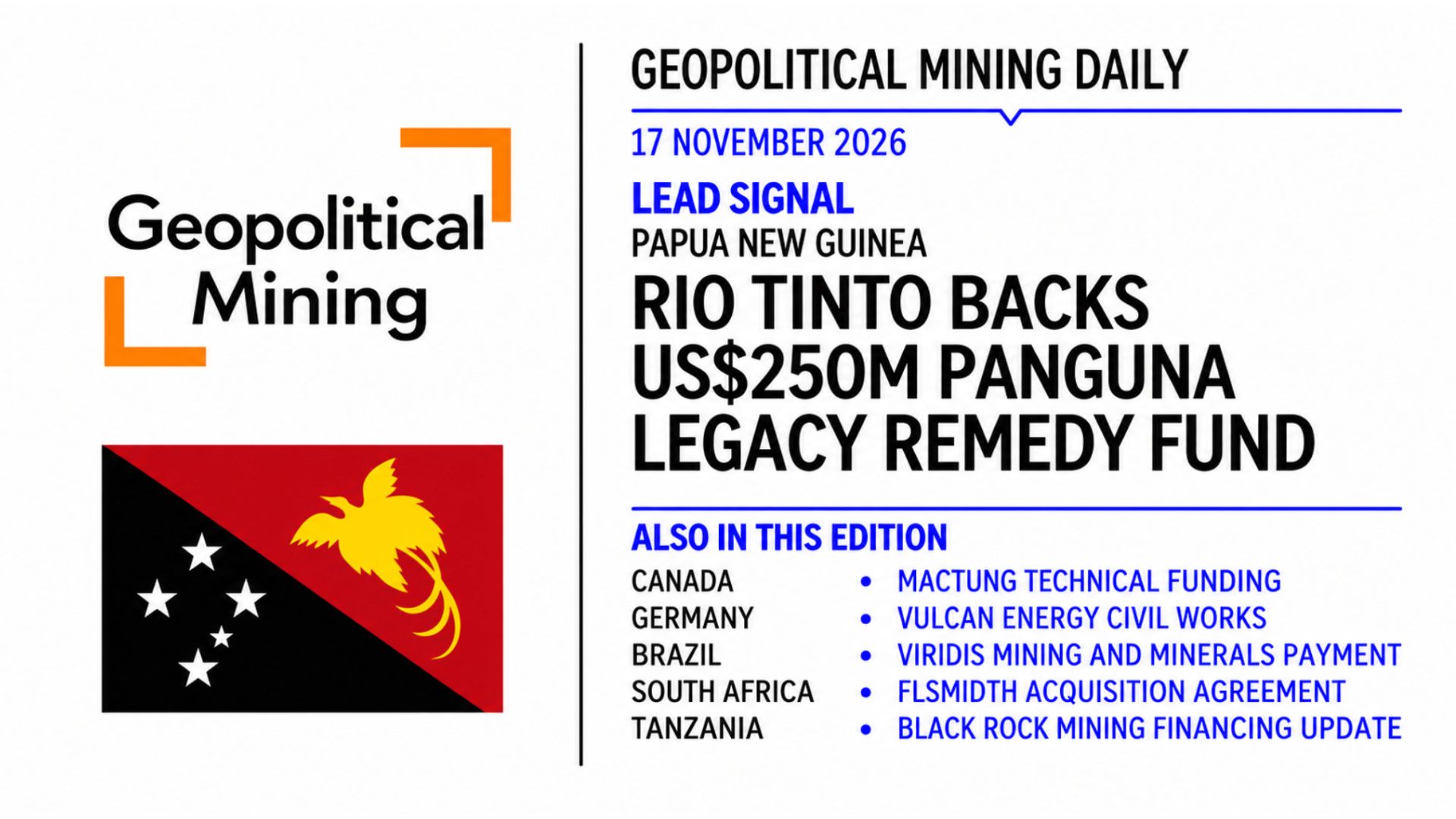

Geopolitical Mining Daily · November 17, 2026
Papua New Guinea: Rio Tinto Commits US$250 Million to Panguna Legacy Fund
Rio Tinto’s Panguna legacy fund commitment brings community priorities and practical remedy into focus. Elsewhere, mining projects advance through public funding, construction, equity payments and proposed transactions.
Canada supports Mactung engineering, Vulcan starts lithium plant civil works in Germany, Viridis receives a Brazilian funding tranche, FLSmidth agrees a South African acquisition, and Black Rock Mining revises Mahenge financing in Tanzania.
The GM observation framework
The ten Signals
Each Daily uses the same ten strategic lenses. The highlighted dimensions classify the developments in this edition.
Bougainville · Legacy impacts and community priorities
Papua New Guinea: Rio Tinto commits US$250 million to Panguna legacy fund
What happened
Rio Tinto announced on November 16 that it will contribute US$250 million over the coming years to a Panguna legacy fund. Together with Bougainville Copper Limited and the Autonomous Bougainville Government, it agreed with community leaders to establish the fund. The voluntary contribution will support responses to impacts identified by the Panguna Mine Legacy Impact Assessment in Bougainville, Papua New Guinea.
The fund will support practical work in river and delta areas, alongside social programmes across affected communities. Its governance, delivery arrangements and detailed priorities will be developed through consultation. The fund remains separate from future mine and port redevelopment decisions, which rest with Bougainville’s government and people.
The commitment moves the process from assessing harm towards financing a response. The amount alone cannot determine the outcome. Community participation, clear priorities and the delivery of agreed works will shape whether the fund produces lasting improvements. For mining companies, Panguna also shows how relationships and legacy impacts can require attention long after operations have ceased.
Primary announcement
Rio Tinto · Panguna legacy impact response fund · November 16, 2026Canada · Public funding and project preparation
Canada: Up to C$14 million supports Mactung work towards an investment decision
What happened
Canada announced up to C$14 million for Fireweed Metals on November 16 to advance the Mactung tungsten project in Yukon. The funding covers engineering, validation and technical work towards a final investment decision. It therefore supports project preparation rather than a decision to build the mine.
Tungsten serves defence, aerospace and advanced manufacturing. The government also links Mactung to the development of a secure supply for North American industry. Earlier public support addressed studies, design and engagement for road and transmission infrastructure in eastern Yukon. Together, these measures address different requirements for future mine development.
The announcement shows how public policy can support the work needed before major capital is committed. However, strategic importance does not remove the need for a robust project plan. Technical results, infrastructure, approvals and financing must still come together before a new source of tungsten can enter production.
Germany · Lithium extraction and industrial construction
Germany: Vulcan starts civil works at Lionheart lithium extraction plant
What happened
Vulcan Energy Resources announced on November 16 that civil construction had started at its commercial Lithium Extraction Plant in Germany. The works follow completed bulk earthworks at the Lionheart project. They include foundations, concrete structures, roads and drainage before buildings and process equipment are installed.
The plant will extract lithium chloride from geothermal brine, using energy from the same resource. This intermediate will then move to the company’s downstream chemical plant in Frankfurt-Hoechst for conversion into battery grade lithium hydroxide. Lionheart targets annual capacity of 24,000 tonnes of lithium hydroxide monohydrate, with first production planned for the second half of 2028.
The milestone concerns physical delivery of an integrated industrial route. Extraction, energy supply and chemical conversion must operate together to serve customers. Construction progress at one site matters within the wider project schedule, while the stated capacity remains a production target rather than current output.
Primary announcement
Vulcan Energy Resources · Lithium Extraction Plant civil works · November 16, 2026Brazil · Rare earth project equity funding
Brazil: Viridis receives second US$5 million tranche for Colossus
What happened
Viridis Mining and Minerals reported receipt of a second US$5 million tranche on November 16. The payment forms part of its existing US$30 million agreement with ORE Investments and Régia Capital, signed in November 2025. A further US$20 million remains to be funded under that agreement.
The new tranche comes through the Brazilian Critical Minerals Fund, backed by Vale and BNDESPAR, the investment arm of Brazil’s development bank. Viridis also links the investment to its Colossus rare earth project and plans for domestic separation capacity. Its broader funding presentation includes proceeds that have not yet arrived and remain subject to conditions.
This update records cash received, rather than simply an announced commitment. However, one equity payment does not complete the project’s financing. The distinction matters because development depends on the timing of capital, further funding and approvals, as well as on the industrial partnerships intended to connect production with processing.
Primary announcement
Viridis Mining and Minerals · Second ORE and Régia tranche · November 16, 2026South Africa · Crushing technology and local service capacity
South Africa: FLSmidth agrees to acquire Crushing Equipment Africa
What happened
FLSmidth announced on November 16 that it had signed an agreement to acquire all shares in Crushing Equipment Africa. The South African manufacturer supplies crushing equipment and mining services across Southern Africa. The proposed acquisition will expand FLSmidth’s compact jaw and cone crusher offering.
It will also add repair, refurbishment, parts and field service capacity near the region’s mines. Local management is expected to remain in place after completion. However, the transaction still requires South African competition clearance and other closing conditions. FLSmidth expects completion in the first quarter of 2027 and did not disclose the price.
The strategic value extends beyond equipment sales. Mines also depend on timely maintenance, parts and technical support to sustain production. Combining local manufacturing and service relationships with a global supplier could strengthen that support, although the practical outcome will depend on integration after the transaction closes.
Primary announcement
FLSmidth · Crushing Equipment Africa acquisition agreement · November 16, 2026Tanzania · Graphite project financing and conditions
Tanzania: Black Rock Mining revises Mahenge financing structure
What happened
Black Rock Mining announced a revised funding structure for the first module of its Mahenge graphite project on November 16. It signed an amended binding agreement for a US$40 million equity subscription by POSCO International. Separately, African Critical Minerals signed a non-binding term sheet for a proposed US$70 million investment at project level.
However, the POSCO subscription remains conditional, including on the African Critical Minerals transaction completing alongside it. In turn, that proposed investment requires due diligence, approvals and binding documents. Furthermore, Black Rock must secure commitments for approximately US$40 million of remaining equity. It is targeting financial close by December 31, beyond the facility’s current November 30 deadline.
The update outlines a possible route to funding rather than a completed package. Its importance lies in how the commitments depend on one another. Converting the proposed investment into binding finance, securing the remaining equity and aligning lender deadlines are all needed before this structure can support construction.
Primary announcement
Black Rock Mining · Mahenge Module 1 funding update · November 16, 2026The Daily records verified changes. The Signals provide the classification map. The Weekly brings the developments together for the deeper system reading.