
Geopolitical Mining · Geopolitical Milestones
Pakistan Imposes Emergency Rule in Khyber Pakhtunkhwa
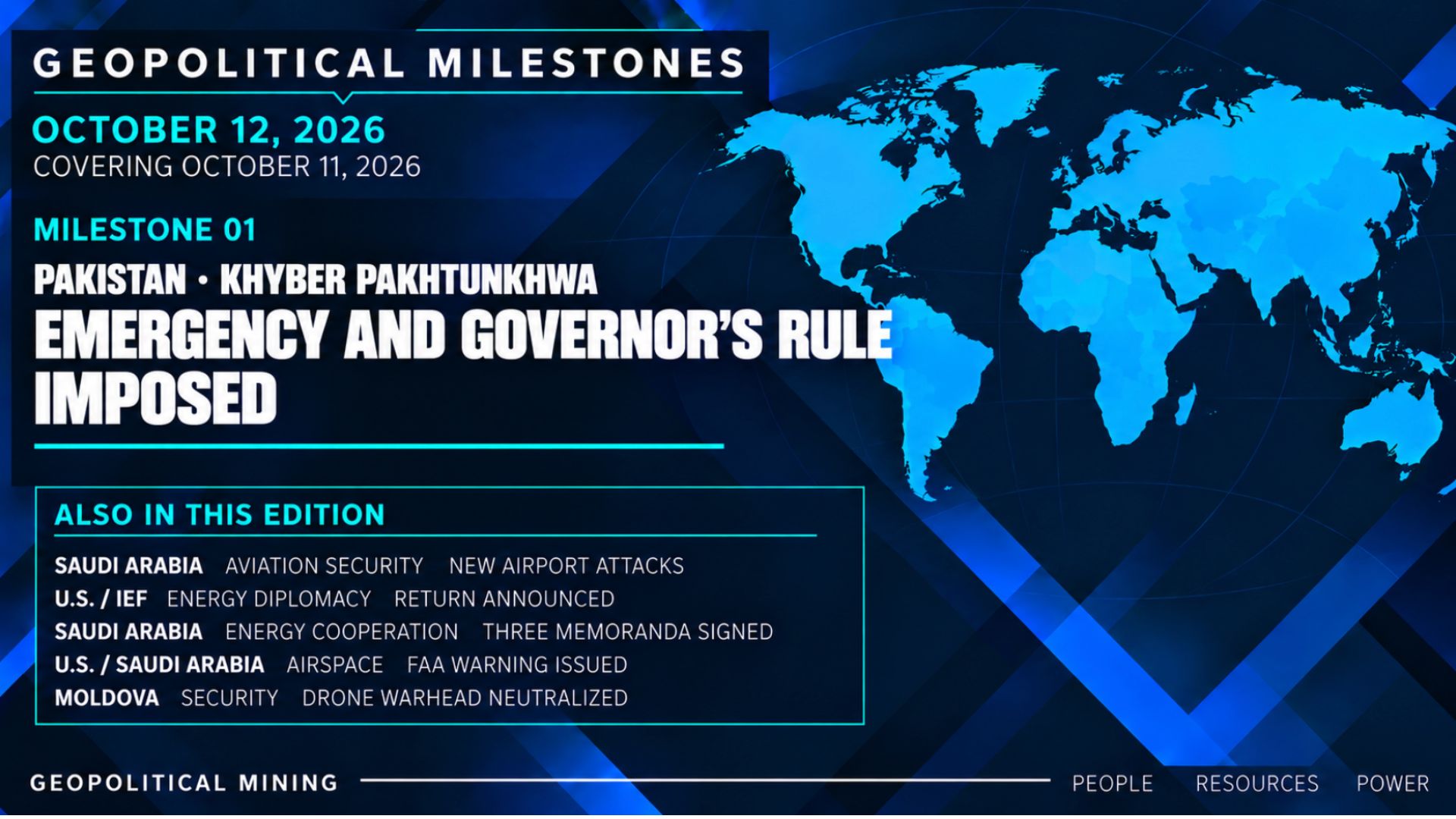
Pakistan imposed emergency and governor’s rule in Khyber Pakhtunkhwa on October 11 after a dispute over security and counterterrorism. As a result, provincial executive powers passed to the governor. Also in this edition: Saudi airport attacks, U.S. energy diplomacy and three Saudi energy agreements. Meanwhile, the FAA warned of airspace risks, and Moldova’s police neutralized a suspected drone warhead.
Geopolitical Milestones is a daily briefing for senior executives, investors and policymakers. Each edition examines significant international developments and their implications for investment, business strategy and public policy.
Also in this edition: New strikes hit Riyadh and Dammam airports; the United States announces its return to the International Energy Forum; Saudi Arabia signs three energy cooperation memoranda; the FAA issues a Jeddah airspace advisory; Moldova’s police neutralize a drone warhead.
Political institutions, internal security and provincial authority
Pakistan imposes emergency and governor’s rule in Khyber Pakhtunkhwa
Pakistan’s President Asif Ali Zardari approved the prime minister’s advice on October 11, according to government statements. He then promulgated emergency and governor’s rule in Khyber Pakhtunkhwa under Articles 232 and 234 of the Constitution. Law Minister Azam Nazeer Tarar said the elected provincial administration, led by the chief minister, had ceased to exercise its powers. Instead, the governor took over those powers. Authorities also established an advisory council of eleven members and announced a separate administrative arrangement for twelve districts. Military personnel would assist with maintaining order.
The decision changes who exercises political authority in a province bordering Afghanistan. Until then, the party of former prime minister Imran Khan had governed it. The federal cabinet cited deteriorating security and an alleged lack of provincial cooperation against militancy to justify the measure. However, those allegations represent the federal government’s position rather than independent findings. Officials also said they would convene parliamentary proceedings to consider the measures. The decision therefore opens a new constitutional and political phase alongside a change in counterterrorism administration.
Pakistan government statements · Pakistan Broadcasting Corporation
Law minister announces emergency, governor’s rule and advisory council · Pakistan Broadcasting Corporation, October 11Presidential approval of prime minister’s advice · Pakistan Broadcasting Corporation, October 11
Cabinet recommendation · Pakistan Broadcasting Corporation, October 11
Critical infrastructure, airport attacks and military interception
Further October 11 attacks hit airports in Riyadh and Dammam
Saudi authorities reported another attack at King Khalid International Airport in Riyadh on Sunday, October 11, after Saturday’s deadly strike. A coalition spokesman said an unidentified projectile hit Terminal 4 and started a fire. The General Authority of Civil Aviation confirmed injuries. It also said airport safety inspections and damage assessments were under way. Separately, the coalition announced that air defence forces had intercepted and destroyed a cruise missile near the Riyadh airport.
Later on October 11, the Saudi aviation authority reported an attack on King Fahd International Airport in Dammam. Inspections there were also in progress. Together, the reports from both airports widened the immediate civil aviation security concern beyond the capital. Saturday’s Riyadh attack had caused 12 deaths and 309 injuries; those figures concern the previous day’s incident. Meanwhile, the renewed attacks coincided with the opening period of Riyadh’s international energy meetings.
Saudi Press Agency · Saudi GACA and coalition statements
Coalition statement on Terminal 4 strike · Saudi Press Agency, October 11GACA confirms new attack and injuries in Riyadh · Saudi Press Agency, October 11
Missile interception near Riyadh airport · Saudi Press Agency, October 11
Dammam airport attack · Saudi Press Agency, October 11
Energy diplomacy, market stability and international institutions
United States announces return to International Energy Forum at Riyadh ministerial
The United States announced its intention to rejoin the International Energy Forum (IEF) at its seventeenth ministerial meeting in Riyadh on October 11. The IEF welcomed the announcement after ministers and industry leaders discussed supply and demand security, investment, market information and trade routes. Saudi Arabia hosted the meeting, while Italy and Nigeria served as cohosts. Ministers also expressed solidarity with Saudi Arabia following attacks on civilian infrastructure, according to the forum’s report.
The U.S. announcement marks a step toward renewed participation in the dialogue between energy producers and consumers. However, it does not establish a new oil supply agreement or financing for an individual project. Ministers also discussed improving reporting through the Joint Organisations Data Initiative. Participating organizations had already endorsed the JODI Roadmap for 2026 to 2030 before the ministerial. Meanwhile, the wider Riyadh energy week included the WPC Energy Congress welcome reception that evening. Its formal inaugural session was scheduled for October 12.
International energy cooperation, infrastructure and supply chains
Saudi Arabia signs energy cooperation memoranda with Kuwait, Qatar and Egypt
In Riyadh on October 11, Saudi Arabia signed separate energy cooperation memoranda with Kuwait, Qatar and Egypt. Kuwait’s Ministry of Electricity, Water and Renewable Energy outlined cooperation on electrical interconnection, possible electricity exports and renewable generation. It also included energy storage, smart grids and cyber security. Meanwhile, Qatar’s official news agency listed oil and gas, power, hydrogen, carbon management and energy efficiency. Egypt’s Ministry of Petroleum and Mineral Resources confirmed cooperation on oil, gas and petrochemicals. Its agreement also covered the trading, transportation and storage of petroleum products.
The memoranda expand bilateral coordination across neighbouring energy systems and Gulf supply chains. However, they establish cooperation frameworks rather than construction contracts, pipeline operating authorizations or public funding disbursements. Egypt’s document sets out infrastructure and logistics objectives, while the Kuwaiti text covers knowledge exchange and potential joint initiatives. Qatar’s memorandum, meanwhile, will enter into force only after both countries complete their domestic legal procedures. Qatar News Agency dates the signature to October 11.
Kuwait energy ministry · Qatar News Agency · Egypt petroleum ministry
Kuwait Ministry of Electricity, Water and Renewable Energy · MoU with Saudi Arabia, October 11Qatar News Agency · energy cooperation MoU signed in Riyadh, October 11
Egypt Ministry of Petroleum and Mineral Resources · October 11 bilateral energy MoU
Airspace safety, military activity and civil aviation risk
FAA caution notice covers Saudi airspace over military and navigation risks
U.S. Federal Aviation Administration advisory NOTAM A0056/26 took effect on October 11 at 21:00 UTC in the Jeddah Flight Information Region (OEJD). It advises U.S. operators to exercise caution because military activity and interference with global navigation satellite systems could affect all altitudes. The warning covers overflights as well as arrivals and departures. It applies to specified U.S. air carriers, licensed airmen and operators of civil aircraft registered in the United States. However, its terms include exceptions for foreign airlines.
The advisory runs until December 10 at 05:00 UTC under its issued terms. It communicates operational risk rather than imposing a blanket flight ban or closing an airport. Its scope also extends across the wider flight information region amid renewed attacks on Saudi airport facilities. Notamify reproduces the raw advisory text, while the FAA maintains a general index of aviation restrictions and notices.
FAA NOTAM text · reproduced in Notamify; FAA guidance index
FAA NOTAM A0056/26 · full raw advisory text reproduced by NotamifyFederal Aviation Administration · standing index of aviation restrictions and notices
European border security, unmanned systems and public safety
Moldovan police neutralize drone warhead after overnight security incident
Moldova’s Ministry of Defence reported an overnight incident near Geamăna and Văratic in Anenii Noi district on October 11. The ministry said an apparent drone sound followed by an explosion had been heard during large Russian attacks against Ukraine. Emergency teams then found an object near Geamăna. Police explosives specialists subsequently neutralized a warhead associated with an unmanned aircraft. NewsMaker reported the neutralization on October 11; Moldpres also published the police account.
The response illustrates the domestic security risks from unmanned systems and unexploded ordnance near a conflict zone. However, Moldova’s Defence Ministry said its air surveillance systems had recorded no unauthorized overflight during the relevant period. The physical discovery did not establish the aircraft’s route. The official accounts did not identify who launched the aircraft or establish that a particular state deliberately targeted Moldovan territory.
Continue reading Geopolitical Mining. Explore our daily mining coverage, weekly reviews and country analysis.