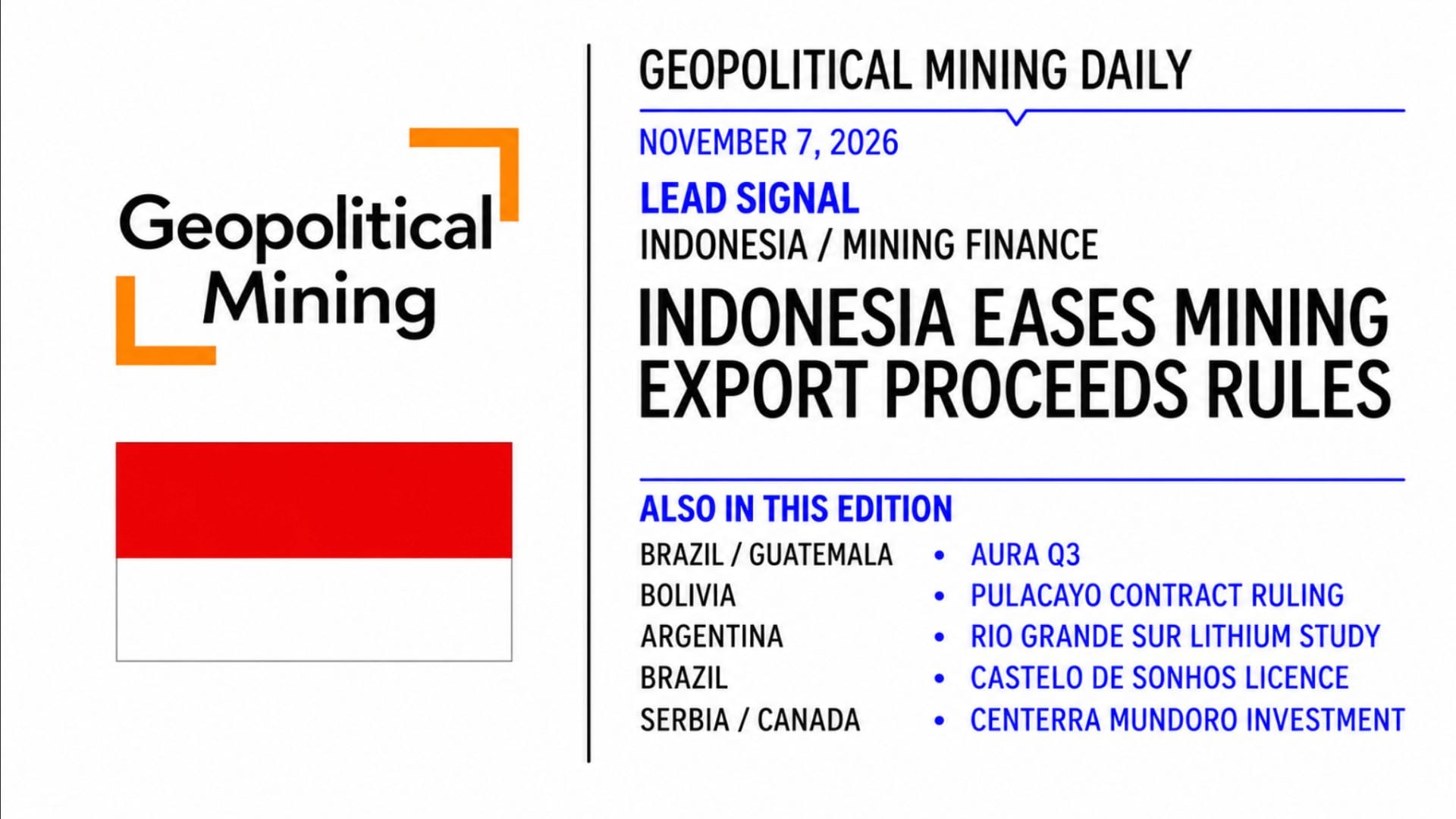

Geopolitical Mining Daily · November 7, 2026
Indonesia Expands Access to Flexible Mining Export Proceeds Rules
Indonesia announced that mining exporters with qualifying shareholders from Japan, South Korea and the European Union would gain access to more flexible export proceeds rules. The change would give eligible companies greater freedom to manage foreign currency earnings while retaining part of those revenues in Indonesia.
Elsewhere, Aura reports stronger gold output in Brazil and progress in Guatemala, a court ruling changes the position of a silver project in Bolivia, and lithium reserves, environmental consultation and exploration financing shape developments in Argentina, Brazil and Serbia.
Indonesia’s announcement links the management of export revenues to the origin and structure of foreign investment. Across the other developments, the connection between capital and project delivery takes different forms: cash generated by operating mines, the legal standing of a mining contract, the price assumptions behind a larger reserve, consultation requirements and a proposed strategic investment.
The GM observation framework
The ten Signals
Each Daily uses the same ten strategic lenses. The highlighted dimensions classify the developments in this edition.
Indonesia · Export revenues and foreign investment
Indonesia expands access to flexible mining export proceeds rules
What happened
Indonesia announced on November 6 that Japan, South Korea and the European Union would join the jurisdictions whose qualifying shareholders give mining exporters access to special export proceeds rules. Under this arrangement, eligible companies retain at least 30% of the relevant earnings in Indonesia’s financial system for three months. The general regime for non oil natural resource exports requires 100% retention for twelve months.
Eligibility depends on the exporter’s ownership. The special regime requires an Indonesian company with a qualifying foreign shareholder holding at least 10%; the destination of the mineral shipment does not determine access. The newly announced jurisdictions would join the United States, Canada, China including Hong Kong, and Australia. The government also described changes to accommodate indirect ownership, with implementing adjustments still required.
The distinction matters for working capital. Retention rules determine where export earnings remain and for how long, affecting the flexibility available for financing and treasury management. They are not a tax on those earnings, and the domestic regime permits specified uses of retained funds. By extending eligibility, Indonesia is seeking to preserve domestic foreign currency availability while making its mining investment framework more accommodating to a wider group of international shareholders.
Brazil / Guatemala · Gold production and project investment
Brazil and Guatemala: Aura raises quarterly output as development advances
What happened
Aura reported production of 95,557 gold equivalent ounces in the third quarter, up 27% from the preceding quarter. Its November 6 results included 22,842 ounces from Borborema in Brazil. The company also reported recurring free cash flow of US$123.5 million, a measure it uses to describe cash generation from the business.
In Guatemala, Era Dorada remained under development. Aura reported overall physical progress of 13.1%, while the construction component stood at 7.6%. These figures measure different scopes within the project. Meanwhile, group all in sustaining costs reached US$1,953 per gold equivalent ounce, 40% above the same period last year.
Borborema’s contribution and Era Dorada’s progress place Aura at two points in the investment cycle. The Brazilian mine is contributing current production, while the Guatemalan project requires expenditure before it can add output. Stronger cash generation supports that development path, although rising operating costs remain important to how much of the current revenue environment can be converted into capital for growth.
Bolivia · Silver project contract and legal process
Bolivia: Court ruling annuls cancellation of Silver Elephant’s mining contract
What happened
Silver Elephant said on November 6 that Bolivia’s Supreme Tribunal of Justice had annulled the COMIBOL resolution cancelling its Pulacayo and Paca mining production contract, together with the subsequent administrative proceedings. The company said it received notice of the ruling on November 5. The cancellation resolution dated from December 2024.
The contract covers approximately 2,803 hectares. According to Silver Elephant, the judgment restores its contractual position following the dispute with Bolivia’s state mining company. The announcement leaves further implementation steps to be resolved. Earlier company financial disclosures also identified legislative approval as outstanding; the latest release does not establish that this requirement has been completed.
The ruling changes the legal basis on which Silver Elephant can seek to advance the project. Its commercial significance depends on how the judgment is implemented and how the remaining approvals are addressed. In Bolivia, the relationship between private capital, the state mining company and the institutions that validate mining agreements is central to converting a mineral asset into an investable development project.
Argentina · Lithium reserve and project economics
Argentina: Pursuit expands Rio Grande Sur lithium reserve in updated study
What happened
Pursuit Minerals released an update to its Rio Grande Sur prefeasibility study on November 6, increasing the probable reserve to 438,000 tonnes of lithium carbonate equivalent from 125,000 tonnes. The development plan envisages an initial production rate of 5,000 tonnes a year, followed by expansion to 17,500 tonnes.
The economic model uses a lithium price of US$27,300 a tonne, compared with a current reference price of US$13,707 a tonne disclosed in the same announcement. That difference is material to interpreting the study’s projected returns. The update also considers potential benefits under Argentina’s RIGI investment regime, rather than confirming that those benefits have been secured.
A larger reserve extends the resource base available to support development, but financing will depend on the economics that lenders and investors accept. In this case, the gap between the modelled price and the disclosed market reference makes price sensitivity particularly important. Staging the expansion can spread capital requirements over time, while leaving a separate decision on funding and construction for each phase.
Brazil · Environmental licensing and consultation
Brazil: Interim ruling suspends Castelo de Sonhos preliminary licence
What happened
TriStar Gold disclosed on November 6 that an interim court ruling issued on November 4 had temporarily suspended the preliminary environmental licence for its Castelo de Sonhos gold project in Brazil. The ruling concerns the completion of an indigenous component study and consultation requirements.
The company said studies could continue while the legal and consultation process proceeds. The ruling restricts progress toward construction and operating permissions pending the required steps. A period of 60 business days relates to the submission of documentation; it should not be read as the date by which consultation will be completed. TriStar said it did not expect an effect on its current project schedule.
The development places consultation within the project’s licensing sequence. Technical work can continue, but the route toward construction also depends on resolving the requirements identified by the court. For capital planning, the relevant issue is how those processes fit together: engineering progress, consultation and regulatory decisions each contribute to the timetable on which a project can move into execution.
Serbia / Canada · Exploration capital and partnerships
Serbia and Canada: Centerra proposes strategic investment in Mundoro
What happened
Mundoro announced on November 6 that Centerra Gold proposed to invest approximately C$4.08 million for a 9.9% interest in the company. Closing was expected around November 27, subject to applicable approvals and other conditions. The proposed investment would introduce another mining company into Mundoro’s shareholder base.
The update also described changes to Mundoro’s partnership with BHP in Serbia. BHP would retain its options over Trstenik and South Timok while returning Central Timok and Borsko, allowing Mundoro to seek other partners for those licences. The changes distinguish the areas remaining within the existing partnership from those available for a new funding arrangement.
Exploration portfolios depend on how capital and geological interest are allocated among projects. Centerra’s proposed investment would strengthen Mundoro’s corporate funding, while the changes to BHP’s options would reopen part of the Serbian portfolio to other partners. Together, they change the available routes for financing exploration without establishing that a mine development decision has been made.
The Daily records verified changes. The Signals provide the classification map. The Weekly brings the developments together for the deeper system reading.