
Geopolitical Mining · Weekly
Geopolitical Mining Weekly
Week of May 18–24, 2026
Authors: Marta Rivera | Eduardo Zamanillo
May 25, 2026
What this week really tells us
This week’s signals showed how geopolitical mining is moving deeper into the operating architecture behind supply: processing capacity, integrated rare earth development, copper province governance, Arctic infrastructure, institutional credibility, sanctions exposure and local resource control.
In the United States, the Department of Energy moved critical minerals strategy into pilot scale processing capacity, with funding for technologies focused on magnesium, rare earth elements and recovery from ore deposits, mine waste, industrial waste and recycled materials. In Australia, Arafura reached a Final Investment Decision for Nolans, moving a fully integrated rare earth project closer to construction. In South Australia, the modernization of the Olympic Dam and Stuart Shelf Indenture showed how copper province governance can become a platform for future investment and critical mineral optionality.
In Canada’s North, Agnico Eagle’s Hope Bay decision placed mining inside a wider Arctic infrastructure, energy, Indigenous participation and sovereignty frame. In Chile, Codelco’s production reporting audit showed why state owned copper champions are becoming tests of institutional credibility. Sherritt’s Cuba update showed how sanctions can reshape nickel cobalt exposure, refining continuity and corporate structure. And Zimbabwe’s restriction on foreign participation in small scale gold mining gave sharper form to the politics of local mining, formalization and resource nationalism.
Taken together, the week’s coherence is clear: mineral security is not being shaped only at the mine. It is being shaped in processing plants, legal frameworks, Arctic energy systems, boardrooms, sanctions regimes, waste streams and ownership rules.
The question is increasingly practical: which countries and companies can organize the full system required to turn mineral potential into reliable, legitimate and strategically useful supply?
For the full Geopolitical Mining framework behind this note, see our book Mining Is Dead. Long Live Geopolitical Mining.
Signals of the week
Signal 1: The United States is moving critical minerals into pilot scale processing
What happened
On May 19, the U.S. Department of Energy’s Office of Critical Minerals and Energy Innovation announced US$45.7 million for 19 projects aimed at addressing domestic critical minerals and materials supply chain gaps. DOE said the funding supports novel technologies for critical materials production, including pilot scale facilities for processing magnesium and rare earth elements. The funding opportunity also targets critical minerals from ore deposits, mine waste, industrial waste and recycled materials.
Why it matters
This matters because the critical minerals bottleneck is increasingly a processing problem. Resource identification is important, but mineral security depends on whether materials can be transformed into usable industrial inputs at scale.
The signal is especially relevant because DOE is not only funding exploration or research. It is supporting pilot scale capabilities that can help move technologies closer to commercial deployment. That is the space where many critical mineral strategies fail: between geological potential and industrial production.
Implications for capital and strategy
For capital, the signal is that processing technologies and recovery pathways may become more investable as public funding helps reduce early technical and scale up risk. Projects connected to magnesium, rare earth elements, waste recovery and recycled inputs may gain relevance if they can demonstrate a credible path from pilot to commercial operation.
For strategy, the deeper message is that domestic mineral security requires a full industrial chain. The United States is trying to build not only access to resources, but the processing base that allows those resources to become useful supply.
Signal 2: Arafura’s Nolans project shows rare earth strategy moving into execution
What happened
On May 21, Arafura Rare Earths announced that its Board had made a Final Investment Decision for the Nolans Rare Earths Project in Australia’s Northern Territory. The company described Nolans as Australia’s first fully integrated ore to oxide rare earths operation and said it is now targeting the commencement of construction from September 2026.
The announcement followed a multi year financing and offtake strategy involving sovereign-backed institutions across several countries and binding offtake relationships with manufacturers. Arafura also said Export Finance Australia had issued a non binding letter of support regarding potential support under the Critical Minerals Strategic Reserve for up to 500 tonnes per year of NdPr oxide from the project.
Why it matters
This matters because rare earth diversification needs integrated projects, not only deposits. Nolans is significant because it links mining and oxide production inside one project structure. That matters in a market where the strategic bottleneck often sits in separation, processing and qualified product supply.
The FID also shows how rare earth projects increasingly depend on aligned customers, public finance, offtake structures and government-backed support. In this case, the project is being carried not only by geology, but by a financing and demand architecture built over several years.
Implications for capital and strategy
For capital, Nolans shows that rare earth projects become more credible when they combine permitting, offtake, financing, processing and construction readiness. A project that can move from strategic relevance into execution becomes materially different from a project that remains only a deposit.
For strategy, the deeper message is that rare earth security is becoming an industrial execution test. Countries seeking non China supply will need projects that can deliver product, not only resource announcements.
Signal 3: South Australia is turning copper province governance into strategic mineral optionality
What happened
South Australia announced the modernization of the Olympic Dam and Stuart Shelf Indenture, describing it as a clearer and more contemporary framework to support future activities in BHP’s Copper SA Province. The government said the modernized framework covers approval processes for expansion projects, the operation of Roxby Downs, transition to the current Aboriginal Heritage Act, water extraction, local jobs and business opportunities, financial assurances and royalties.
Mining.com also reported that under the new agreement BHP must assess whether rare earths and other critical minerals at Olympic Dam can be commercially produced. The report notes that Olympic Dam is primarily a copper operation that also produces gold, silver and uranium as by products, and that the orebody contains other minerals currently discarded in waste streams.
Why it matters
This matters because copper province governance is becoming a strategic mineral issue. South Australia is not only updating an agreement around one operation. It is trying to create a more durable framework for a copper province that includes Olympic Dam, Prominent Hill and Carrapateena.
The critical minerals angle gives the signal additional weight. If rare earths or other minerals can eventually be recovered from existing copper systems, the strategic value of the province could extend beyond copper. That does not make by product recovery automatic. It does make the governance framework more important, because the rules around approvals, water, heritage, expansion and financial assurances shape what can be tested and developed.
Implications for capital and strategy
For capital, the signal is that large copper provinces should be evaluated not only by current production, but by the regulatory and industrial frameworks that support future expansion and by product optionality.
For strategy, the deeper message is that copper assets can become platforms. Where geology, infrastructure, processing systems and stable governance align, a copper province may also become a future source of other strategic minerals.
Signal 4: Hope Bay shows how Arctic mining is becoming strategic infrastructure
What happened
On May 19, the Government of Canada marked the groundbreaking of Agnico Eagle’s Hope Bay Project in Nunavut. Canada said Agnico Eagle had approved more than US$2 billion for construction of the mine, described the project as strategically important, and projected that Hope Bay could increase Canada’s exports by C$2.6 billion annually while supporting close to 2,000 jobs and generating economic benefits for Indigenous organizations, including the Kitikmeot Inuit Association.
Canada also announced C$25 million in federal funding for the Hope Bay Wind Project, led by Inuit owned and operated Kitikmeot Tugliq Limited Partnership. The wind project is expected to add 4.2 megawatts of wind power and 4 megawatts of battery storage to the mine’s power system. Agnico Eagle separately said the Hope Bay investment decision is based on an underground operation supported by a 6,000 tonnes per day processing facility, with expected annual gold production of more than 400,000 ounces and initial production possible as early as 2030.
Why it matters
This matters because Hope Bay is not only a gold project. It is an Arctic infrastructure signal. The project connects mining, northern development, Indigenous economic participation, clean energy, logistics and Canada’s strategic presence in the North.
That combination matters in a period when Arctic geography is becoming more important for sovereignty, infrastructure, security and resource development. A mine in Nunavut can become more than an isolated asset if it helps build energy systems, port/logistics experience, employment pathways and institutional capacity in the North.
Implications for capital and strategy
For capital, the signal is that Arctic projects should be evaluated through a wider infrastructure lens. Resource quality matters, but so do energy systems, logistics, Indigenous partnerships, workforce development and the capacity to operate in extreme conditions.
For strategy, the deeper message is that mining can become part of national territorial capacity. In the Arctic, mineral development increasingly intersects with sovereignty, resilience, infrastructure and long term regional presence.
Signal 5: Codelco shows why copper security also depends on institutional credibility
What happened
On May 20, Codelco announced measures after an internal audit identified deviations in the application of internal rules for recognizing 2025 production. The company said the audit related to 20,000 tonnes of fine copper contained in oxides from Chuquicamata and 6,875 tonnes contained in calcium arsenite from Ministro Hales, together equivalent to about 2% of Codelco’s own reported production for the year.
Codelco said the findings did not require changes to its audited 2025 financial statements, but that explanatory notes would be added to production figures in official communications. The company also announced disciplinary measures, the dismissal of one executive, warnings for other professionals involved, a review of internal production reporting rules and a complaint to Chile’s Public Prosecutor’s Office.
Why it matters
This matters because Codelco is not only a mining company. It is a state owned copper champion, a fiscal pillar for Chile and a structural actor in global copper supply. When copper becomes more strategic for grids, electrification, defense, AI infrastructure and industrial policy, the credibility of copper institutions matters.
The signal should not be reduced to an internal reporting issue. It points to a broader governance question: how do state owned mining companies preserve trust while managing production pressure, incentives, financial expectations and public accountability?
Implications for capital and strategy
For capital, the signal is that production credibility, governance systems and internal controls matter in the valuation of state owned mining systems. Investors, lenders, partners and counterparties need confidence not only in reserves and operations, but in the institution that reports and manages them.
For strategy, the deeper message is that copper security depends on institutional reliability. Countries with strategic state owned producers will increasingly be assessed by their ability to combine national ownership, technical execution, transparency and continuity.
Signal 6: Sherritt shows how sanctions can reshape nickel cobalt supply architecture
What happened
On May 19, Sherritt International provided a further update on its Cuba activities following the May 1 U.S. Executive Order expanding sanctions against Cuba. Sherritt said it is no longer proceeding with the dissolution and disclaimer steps described in its May 15 release, including the dissolution of its joint venture with General Nickel Company S.A. of Cuba, but it is maintaining the suspension of direct participation in joint venture activities in Cuba while it continues to evaluate steps to address the Executive Order.
Sherritt also said that unless these matters are resolved, it faces acute operational, financial and legal difficulties, including the ability to comply with debt covenants. The company describes itself as a hydrometallurgical nickel and cobalt producer and says it operates a strategically important refinery in Alberta, Canada, recognized as the only significant cobalt refinery and one of just three nickel refineries in North America.
Why it matters
This matters because sanctions can reorganize mineral supply chains even when the physical asset remains in place. Nickel and cobalt exposure is not only about mines, refineries and reserves. It is also about banking access, legal structure, counterparty risk, debt covenants, jurisdictional exposure and the ability to continue operating under geopolitical constraint.
The Sherritt case is especially relevant because it links Cuba, Canada, nickel, cobalt and refining capacity. It shows how a sanctions event can create pressure across ownership, operations, financing and supply chain continuity.
Implications for capital and strategy
For capital, the signal is that jurisdictional and sanctions risk can directly affect asset continuity, financing capacity and corporate structure. Projects and companies exposed to high risk jurisdictions may need to be read through legal and financial resilience as much as through operating performance.
For strategy, the deeper message is that mineral security includes the legal architecture around supply. Critical minerals policy cannot focus only on deposits and processing. It must also account for sanctions regimes, banking channels, corporate exposure and geopolitical durability.
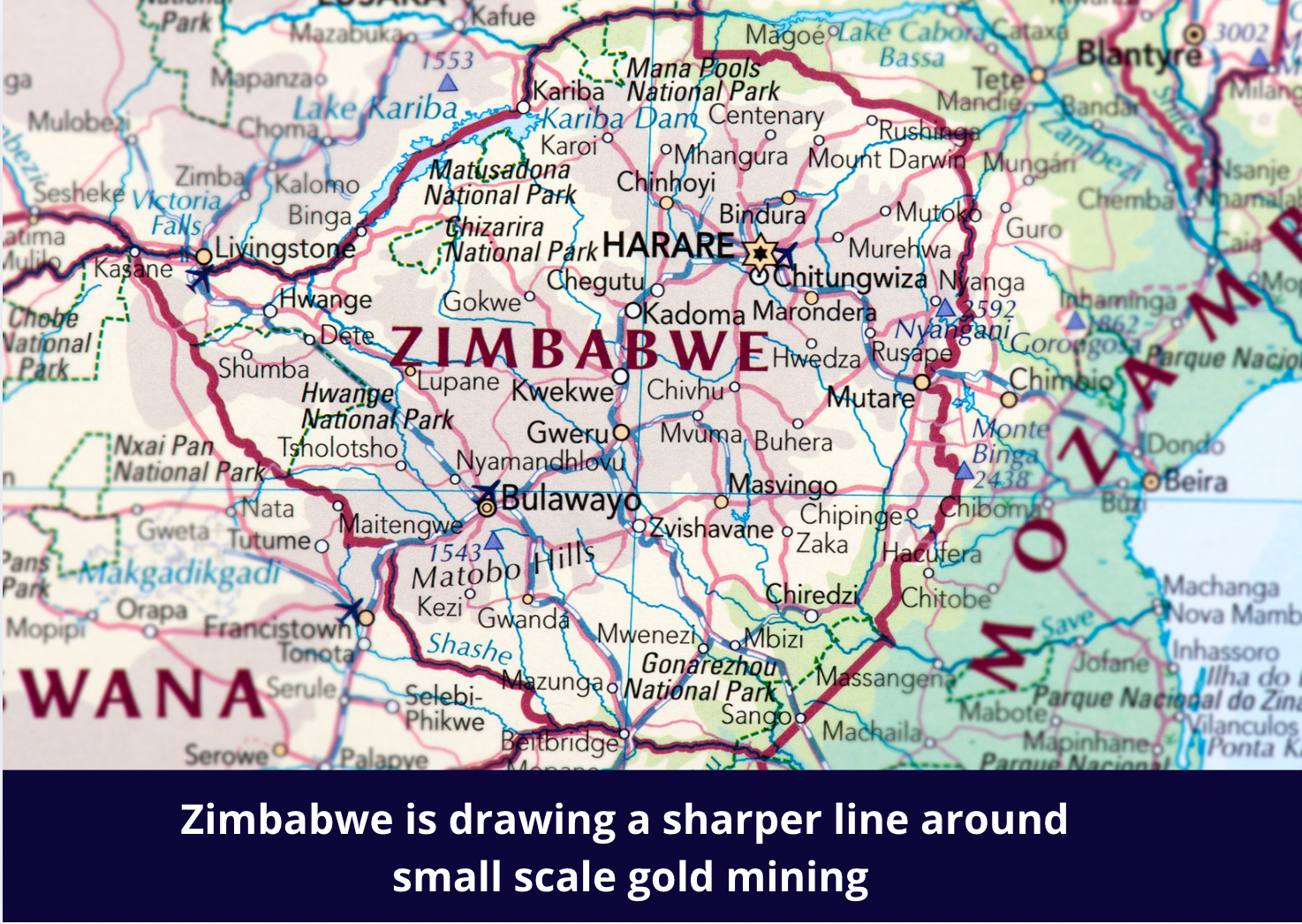
Signal 7: Zimbabwe is drawing a sharper line around small scale gold mining
What happened
Mining.com, citing Bloomberg, reported that Zimbabwe has banned foreign companies and individuals from small scale gold mining. Mines Minister Polite Kambamura said the small scale gold mining sector is reserved exclusively for Zimbabwean citizens. The restriction applies to producers whose monthly output is no more than 20 kilograms and whose capital investment is below US$15 million. Foreign investors and entities participating in small scale mining must either increase production capacity and investment or halt operations by January.
The same report states that small-scale miners produce about 65% of Zimbabwe’s gold, giving the measure significance beyond a narrow regulatory adjustment.
Why it matters
This matters because Zimbabwe is using ownership rules to reorganize the boundary between local mining, foreign participation and formal investment. The policy does not simply restrict foreign actors. It pushes them toward larger scale operations with higher capital commitments while reserving smaller scale gold production for domestic miners.
That distinction is important. In many mineral rich countries, small scale mining sits at the frontier between employment, informality, local livelihoods, environmental risk, gold flows and state control. By drawing a sharper line around who can operate in that space, Zimbabwe is making small scale gold mining part of a broader national resource governance question.
Implications for capital and strategy
For capital, the signal is that foreign participation in Zimbabwe’s gold sector may increasingly depend on scale, formal investment and compliance with a clearer policy boundary. Smaller foreign backed operations could face pressure to consolidate, expand or exit.
For strategy, the deeper message is that resource nationalism is not only about large mines, royalties or export bans. It can also operate through the rules that define who is allowed to mine at smaller scales. Zimbabwe shows how governments may seek to protect local participation while pushing foreign capital toward more formal, higher investment models.
Signals to watch
- Whether DOE’s pilot scale processing funding helps move magnesium, rare earth and recovery technologies closer to commercial deployment.
- Whether Arafura’s Nolans FID translates into construction execution, final financing milestones and a credible ore to oxide rare earth supply chain.
- Whether South Australia’s modernized copper framework helps BHP advance copper expansion while also assessing rare earth and other critical mineral optionality at Olympic Dam.
- Whether Hope Bay becomes a broader model for Arctic mining infrastructure, Indigenous energy participation and northern supply chain development.
- Whether Codelco’s internal reforms strengthen confidence in production reporting, incentive structures and governance of a strategic state owned copper producer.
- Whether Sherritt finds a durable structure to address Cuba sanctions while preserving nickel cobalt refining continuity in North America.
- Whether Zimbabwe’s small scale gold mining restriction becomes a formalization tool that strengthens local participation and state oversight, or whether it creates new pressures around informality, enforcement and foreign backed operating structures.
- Whether Marimaca’s sulphuric acid strategy becomes a wider model for copper projects seeking to reduce exposure to acid price volatility and supply disruptions. Marimaca said it has signed a non binding MOU to explore a joint venture framework for future sulphuric acid supply and potential integration of its previously acquired Dos Amigos acid plant in Mejillones.
- Whether the REalloys Critical Metals definitive offtake agreement for Tanbreez strengthens the emerging mine to magnet architecture for U.S. aligned heavy rare earth supply. REalloys said the agreement covers 15% of monthly Phase 1 production from Tanbreez and establishes a long term HREE feedstock source for downstream separation, metallization and magnet manufacturing.
Three strategic questions for this week
- Which parts of the mineral system are becoming more strategic: the mine, the processing plant, the governance framework, the energy system or the ownership rule?
- Where is supply becoming more reliable because execution systems are getting stronger?
- How should investors read mineral assets when strategic value increasingly depends on processing, sanctions exposure, institutional credibility, local ownership and infrastructure resilience?
Resources
Signal 1
Signal 2
Signal 3
- Premier of South Australia — State Government receives record royalty payment for copper
- Mining.com — BHP urged to assess rare earths at Olympic Dam
Signal 4
- Government of Canada — Government of Canada marks groundbreaking at Hope Bay Mine
- Agnico Eagle — Agnico Eagle approves Hope Bay investment decision
Signal 5
Signal 6
Signal 7
Signals to watch