Geopolitical Mining · Weekly
Geopolitical Mining Weekly
Week of June 8–14, 2026
Authors: Marta Rivera & Eduardo Zamanillo
June 14, 2026
What this week really tells us
What stood out this week is that critical minerals policy is moving deeper into the architecture of execution.
The signals were not only about supply risk, China, or demand from energy and defence. They were about the instruments countries are now trying to use to make mineral security operational: finance, offtake, risk sharing, allied diplomacy, processing capacity, permitting prioritization, industrial subsidies and institutional capability.
In Paris, a G7 linked statement brought mining companies, financial institutions, industrial groups and public stakeholders around the same issue: critical minerals projects are difficult to finance at the early stage, and private capital will not move at scale without stronger coordination, better project preparation, long term offtake and public risk sharing tools.
In the United States, the House passage of the DOMINANCE Act showed that critical minerals are being treated as a diplomatic and allied supply chain question, not only as a domestic mining question. In Ontario, public funding moved toward project level innovation in the critical minerals supply chain. In Kazakhstan, critical minerals appeared inside strategic conversations with both the United States and Saudi Arabia, alongside transport, logistics, mining, metallurgy and infrastructure.
Brazil sent a different but equally important signal. The Agência Nacional de Mineração framed critical minerals as a central issue for technological, energy and geopolitical transformation, while also pointing to permitting prioritization and the growing race for rare earths. Japan, meanwhile, showed the industrial side of the same story: Shin Etsu’s planned rare earth refinery is a reminder that supply security ultimately depends on processing capacity, not only on access to mineral resources.
The week’s message is direct: mineral security is no longer being built through declarations alone.It is being built through bankability, public finance, allied networks, permitting capacity, processing infrastructure and the ability to turn strategic intent into investable projects.
The deeper signal is that the question is changing. Countries are no longer asking only where the minerals are. They are asking who can finance them, process them, certify them, move them, buy them and protect the industrial systems that depend on them.
For the full Geopolitical Mining framework behind this note, read our book Mining Is Dead. Long Live Geopolitical Mining.
Signals of the week
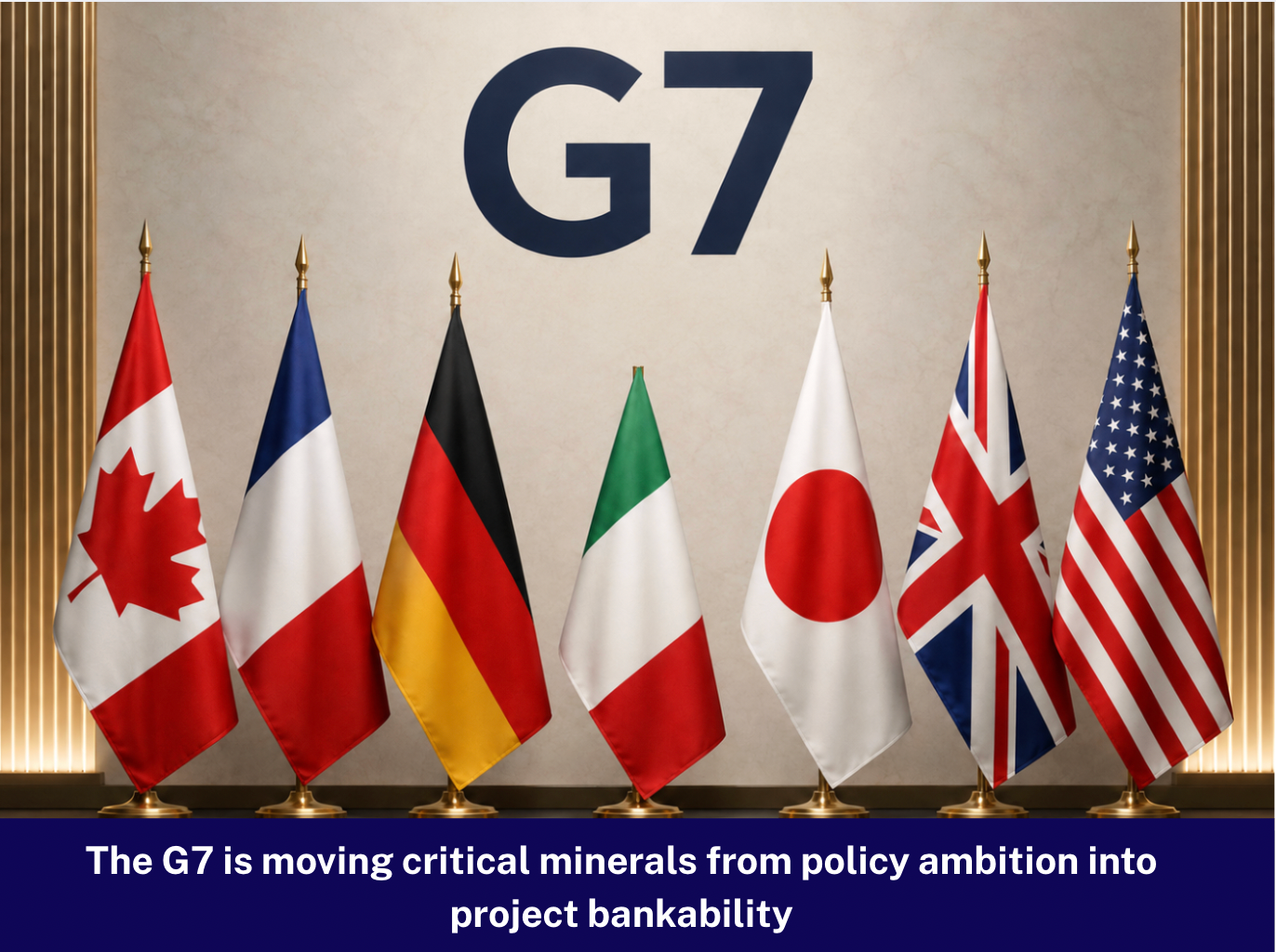
Signal 1: The G7 is moving critical minerals from policy ambition into project bankability
What happened
On June 10, mining companies, financial institutions, industrial groups, business associations and public stakeholders from G7 and like minded countries gathered in Paris under the French G7 Presidency and issued a statement on accelerating investment for critical minerals projects. The statement recognized the strategic importance of critical minerals for prosperity, economic security and the energy transition. It also identified one of the central problems in the sector: financing mining, processing and refining projects at an early stage remains difficult.
The signatories called for stronger private sector mobilization, expanded use of equity and blended finance instruments, long term offtake agreements, better project preparation, improved risk management standards and closer coordination between industry, financial institutions and public actors. The statement also called on G7 governments to scale up risk sharing instruments, support early stage project development, coordinate with multilateral development banks and encourage demand aggregation across trusted partners.
Why it matters
This matters because it moves the critical minerals conversation closer to the real constraint: bankability. For several years, governments have spoken about the need to diversify critical minerals supply chains. But diversification does not happen because a mineral is strategically important. It happens when projects can become financeable, permitted, technically credible, commercially contracted and politically durable.
The Paris statement is important because it recognizes that strategic minerals projects often fail to cross the gap between policy relevance and investable reality. Early stage projects carry geological, technical, permitting, price, offtake, political and execution risk. Private capital alone is rarely willing to absorb all of that risk, especially in markets where dominant producers already control processing capacity and price formation. The statement also shows that the G7 is beginning to understand mineral security as a system. Mining companies cannot solve it alone. Banks cannot solve it alone. Governments cannot solve it alone. The problem sits across the value chain.
Implications for capital and strategy
For capital, the signal is that critical minerals financing may increasingly depend on structured public-private mechanisms. Equity, blended finance, offtake, risk sharing instruments and multilateral coordination are becoming part of the investment case. For strategy, the deeper message is that mineral security is moving from resource identification to project conversion. The countries that succeed will not be the ones that only publish lists of critical minerals. They will be the ones that make credible projects bankable.
Signal 2: The United States is turning critical minerals into an allied supply chain and diplomacy agenda
What happened
On June 8, U.S. Representative Ami Bera announced that the U.S. House of Representatives had passed H.R. 7037, the Developing Overseas Mineral Investments and New Allied Networks for Critical Energies Act, known as the DOMINANCE Act. The legislation was introduced by Representatives Ami Bera and Young Kim. It is designed to strengthen U.S. energy security, reduce reliance on China for critical minerals and build more resilient supply chains with trusted allies and partners.
The official release framed critical minerals as essential to the U.S. defence industrial base, advanced manufacturing and emerging technologies. It also described China’s dominance in rare earth processing as a strategic vulnerability for the United States and its allies. The Act focuses on expanding cooperation with allies and partners, supporting strategic mineral and energy investments, strengthening U.S. energy diplomacy and investing in the workforce and expertise needed to build secure and diversified supply chains.
Why it matters
This matters because the United States is treating critical minerals as a foreign policy and economic security issue, not only as a domestic industrial issue. Domestic mining, refining, recycling and processing remain important. But the DOMINANCE Act recognizes that the United States cannot build secure supply chains alone. Critical minerals supply depends on allied jurisdictions, resource rich partners, trade relationships, investment protection, technical expertise and the ability to mobilize capital across borders.
That is a major shift. It means mineral security is becoming part of diplomacy. The strategic question is not only how much the United States can produce at home. It is how the United States can use its diplomatic, financial and industrial tools to build supply chains that are trusted, diversified and less exposed to coercion. This also reflects a broader reality of the material economy. Modern supply chains are not national in a simple sense. A secure mineral system may involve extraction in one country, processing in another, component manufacturing in another and final industrial use somewhere else.
Implications for capital and strategy
For capital, the signal is that projects located in allied or partner jurisdictions may become more strategically relevant if they can connect to U.S. security, energy, manufacturing or defence priorities. For strategy, the deeper message is that critical minerals diplomacy is becoming an execution tool. Access to minerals may increasingly depend on who can build trusted networks, not only who controls deposits.
Signal 3: Ontario is using project level innovation to build critical minerals supply chain capacity
What happened
On June 10, the Ontario government announced support for 18 projects through the Critical Minerals Innovation Fund. The funding is aimed at strengthening made in Ontario supply chains, accelerating homegrown innovation and reducing reliance on foreign adversaries. The selected projects cover different parts of the critical minerals system, including exploration technologies, processing, recycling, waste valorization, environmental performance and supply chain innovation. Ontario framed the announcement as part of a broader strategy to build a more competitive and self reliant economy, connected to critical minerals, northern development and industrial resilience.
Why it matters
This matters because critical minerals strategy cannot remain at the level of national ambition. It has to move into specific projects, technologies and capabilities. Ontario is one of the most important mining jurisdictions in North America, but the strategic value of its mineral base depends on more than geology. It depends on infrastructure, permitting, Indigenous partnerships, processing capacity, technical innovation, workforce availability and the ability to move projects from concept to production. The Critical Minerals Innovation Fund is not the full answer to supply security. But it is a practical signal. It shows a government trying to support the enabling technologies and project capabilities that sit around the mine.
That is important because many critical minerals projects face problems that are not solved by higher prices alone. Complex metallurgy, waste streams, recovery rates, environmental performance, data quality and processing technologies can determine whether a resource becomes viable.
Implications for capital and strategy
For capital, the signal is that jurisdictions supporting innovation around exploration, processing, recycling and project development may become more attractive than jurisdictions focused only on resource promotion. For strategy, the deeper message is that critical minerals capacity is built through an ecosystem. Mines matter, but so do laboratories, engineering, metallurgical testing, waste recovery, permitting systems, infrastructure and local technical capacity.
Signal 4: Kazakhstan is positioning critical minerals inside strategic diplomacy, logistics and industrial cooperation
What happened
During the week, Kazakhstan held two important strategic discussions that included critical minerals. On June 9, Kazakhstan’s Foreign Minister Yermek Kosherbayev met with U.S. Special Envoy Sergio Gor in Astana. The parties discussed economic and investment partnership, innovation, artificial intelligence, education and science. Transport, logistics and critical minerals were discussed separately. The meeting also referenced the upcoming C5+1 Critical Minerals Dialogue and a planned business roundtable involving delegations from the United States and Central Asian countries. On June 11, Kazakhstan’s Foreign Minister met with Saudi Arabia’s Minister of Industry and Mineral Resources, Bandar Al-Khorayef. The discussions focused on trade, investment and industrial cooperation, with particular attention to mining and metallurgy, critical minerals and infrastructure. The parties also discussed opportunities for joint projects in mining and critical minerals, including Saudi company participation in investment initiatives in Kazakhstan.
Why it matters
This matters because Kazakhstan is not treating critical minerals as a narrow mining issue. It is positioning them inside a broader strategic package: investment, logistics, industrial cooperation, regional diplomacy and infrastructure. That is especially important in Central Asia. Mineral potential is only one part of the equation. The ability to connect projects to processing, transport corridors, capital, export markets and strategic partners can be just as important as the resource itself.
Kazakhstan’s engagement with both the United States and Saudi Arabia also shows how critical minerals are creating new diplomatic alignments. The United States is looking for trusted and diversified sources. Saudi Arabia is building a minerals and industrial strategy as part of its wider economic transformation. Kazakhstan can position itself as a resource rich, logistics relevant and strategically connected jurisdiction between Asia, Europe and the Middle East.
Implications for capital and strategy
For capital, the signal is that Kazakhstan’s critical minerals opportunity may become more visible if it can combine resource potential with credible logistics, infrastructure and partner country investment. For strategy, the deeper message is that mineral security is increasingly corridor based. It depends not only on deposits, but on the routes, partners and institutions that allow minerals to move into industrial supply chains.
Signal 5: Brazil is turning critical minerals into an institutional and geopolitical agenda
What happened
On June 11, Brazil’s Agência Nacional de Mineração published an official note on the growing global importance of critical minerals and the strategic relevance of Brazil. The note linked critical minerals to the energy transition, advanced technologies, defence, data centers, electronics, batteries, wind turbines, solar panels and military equipment. It also emphasized that critical minerals are those whose supply is concentrated in a small number of countries, creating risk of disruption in global supply chains.
The ANM also highlighted that Brazil is seeing a sharp increase in interest in rare earths. According to the agency, 476 research authorization requests related to rare earths were filed between 1975 and 2020. That number rose to 901 requests in 2023 and reached a record 1,081 in 2024. In 2025, 655 requests were recorded, and by June 8, 2026, another 401 requests had already been filed. The agency also stated that documentation related to critical and strategic minerals is receiving priority in ANM analysis under Brazil’s multiyear plan.
Why it matters
This matters because Brazil is beginning to frame critical minerals through the lens of state capacity, not only resource potential. Brazil has geological relevance in several minerals connected to the material economy, including lithium, nickel, copper, niobium, manganese, graphite and rare earth potential. But geology alone is not enough. The strategic question is whether Brazil can convert that potential into credible projects, processing capacity, regulatory efficiency and higher value participation in supply chains. The increase in rare earth applications is an important signal. It shows that the market is responding to global demand and geopolitical interest. But it also creates pressure on the state. More applications mean more need for technical evaluation, permitting capacity, environmental governance, land-use clarity and institutional coordination.
Brazil’s relevance will depend on whether it can avoid becoming only a supplier of raw potential. The opportunity is not only to host minerals. It is to build the institutional and industrial conditions that make those minerals viable.
Implications for capital and strategy
For capital, the signal is that Brazil may become more relevant in critical minerals if permitting prioritization, regulatory capacity and project execution improve. For strategy, the deeper message is that Latin America’s role in the material economy will not be determined by geology alone. It will be determined by governance, infrastructure, legitimacy, processing capability and the ability of the state to facilitate viable projects.
Signal 6: Japan’s Shin-Etsu shows that rare earth security depends on refining capacity, not only mineral access
What happened
On June 11, Mining.com, citing Bloomberg, reported that Shin-Etsu Chemical plans to build a new domestic rare earth refinery in Japan. The plant would be the company’s third in Fukui Prefecture and is intended to help ensure a stable supply of rare earth related products and magnets. Nippon.com, citing Jiji Press, also reported that Shin-Etsu plans to build a new rare earth factory in Fukui Prefecture to increase domestic supplies and reduce Japan’s heavy reliance on imports from China. The report said the investment is expected to be at least 35 billion yen, with 17.5 billion yen of the total to be covered by government subsidies. Shin-Etsu already smelts rare earths and manufactures magnets using rare earth materials at its plant in Echizen. Its products are used in electric vehicles, hard disk drives and other industrial applications.
Why it matters
This matters because the rare earth bottleneck is not only about mining. It is about separation, refining, metals, alloys, magnets and industrial qualification. Japan understands this because its industrial base depends on rare earth magnets for high value manufacturing. A new refinery in Japan is not simply a company expansion. It is part of a larger effort to reduce exposure to concentrated processing capacity and strengthen the industrial layers that turn rare earth inputs into usable components. The signal also connects to the broader G7 discussion. Countries can identify rare earth resources, finance mining projects and build strategic partnerships. But if they cannot process and refine the material, they remain exposed.
Rare earths are a useful case because they show how mineral security becomes industrial security. The value is not in the oxide alone. It is in the ability to produce consistent, qualified materials that manufacturers can actually use.
Implications for capital and strategy
For capital, the signal is that refining and magnet related capacity may continue to attract strategic value, especially in jurisdictions seeking to reduce exposure to Chinese processing dominance. For strategy, the deeper message is that supply security must be measured across the chain. A mine without processing is not enough. A processing plant without customers is not enough. A magnet supply chain without qualified materials is not enough.
Signals to watch
- Whether the G7 statement leads to specific financing mechanisms, working groups, project pipelines or risk-sharing instruments that can move critical minerals projects from policy relevance to bankability.
- Whether the DOMINANCE Act advances beyond the House and becomes a practical tool for U.S. critical minerals diplomacy, allied investment and overseas project support.
- Whether Ontario’s 18 Critical Minerals Innovation Fund projects remain pilot level initiatives or begin to strengthen real project development, processing, recycling and supply chain capacity.
- Whether Kazakhstan’s critical minerals discussions with the United States and Saudi Arabia translate into concrete investment vehicles, project partnerships or logistics corridor agreements.
- Whether Brazil’s prioritization of critical and strategic minerals within ANM analysis is matched by enough institutional capacity to handle rising applications, especially in rare earths.
- Whether Shin-Etsu’s planned refinery becomes part of a wider Japanese and G7 effort to rebuild rare earth processing and magnet supply chains outside China.
- Whether the European Union’s Raw Materials Mechanism moves from demand collection into meaningful aggregation when its first diversification round enters the offtaker aggregation phase on June 17.
Three strategic questions for this week
- Which jurisdictions are doing the most to turn critical minerals policy into bankable projects?
- Where is the real bottleneck now: capital, permitting, processing, logistics, offtake, technology or state capacity?
- How should investors evaluate mineral assets when strategic value increasingly depends on the system around the asset, not only the deposit itself?
Resources
Signal 1
Signal 2
- U.S. Representative Ami Bera — Rep. Bera Applauds House Passage of Bipartisan DOMINANCE Act
- U.S. Representative Young Kim — Reps. Kim, Bera DOMINANCE Act Passes House Foreign Affairs Committee
Signal 3
- Government of Ontario — Ontario Takes Action to Build Critical Minerals Supply Chain
- Government of Ontario — Critical Minerals Innovation 2025–2026 Intake Recipients
Signal 4
- Government of Kazakhstan — Astana Hosts Discussions on the Development of the Kazakhstan-U.S. Strategic Partnership
- Government of Kazakhstan — Astana Hosts Discussions on Advancing Industrial Cooperation with Saudi Arabia
Signal 5
- Agência Nacional de Mineração — Minerais críticos ganham protagonismo global e ampliam relevância estratégica do Brasil
- Agência Nacional de Mineração — Minerais Críticos e Estratégicos
Signal 6
- Mining.com / Bloomberg — Japan’s Shin-Etsu plans new rare earth refinery to secure supply
- Nippon.com / Jiji Press — Shin-Etsu Chemical to Build New Rare Earth Plant
- Shin-Etsu Chemical — Takefu Plant / rare earth magnets and rare earth compounds
Signals to watch