
Geopolitical Mining · Weekly
Geopolitical Mining Weekly
Week of July 20–26, 2026
Authors: Marta Rivera | Eduardo Zamanillo
July 27, 2026
What this week really tells us
What stood out this week is that mineral security is moving into control systems.
The signals were not only about access to minerals, project announcements or strategic partnerships. They were about the mechanisms that determine whether supply can be verified, permitted, selected, financed, governed and eventually produced.
The United States moved critical materials deeper into defence procurement. A new executive order directed federal agencies to strengthen domestic acquisition of critical materials and map defence supply chains back to raw material origin. That matters because mineral security is no longer only about securing deposits or processing capacity. It is also about knowing exactly where the materials inside defence systems come from, which suppliers carry risk and which alternative sources can be qualified.
Canada advanced the Crawford Nickel Project to the final federal impact assessment decision stage. That signal is important because a large nickel-cobalt project does not become supply through resource size alone. It must pass through the legal, environmental and Indigenous consultation gates that decide whether it can move from project file to construction.
Sweden released a new mineral strategy that frames access to metals and minerals as a strategic security issue in a geopolitical context. The United Kingdom moved its Magnet Hub process forward as expressions of interest closed on July 22. Chile’s Codelco commissioned an external KPMG audit of production reporting after inconsistencies were found in the recognition of 26,875 tonnes of copper reported as finished production in December 2025. Zambia, meanwhile, appeared in a different kind of signal: a USTDA-backed feasibility process for expanding copper and cobalt mining and concentrating capacity at the Kazozu mine.
The week’s message is direct: mineral security is becoming a systems question. It is shaped by procurement rules, permitting decisions, national strategies, industrial selection, production credibility and feasibility work. None of these is enough on its own. But together they determine whether mineral ambition can move toward supply. The deeper signal is that the decisive question is moving beyond the mineral itself. It is moving toward the reliability of the systems around it.
For the full Geopolitical Mining framework behind this note, read our book Mining Is Dead. Long Live Geopolitical Mining.
Signals of the week
Signal 1: The United States is turning defence procurement into critical materials control
What happened
On July 20, the White House issued an executive order on securing America’s defence supply chains and ensuring domestic acquisition of critical materials. The order directs federal action around the sourcing of critical materials and components needed to manufacture, maintain, sustain and repair military equipment. The order also directs supply chain mapping, including an indentured bill of materials that reaches back to raw material origin, and requires defence contractors to qualify domestic or alternative sources where needed. It also limits certain waiver practices beginning in 2027 unless mitigation plans are in place.
Why it matters
This matters because critical minerals are being pulled into a stricter system of traceability and procurement control. The issue is no longer only whether the United States can mine or process more material. It is whether the defence industrial base knows where its inputs come from, which suppliers are exposed, and where replacement sources can be qualified.
That is a different stage of mineral security. It moves the conversation from supply ambition into supply chain verification. It also shows why strategic materials are becoming embedded inside procurement rules. Defence systems are built from thousands of components, and the vulnerability may sit far below the level of the final platform. A missile, radar system, aircraft or secure communications system may depend on a mineral, alloy, component or sub-supplier that is invisible until the chain is mapped.
Implications for capital and strategy
For capital, the signal is that projects and processors able to support traceable, qualified and defence relevant supply may become more valuable than assets that only offer generic material exposure. For strategy, the deeper message is that mineral security is becoming a compliance system. Supply must not only exist. It must be visible, auditable and capable of entering controlled industrial chains.
Signal 2: Crawford Nickel shows that critical minerals supply still depends on permitting gates
What happened
On July 20, the Impact Assessment Agency of Canada finalized the impact assessment report for the Crawford Nickel Project and submitted it to the federal Minister of Environment, Climate Change and Nature for a decision statement. The Crawford project, proposed by Canada Nickel Company, is an open pit nickel-cobalt mine and on site metal mill located north of Timmins, Ontario. The mine would have a maximum ore extraction rate of up to 240,000 tonnes per day, while the processing plants would have a combined maximum throughput of 120,000 tonnes per day and an expected operating life of about 41 years.
The project has now moved into the post assessment decision stage. If approved, it may proceed toward construction as federal authorizations, permits, conditions and other requirements are met.
Why it matters
This matters because a large critical minerals project does not become supply when its resource is identified. It becomes possible supply when it moves through the permitting, environmental, Indigenous consultation and decision making framework that allows construction to begin.
Crawford is important because nickel and cobalt sit inside batteries, stainless steel, clean industrial materials and broader manufacturing chains. But the strategic relevance of the materials does not remove the need for a credible review process. The signal is useful because it shows the project moving into a decisive institutional gate. The mine is still not approved supply. But it is no longer just a resource story either.
Implications for capital and strategy
For capital, the signal is that late stage permitting milestones can materially change how investors read project risk, even before a final construction decision. For strategy, the deeper message is that permitting capacity is part of mineral security. Countries that want critical minerals supply need review systems that are credible, durable and capable of moving major projects to decision.
Signal 3: Sweden is framing mineral access as a strategic security issue
What happened
On July 23, the Swedish government published Sveriges mineralstrategi, Sweden’s mineral strategy. The government stated that secure access to raw materials is important for the climate and energy transition, technological innovation and sustainable economic growth. It also stated that, in a geopolitical context, access to metals and minerals is a strategic security issue. The strategy presents Sweden as having strong conditions to contribute to a more independent supply of raw materials, metals and minerals.
Why it matters
This matters because European mineral strategy is becoming more explicitly connected to security. Sweden is not only a resource jurisdiction. It is also an industrial, technological and defence relevant economy inside Europe. When it frames minerals through security, innovation and raw material independence, it reflects a broader European shift: mineral policy is being connected to industrial resilience.
The signal is also important because mineral strategies matter when they shape implementation. A strategy by itself does not build mines, processing plants or transport corridors. But it can define priorities, coordinate institutions and create the policy basis for project development. For Europe, the issue is not only access to foreign supply. It is whether domestic resource potential can be converted into responsible production, processing capability and industrial advantage.
Implications for capital and strategy
For capital, the signal is that Swedish and Nordic mineral projects may increasingly be read through a security and industrial resilience lens, not only through commodity exposure. For strategy, the deeper message is that mineral security is becoming national industrial policy. Countries with geology, institutions and industrial capacity are trying to connect those pieces into a more coherent supply position.
Signal 4: The United Kingdom is moving rare earth magnet capacity into industrial selection
What happened
The United Kingdom’s Magnet Hub expression of interest window closed on July 22. The Magnet Hub is part of the UK Critical Minerals Programme and sits alongside the Critical Minerals Accelerator and Demand Aggregation Platform. The process requires applicants to submit an expression of interest before being invited to make a full application. One organisation or consortium will ultimately be selected to establish and operate the Magnet Hub, with funding decisions expected in autumn 2026 and the grant period running to March 31, 2030.
The UK government describes the programme as supporting supply chain resilience, domestic production and recycling, commercialization of innovative technologies and high value jobs.
Why it matters
This matters because rare earth security depends on magnets, not only on oxides or mines. Permanent magnets sit inside electric vehicles, wind turbines, robotics, industrial systems, defence applications and advanced manufacturing. But magnet manufacturing requires capability, qualification, specialized equipment, skilled people and customer trust.
The UK signal is not that a hub has been selected yet. It is that the process has moved from an open call into the next stage of industrial selection.
That distinction matters. Mineral security often fails in the middle of the chain, where technical capability must become industrial capacity. Magnet supply is exactly that kind of middle-chain problem.
Implications for capital and strategy
For capital, the signal is that magnet-related capabilities may continue to attract strategic support, especially where they connect recycling, manufacturing, technical expertise and downstream demand. For strategy, the deeper message is that countries are trying to build capability nodes, not only supply agreements. The magnet problem cannot be solved by mining alone.
Signal 5: Codelco shows why production credibility is part of copper security
What happened
On July 21, Codelco announced that its board had commissioned KPMG to conduct an independent external audit of production reports for 2024 and 2025. The decision followed an internal audit that detected inconsistencies in the recognition of 26,875 tonnes of copper reported as finished production in December 2025. Codelco said the measures also included correction of production reports, review of procedures, recalculation of variable incentives, administrative sanctions and delivery of background information to prosecutors to determine possible criminal responsibility.
Why it matters
This matters because copper security is not only about ore, projects or national ownership. It is also about operational credibility. Codelco is not just another copper producer. It is a state owned company at the centre of Chile’s mining model and one of the most important copper producers in the world. When production reporting comes under review, the issue is not only accounting. It touches governance, trust, incentives and the credibility of the production system.
That is especially important in copper. The world needs more supply, but production guidance, reported output and operational performance all affect how markets, governments and investors read the sector. The signal is also a reminder that state ownership does not automatically create strategic capacity. Strategic capacity depends on discipline, controls and reliable execution.
Implications for capital and strategy
For capital, the signal is that production credibility matters when valuing copper companies, particularly where operational reliability, internal controls, board oversight and incentive structures shape the investment case. In Codelco’s case, the issue also has a wider governance dimension. As a state-owned company at the centre of Chile’s mining system, weaknesses in production reporting can raise questions about management accountability, the effectiveness of internal controls and the board’s capacity to identify and correct problems.
The governance test will therefore depend not only on what the external audit finds, but also on how transparently Codelco reports the findings, addresses any control weaknesses and aligns incentives with accurate operational reporting. For strategy, the deeper message is that mineral security depends on trust in the numbers and in the institutions responsible for producing them. A country may have world-class copper resources, but the credibility of its mineral supply system depends on whether production can be measured accurately, reported transparently and governed with effective oversight and accountability.
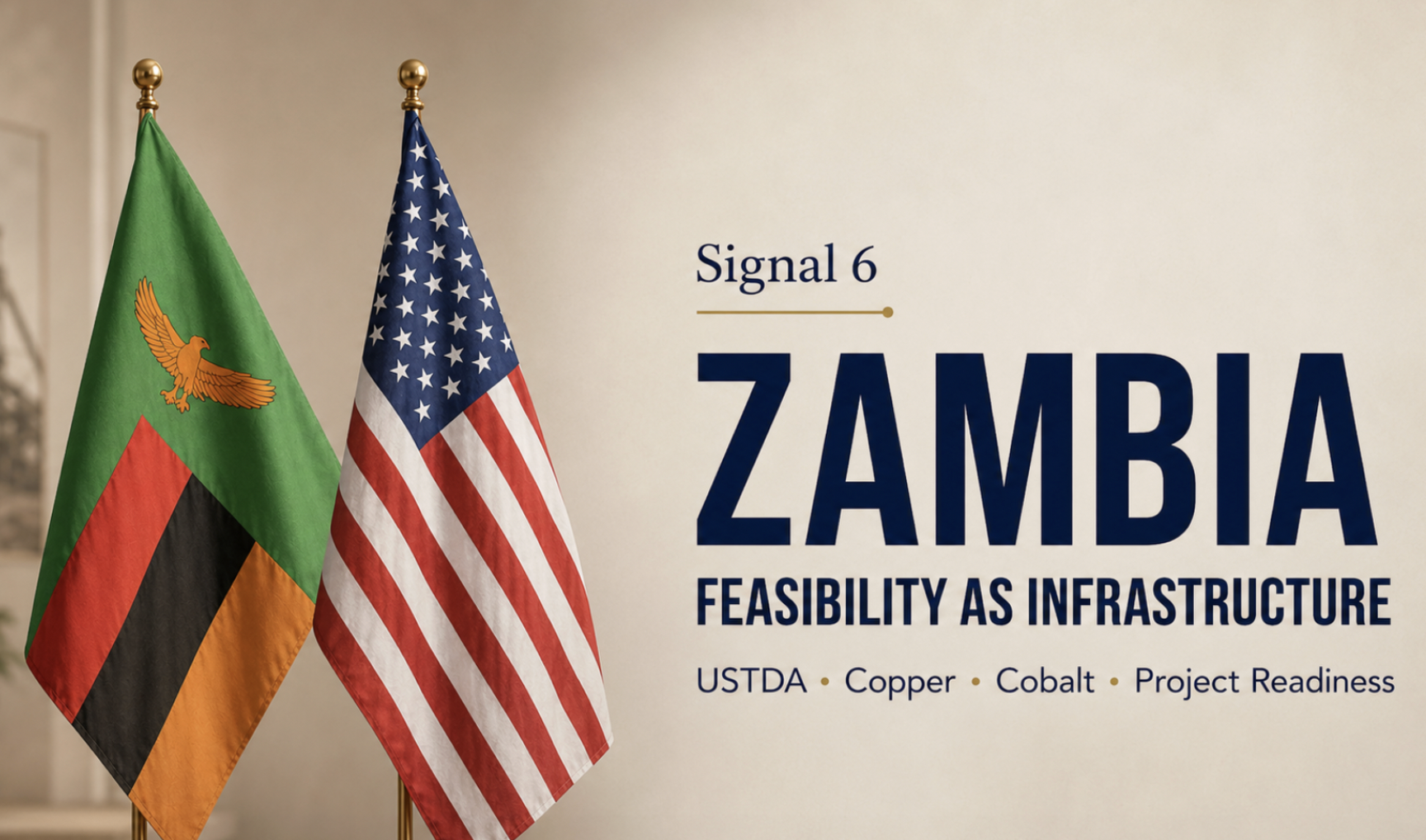
Signal 6: Zambia shows why feasibility work is part of critical minerals infrastructure
What happened
On July 22, the U.S. Trade and Development Agency listed a business opportunity for the Metalex Cobalt and Copper Production Expansion in Zambia. The opportunity invites U.S. firms to submit qualifications and proposal data for a feasibility study for the proposed expansion of copper and cobalt mining and concentrating at the Kazozu mine in Zambia. The selected U.S. firm will be paid from a US$3.567 million USTDA grant to Metalex Africa Zambia Limited. The proposed project would increase mining and production capacity by up to 25,000 additional metric tonnes of copper and cobalt concentrates.
The study includes geological data collection, resource assessment, metallurgical test work, plant feasibility, energy supply feasibility, logistics feasibility, economic analysis, financing plan, environmental impact assessment, climate resilience assessment, offtaker identification and an implementation plan.
Why it matters
This matters because critical minerals supply is often decided before construction begins. Feasibility work is not administrative detail. It is where a project becomes legible to capital, regulators, offtakers and infrastructure providers. The Zambia signal is especially useful because it shows the full system around a copper-cobalt project. Geology matters, but so do metallurgy, power, logistics, environmental assessment, climate resilience, offtake and financing.
That is where many projects stall. They may have mineral potential, but they cannot become financeable unless the technical, environmental, infrastructure and commercial questions are answered.
Implications for capital and strategy
For capital, the signal is that early feasibility work can create strategic value by reducing uncertainty before larger pools of capital enter. For strategy, the deeper message is that critical minerals infrastructure begins with project definition. Countries and companies cannot build supply if the project is not technically, commercially and institutionally ready.
Signals to watch
- Whether the U.S. defence supply chain order changes contractor behaviour around raw material origin, supplier qualification and domestic sourcing.
- Whether DOE’s new Common Investment Initial Screening Application becomes a useful entry point for critical minerals projects seeking federal funding across multiple agencies.
- Whether the Crawford Nickel Project receives a federal decision statement, and what conditions would shape any path toward construction.
- Whether Sweden’s new mineral strategy leads to permitting, infrastructure, exploration or processing measures that change the investment case for Swedish mineral projects.
- Whether the UK Magnet Hub receives credible full applications and whether the selected operator can connect magnet manufacturing, recycling, technology and downstream customers.
- Whether Codelco’s external audit strengthens confidence in production reporting and internal controls, or exposes deeper governance and incentive problems.
- Whether the USTDA backed Zambia study moves the Kazozu copper-cobalt expansion toward bankability, offtake and financing.
- Whether the DOE–DOL mining innovation and safety agreement leads to field deployment of AI, automation, advanced sensors and data systems in U.S. mining.
Three strategic questions for this week
- Which control system matters most for mineral security: origin tracing, permitting, national strategy, industrial selection, production reporting or feasibility work?
- How should investors value projects when the decisive risk sits before construction, in review processes, data credibility, qualification or feasibility?
- Are governments building mineral security by adding more policy, or by creating systems that can verify and deliver supply?
Resources
Signal 1
- The White House — Securing America’s Defense Supply Chains and Ensuring Domestic Acquisition of Critical Materials
- The White House — Fact Sheet: President Donald J. Trump Secures America’s Defense Supply Chains and Ensures Domestic Acquisition of Critical Materials
Signal 2
Signal 3
Signal 4
Signal 5
Signal 6
Signals to watch