
Geopolitical Mining · Weekly
Geopolitical Mining Weekly
Week of July 27–August 2, 2026
Authors: Marta Rivera & Eduardo Zamanillo
August 3, 2026
What this week really tells us
What stood out this week is that mineral security is moving into the systems that decide whether supply can actually be recovered, approved, organized, restarted and governed. The signals were not only about strategic minerals as a category. They were about the practical pathways that make supply possible: recycling rules, project approvals, state level project coordination, offtake infrastructure, bilateral mineral partnerships and governance against illicit mining.
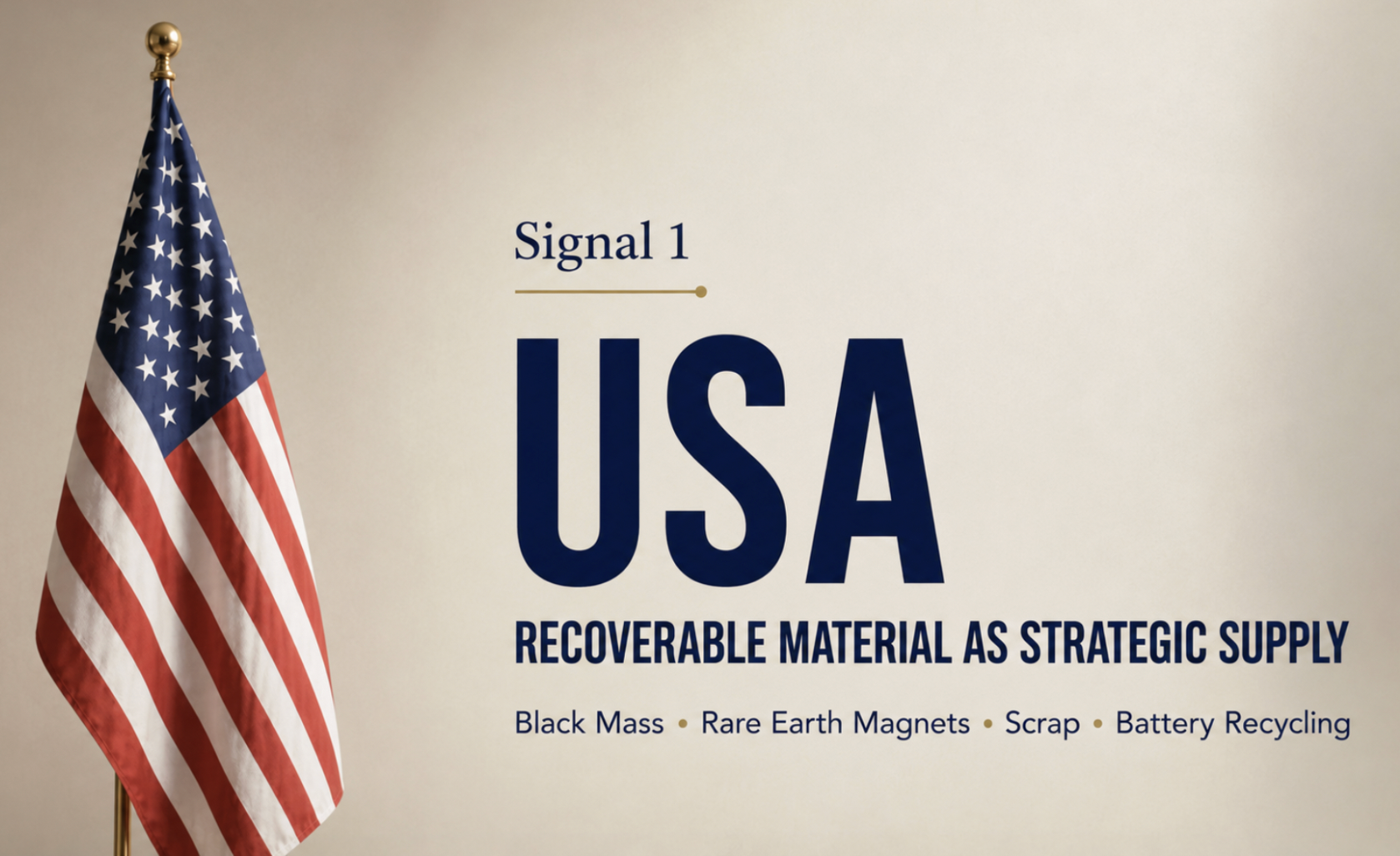
In the United States, recoverable critical minerals and materials were pulled into the national defence framework. The White House determination defined recoverable materials to include black mass (a battery-recycling concentrate containing recoverable critical minerals), end of life rare earth permanent magnets, swarf, and other waste and scrap containing critical minerals and materials. The same week, DOE announced winners of a lithium-ion battery recycling prize focused on the infrastructure needed to collect, sort, transport and process spent or discarded batteries. Together, these signals show that secondary materials are becoming part of mineral security, not just waste management.
Canada moved the Crawford Nickel Project into a new stage after issuing the federal impact assessment decision statement. That matters because a large nickel cobalt project does not become supply through scale alone. It still depends on legally binding conditions, permits, Indigenous consultation, environmental commitments and the ability to move from decision statement to construction.
Queensland released Delivering Queensland’s Critical Minerals Future 2026–30, setting out a plan to unlock investment, accelerate projects and build industries around critical minerals. Bunker Hill shipped its first concentrate to Teck’s Trail smelter, showing how a brownfield restart becomes more credible when the processing plant, offtake pathway and revenue stream begin to work. South Korea and Chile, meanwhile, signed memorandums of understanding that included mineral resources cooperation around lithium and copper. South Africa’s Cabinet statement also placed critical minerals beneficiation inside a regional industrialisation agenda and approved publication of a mining law amendment bill aimed at illicit mining.
The week’s message is direct: mineral security is becoming a pathway question. It depends on whether materials can be recovered, whether projects can pass decision gates, whether jurisdictions can coordinate investment and infrastructure, whether old mines can restart into real offtake systems, whether partnerships can move along the value chain, and whether governments can protect the legitimacy of their mineral sectors. The deeper signal is that supply is not created by mineral potential alone. It is created by the systems that turn potential into usable, permitted, processed, commercial and governed material.
For the full Geopolitical Mining framework behind this note, read our book Mining Is Dead. Long Live Geopolitical Mining.
Signals of the week
Signal 1: The United States is turning recoverable material into strategic supply
What happened
On July 30, the White House issued a Presidential Determination under Section 101 of the Defense Production Act on recoverable critical minerals and materials. The determination states that recoverable critical minerals and materials are industrial resources necessary to promote national defence, and that inadequate U.S. supply poses an increasing risk to defence and security. The determination defines recoverable critical minerals and materials to include black mass, end of life rare earth permanent magnets and other finished goods, swarf, and other waste and scrap containing critical minerals and materials. It also states that copper scrap is excluded because it is already covered separately under the 2025 copper action.
The same week, on July 28, DOE’s Office of Critical Minerals and Energy Innovation announced eight winners of the Lithium Ion Battery Recycling Prize Breakthrough Contest. DOE said the contest is designed to accelerate the infrastructure needed to collect, sort, transport and process spent or discarded lithium-ion batteries, and to keep critical materials inside the domestic supply chain.
Why it matters
This matters because the United States is widening the definition of mineral security. The strategic resource is no longer only the deposit in the ground. It can also be the battery at end of life, the rare earth magnet inside finished equipment, the scrap stream, the swarf, the black mass or the discarded product that still contains recoverable material.
That is important because critical minerals supply often depends on materials already circulating through the economy. The issue becomes whether the system can identify, collect, process and retain those materials before they leave the domestic industrial base. The policy signal and the DOE prize are different instruments, but they point in the same direction. One treats recoverable material as a national defence resource. The other supports practical recycling infrastructure. Together, they show secondary supply becoming part of the mineral security architecture.
Implications for capital and strategy
For capital, the signal is that recycling, collection, sorting, processing and recovery platforms may become more strategically relevant when they can keep critical materials inside trusted supply chains. For strategy, the deeper message is that mineral security increasingly includes the back end of the product life cycle. Countries that cannot recover value from existing materials may remain dependent even when useful material is already inside their economies.
Signal 2: Crawford Nickel shows how project approval turns resource scale into conditional supply
What happened
On July 31, the Government of Canada issued the impact assessment decision statement for the Crawford Nickel Project to Canada Nickel Company. The project is an open pit nickel-cobalt mine and on site metal mill located north of Timmins, Ontario, with proposed mine ore production capacity of 240,000 tonnes per day, mill ore input capacity of 120,000 tonnes per day and an expected operating life of about 41 years. The project is now in the post decision phase. Canada’s registry states that, if approved, the project may proceed to construction as federal authorizations and permits are issued and as conditions and other requirements are met.
Why it matters
This matters because Crawford moved from being a large critical minerals project under assessment into a more concrete institutional pathway. Nickel and cobalt are strategically relevant, but strategic relevance does not remove the need for conditions, permits, environmental commitments, Indigenous consultation and construction readiness. A decision statement does not turn a project into operating supply. It creates the framework through which the project may move toward construction.
That distinction matters. Governments can identify critical minerals. Companies can define large resources. Investors can model future output. But supply becomes more credible only when the project passes the gates that allow capital and construction to move. Crawford is therefore a useful signal because it shows the transition from project potential toward conditional supply.
Implications for capital and strategy
For capital, the signal is that late-stage approval milestones can change project risk, but the next phase still depends on authorizations, financing, execution and compliance with conditions. For strategy, the deeper message is that permitting decisions are part of mineral security. A country cannot build critical minerals supply if major projects cannot move from assessment into a credible development pathway.
Signal 3: Queensland is organizing critical minerals around project pathways and industrial capacity
What happened
During the week, Queensland released Delivering Queensland’s Critical Minerals Future 2026-30. The strategy sets out how the state intends to unlock investment, accelerate projects and build industries around critical minerals. The Queensland materials describe a coordinated approach that brings together funding programs, faster project pathways, regulatory reforms, geoscience, infrastructure and investment tools. The plan links critical minerals development with processing, refining, manufacturing, recycling and strategic infrastructure.
Why it matters
This matters because critical minerals strategy is becoming more jurisdictional and more practical. Queensland is not only presenting itself as a place with mineral potential. It is trying to organize the conditions around that potential: capital, approvals, infrastructure, downstream capability, geoscience and government coordination.
That is important because many critical minerals projects do not fail because the mineral is unimportant. They fail because the project cannot move through the steps between resource identification and bankable development. The Queensland signal also matters because it treats the value chain as a development question. Mining is part of the picture, but so are processing, refining, manufacturing and recycling.
Implications for capital and strategy
For capital, the signal is that jurisdictions with coordinated project pathways may become more attractive than jurisdictions that only promote geology. For strategy, the deeper message is that mineral security requires public systems capable of moving projects through uncertainty. State capability is becoming part of the resource base.
Signal 4: Bunker Hill shows why brownfield restart depends on processing and offtake
What happened
On July 31, Bunker Hill Mining announced its first shipment of concentrate to Teck Resources’ Trail smelter. The company described the shipment as the first revenue generating concentrate sale from the mine in more than 45 years and linked it to commissioning of its new 1,800 ton per day processing plant. The Bunker Hill mine is a zinc-lead-silver operation in Idaho’s Silver Valley. Earlier company materials also describe Teck’s Trail smelter as the destination for Bunker Hill’s zinc and lead concentrates under offtake arrangements.
Why it matters
This matters because brownfield supply is not created by reopening a nameplate asset. It is created when the mine, processing plant, concentrate quality, logistics and offtake pathway begin to work together. Bunker Hill is a useful signal because it shows a historic mining asset moving into a commercial pathway after decades of closure. The milestone is not only that material was mined. It is that concentrate was produced, shipped and connected to an existing smelting system.
That is where brownfield restart becomes more credible. Existing infrastructure and known mineral districts can help, but they do not remove the need for commissioning, operating discipline, product acceptance and customer linkage.
Implications for capital and strategy
For capital, the signal is that brownfield restarts can gain value when they demonstrate processing performance and offtake execution, not just historical production potential. For strategy, the deeper message is that mineral security can come from reactivating existing districts, but only when the operating system around the asset is rebuilt.
Signal 5: South Korea and Chile are pushing lithium and copper cooperation further along the value chain
What happened
On July 30, South Korea and Chile signed five memorandums of understanding, including a mineral resources partnership aimed at deepening cooperation in lithium and copper supply chains. Mining.com reported that the agreements were signed after a summit between the two presidents in Santiago and covered mineral resources, investment promotion and other areas of bilateral cooperation. Additional reporting described the mineral cooperation as covering the lithium and copper value chain, including exploration, development, production, processing, information exchange, technology cooperation and professional exchange.
Why it matters
This matters because bilateral mineral cooperation is becoming more specific. The issue is not only that Chile has copper and lithium, or that South Korea has downstream demand in batteries, manufacturing and industrial technology. The more important signal is that cooperation is moving toward the full chain: exploration, development, processing, technology and investment.
That matters for Chile because mineral diplomacy is increasingly tied to the question of value creation at home. It is not enough to be a source of raw material if the strategic opportunity is also in processing, technology, skills and industrial linkage. It matters for South Korea because secure mineral access depends on durable partnerships with producer countries, not only on purchasing material in the market.
Implications for capital and strategy
For capital, the signal is that projects connected to bilateral industrial partnerships may become more visible to downstream users and strategic investors. For strategy, the deeper message is that mineral diplomacy is moving beyond offtake. The more durable partnerships will be those that connect resources to technology, processing, skills and industrial development.
Signal 6: South Africa is tying mineral governance to regional value chains and illicit mining control
What happened
On July 29, South Africa’s Cabinet statement highlighted preparations for the 2026 SADC Industrialisation Week, held from July 27 to 31 in Durban. The statement said this year’s focus included regional value chains in agro processing, pharmaceuticals, consumer goods and critical minerals beneficiation, alongside infrastructure development in energy, transport, logistics, water and ICT (information and communications technology).
The same Cabinet statement also approved publication of the General Mining Laws Amendment Bill, 2026 for public comment. The bill seeks to strengthen the legislative framework to combat illicit mining and related activities, and proposes amendments to several laws, including the Criminal Procedure Act, the Diamonds Act, the Mineral and Petroleum Resources Development Act and the Precious Metals Act.
Why it matters
This matters because mining governance is being pulled in two directions at once. On one side, governments want regional value chains, beneficiation and industrialisation. On the other, they must deal with illegal mining, public safety risks, enforcement gaps and damage to the legitimacy of the mineral sector.
South Africa’s signal is useful because it places both issues in the same week: critical minerals beneficiation as part of regional industrial development, and mining law reform as part of the fight against illicit mining. That is a practical reminder. Mineral value addition cannot be separated from governance. If the state cannot control the conditions under which mining happens, it becomes harder to build credible value chains around the sector.
Implications for capital and strategy
For capital, the signal is that investors in Southern African mineral projects will need to read opportunity and governance together: beneficiation, infrastructure and regional integration on one side; enforcement, illicit mining and legal reform on the other. For strategy, the deeper message is that mineral security requires legitimacy. Regional value chains can only become durable if the underlying mining system is governed.
Signals to watch
- Whether the U.S. recoverable critical minerals determination leads to concrete export restrictions, reporting requirements or new domestic recycling obligations for black mass, rare earth magnets and other scrap streams.
- Whether DOE’s lithium-ion recycling prize winners move from competition stage proposals into scalable collection, sorting, transport and processing models.
- Whether Crawford Nickel’s post decision phase produces a clear path through federal authorizations, conditions, financing and construction planning.
- Whether Queensland’s 2026-30 critical minerals plan leads to specific project acceleration, processing commitments, infrastructure decisions or new investment.
- Whether Bunker Hill’s first concentrate shipment develops into stable ramp up, continuous plant operation and a reliable offtake relationship with Teck’s Trail smelter.
- Whether the South Korea-Chile mineral resources partnership moves beyond memorandums into specific lithium, copper, processing, technology or investment projects.
- Whether South Africa’s General Mining Laws Amendment Bill becomes an effective tool against illicit mining without weakening legitimate small scale and formal mineral development.
- Whether SADC’s focus on critical minerals beneficiation produces practical regional value chain projects rather than only policy language.
Three strategic questions for this week
- Where is the most important supply pathway now: recycling, permitting, jurisdictional coordination, brownfield restart, bilateral partnerships or governance reform?
- How should investors value projects when the decisive signal is not only the deposit, but the ability to move material through processing, offtake and institutional gates?
- Can countries build critical minerals value chains without first building the governance systems that make those value chains credible?
Resources
Signal 1
- The White House — Presidential Determination on Recoverable Critical Minerals and Materials.
- The White House — Fact Sheet on Defense Production Act authority for recoverable critical minerals and materials.
- U.S. Department of Energy — Winners of Lithium-Ion Battery Recycling Prize Breakthrough Contest.
Signal 2
Signal 3
- Government of Queensland — Delivering Queensland’s Critical Minerals Future 2026–30.
- Queensland Government — Turbocharging Critical Minerals to boost Queensland’s economy.
Signal 4
- Bunker Hill Mining — Bunker Hill ships first concentrate to Trail smelter.
- Bunker Hill Mining — Bunker Hill produces first concentrate on schedule for shipment to Trail smelter.
Signal 5
- Mining.com — South Korea, Chile sign five MOUs, deepen lithium and copper cooperation.
- Aju Press — South Korea and Chile revive FTA talks and strengthen critical minerals cooperation.
Signal 6