
Minería Geopolítica · Artículo
Future Minerals Forum 2026: Reputation, Governance and the New Architecture of Mining
Authors: Marta Rivera | Eduardo Zamanillo
FMF 2026 in Riyadh reframed mining as a geopolitical, institutional and symbolic system, linking reputation, governance and supply in a single track.
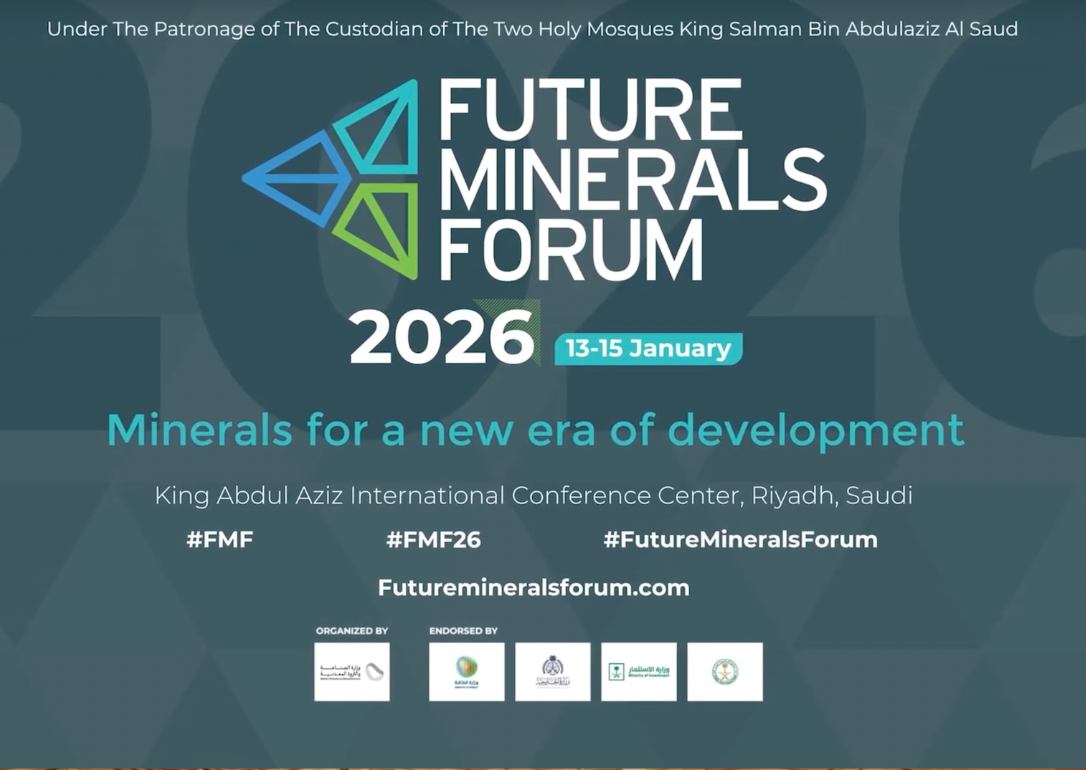
The fifth Future Minerals Forum (FMF), held in Riyadh on 13 – 15 January 2026, has become a key stage where mining is being reframed as a geopolitical, institutional and symbolic system. Over three days, Saudi Arabia brought together more than 100 countries, dozens of multilateral institutions and hundreds of companies to discuss critical minerals, infrastructure and standards. At the same time, a 50 minute “Great Debate” on the industry’s reputation asked whether mining can ever regain trust, and what that would require in practice. Taken together, the Forum and this debate show how reputation, governance and supply now move on the same track. What reaches the market is shaped not only by the orebody and capital, but by the way rules, expectations and trust are managed.
1. Riyadh’s bid to build a global mining architecture
FMF describes itself as a government led mineral platform and the world’s go to forum for shaping the future of minerals, explicitly focused on mineral resilience and responsible supply. The 2026 edition reinforced that ambition through three key moves:
a) The Future Minerals Barometer: from data to framing
FMF 2026 launched the Future Minerals Barometer, a tool designed to measure and track progress across critical mineral value chains in supplier regions. Developed with input from more than 130 experts across 42 countries, the Barometer sits within a broader Future Minerals Framework that identifies key enablers of investable supply, policy, finance, infrastructure, sustainability, talent, technology and geology.
The Barometer is a dashboard that combines market indicators (including a minerals price index and deal flow), leadership sentiment, country performance and sector reputation into a single reference point for governments and investors. In practice, it does three things:
- Creates a common language for discussing readiness across seven strategic mineral corridors, initially in Africa and South America.
- Makes progress (or lack of it) visible, corridor by corridor.
- Positions FMF, and by extension Riyadh, as a central interpreter of global minerals trends.
The risk and opportunity are obvious: whoever defines the metrics that describe progress and resilience does not control prices, but does influence how capital and policy perceive risk and priority.
b) A permanent steering group: turning an event into an institution
FMF’s Ministerial Roundtable has become the largest ministerial gathering on minerals globally, with participation from around 100 governments and nearly 60 international organizations. In 2026, ministers agreed to establish a Permanent Ministerial Steering Group to guide strategy between forums and help translate high level commitments into policy and project pipelines.
This matters because it moves FMF away from being a once a year talking shop towards a standing governance process. In practical terms, the steering group is expected to:
- Monitor implementation of the Future Minerals Framework and Barometer findings.
- Identify priority infrastructure and project bottlenecks along key corridors.
- Coordinate positions on standards, traceability and responsible supply.
If it gains traction, this group could become a soft governance node in the emerging critical minerals order, not replacing national sovereignty, but shaping expectations about how responsible and strategic mining should look.
c) Deals, corridors and the World Bank: making real supply investable
On the transactional side, the fifth FMF saw 132 agreements and memorandums of understanding worth around SAR 100 billion (US$26.6 billion aprox.) signed in areas ranging from exploration and mining, to financing, R&D, innovation, sustainability, value added chains and mining industries.
Among them were government to government MoUs between Saudi Arabia and Chile, Canada and Brazil on cooperation in mineral resources and critical minerals value chains. On the industrial side, deals like the planned battery anode materials facility between Canada’s Northern Graphite and Saudi’s Obeikan Investment Group point to an emerging midstream agenda in the Kingdom.
Multilateral institutions also used FMF to signal a shift. In a keynote at the Ministerial Roundtable, the World Bank Group’s Vice President for Infrastructure laid out a new metals and minerals strategy and pledged to scale up support five fold over the next five years. The Bank framed minerals as a development opportunity constrained by three gaps:
- Weak policy and regulatory capacity in many producer countries.
- Chronic infrastructure deficits along mineral corridors.
- Difficulty in mobilizing responsible private capital at scale.
The World Bank is now working with FMF partners on funding models for seven future mineral corridors in Africa and Latin America, combining transport, power and port infrastructure to unlock stranded resources. In short, FMF 2026 is attempting to bind together data (Barometer), governance (steering group) and capital (corridors, MoUs, multilateral support) into a single architecture for critical minerals.
2. Mining’s reputation: from PR problem to production constraint
Against this institutional backdrop, the “Great Debate: Can the mining industry’s poor reputation be turned around, if so, how?” offers a revealing counterpoint. The panel brought together leaders from industry associations, companies, human rights and investor bodies and media. Rather than a superficial call for better communication, the discussion exposed deeper structural tensions in how mining is perceived and governed. Several themes stand out.
a) Reputation is not uniform
Canadian and Australian association leaders challenged the idea of a universally terrible reputation. In their jurisdictions, long term opinion data suggests mining enjoys relatively strong standing compared to other sectors, yet individual projects still face opposition. The distinction they draw is between sector level reputation and project level trust.
This mirrors a key insight for investors: a jurisdiction can have an apparently good macro reputation while specific assets remain blocked by local history, unresolved grievances or weak institutions.
b) Visibility and asymmetry of impacts
Panelists noted that mining’s negative impacts are highly visible and often irreversible: tailings failures, landscape change, cultural heritage destruction. By contrast, other sectors (fast fashion, tech) often externalize or hide harms in long supply chains or algorithms.
This visibility means that a small number of high profile failures can become narrative anchors for the entire industry, raising the reputational and regulatory risk premium even for well run operators.
c) Legal versus legitimate
Another recurring theme was the gap between what is legally permitted and what society considers acceptable. Examples such as major tailings failures or the destruction of cultural heritage sites under valid permits highlight how compliance alone is no longer sufficient to secure legitimacy.
For boards and policymakers, this underscores that permitting is a floor, not a shield. When legal and social expectations diverge, projects risk delay, redesign or cancellation, regardless of formal approvals.
d) Distribution, informal mining and the value chain
The debate also addressed who actually benefits from mining, particularly in African contexts. Governments and communities may see minerals leave the country with limited local value added, while goods are imported back at a premium. At the same time, illegal and artisanal mining (ASM) provides livelihoods to millions, yet often under dangerous and environmentally damaging conditions.
Investors hear mining and think of large, listed companies. Many citizens, however, associate the term with informal or illicit operations. This dissonance complicates any attempt to rebuild trust: legitimacy must be built across the entire value chain, from ASM to OEMs and buyers of critical minerals.
e) Reputation and the speed constraint
Finally, several speakers linked reputation directly to development timelines. Greenfield projects that might have taken 7 – 8 years to bring online fifteen years ago now often require 15 – 20 years, as regulatory complexity, social opposition and capital discipline combine to slow delivery.
In that sense, reputation is no longer a communications issue; it is a rate determining factor for the energy transition. Without credible, trusted pathways for new projects, the copper, nickel, lithium and rare earths required for electrification and AI driven demand may simply not materialise in time.
3. How FMF 2026 and the reputation debate converge
Viewed together, FMF’s institutional agenda and the reputation debate point in the same direction: mining is becoming a strategic system shaped as much by governance and legitimacy as by geology. Several convergences are worth highlighting:
- From sector to system. FMF’s Barometer and corridors treat mining as part of a broader development and security system, the same shift the debate hints at when it moves beyond image into distribution, informal supply and state capacity.
- From PR to proof. The push for traceability standards (such as the copper traceability pilot under ISO) and transparency frameworks reflects recognition that narratives must be backed by verifiable data. A reputation built only on messaging cannot carry the weight of the energy transition.
- From national projects to corridors and alliances. The conversation in Riyadh is less about single projects and more about corridors and cross border infrastructure, backed by multilateral finance. That framing acknowledges that no single jurisdiction can de risk the supply challenge alone.
- From compliance to legitimacy. Both FMF and the debate recognise that legal frameworks, while essential, are insufficient. The International Minerals Framework and similar initiatives aim to create shared principles that sit above national law, while the panel emphasised trust, fairness and long term relationships as conditions for social licence.
For investors and decision makers, this convergence suggests that the relevant question is no longer whether mining can fix its image, but who will successfully integrate governance, data, infrastructure and local legitimacy into a coherent strategy.
4. Signals to watch from here
Several concrete signals emerging from FMF 2026 deserve close monitoring:
- Governance of the Future Minerals Barometer. Will the Barometer remain an open, auditable dashboard, or evolve into a de facto rating that influences access to finance and procurement? Its methodology, transparency and uptake by DFIs and major buyers will determine whether it becomes a useful reference or a new gatekeeper.
- Effectiveness of the Ministerial Steering Group. If the steering group can coordinate reforms and infrastructure plans between forums, it may meaningfully shorten project timelines in some corridors. If not, it risks becoming another layer of process without delivery.
- Conversion of MoUs into projects. The 132 agreements and MoUs announced at FMF will only matter if they translate into financed, permitted and constructed assets. Tracking which deals move from announcement to final investment decision (FID) will show how much real supply FMF has unlocked.
- Alignment between corridors, standards and legitimacy on the ground. Infrastructure and standards will only deliver if they align with local expectations and national development strategies. Signals of improved community relations, shorter permitting times or fewer high impact conflicts along priority corridors would indicate that the architecture is working.
- Replication of the reputation debate in other forums. If similar debates start to appear in other regions, and lead to specific institutional changes, that will be a sign that reputation is being treated as a structural variable, not a cosmetic one.
Closing reflection
At Geopolitical Mining, we argue that mining has died as a purely industrial story and been reborn as geopolitical mining: a space where power, security, technology and legitimacy intersect. FMF 2026 is an early attempt to formalise that new order, through frameworks, metrics, corridors and alliances. The reputation debate held in the same forum shows why this matters: without trust, fair distribution and credible institutions, new supply will not arrive fast enough, no matter how strong the geological potential.
For boards, investors and policymakers, the task ahead is not only to find the right projects, but to understand, and help shape, this emerging architecture. The real question is not whether mining’s reputation can be turned around, but whether the sector can build a governance system that turns minerals into legitimate, investable and timely supply in a fractured world.
Resources
For readers who want to go back to the primary material behind this analysis:
-
Future Minerals Forum. Official site
https://www.futuremineralsforum.com -
State of the Sector. Future Minerals Barometer
https://www.futuremineralsforum.com/state-of-the-sector/ -
FMF Barometer 2026 preview
https://www.futuremineralsforum.com/fmf-barometer-2026/ -
FMF 2026. Official event brochure (“Dawn of a global cause”) (PDF)
https://www.futuremineralsforum.com/media/durhzqzu/fmf26-official-event-brochure_150725.pdf -
World Bank. “World Bank Group at the Future Minerals Forum 2026”
https://www.worldbank.org/en/events/2026/01/13/world-bank-group-at-the-future-minerals-forum-2026 -
World Bank. Valerie Levkov keynote at the Ministerial Roundtable
https://www.worldbank.org/en/news/speech/2026/01/13/future-minerals-forum-2026-keynote-valerie-levkov-at-ministerial-round-table -
Press release. “FMF’s 5th Ministerial Roundtable concludes with 100 governments and 59 multilaterals…”
https://www.prnewswire.com/ae/news-releases/fmfs-5th-ministerial-roundtable-concludes-with-100-governments-and-59-multilaterals-laying-framework-for-a-new-age-of-minerals-development-302660965.html -
MiningWeekly. “Future Minerals Forum making ‘excellent progress’ in reaching its goals”
https://www.miningweekly.com/article/ministerial-roundtable-welcomes-progress–2026-01-13 -
Mining.com.au. “World’s largest ministerial roundtable: Future Minerals Forum”
https://mining.com.au/worlds-largest-ministerial-roundtable-future-minerals-forum/ -
GCC Business Watch. “Future Minerals Forum launches global Barometer…”
https://gccbusinesswatch.com/news/future-minerals-forum-launches-global-barometer-to-track-critical-mineral-value-chain-progress/ -
MarketMinute. “The $5 Trillion Chasm: Future Minerals Forum 2026 warns of 16-year delay…”
https://markets.chroniclejournal.com/chroniclejournal/article/marketminute-2026-1-13-the-5-trillion-chasm-future-minerals-forum-2026-warns-of-16-year-delay-in-global-energy-transition -
CNBC Africa. “How the future of global minerals is being shaped…”
https://www.cnbcafrica.com/2026/how-the-future-of-global-minerals-is-being-shaped-at-fmf-ministerial-roundtable/ -
YouTube. GREAT DEBATE: “Can the mining industry’s poor reputation be turned around – if so, how?”
https://www.youtube.com/watch?v=Qft1k7f86lw

For the full Geopolitical Mining framework behind this Weekly, see our book Mining Is Dead. Long Live Geopolitical Mining .