
Geopolitical Mining · Geopolitical Milestones
FORTRESS America, Cobre Panamá Final Report and Milwaukee Steel Framework
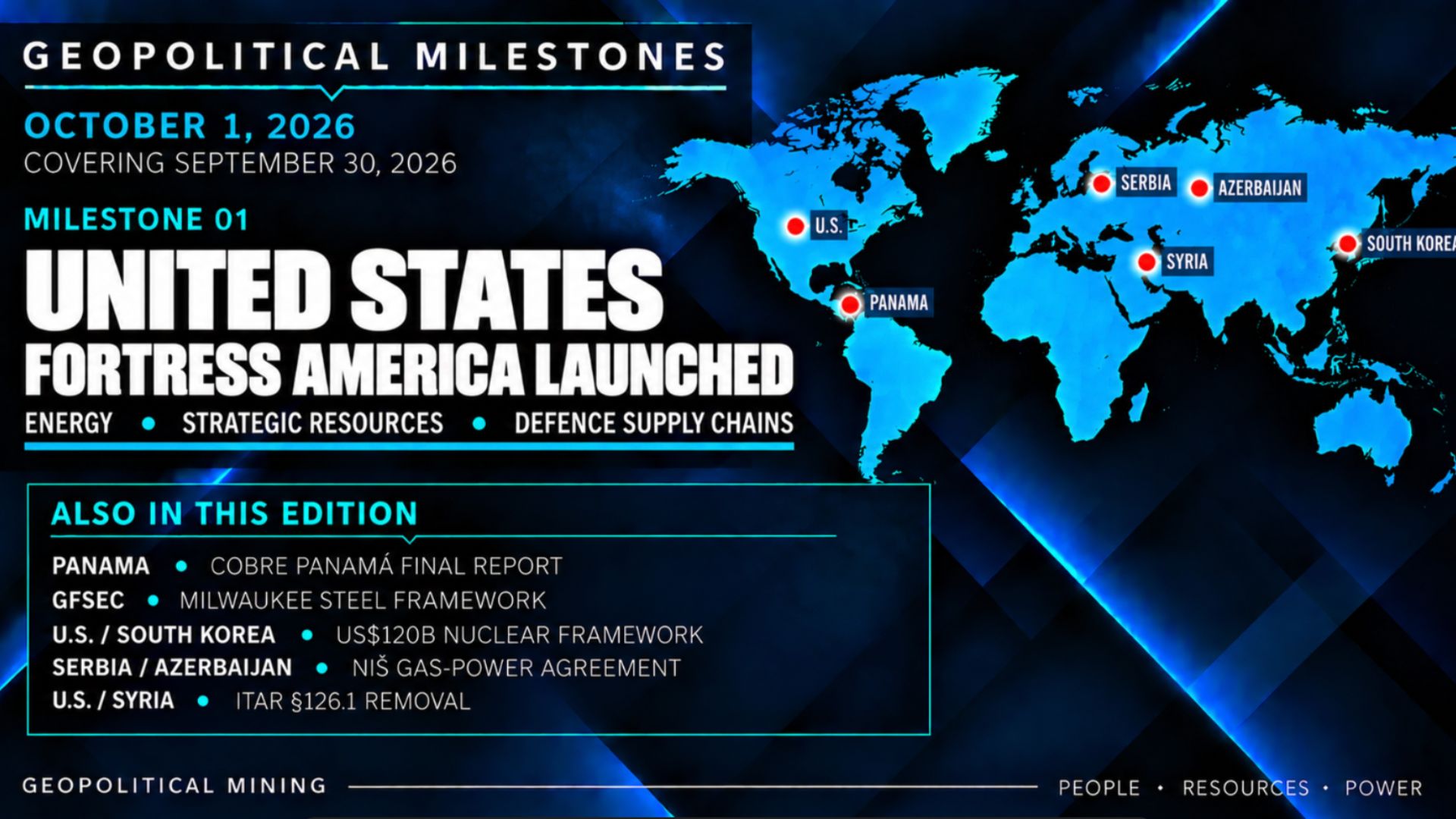
September 30 brought the launch of a new U.S. defence resilience programme centred on energy, strategic resources and supply chains, delivery of Panama’s final interministerial report on Cobre Panamá, and adoption of the Milwaukee Framework on global steel excess capacity. Also in this edition: a U.S. and South Korea nuclear framework, a Serbia-Azerbaijan gas power agreement and a U.S. defence trade policy shift toward Syria.
Also in this edition: the Cobre Panamá final report, the Milwaukee steel framework, U.S. and South Korea nuclear cooperation, the Niš gas power project and the U.S. ITAR policy change for Syria.
Defence industrial resilience and strategic resources
U.S. launches FORTRESS America around energy, supply chains and strategic resources
The U.S. Department of War announced FORTRESS America on September 30 as a new department wide programme intended to strengthen the resources, industrial capacity and infrastructure supporting U.S. military power. The initiative is organised around energy independence, supply chain and defence industrial base resilience, strategic reserves, installation hardening and cyber resilience, and resilience in space and spectrum.
The programme explicitly links military readiness to dependence on foreign mines, overseas manufacturing and vulnerable supply chains for inputs including rare earths, specialty metals, semiconductors and propellants. It also calls for greater independent power capacity at major military installations and deeper reserves of critical supplies, placing resource access, domestic processing and infrastructure resilience inside a single defence framework.
U.S. Department of War · State of the Force initiatives
Secretary Hegseth Announces Six Major Initiatives at Quantico Speech · September 30, 2026Resource sovereignty, arbitration and mine governance
Panama commission submits Cobre Panamá final report and recommends evaluating negotiated path
Panama’s interministerial commission on Cobre Panamá delivered its final report to President José Raúl Mulino on September 30, presenting 17 recommendations and six criteria for any future solution. The commission recommends evaluating the viability of an agreement that could resolve pending international arbitration proceedings and establish conditions for a restart that would lead to an orderly closure of the site, without fiscal cost to the state, without the possibility of an extension and in compliance with the Supreme Court ruling.
The report places state control over mineral deposits, transparency, environmental supervision and the financing of final closure among its governing conditions. The government also stated that there is currently no mining extraction at the site: it remains under a state ordered preservation plan, while previously extracted stockpiled material is being processed principally as an environmental safety measure.
Presidency of Panama · Cobre Panamá final report
Interministerial Commission delivers final report on Cobre Panamá · September 30, 2026Industrial capacity, trade and steel policy
GFSEC ministers adopt Milwaukee Framework on global steel excess capacity
Ministers participating in the Global Forum on Steel Excess Capacity met in Milwaukee on September 30 and reached consensus on a comprehensive framework for joint action, named the Milwaukee Framework. The agreement moves the forum toward coordinated national measures addressing excess steel capacity and the market distortions that participating governments associate with it.
The development places industrial capacity and steel trade policy at the centre of the G20 trade discussions in Milwaukee. The framework is designed to guide participating members as they implement measures through their own legal and policy systems, linking steelmaking capacity, trade enforcement and industrial policy disciplines in a common process.
U.S. Trade Representative / Global Forum on Steel Excess Capacity · Ministerial documents
USTR · GFSEC reaches consensus on the Milwaukee Framework · September 30, 2026GFSEC · Comprehensive Framework for Joint Action · September 30, 2026
Nuclear industrial policy and power for AI
U.S. and South Korea nuclear framework envisages up to US$120 billion for eight U.S. reactors
A U.S. and South Korea strategic framework announced on September 30 envisages up to US$120 billion of Korean investment to support construction of eight large nuclear reactors in the United States. The contemplated programme includes six Westinghouse AP1000 reactors and two Korean APR1400 reactors incorporating Westinghouse technology, with deployment proposed on U.S. federal sites.
The framework also provides for a Korean equity investment of between 5% and 10% in Westinghouse and links the proposed reactor buildout to growing U.S. electricity demand from electrification, reindustrialisation, artificial intelligence and compute infrastructure. It builds on earlier U.S. partnerships intended to expand domestic nuclear generation.
Brookfield Asset Management / Westinghouse · U.S. and South Korea nuclear framework
U.S. and South Korea Framework Advances Deployment of Westinghouse Nuclear Technology · September 30, 2026Energy infrastructure and strategic partnership
Serbia and Azerbaijan sign shareholders’ agreement for Niš gas power project
Serbia’s state owned electricity company EPS, gas company Srbijagas and Azerbaijan’s SOCAR signed a shareholders’ agreement in Belgrade on September 30 for development of a combined cycle gas power plant in Niš. The agreement also provides for creation of a joint company, with the Serbian companies collectively holding 50% and SOCAR holding the other 50%.
The agreement defines ownership rights, joint management, unanimous decisions on key questions during the preparatory phase and financing for development work. Serbia presents the project as a long term element of its electricity security strategy and a further step in energy cooperation with Azerbaijan.
Government of Serbia · Ministry of Mining and Energy
Gas power plant construction in Niš: strategic Serbia-Azerbaijan project · September 30, 2026Defence trade and diplomatic normalisation
U.S. finalises removal of Syria from ITAR policy of denial list
The U.S. Department of State placed a final rule on public inspection on September 30 removing Syria from the list of countries subject to a comprehensive policy of denial under section 126.1 of the International Traffic in Arms Regulations. The change permits requests involving defence articles and defence services for Syria to be reviewed on an individual licensing basis.
The measure marks another step in the changing U.S. policy toward Syria following earlier sanctions relief and the rescission of the terrorism support determination underlying sections 40 and 40A of the Arms Export Control Act. The rule removes the comprehensive ITAR policy of denial while leaving proposed transfers subject to individual licensing and other applicable U.S. legal requirements.
U.S. Department of State / Federal Register · Final rule
International Traffic in Arms Regulations: Syria Country Policy Revision · filed September 30, 2026 · effective October 1, 2026Continue reading Geopolitical Mining. Explore our daily mining coverage, weekly reviews and country analysis.