
Geopolitical Mining · Geopolitical Milestones
EU Adds 1,569 Russia Sanctions Listings
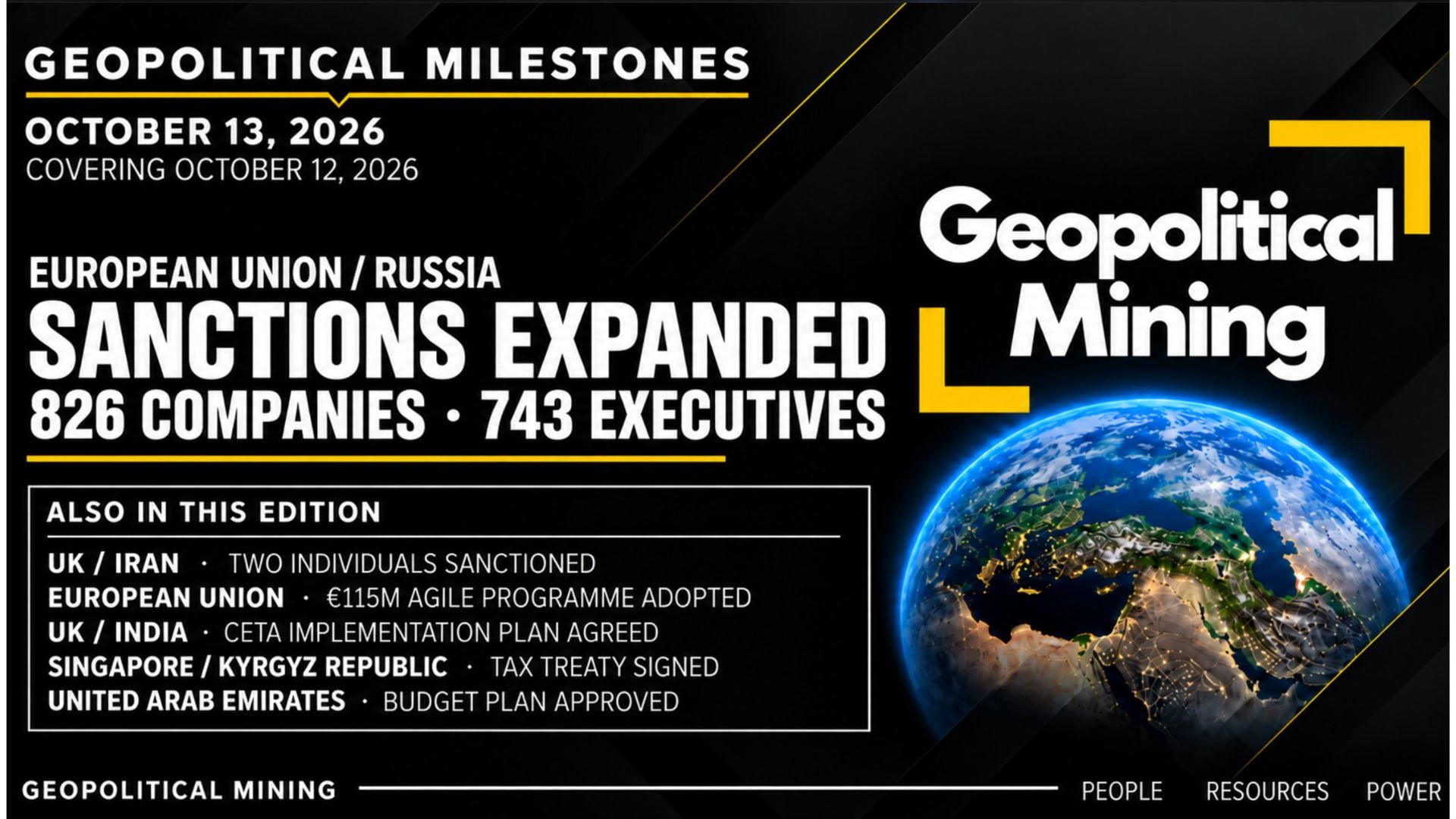
The European Union adopted 1,569 Russia sanctions listings on October 12, expanding restrictions across the military industrial supply chain. Also in this edition: UK measures against two Iranian nationals, final EU approval for defence innovation funding, UK–India trade implementation, a Singapore–Kyrgyz tax agreement and the UAE’s federal budget plan for three years.
Geopolitical Milestones is a daily briefing for senior executives, investors and policymakers. Each edition examines significant international developments and their implications for investment, business strategy and public policy.
Also in this edition: The United Kingdom sanctions two Iranian nationals; the EU approves its AGILE defence innovation programme; Britain and India agree trade implementation machinery; Singapore and the Kyrgyz Republic sign a tax agreement; the UAE Cabinet approves a federal budget plan for three years.
Sanctions, industrial supply chains and counterparty risk
EU adds 1,569 listings targeting Russia’s military industrial complex
The Council of the European Union adopted 1,569 additional sanctions listings on October 12, targeting 826 Russian companies and 743 executives in the military industrial complex. In fact, the Council described this as its largest single batch of listings. The action focuses on intermediate suppliers of components used in missiles, drones and aircraft, including electronics, radar and navigation equipment. According to the Council, the targeted businesses generate at least €20 billion in annual turnover and employ more than 250,000 people.
As a result, listed parties face asset freezes and restrictions on the provision of funds or economic resources. Listed individuals also face EU travel bans. For companies and investors, the decision significantly expands the range of counterparties affected across Russian industrial supply chains. The relevant legal acts have been published in the Official Journal. However, the milestone is the adoption of additional restrictions on named parties; it does not establish a blanket embargo on every company operating in the industries concerned.
Council of the European Union · Latvian Ministry of Foreign Affairs
Council of the EU · additional military-industrial listings, October 12Latvian foreign ministry · confirmation of the EU decision
Security attribution, targeted sanctions and diplomacy
United Kingdom sanctions two Iranian nationals over alleged overseas activity
The United Kingdom imposed sanctions on two Iranian nationals on October 12, citing their alleged involvement in hostile activity overseas. Specifically, the Foreign Office identified Ruhollah Bazghandi as the Islamic Revolutionary Guard Corps’ counterespionage operations chief. It also described Shahram Ali Reza Tamarzadeh Jakki as a facilitator of the Zindashti criminal network. In practice, the measures include asset freezes, travel bans and disqualifications from serving as company directors. London also summoned Iran’s ambassador, adding a diplomatic response to the restrictions on the two individuals.
A separate joint statement by partner governments supported Britain’s attribution of Iranian involvement in the September 27 incident at RAF Fairford. The new milestone is the October 12 sanctions and diplomatic response; the underlying incident occurred earlier. For businesses, the UK decision creates specific restrictions involving the designated individuals. The allied statement signals diplomatic coordination but does not itself impose collective sanctions. The claims about responsibility remain the governments’ stated assessment, rather than findings established by a court in these announcements.
UK Foreign, Commonwealth & Development Office
UK foreign secretary · targeted sanctions and ambassador summons, October 12Partner governments · joint statement on Iran, October 12
Defence technology, public funding and industrial capacity
EU gives final approval to €115 million AGILE defence innovation programme
The Council of the European Union gave final approval on October 12 to AGILE, a €115 million programme for emerging defence technologies. The instrument supports small and medium enterprises, including start-ups and scale-ups, in turning prototypes into operational products. Its scope also includes civilian technologies adapted for military use. For example, support will include grants with a target award timetable of four months, access to testing facilities, links with major defence companies and simplified procurement of supported products. In addition, member states will help define the capability challenges.
The decision completes legislative adoption following the European Parliament’s October 6 vote. The regulation still requires signature and publication, with entry into force 20 days after publication. The first call for proposals is expected in early 2027. For investors and suppliers, the decision establishes a funded route toward commercial development, while applications and disbursements remain future steps. The grant timetable of four months is a programme target. Ultimately, its commercial significance will depend on execution and the transition from testing to actual procurement.
Council of the European Union
Council of the EU · final approval of AGILE, October 12Trade implementation, market access and technology cooperation
United Kingdom and India agree practical machinery for trade pact implementation
The United Kingdom and India agreed a practical implementation plan for their Comprehensive Economic and Trade Agreement at the 16th JETCO meeting in New Delhi on October 12. Specifically, the plan covers treaty committees, working groups and government contact points. Ministers also agreed annual exchanges of tariff-utilisation data and business feedback, beginning one year after the agreement’s entry into force. These arrangements are intended to identify obstacles preventing companies from using an agreement that is already operational.
In practice, the decision provides exporters and investors with a more structured route for raising customs and market access problems. Meanwhile, the Science and Innovation Council launched a Technology Translation Partnership linking UK Catapults with Indian science and technology clusters. That initiative supports development, validation, pilots and commercialisation. Together, the decisions connect the use of trade preferences with practical industrial cooperation. However, their commercial value will depend on business participation and the resolution of operational barriers. The governments also agreed to hold the next JETCO meeting in the United Kingdom in 2027.
UK government · UK–India joint ministerial statements
Joint statement · 16th UK–India JETCO, October 12Joint statement · 8th UK–India Science and Innovation Council, October 12
International taxation, investment and bilateral agreements
Singapore and the Kyrgyz Republic sign double-taxation agreement
On October 12, Singapore and the Kyrgyz Republic signed an agreement for the avoidance of double taxation. Singapore’s Second Minister for Finance Jeffrey Siow and Kyrgyz Minister of Economy and Commerce Sydykov Bakyt Tolomushevich signed the instrument. In particular, the agreement sets out how the two countries will tax income arising from bilateral business and investment. For example, it includes provisions covering dividends, interest, royalties and the circumstances in which a commercial presence becomes taxable in the other country.
For investors and companies, the agreement offers a prospective framework for assessing the tax treatment of income earned across the two jurisdictions. Such rules can clarify the allocation of taxing rights when planning an investment or operating a business abroad. However, both countries must ratify the treaty before it enters into force. Its signature therefore establishes a new bilateral commitment, while access to its benefits remains a future implementation step. The official announcement gives no date for those benefits to become available.
Inland Revenue Authority of Singapore
IRAS · double-taxation agreement and official terms, October 12Fiscal policy, public spending and government demand
UAE Cabinet approves AED292.5 billion federal budget plan for three years (Approx. US$79.65 billion
The UAE Cabinet approved a federal budget plan totalling AED292.5 billion for 2027–2029 on October 12, alongside AED90.1 billion in planned spending for 2027 (US$24.53 billion). State news agency WAM reported that the envelope for the three years is 28.3% larger than the preceding cycle. Specifically, the 2027 allocations include AED34.6 billion for social development and pensions, AED29.1 billion for government affairs, AED17.8 billion for federal expenses, AED5.6 billion for financial investments and AED3 billion for infrastructure and the economic sector.
The decision provides a spending framework for the coming years for companies supplying federal programmes and investors assessing demand supported by government spending. Education, healthcare, housing and social services remain stated priorities. However, Cabinet approval establishes the plan’s current institutional stage; final enactment, disbursement and individual contract awards are separate steps. Moreover, the figures concern the federal budget. Separate budgets and spending by individual emirates sit outside this total, an important distinction when assessing the scale of public sector demand across the country.
Emirates News Agency (WAM) · UAE Cabinet decision
WAM · Cabinet approval of the federal budget plan, October 12Continue reading Geopolitical Mining. Explore our daily mining coverage, weekly reviews and country analysis.