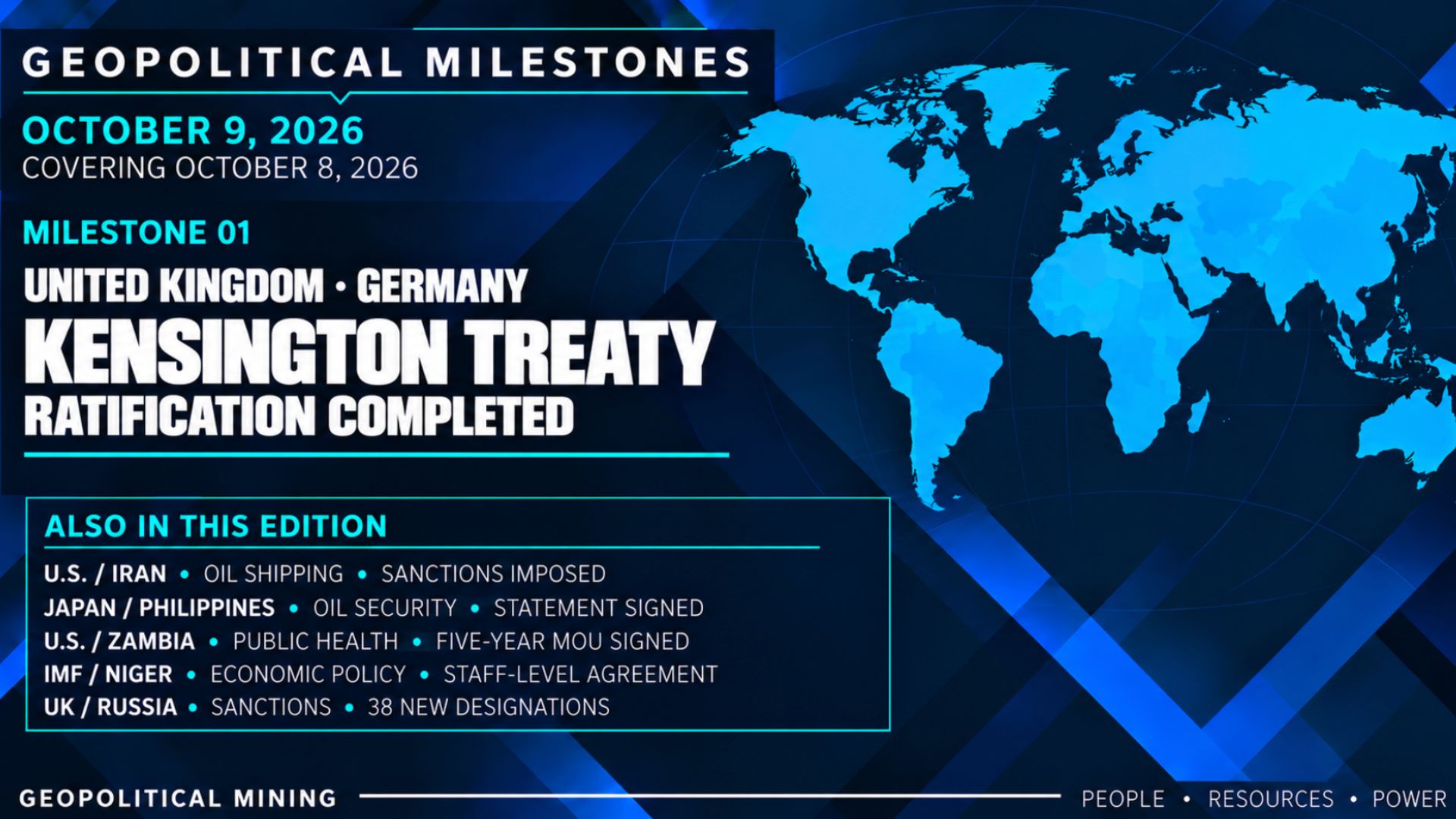

Geopolitical Mining · Geopolitical Milestones
EU China Trade Statement on Hybrids and Rare Earths
The EU China trade statement of October 9 records new understandings on hybrid vehicles and rare earth export licensing. Implementation of the vehicle arrangement remains subject to EU political review, and existing export controls remain in place. Also in this edition: a U.S. license for Russian origin diesel transactions, U.S. sanctions against the International Criminal Court, 46 EU critical minerals projects selected, final approval of EU defence legislation, and UK Japan technology priorities.
Also in this edition: a limited Russian origin diesel license, an ICC sanctions designation with exemptions, 46 EU critical minerals projects selected, defence laws approved but not yet in force, and 15 UK Japan technology priorities.
Trade diplomacy, market access and economic security
EU China trade statement outlines hybrid vehicle and rare earth understandings
The EU China trade statement followed ministerial talks in Beijing on October 8–9. European Commissioner Maroš Šefčovič and Chinese Commerce Minister Wang Wentao reached a WTO consistent understanding on trade in hybrid and plug in hybrid vehicles. Šefčovič said the proposal could reduce projected Chinese hybrid and plug in hybrid exports to the EU by more than 50% over the next four years compared with a scenario assuming no policy change. However, EU leaders still need to assess the outcome before implementation. The two sides also agreed to examine possible tariff reductions and discuss market access.
On rare earths and permanent magnets, China expressed willingness to continue facilitating export licenses through an existing fast track mechanism. Both sides discussed more predictable licensing and advance notice of relevant controls. They also planned a ministerial video conference for January 2027. The next formal consultations are scheduled for March 2027.
Petroleum trade, sanctions licensing and energy supply
U.S. Treasury issues limited authorization for Russian origin diesel transactions
The U.S. Treasury’s Office of Foreign Assets Control (OFAC) issued General License 135 on October 9. It permits specified dealings in Russian origin diesel under the relevant sanctions rules. In particular, the authorization covers sales, deliveries, offloading and imports, including imports into the United States.
The license runs through 12:01 a.m. U.S. Eastern daylight time on April 7, 2027. However, it does not permit debits to U.S. held accounts of Russia’s central bank, National Wealth Fund or Finance Ministry. The measure broadens permissions for defined petroleum transactions. It does not establish that any fuel shipment has arrived.
U.S. Treasury · Office of Foreign Assets Control
OFAC · Issuance of Russia related General License · October 9, 2026OFAC · General License 135 · signed legal text · October 9, 2026
International institutions, sanctions policy and multilateral diplomacy
United States adds International Criminal Court to sanctions list
On October 9, the U.S. Treasury added the International Criminal Court (ICC) itself to the Specially Designated Nationals list. Earlier sanctions had targeted individual Court officials. On the same day, OFAC issued General Licenses 13–16. These permit certain operating, telecommunications, software, pension and detainee related transactions, subject to conditions.
General License 13 permits certain transactions needed to maintain or wind down the Court’s operations through 12:01 a.m. Eastern daylight time on April 7, 2027. It also covers specified member state contributions and staff payments. Meanwhile, eight foreign ministers opposed the sanctions in a joint statement. They represented Canada, Denmark, France, Germany, Italy, Japan, the Netherlands and the United Kingdom.
Industrial policy, critical raw materials and supply chain diversification
European Commission selects 46 new critical raw materials Strategic Projects
On October 9, the European Commission selected 46 new Strategic Projects under the Critical Raw Materials Act. They span 16 EU member states and cover 15 of the law’s 17 strategic raw materials. The list includes eight extraction projects, 11 processing projects, 19 recycling projects and eight integrated projects.
The projects involve materials such as lithium, nickel, cobalt, graphite, rare earths, magnesium and tungsten. With earlier selections, the programme now contains 106 projects in EU and partner countries. Moreover, Strategic Project status can facilitate permitting and access to finance. However, selection does not itself grant construction permits or release new project funding.
European Commission · Directorate General for Internal Market, Industry, Entrepreneurship and SMEs
European Commission · 46 Strategic Projects selected · October 9, 2026European Commission · selected projects and Commission Decision C(2026)8051
Defence readiness, public procurement and industrial regulation
EU Council gives final approval to defence readiness simplification laws
On October 9, the Council of the EU gave final approval to three defence readiness laws under Omnibus V. The measures simplify certain investment and procurement procedures. They also ease transfers of defence related products between member states and reduce administrative requirements for the European Defence Fund.
One regulation sets a standard permitting deadline of 42 working days after a complete application, extendable to a maximum of 102 working days in specified exceptional cases. Other measures address joint procurement and industrial partnerships. However, the laws do not take effect immediately. First, they must appear in the EU Official Journal. Entry into force follows on the twentieth day after publication.
Technology diplomacy, artificial intelligence and research security
UK and Japan endorse science priorities spanning AI and quantum technology
The United Kingdom and Japan met in Tokyo on October 9 for their thirteenth Science and Technology Joint Committee. Their statement sets out 15 areas for bilateral work. These include AI, quantum computing, cybersecurity, high performance computing, research security, batteries and fusion energy.
The priorities build on existing scientific cooperation. For example, the partners discussed AI model evaluation, quantum applications and secure links between universities and industry. They also plan further talks among research funding agencies. The next committee meeting is scheduled for the United Kingdom in 2027. However, the statement does not establish a new treaty.
UK Government · official bilateral joint statement
UK Japan Science and Technology Joint Committee · joint statement and 15 area fact sheet · October 9, 2026Continue reading Geopolitical Mining. Explore our daily mining coverage, weekly reviews and country analysis.