Geopolitical Mining Daily · October 24, 2026
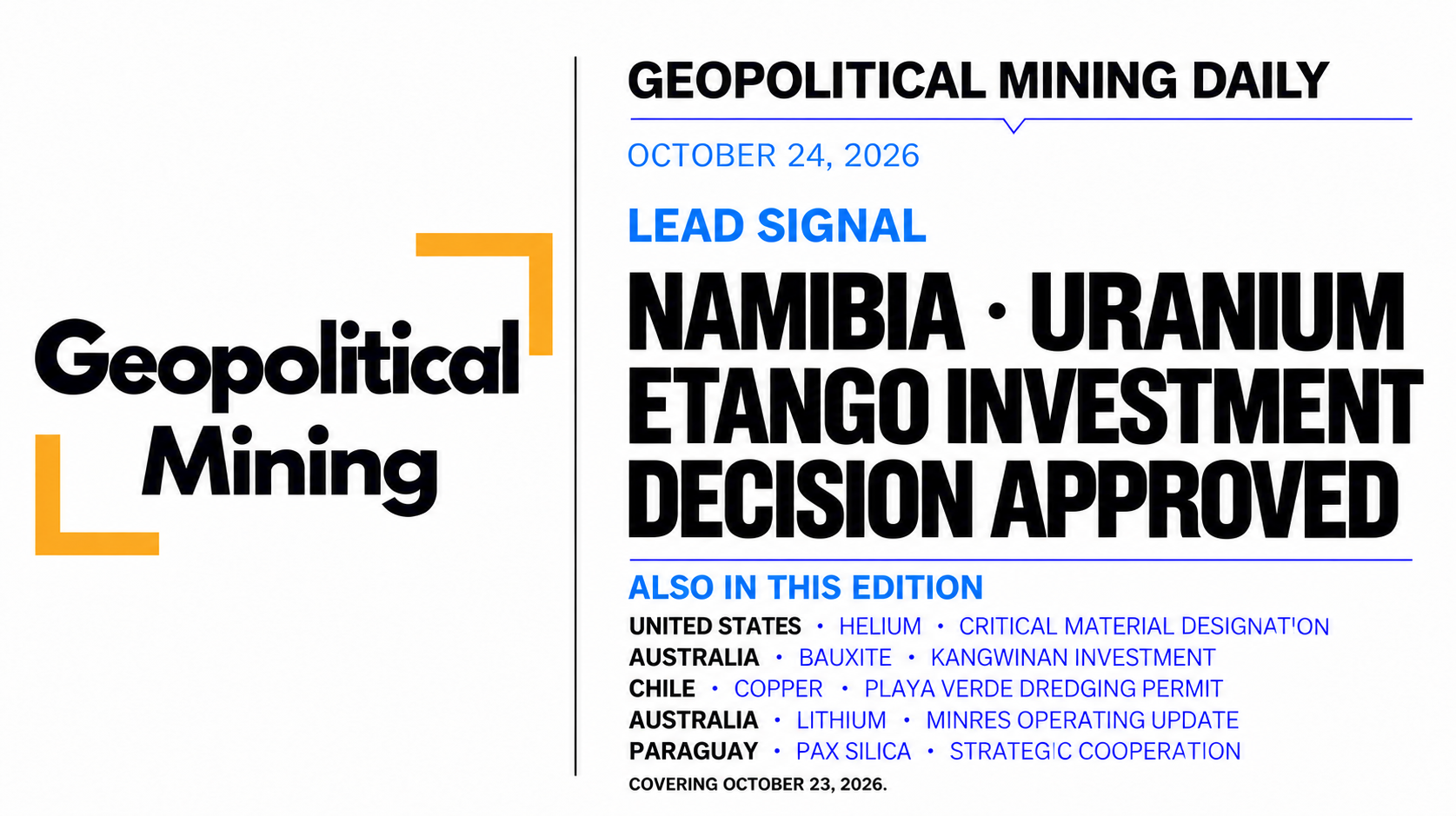
Etango Uranium Investment Decision Approved in Namibia
The Etango uranium investment decision leads this Geopolitical Mining Daily for investors, senior executives and policymakers. Six developments announced on October 23 connect mine construction, strategic materials, replacement capacity, permissions, operating cash generation and industrial partnerships.
A new uranium construction commitment in Namibia leads a day spanning US helium policy, Australian bauxite investment, Chilean tailings recovery and Paraguay’s industrial partnerships.
Etango advances from early works towards full construction, backed by existing joint venture funding. The United States designates helium a critical material, while Rio Tinto commits capital to bauxite supply continuity. Playa Verde obtains a specific dredging permission, MinRes reports higher lithium sales alongside weaker realised prices, and Paraguay joins Pax Silica. For investors, the distinction across these developments is the stage of execution: approved capital, formal policy status, partial permissions, operating results and institutional alignment each provide different evidence of future supply and commercial value.
The GM observation framework
The ten Signals
Each Daily uses the same ten strategic lenses. The highlighted dimensions classify the developments in this edition.
Namibia · Uranium development
Etango investment decision moves uranium development into full construction
What happened
Bannerman Energy announced a positive final investment decision for Etango on October 23. The joint venture, owned 55% by Bannerman and 45% by CNNC Overseas Limited, holds 95% of the Namibian project. The decision authorises the transition from advanced early works to full construction over the coming months. Commissioning and first production remain targeted for 2028, with planned annual output of approximately 3.5 million pounds of uranium oxide.
The company reaffirmed estimated preproduction capital of US$353 million, within a range of plus or minus 10%. It states that remaining capital expenditure is covered by joint venture cash of approximately US$295 million, with Bannerman’s share of working capital supported by its own cash. These are existing funding resources following the September transaction, rather than a new financing raised on October 23.
For investors, the new decision shifts attention towards construction delivery, cost control and commissioning. The partnership also illustrates how Australian equity participation and Chinese capital can combine in African uranium development. Ownership, funding and eventual customer exposure need to be assessed separately. A sanctioned project improves visibility of prospective supply, while 2028 remains a delivery target subject to execution.
United States · Critical materials
Helium gains critical material status as refining constrains supply
What happened
The US Department of Energy announced on October 23 that helium has been designated a critical material under the Energy Act of 2020. DOE cited its essential role in semiconductor production, the absence of viable substitutes in many applications and rising exposure to supply disruption. The department also identified limited refining capacity and lengthy permitting timelines as constraints on US production, despite significant domestic resources.
The decision brings industrial gases into the discussion of material security. For investors, it highlights a distinction between resource availability and usable supply: an abundant deposit contributes little to a semiconductor customer until extraction, purification and delivery can meet operating requirements. Those conversion stages can determine both project cost and commercial value.
The designation establishes a policy status. The announcement contains no specific project award or new production volume. Commercial assessment therefore still requires evidence of processing capacity, product quality, customer qualification and an executable delivery plan. Subsequent programme decisions and investment commitments will show how far this recognition changes financing conditions for helium projects.
Australia · Bauxite supply
Rio Tinto commits US$1.9 billion to Kangwinan supply continuity
What happened
Rio Tinto announced on October 23 an investment of US$1.9 billion in the Kangwinan bauxite project in Queensland. The project is designed for annual capacity of 20 million tonnes, with first production expected in 2029 and full production in 2032. The investment includes US$150 million of early works approved in 2025 and is already incorporated in the company’s capital guidance for the medium term.
The capacity figure needs context. Kangwinan will replace Andoom and help offset the expected closure of Gove in 2029. Weipa capacity is expected to rise from approximately 38 million to 44 million tonnes annually. Consequently, the project’s 20 million tonnes should not be interpreted as an equivalent net addition to Rio’s bauxite supply. The company estimates an internal rate of return of around 22%.
For investors, this is a substantial commitment to continuity of raw material supply as existing operations mature. Using established infrastructure can support execution, but the schedule still matters for customers and downstream refineries. Investment in replacement capacity can be strategically consequential even when headline production growth is limited: it protects an operating system whose supply would otherwise decline.
Chile · Recovery from mining waste
Playa Verde clears a dredging permission while other approvals remain
What happened
Halo Minerals announced on October 23 that its subsidiary Minera Playa Verde received a key mining permit for its copper and gold tailings project at Chañaral, Chile. Issued under Article 17 No. 1 of the Mining Code, the authorisation covers mining works involving dredging of mineral bearing material at the beach, including within the urban area. The project proposes treating historic tailings and returning the material after processing and conditioning.
The approval removes a defined regulatory barrier. Other sectoral permissions remain outstanding, including the requested mining easement and a maritime concession under review. The company continues to advance towards a final investment decision. The announcement does not report a financing close or an unconditional construction commitment.
For investors, recovering metals from historic waste brings resource development into direct contact with an existing environmental and community setting. The quality of the investment case depends on metallurgical performance, access rights and the ability to deliver the proposed treatment process. A permit can improve project readiness without settling those questions. The remaining approvals and financing terms will determine when regulatory progress can translate into a credible construction programme.
Primary issuer announcement
Halo Minerals · Regulatory announcement: Playa Verde mining permit · October 23, 2026Australia · Operating cash generation
MinRes raises lithium sales while weaker prices test cash conversion
What happened
Mineral Resources reported record attributable lithium sales of 170,000 dry metric tonnes on an SC6 equivalent basis in its October 23 quarterly update, an 8% increase from the previous quarter. The average realised price fell 23% to US$1,873 per dry metric tonne. Group net debt declined by approximately A$200 million to A$4.1 billion, and liquidity rose to A$2.5 billion. FY27 guidance remained unchanged across all divisions.
Onslow Iron shipped 9.2 million wet metric tonnes on a 100% basis, with attributable shipments of 5.0 million tonnes. Its reported FOB cost was A$53 per wet metric tonne. The company also warned that higher September diesel prices were expected to enter operating costs from October through a pricing lag.
For investors, the release places higher physical output alongside softer selling prices and delayed cost pressure. Debt reduction is evidence of balance sheet progress, while the next quarter will test how much operating improvement survives changes in commodity prices and fuel. Production records alone provide an incomplete measure of the cash available for reinvestment.
Paraguay / United States · Industrial partnerships
Paraguay joins Pax Silica with hydropower and minerals in view
What happened
Paraguay became the twenty sixth signatory to the Pax Silica Declaration on October 23. Foreign Minister Rubén Ramírez Lezcano signed in Washington alongside US Under Secretary for Economic Affairs Jacob Helberg. Paraguay’s foreign ministry said the countries intend to draw on the potential of Paraguayan critical minerals and hydropower for advanced intelligence infrastructure across the American continent, with cooperation involving security practices, infrastructure and incentives.
The announcement connects access to energy and materials with the geography of digital investment. For investors, the practical question is whether such partnerships can help bring together electricity supply, physical infrastructure, qualified developers and customers. Each component needs its own commercial evidence, even when governments describe them within a common strategic framework.
The published statement specifies no mineral inventory, project budget, investment timetable or committed production. Its immediate significance is institutional alignment. A defined project, contracted power and an accountable financing structure would provide stronger evidence of industrial delivery. The distinction matters when evaluating whether a country’s resource potential can support sustained local economic activity.
The Daily records verified changes. The Signals provide the classification map. The Weekly brings the developments together for the deeper system reading.