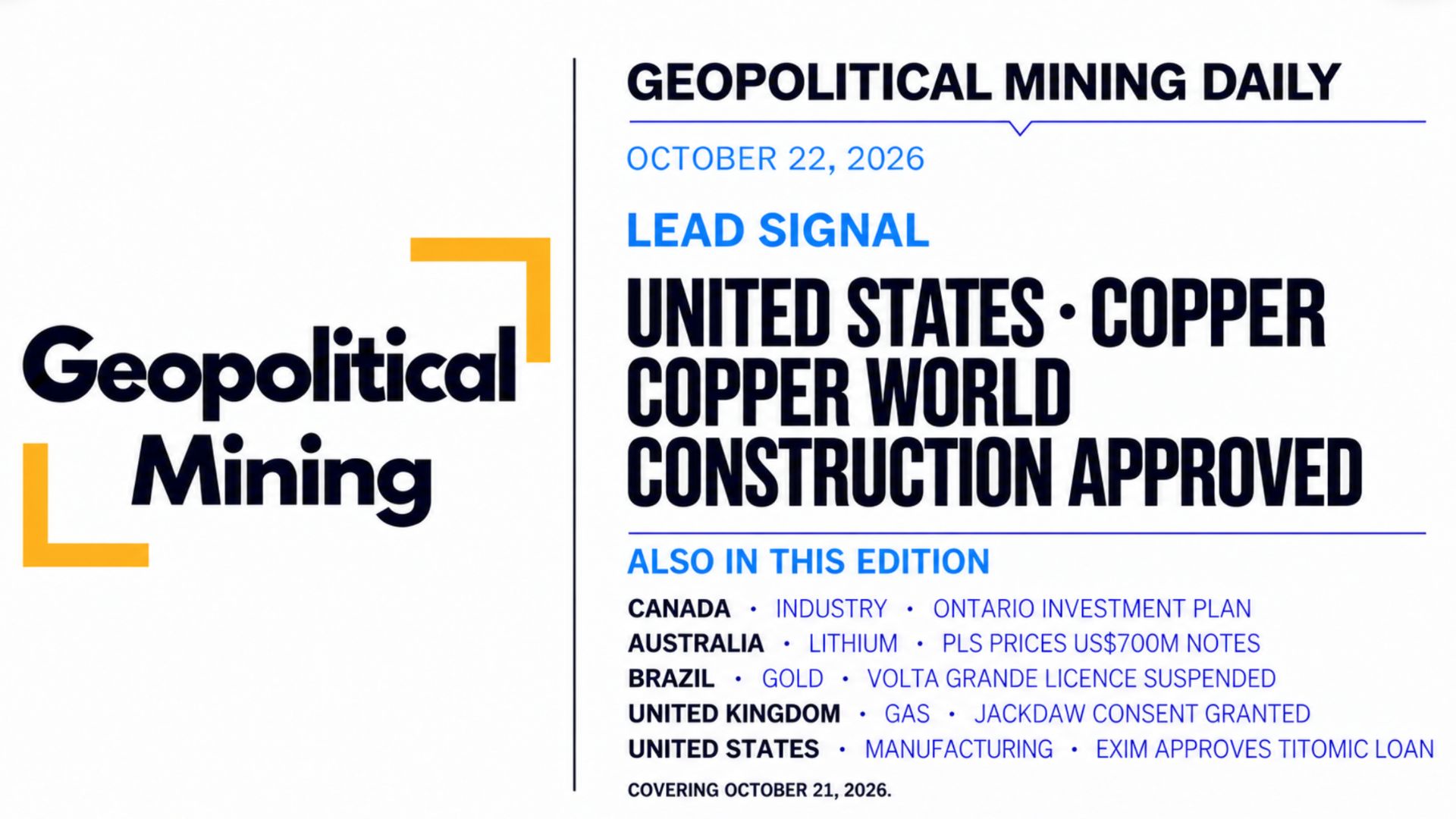

Geopolitical Mining Daily · October 22, 2026
Copper World Construction Approved by Hudbay and Mitsubishi
Copper World construction approval leads this Geopolitical Mining Daily for senior executives, investors and policymakers. Six developments reported on October 21 connect copper investment, industrial policy, lithium financing, permitting, energy security and advanced manufacturing.
A sanctioned US copper project leads a day in which capital, court decisions and industrial policy reshape the route from resources to usable supply.
Hudbay and Mitsubishi move Copper World into execution, while Canada and Ontario connect industrial support with mineral access. PLS prices US$700 million in notes, but Belo Sun faces a renewed judicial constraint. Jackdaw receives production consent, and EXIM approves financing for metal-component capacity. Across these developments, the distinction between approval, available funding and physical delivery remains central to the investment case.
The GM observation framework
The ten Signals
Each Daily uses the same ten strategic lenses. The highlighted dimensions classify the developments in this edition.
United States · Copper investment
Copper World construction approval shifts Arizona copper into execution
What happened
Hudbay and Mitsubishi approved construction of Copper World on October 21, advancing their 70/30 Arizona joint venture toward a targeted first production in the second half of 2029. The definitive feasibility study projects average annual production of 102,000 tonnes of copper contained in concentrate during the first ten years of a 15-year mine plan. Initial growth capital is US$2.070 billion, net of US$127 million in anticipated equipment financing.
The decision moves a potential source of US copper from study into execution, backed by a Japanese strategic investor. Mitsubishi expects additional equity of up to US$423 million, taking its cumulative investment to approximately US$1.02 billion, depending on the financing structure. Planned project debt of US$650 million remains a funding requirement. Securing that debt will shape the partners’ remaining equity exposure as construction advances.
For investors, sanction is a substantive milestone, but it does not remove financing, construction or copper-price exposure. The study’s US$1.2 billion net present value at an 8% discount rate and 17% internal rate of return use a US$5-per-pound long-term copper price. A longer, 37-year development case also requires federal permits by operating year ten. Consequently, neither the extended mine life nor the targeted 2029 production should be treated as secured by the investment decision alone.
Canada · Industrial policy
Canada and Ontario connect steel support with Ring of Fire access
What happened
Canada and Ontario announced a C$8.7 billion industrial package on October 21, linking tariff protection with infrastructure and investment support. A Joint Steel Action Fund carries five-year commitments of C$3.55 billion from Ottawa and C$1.67 billion from Ontario. Separately, the federal government committed up to C$1 billion over three years for road infrastructure supporting critical mineral development in the Ring of Fire.
The package addresses both ends of an industrial supply chain. Steel support and domestic procurement preferences aim to sustain demand and manufacturing capacity. Meanwhile, northern roads could improve access to mineral resources. The governments also plan coordinated federal and provincial permitting and an Indigenous consultation working group. These measures address different constraints, rather than creating a single mine-development approval.
For investors, the distinction matters: announced public commitments do not establish disbursement schedules, completed roads or permitted mines. The steel fund also builds on existing financing mechanisms. Project selection, consultation and execution will determine which companies benefit. Consequently, the near-term signal is a more explicit state-backed investment framework, not an immediate addition to mineral supply.
Australia · Growth capital
PLS prices US$700 million notes with settlement still pending
What happened
PLS priced US$700 million of senior unsecured notes carrying an 8.00% coupon and maturing in 2032, according to its October 21 ASX announcement. Settlement is expected in New York on October 23, subject to customary closing conditions. Certain wholly owned subsidiaries will guarantee the notes. Interest is payable twice a year, beginning on May 1, 2027.
The company intends to use the proceeds for general corporate purposes, including capital expenditure and growth. That mandate gives PLS flexibility across its investment programme rather than tying the financing to a single expansion. A 2032 maturity extends the funding horizon beyond immediate market conditions. However, the resulting capital must still earn a return through the lithium cycle, with interest payments continuing regardless of near-term commodity prices.
At the stated principal and coupon, the notes imply US$56 million of annual coupon payments, a calculation before other financing costs. This creates a fixed cash obligation alongside the flexibility provided by longer-dated debt. For investors, settlement is the immediate milestone. Thereafter, capital allocation discipline and operating cash generation will determine whether the additional financial capacity strengthens the business or increases exposure during a weaker pricing cycle.
Brazil · Permitting risk
Volta Grande faces a renewed judicial barrier to physical works
What happened
Belo Sun reported on October 21 that Brazil’s Supreme Federal Court had temporarily suspended the ruling that restored the effectiveness of Volta Grande’s installation licence. According to the company, the suspension remains in place until the Federal Regional Court of the First Region, TRF-1, approves the agreement reached with Indigenous affairs agency FUNAI. That agreement has been submitted for judicial approval, which remains pending.
The company says it is refraining from physical interventions at the gold project under the agreement. This makes the distinction between an agreement and an effective development permission especially important. A negotiated settlement can establish a route through a dispute without itself clearing construction. Here, the unresolved judicial step continues to determine whether the project can move beyond its current constraint.
For investors, court approval and its effect on the licence now govern the route back to physical development. The temporary suspension is not a permanent cancellation, but it extends the period in which capital and construction planning depend on judicial progress. Until that milestone is resolved, an agreed settlement offers a potential pathway rather than a dependable execution timetable. This gap between negotiation and effective permission remains central to the project’s risk profile.
Primary issuer source
Belo Sun · Volta Grande temporary suspension update · October 21, 2026United Kingdom · Energy security
Jackdaw consent moves UK gas toward a production milestone
What happened
The North Sea Transition Authority granted development and production consent for the Jackdaw gas field on October 21. The consent went to owner Adura following government consideration of its environmental statement. The UK government expects first gas as early as the end of October and says the field could increase domestic gas production by around 6% at peak, over a lifespan of up to 11 years.
The decision converts a regulatory process into permission to deliver supply, although first production remains prospective. Its relevance to the materials economy is industrial energy security, rather than a direct increase in metals output. The 6% figure concerns domestic gas production, not total UK consumption. Moreover, approval of this existing field does not reverse the restriction on new exploration licences.
Alongside the decision, the government announced an Energy Wealth Fund within the National Wealth Fund, starting with £2 billion for renewable and low-carbon infrastructure. Future North Sea revenues are intended to feed it over time. Investors therefore face two separate execution tests: Jackdaw reaching first gas, and the new fund translating its initial capital into individual investments. Neither outcome is demonstrated by the announcement alone.
United States · Advanced manufacturing
EXIM approves financing for Titomic metal-component capacity
What happened
The Export-Import Bank of the United States announced on October 21 that it had approved a US$10.3 million direct loan to Titomic USA. The financing supports expansion in Huntsville, Alabama, under EXIM’s Make More in America initiative. It will fund an integrated high-pressure cold-spray production cell, increasing the company’s ability to manufacture, repair and restore high-performance metal components domestically.
This is a downstream industrial-capacity development, not a mine or refinery investment. The equipment targets the conversion and restoration of metal components for markets that include aerospace, space, energy, maritime and industry. Its strategic relevance lies in manufacturing capability: a secure material supply chain also needs equipment and facilities that can turn available inputs into usable products.
For investors, the approved loan gives the expansion a defined public-financing instrument and a specified equipment purpose, although disbursement is not established. The commercial test now moves to equipment delivery, commissioning and customer demand. Financing a production cell can reduce an investment constraint, but revenue depends on converting that equipment into reliable component output. This makes manufacturing execution and customer adoption as important as the availability of funding.
The Daily records verified changes. The Signals provide the classification map. The Weekly brings the developments together for the deeper system reading.