
Geopolitical Mining · Critical Minerals
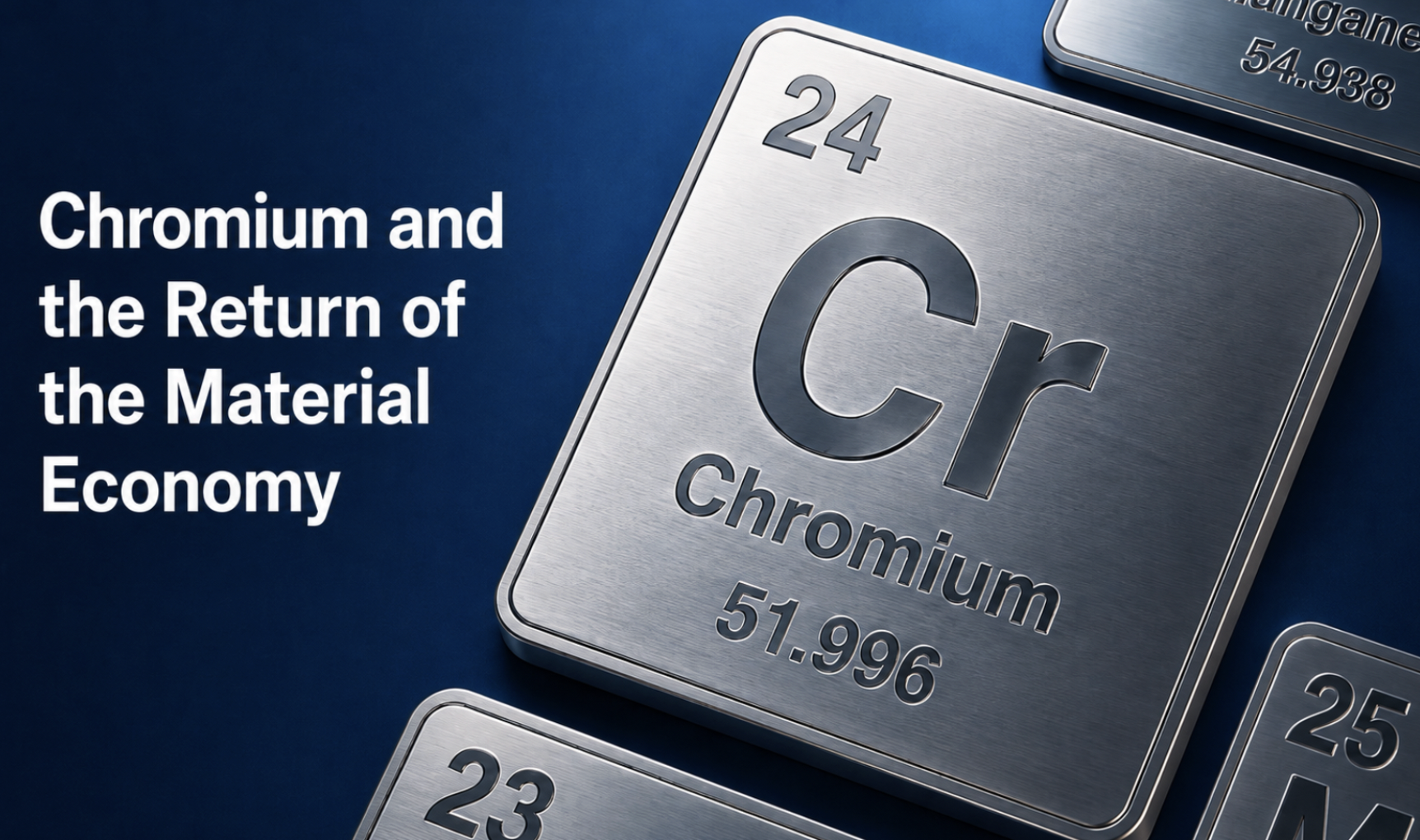
Chromium and the Return of the Material Economy
Why the new industrial era requires a broader understanding of the minerals that make modern life work and last
By Marta Rivera Muñoz and Eduardo Zamanillo
For much of the past decade, the public conversation about minerals has been dominated by a relatively small group of names. Lithium became synonymous with batteries. Copper came to represent electrification and the expansion of the grid. Cobalt and nickel entered the debate through electric vehicles, while rare earths became closely associated with permanent magnets, advanced technologies, defence systems and the strategic competition between China and the West. Their prominence is justified. These minerals sit at the centre of technological and industrial transformations that will shape the coming decades. They have also helped make an important reality visible: economies do not become less dependent on physical materials as they become more digital, sophisticated or technologically advanced. In many respects, they become more dependent on them.
Yet the return of the material economy is now widening that conversation. As governments rediscover industrial policy, seek to rebuild manufacturing capacity and invest in infrastructure, energy, defence and supply chain resilience, they must also recover a broader understanding of the mineral base beneath those ambitions. Industrial systems depend on more than the minerals associated with a single technology or transition. They require a much wider range of materials, each contributing particular properties: conductivity, strength, hardness, chemical stability, heat tolerance, resistance to corrosion and the ability to remain in service over time. If industrial policy is returning, then the importance of different minerals must return with it. This does not mean that every mineral will face the same demand, scarcity or geopolitical pressure. It also does not require extending the label critical without distinction. It means understanding more precisely what each mineral does, where it enters the economy, how its value chain operates and which industrial capabilities depend upon it.
Chromium provides a particularly revealing place to begin. Unlike lithium or rare earths, chromium is not strongly attached in the public imagination to one emblematic technology. Its contribution is distributed across steels and other alloys, chemicals, refractories and industrial processes. Most people do not encounter chromium as a recognisable product. They encounter it through the performance it gives to other materials: a surface that resists corrosion, equipment that tolerates repeated cleaning, a component that operates at high temperatures or infrastructure designed to remain functional for decades. Chromium’s relative invisibility is therefore not evidence of limited importance. It reveals a wider distance between the minerals modern societies use and the minerals they understand.
At a glance
Key Takeaways
- The return of industrial policy is widening the mineral conversation beyond a small group of headline commodities.
- Chromium’s importance lies in the corrosion resistance, durability and industrial performance it gives to stainless steels and other alloy systems.
- The chromium chain separates resource power from conversion power: South Africa leads chrome ore production, while China leads ferrochrome and stainless steel production.
- Chromium demand is shaped by both volume and performance, particularly where infrastructure and industrial systems must operate reliably under demanding conditions.
- Making chromium socially intelligible helps connect mineral origin with everyday function and strengthens the symbolic legitimacy of mining.
For the full Geopolitical Mining framework developed by Marta Rivera Muñoz and Eduardo Zamanillo behind this article, see our book Mining Is Dead. Long Live Geopolitical Mining.
Industrial policy needs a wider mineral vocabulary
The World Bank’s 2026 report Industrial Policy for Development: Approaches in the 21st Century describes industrial policy as being “back with a vengeance.” Its review of national development plans across 183 economies found that every government examined targeted at least one industry. The report also moves the discussion beyond tariffs and subsidies, examining 15 policy instruments and the institutional, fiscal and market conditions required for industrial policy to succeed.
The significance of this shift extends beyond the return of a particular set of government programmes. It restores production, capabilities, infrastructure and strategic sectors to the centre of economic thought. The debate increasingly concerns what economies can produce, which capabilities they wish to retain and what institutional, technical and material foundations are required to support them.
In an earlier Geopolitical Mining analysis, we described this change as the return of the material economy . The term does not suggest that the world is becoming less digital. It means that the physical foundations of digital, industrial and geopolitical power have become harder to ignore. Data centres require electricity, cooling systems, construction materials and specialised equipment. Defence capability requires metals, alloys, processing facilities and manufacturing capacity. Energy security depends on mines, refineries, grids, industrial machinery and transport corridors.
When production returns to economic strategy, its material foundations return with it. This creates a need for a more differentiated mineral vocabulary. The expression critical minerals has been useful in drawing political attention to concentrated supply chains and strategic dependence, but it can also flatten important differences. Minerals do not enter the economy as interchangeable units of strategic value. A battery, a bridge, a semiconductor plant, a water treatment facility and an aircraft engine require different material properties and therefore different mineral combinations.
Some minerals become visible because they are associated with a recognisable technology. Others are understood through the physical scale at which they are consumed. A third group is less visible because its value is incorporated into the performance of another material. Chromium belongs strongly to this third group. Its importance lies not in being the defining input of a single technology, but in the essential properties it brings to a wide range of steels and other alloy applications, including corrosion resistance, durability and high temperature performance.
This gives chromium broad industrial relevance, but it also makes its contribution harder to communicate. The finished product is visible; the mineral property within it is not. This is the mineral visibility gap : the distance between the systems society recognises and the mineral functions that allow those systems to perform.
What chromium gives the material economy
Chromium has a wide range of uses in steels and other alloys, chemicals and refractories. According to the U.S. Geological Survey, its use in iron, steel and nonferrous alloys enhances hardenability and resistance to corrosion and oxidation. It is also used in alloy steels, metal plating, pigments, catalysts, surface treatments, leather processing and materials designed for high temperature environments.
Its most important industrial relationship, however, is with stainless steel. Steel qualifies as stainless when it contains at least 10.5% chromium. At this concentration, chromium supports the formation of a thin, chromium-rich oxide layer on the surface. This passive layer protects the underlying steel against corrosion and naturally regenerates when exposed to oxygen. Chromium is therefore the defining alloying element that gives stainless steel its recognisable corrosion resistance.
The industrial chain begins with chromite, the only ore from which chromium is extracted commercially. Metallurgical grade chromite is transformed into ferrochrome, an intermediate alloy generally containing between 50% and 70% chromium. Ferrochrome is then used to introduce chromium into stainless, alloy and specialty steels. More than 80% of global ferrochrome production is used in stainless steel manufacturing, making stainless steel the principal driver of the chromium market.
This metallurgical sequence explains why chromium is widely present without being widely recognised. The mineral becomes an integral component of the alloy, while the property it creates remains visible throughout the economy. Materials containing chromium appear across strategic and essential sectors, including aerospace, defence, energy, transport, healthcare, chemical and pharmaceutical processing, water and wastewater infrastructure and industrial machinery, as well as in built infrastructure, commercial kitchens and household products. These applications should not be understood as a simple catalogue of uses. Their common feature is the need for materials to continue performing under demanding conditions. Moisture, salt, corrosive chemicals, elevated temperatures, friction, wear and repeated cleaning or sanitation all place stress on physical systems. Chromium enables selected steels and alloys to withstand these conditions more effectively, providing corrosion resistance, durability and performance in applications where premature material failure can carry significant operational or safety consequences.
Chromium becomes particularly valuable in parts of the built environment where materials must perform under demanding conditions. For example, stainless steel is used in façades, roofing, plumbing systems, elevators, escalators, fasteners, architectural components and equipment exposed to moisture or weather. Stainless reinforcement can also support coastal infrastructure, bridges exposed to de-icing salts, wastewater facilities, desalination plants and structural areas that are difficult or expensive to inspect and repair.
Across these applications, chromium contributes corrosion resistance, durability and longer service life, helping critical components remain reliable in environments where material performance carries lasting economic and operational value. The Samuel De Champlain Bridge in Montreal provides a tangible example. Approximately 15,000 tonnes of duplex stainless steel reinforcement were used in critical areas of the new bridge to resist corrosion caused by de-icing salts, one of the problems that had contributed to the deterioration of the previous structure. The use of stainless steel was selective, directed towards the parts of the asset where corrosion resistance and long term performance carried the greatest value.
This is why durability matters to the chromium story. Durability can sound like a secondary material characteristic, but in an industrial economy it has direct consequences for productive capacity. Corrosion shortens asset life, increases maintenance requirements and can interrupt water systems, transport networks, industrial facilities and energy infrastructure. Components that deteriorate prematurely must be repaired or replaced, often at considerable economic and operational cost. A material that lasts longer can preserve the value of capital already invested. It can reduce the frequency of shutdowns, limit disruption and improve the reliability of public and industrial systems. Durability, in this context, becomes part of industrial resilience. Chromium therefore belongs to a group of minerals whose contribution is expressed through continuity of operation. It helps make selected systems more resistant, hygienic, reliable and capable of functioning under demanding conditions. Its value lies not only in enabling societies to build, but also in helping what they build continue to perform.
From chromite to industrial power
Chromium also demonstrates why a mineral deposit is not the same as an industrial position. The value chain moves from chromite extraction to ferrochrome smelting, then to the production of stainless and specialty steels, fabrication and final industrial use. Each stage requires a different combination of geology, capital, electricity, infrastructure, technology, metallurgical knowledge, logistics and market access.
The geography of the chain changes markedly as the mineral moves downstream. In 2025, global chrome ore production reached approximately 41.9 million tonnes. South Africa produced close to 26.2 million tonnes, representing about 62% of the total. Global ferrochrome production reached approximately 16.9 million tonnes, of which China produced 9.9 million tonnes, or roughly 58%. At the stainless steel stage, global melt shop production reached 64.2 million tonnes, with China producing 40.9 million tonnes, close to 64% of the world total.
| Stage of the chromium chain, 2025 | Approximate global production | Leading producer | Approximate leading share |
|---|---|---|---|
| Chrome ore | 41.9 million tonnes | South Africa: 26.2 million tonnes | 62% |
| Ferrochrome | 16.9 million tonnes | China: 9.9 million tonnes | 58% |
| Stainless steel | 64.2 million tonnes | China: 40.9 million tonnes | 64% |
The figures reveal one of the central distinctions in geopolitical mining: resource power and conversion power are not the same. South Africa holds the largest chromite resource base and is the world’s leading producer and exporter of chrome ore. China possesses virtually no comparable domestic chromite resources, yet the growth of its stainless steel industry allowed it to overtake South Africa as the world’s largest ferrochrome producer in 2012. Its processing industry now relies heavily on imported ore, particularly from South Africa.
Geology determines where the chain can begin. It does not determine where industrial value will accumulate. Ferrochrome production is energy intensive and commonly relies on submerged electric arc furnaces. Its competitiveness is shaped by the cost and reliability of electricity, furnace efficiency, reductants, logistics and operating scale. Stainless steel production requires a further layer of industrial capability, including metallurgical infrastructure, technical knowledge, scrap and alloy management, customer markets and manufacturing scale.
The 2025 numbers show how consequential this distinction can become. According to the International Chromium Development Association, South African chrome ore production increased by 9% during the year. At the same time, combined ferrochrome production in South Africa and Zimbabwe fell by 48%, while Chinese ferrochrome production increased by 5%. Upstream mineral output expanded in Southern Africa while regional conversion contracted sharply.
This divergence cannot be explained by geology. It reflects the conditions under which industrial conversion takes place. A country may possess world class resources and still lose ground in processing if electricity, infrastructure, logistics or operating economics weaken the competitiveness of its smelters. Another country may possess limited geological resources and accumulate industrial influence by building processing, steelmaking and manufacturing capacity around imported material.
Recent developments in South Africa illustrate the practical nature of this challenge. In June 2026, the Glencore–Merafe Chrome Venture concluded a three-year negotiated electricity pricing agreement with Eskom at 62 South African cents per kilowatt hour. The agreement enabled the planned restart of the Boshoek and Wonderkop smelters and required coordination among the company, Eskom, the National Energy Regulator of South Africa, government, organised labour and other stakeholders. This is industrial policy in operational form. The objective is not achieved through a declaration that beneficiation is desirable. It requires mineral resources, electricity pricing, industrial assets, regulation, labour, capital and market conditions to work together closely enough for production to remain viable.
Other countries occupy important positions within the chromium system. Kazakhstan combines mineral resources with established ferroalloy capacity. India participates in chromite extraction, ferrochrome production and stainless steel manufacturing. Türkiye supplies particular ore qualities and serves specialised markets. Zimbabwe has a significant resource base and continues to pursue a larger downstream position. Finland, Sweden, Albania, Oman and other producers have developed roles in particular grades, alloys or market niches.
For resource rich countries, the strategic question is not necessarily whether they can reproduce the entire value chain domestically. The more practical question is which additional stage they can own competitively and durably. That may involve improved concentrates, more efficient ferrochrome production, specialised alloys, regional industrial partnerships or stronger links with downstream manufacturers. This is where the chromium story connects directly with the return of industrial policy. The World Bank’s framework emphasises that industrial ambition must be matched by government capability, market size, fiscal space, enabling institutions, infrastructure and skills. Resource beneficiation cannot be achieved through an export restriction or political declaration alone. It must be supported by a system capable of producing competitively over time.
Demand is about volume and performance
The figures above establish the scale of chromium’s principal end market. That momentum continued into 2026. According to worldstainless, global stainless steel melt shop production reached 33.0 million tonnes during the first half of 2026, 5% higher than in the corresponding period of 2025. China produced 21.1 million tonnes, an increase of 7.1% year on year.
These figures point to continuing momentum in chromium’s largest end market, but they should not be interpreted as evidence that reindustrialisation will produce a uniform or uninterrupted rise in demand. Stainless steel remains cyclical, and its market is shaped by industrial activity, energy prices, trade measures, inventory cycles, scrap availability and changes in global production. Strategic importance and short term commodity performance are different questions. The longer term chromium story has two connected dimensions. The first is a volume story. Expanding infrastructure, manufacturing, transportation, energy, urban systems, food processing and water networks require substantial quantities of steel, including stainless grades where the application demands them.
The second is a performance story. As physical systems become more sophisticated and operate under more demanding conditions, materials must meet higher standards for corrosion resistance, hygiene, temperature tolerance, reliability and useful life. The mineral requirement changes with the function. A coastal bridge may require stainless reinforcement in selected areas. A food processing facility needs equipment that can be cleaned repeatedly without rapid degradation. A desalination plant must operate in a highly corrosive environment. A turbine, furnace or specialised industrial component may require chromium bearing steel or a superalloy capable of tolerating elevated temperatures and mechanical stress.
The importance of chromium therefore grows not only when economies consume more material, but also when they demand more from the materials they use. This distinction is important for investors. A chrome ore project cannot be assessed solely through resource size or mine production. Its position depends on ore quality, recovery, product specifications, transportation, energy conditions, access to ferrochrome customers and the health of the end use market. An integrated producer faces different risks and opportunities from an ore exporter, while a producer serving a specialised grade must meet different technical and commercial requirements from one supplying a bulk metallurgical market. Chromium should therefore be read as a system rather than only as a mine gate commodity. The orebody matters, but so do the furnace, the power contract, the railway, the port, the steel mill and the customer.
Making minerals socially intelligible
Chromium also offers a way to think more deeply about mining legitimacy. The mining industry has traditionally explained its contribution through employment, exports, taxes, investment and regional development. These measures remain important, but they do not always make the relationship between an extracted mineral and the society that ultimately depends upon it visible. A person encounters a kitchen sink, a surgical instrument, a train carriage, a water treatment facility, an elevator or a bridge. They rarely encounter the chromite mine, ferrochrome furnace or metallurgical process that made the material’s performance possible. Chromium is rarely visible as a material in its own right, yet it is embedded in many of the systems that underpin modern economies and societies. Society sees the finished system while remaining distant from the mineral chain behind it.
As we argued in The Mining Paradox, modern life is materially dependent on mining, yet mining itself often retains a weak symbolic position within society. The technologies, infrastructure and services enabled by minerals are associated with innovation, security, health, mobility and the future, while the activity that provides their material foundation is still understood largely through disruption, environmental impact or an extractive past. This does not mean that better explanations can substitute for responsible conduct. Mining has territorial consequences. It affects land, water, communities and ecosystems. Public legitimacy must be built through environmental performance, institutional accountability, local trust and the ability to govern real impacts responsibly.
Society also needs a language capable of explaining what minerals do. It is no longer sufficient to repeat that mining is essential. The more meaningful task is to connect mineral origin with material property, material property with social function and social function with the systems people value in their daily lives. Chromium makes that relationship unusually clear. Chromite is extracted and transformed into ferrochrome. Ferrochrome introduces chromium into steel. Chromium gives that steel the capacity to resist corrosion and oxidation, and to withstand high temperatures and wear. Those properties are critical to the performance and longevity of strategic systems and essential infrastructure, including aerospace and defence, energy, transportation, water and wastewater, healthcare, chemical and pharmaceutical processing and industrial equipment. They also support a much broader range of commercial, construction and everyday applications, from buildings and food processing to household products.
When this sequence becomes intelligible, the mineral acquires social meaning. This is the basis of mineral literacy. It does not require citizens to become mining engineers or metallurgists. It means recognising that conductivity, corrosion resistance, hardness, heat tolerance and durability have material origins. These properties do not appear spontaneously in finished products. They emerge from particular minerals, technical knowledge, energy, infrastructure and industrial processes. Mineral literacy contributes to the symbolic legitimacy of mining because it allows extraction to be understood within the larger material structure of modern life. It does not ask society to accept mining uncritically. It provides a clearer basis on which mining can be examined, debated, improved and governed.
The return of the material economy makes this work increasingly necessary. Governments can classify minerals as critical, companies can publish demand forecasts and investors can finance new projects. But if societies cannot connect minerals with the functions they provide, mining will remain materially central and symbolically peripheral. Chromium shows how that gap can begin to close.
Chromium: A Case for a Broader Understanding of Mineral Importance
Lithium, copper, cobalt, nickel and rare earths will remain central to the new industrial era. Their importance is not diminished by widening the mineral conversation. Chromium adds another dimension to it. It shows that industrial power depends not only on minerals associated with recognisable new technologies, but also on minerals whose contribution is distributed throughout the physical system. Chromium matters because it expands the boundaries of what steels and other alloys can withstand and therefore where they can be used. It enables selected materials to resist corrosion and oxidation, withstand heat and wear, support hygiene, durability and long term reliability, and remain operational under demanding conditions. In critical applications, these properties can be fundamental to the safe and effective operation of the systems in which those materials are used. Its value chain also demonstrates that mineral power is created at several levels. South Africa’s geological advantage, China’s conversion capacity, the energy intensity of ferrochrome and the scale of stainless steel manufacturing show that resources alone do not determine industrial position. Power accumulates where geology is connected with electricity, infrastructure, processing, technical knowledge, markets and sustained execution.
For governments, this means that mineral policy must become more precise about the different functions and value chains involved. For investors, it means analysing the conversion system rather than the deposit alone. For the mining industry, it means explaining not only that minerals are necessary, but how they participate in the systems society uses and expects to endure.
The return of the material economy must therefore become a return to a broader understanding of mineral importance. The next industrial era will depend on minerals that enable new technologies. It will also depend on those that give the surrounding physical world its strength, reliability and longevity. Chromium deserves attention because the world is returning to the kind of economy in which its enduring importance is becoming impossible to ignore.
Resources
U.S. Geological Survey. Chromium Statistics and Information.
U.S. Geological Survey. (2026). Mineral Commodity Summaries 2026: Chromium.
International Chromium Development Association. What Is Ferrochrome and What Is It Used For?
International Chromium Development Association. Chromium Applications.
worldstainless. Stainless Steel Standards.
worldstainless. Corrosion Properties.
worldstainless. Architecture, Building and Construction Applications.
worldstainless. (2026). Stainless Steel Melt Shop Production Increases by 2.1% in 2025.
worldstainless. Infrastructure: Stainless Steel in Bridges, Water, Sewage and Public Systems.
worldstainless. Where to Use Stainless Steel Rebar?
worldstainless. Stainless Steel Rebar for the New Champlain Bridge in Montreal, Canada.