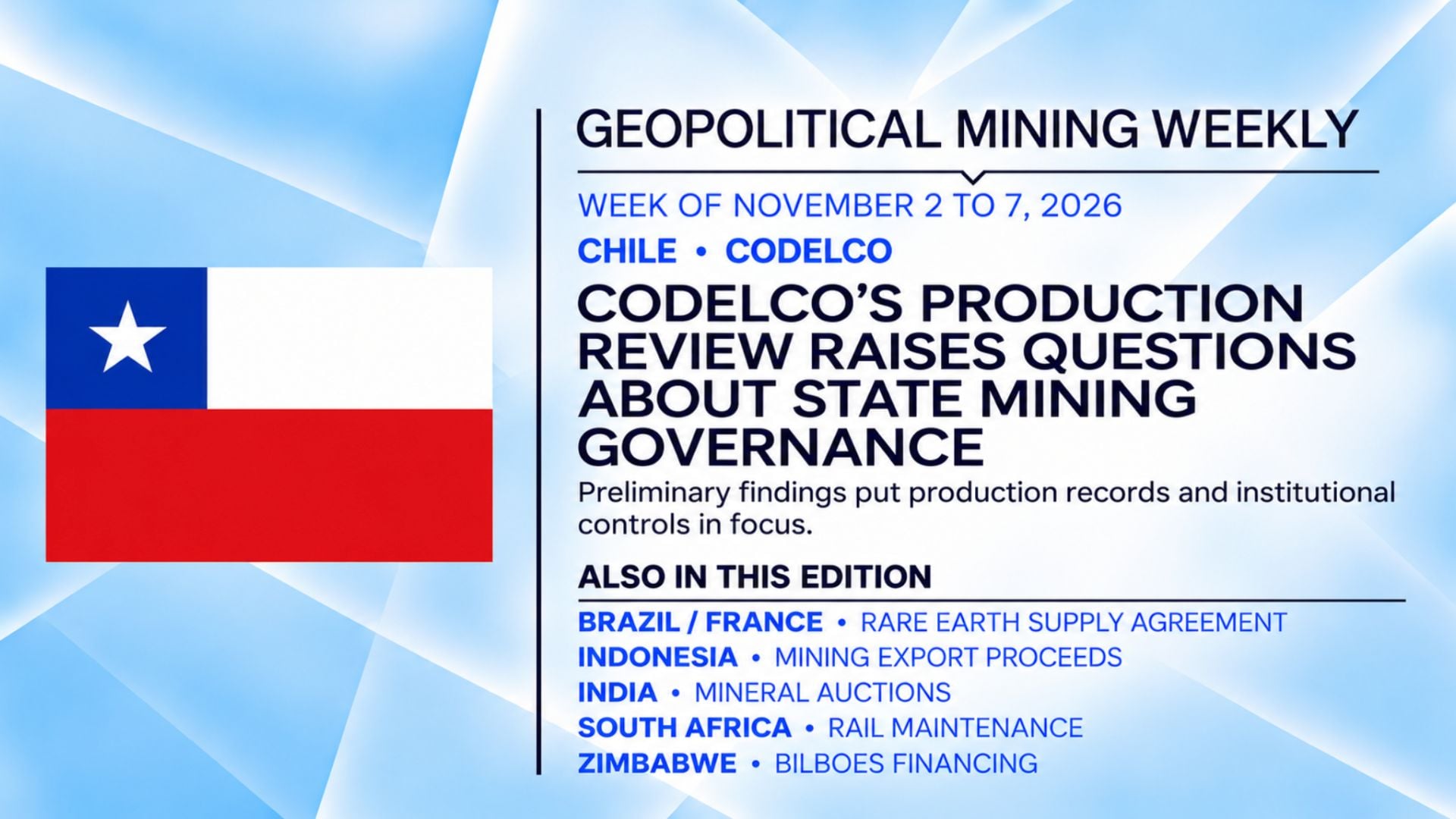
Chile: Codelco’s Production Review Raises Questions About State Mining Governance
Codelco’s review of reported copper production brings the governance of a state mining company into focus. Reliable information connects operational performance with the decisions of boards, public owners and capital providers. Elsewhere this week, developments in Brazil and France, Indonesia, India, South Africa and Zimbabwe show how commercial agreements, financial rules, infrastructure and investment determine the conditions in which mining operates.
At Geopolitical Mining, we read these events as parts of the same material economy. Mineral resources acquire economic and strategic value through organisations able to develop them, finance their operations and account for their results. This week’s evidence puts those capabilities, and the institutions that sustain them, at the centre of the discussion.
A weekly analysis for senior executives, investors and policymakers, connecting mining developments with investment, industrial strategy and public policy.
Evidence base: selected developments reported during November 2 to 7, 2026, the Daily archive and original sources linked below. Published November 8, 2026.
Cover story · Chile
Codelco’s November 5 statement also identified a preliminary net overstatement of 18,100 tonnes for 2025. KPMG is reviewing production across its divisions, while EY is conducting a forensic audit. The figures may change as the investigations proceed.
For a state mining company, the quality of production records reaches beyond an operating report. It also supports the public owner’s ability to assess performance and the company’s capacity to explain how it manages a strategic asset.
From production records to public accountability
Measurements establish what the mine actually produces.
Independent checks connect reported figures with evidence.
Boards and owners depend on reliable information.
Credible reporting supports relationships with capital providers and the public.
The strategic question
What does effective state ownership require from the institutions that govern a mining company?
Chile: why the Codelco review extends beyond production
Codelco described measures to reinforce metallurgical balances and inventory checks. The company also said the irregularities affected variable incentives, with the final amounts still being determined. Taken together, these findings connect the accuracy of operating information with the way performance is evaluated and rewarded.
That connection matters in any mining business. State ownership adds a further relationship: management and the board administer an asset whose ultimate owner is the country. The quality of oversight therefore affects both corporate decisions and the credibility of public stewardship. Although the ongoing review provides a basis for examining those arrangements, it does not establish individual responsibility or a demonstrated change in financing costs.
Production records, commercial commitments and capital
About 70%
Colossus committed volumes
Brazil / France · Share of anticipated capacity represented by minimum magnet rare earth commitments.
27 minerals
Brazil’s strategic list
Brazil · Listing and project registration establish eligibility for policy support.
30% / 3 months
Mining export proceeds
Indonesia · Minimum placement and duration under the special regime for eligible exporters.
20 blocks
Critical mineral auction
India · Ninth round launched alongside 11 exploration licence blocks.
US$390 million
Locomotive support
South Africa · Approximate value of Wabtec’s agreement with Transnet Engineering.
Up to US$150 million
Bilboes interim financing
Zimbabwe · Facilities signed while longer term project financing remains under discussion.
Six readings from the week
Chile: Reliable information is part of state mining capacity. Codelco’s production review connects measurement, incentives and oversight with the stewardship of a public asset.
Brazil / France: A supply chain takes shape through commercial and industrial links. Colossus and La Rochelle connect future mineral output with processing capacity, while Brazil defines eligibility for public support.
Indonesia: Cash management is part of the investment framework. Export proceeds rules link a company’s ownership structure to its financial flexibility.
India: Access to mineral rights depends on institutional design. New auctions combine a larger opportunity set with revised participation rules.
South Africa: Transport reliability is part of mineral supply. Locomotive maintenance links existing infrastructure with the ability to serve export markets.
Zimbabwe: Project finance develops through successive commitments. Bilboes combines local banking capacity with other financing instruments while longer term funding advances.
Chile: Reliable information is part of state mining capacity
Production information is an input to decisions about costs, investment, performance and future output. When its reliability is questioned, the issue reaches the chain of decisions built on it. In Codelco’s case, that relationship is especially visible because the company carries both commercial responsibilities and a national strategic role.
Public ownership does not remove the need for commercial discipline. Instead, it makes the relationship between ownership, management and oversight especially important. The State must be able to evaluate the company as an owner, while the board needs sufficient authority and reliable information to supervise management. In practice, those functions work best when responsibilities are clear and evidence can be tested.
There is also a connection with investment. Capital providers assess a company through operating information, financial reporting and the credibility of its plans. A review of production records can therefore raise questions relevant to their assessment, even before any financing effect is established. However, identifying that exposure is different from claiming an outcome that has not been demonstrated.
For Geopolitical Mining, the significance lies in how a country governs a strategic resource through an operating enterprise. The quality of that governance affects the information available to the owner, the use of capital and the legitimacy of decisions taken on the public’s behalf. Ultimately, Codelco’s response will be judged through the evidence produced by the reviews and the durability of the changes that follow.
Brazil / France: A supply chain takes shape through commercial and industrial links
Solvay and Viridis signed a binding supply agreement linking Brazil’s Colossus project with rare earth processing at La Rochelle in France. Shipments are expected from 2028, with an initial term through 2034. Minimum commitments for neodymium, praseodymium, dysprosium and terbium represent about 70% of anticipated project capacity. A technology licence remains a separately contemplated agreement.
The commercial relationship gives prospective mineral output a defined industrial destination. For a developer, that can strengthen the basis for financing discussions. At the same time, a processor gains a future source of feedstock around which production and customer relationships can be planned. Diversification thus takes shape through linked capabilities in different countries.
Brazil also approved a list of 27 critical and strategic minerals on November 5. Inclusion, together with project registration, determines eligibility for support under its national policy. It also assigns priorities across minerals and connects strategic classification with instruments intended to support investment and domestic value addition.
The two developments operate at different levels. One creates a commercial connection between companies; the other defines how the State directs support. Together, they influence the location of processing, the transfer of technical knowledge and the distribution of value along the chain. A mineral producing country’s position is shaped by those arrangements as well as by its deposits.
Indonesia: Cash management is part of the investment framework
Indonesia announced expanded eligibility for special mining export proceeds rules on November 6, adding Japan, South Korea and the European Union. Qualifying exporters place at least 30% of proceeds for three months, compared with the general requirement of 100% for twelve months. Access depends on eligible share ownership of at least 10%, rather than the destination of the shipment.
These rules affect where cash remains available and for how long. As a result, they are relevant to working capital, debt service planning and the allocation of funds within an international mining group. The distinction is about placement requirements, not an additional tax or an obligation to convert all receipts into rupiah.
The broader issue is how a mineral exporting State balances domestic foreign currency availability with investment conditions. Here, ownership and trade relationships also enter the rules governing treasury management. As a result, the financial terms surrounding an operation can differ even where its mineral output and physical market remain unchanged.
Alongside the Brazilian agreement, Indonesia shows another route through which international relationships enter mining economics. A buyer’s commitment can improve a project’s commercial position; a change in cash retention rules can alter its financial flexibility. In both cases, international relationships influence the conditions under which capital supports production.
India: Access to mineral rights depends on institutional design
India’s Ministry of Mines launched auctions for 20 critical mineral blocks and 11 exploration licence blocks on November 5. The tender documents also incorporate an October reform reducing the minimum number of technically qualified bidders for the second round of certain mineral auctions from three to two. Bid submissions are due on January 7, 2027.
The change addresses a practical part of mineral policy: how interested investors gain access to rights. A geological opportunity becomes commercially relevant only when the allocation process gives companies a workable basis for committing people and capital. Auction design therefore influences how national priorities enter the project pipeline.
Exploration licences serve an earlier stage than a mining lease. In particular, they bring private investment into the work needed to establish what a mineral occurrence may support. That distinction matters because the development pipeline depends on new geological knowledge as well as on the advancement of already defined deposits.
India and Brazil illustrate complementary institutional choices. While India is adjusting access and participation, Brazil is defining priorities for support. Their longer term significance will emerge through investment decisions, exploration results and the projects that progress under those frameworks.
South Africa: Transport reliability is part of mineral supply
Wabtec finalised an agreement worth approximately US$390 million with Transnet Engineering on November 2. It covers support for D43 and D44 locomotives, including components, technical expertise and predictive maintenance. The arrangement also includes skills development and local capabilities, with improved fleet availability and reliability as intended outcomes.
For a mining economy, railway performance connects production with revenue. An operation may have ore, equipment and customers, yet the route to market depends on infrastructure managed outside the mine. Transport reliability therefore influences the ability to plan shipments, manage inventories and serve customers consistently.
The agreement directs attention to the existing industrial system. In particular, spare parts, maintenance knowledge and the organisation of technical work can determine how much of installed infrastructure is usable. Expanding capacity and restoring the performance of current assets are different investments, but both can matter for supply.
This is another dimension of state capacity. Where public infrastructure supports private and public producers, its operating performance shapes the wider investment environment. For Transnet, the next evidence will therefore come from how technical support translates into locomotive availability and service delivery over time.
Zimbabwe: Project finance develops through successive commitments
Caledonia signed interim financing facilities of up to US$150 million for Bilboes on November 5. Eight Zimbabwean financial institutions participate. The facilities complement convertible financing and gold price hedging, while discussions on longer term project finance continue. Meanwhile, initial ground works are under way, with first gold targeted for October 2028.
This structure shows how mine development can draw on different sources of capital at different stages. Local banks bring funding and country knowledge; market instruments and prospective project lenders serve other needs. Combining them therefore requires attention to repayment schedules, conditions and the timing of construction expenditure.
The continuity of funding matters because a development programme does not pause neatly between financing milestones. In the meantime, interim facilities can help maintain momentum while a broader package is negotiated. Their value therefore depends on how they fit into the complete funding plan and the cash generation available to support it.
Across the week, capital appears as more than a headline amount. It depends on credible information in Chile, commercial links across Brazil and France, cash management rules in Indonesia and the structure of development finance in Zimbabwe. Taken together, those relationships help explain why similar resources can face very different investment paths.
The institutions around the mineral matter
This week places governance alongside capital, infrastructure and industrial capability. Each contributes to the conditions under which mineral resources become reliable supply and economic value. Codelco makes the connection especially visible: the quality of information is part of the system through which an enterprise is managed and a public asset is supervised.
The other developments show institutions at work in different forms. Contracts connect resources with processing, rules shape access to rights and cash, banks organise funding, and technical agreements sustain transport. Together, these arrangements influence the capacity of companies and countries to participate in mineral value chains.
Looking ahead, audit findings, implementation details, auction participation, financing arrangements and operating results will provide the next evidence. Following those steps makes it possible to understand how strategic ambition develops into capacity, and where the institutions surrounding mining need to become stronger.
Dates and decisions to watch
Implementation ahead
Final details for expanded eligibility and ownership arrangements.
January 7, 2027
Deadline for technical bids and initial price offers.
October 2028 target
Development and financing milestones precede expected production.
The Daily archive behind this reading
The Daily records individual developments. Building on that reporting and additional original announcements, this Weekly connects the week’s evidence.
Sources behind the Weekly
Company and institutional announcements establish the reported facts. ANTARA provides the Indonesian minister’s announcement. The comparisons and implications above are Geopolitical Mining’s analysis.
Codelco
Extraordinary shareholders’ meeting, preliminary production findings and controls, November 5
Solvay
Viridis supply agreement connecting Colossus with La Rochelle, November 4
Brazil · MDIC
National critical and strategic minerals list and support framework, November 5
Indonesia · ANTARA
Ministerial announcement of expanded mining export proceeds eligibility, November 6
India · Ministry of Mines
Mineral and exploration auctions, participation reform and deadlines, November 5
Wabtec
Transnet Engineering locomotive support agreement, November 2
Caledonia · SEC filing
Bilboes interim financing facilities and development timetable, November 5
GM Signals provides the observation framework. The Daily records developments and their stage. The Weekly then compares the evidence to identify what changed across the mineral system.