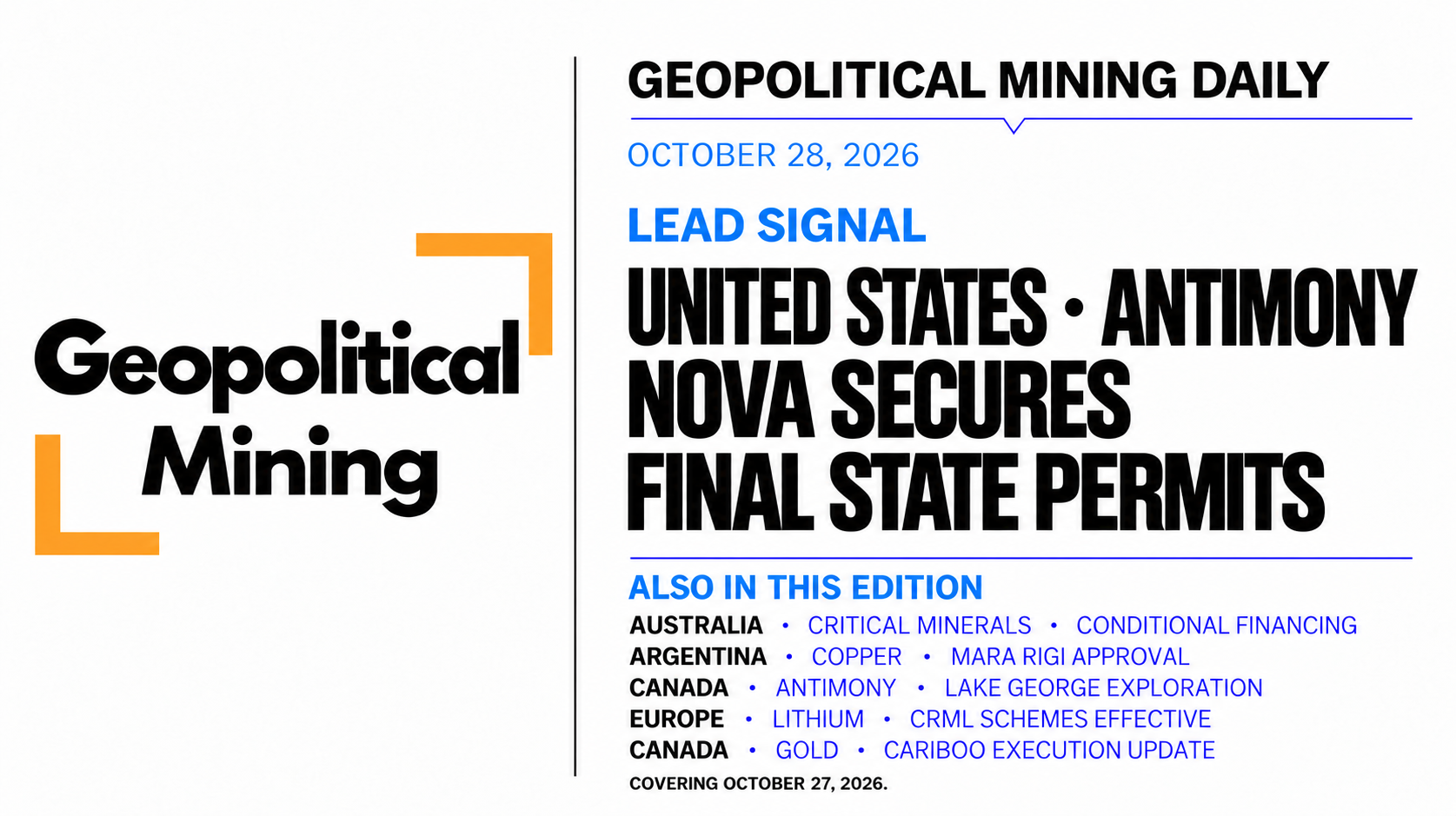

Geopolitical Mining Daily · October 28, 2026
Nova Antimony Project Receives Final Alaska Permits
The Nova antimony project leads this Geopolitical Mining Daily for investors, senior executives and policymakers. Coverage includes six developments reported on October 27, 2026, with an editorial cutoff of 9:46 p.m. EDT that day.
Alaska permitting, Australian conditional finance and Argentina’s investment regime advance alongside Canadian exploration rights, corporate consolidation and a revised construction target.
Regulatory permission, financing access and execution capacity are moving at different speeds. Nova’s Alaska approvals advance a domestic antimony chain, while Australian financing conditions and Argentina’s investment framework shape access to capital. Lake George enters evaluation, Critical Metals advances a corporate transaction and Cariboo lowers its near-term underground development target. For capital allocators, these developments require distinct assessments of legal status, financial availability and delivery risk. The next value inflection depends on which outstanding conditions each project can satisfy.
The GM observation framework
The ten Signals
Each Daily uses the same ten strategic lenses. The highlighted dimensions classify the developments in this edition.
United States · Antimony permitting
Nova antimony project receives final Alaska permits
What happened
Nova Minerals said on October 27 that Alaska’s Department of Natural Resources had approved the Plan of Operations and Reclamation Plan for its antimony project, completing the company’s required permitting process. The initial three-year authorization covers stibnite mining at Styx and Stibium, concentration at Whiskey Bravo within Estelle, and downstream processing and refining at Port Mackenzie.
The company describes Phase 1 as fully funded by its existing US$43.4 million Department of War award. Nova also says process engineering and metallurgical work are complete and major long-lead mining and processing equipment has reached the project locations. Its flowsheet is designed for military-grade antimony trisulfide and antimony metal above 99.65% purity.
The decision advances a proposed domestic chain spanning mining, concentration and refining. Investors now need construction delivery and commissioning evidence against the company’s 2027 production target. The award predates this announcement, and commercial output remains prospective. Product qualification, operating performance and delivery timing will determine how much strategic value the permitted project can ultimately provide to customers.
Primary issuer announcement
Nova Minerals · Final Alaska antimony permits · October 27, 2026Australia · Critical minerals financing
Australia conditionally backs the Donald rare earths project and GAM tantalum production
What happened
Australia announced conditional financing for two critical minerals projects on October 27. Export Finance Australia approved up to A$70 million for the Donald rare earths and mineral sands project, alongside A$110 million from the National Reconstruction Fund. EFA also conditionally approved a US$41.4 million loan for Global Advanced Metals’ tantalum production.
Donald partner Energy Fuels describes the Australian commitments as part of a proposed A$200 million senior debt package, with A$20 million still contemplated from commercial lenders. Definitive documentation, due diligence, remaining debt funding, final approvals and conditions precedent remain outstanding. The company targets a final investment decision by year-end 2026.
Public lenders are addressing project-level financing within Australia’s US-linked supply chain programme. Investors should track signed facilities, the commercial tranche and the investment decision before treating conditional credit approvals as available construction cash. For downstream buyers, financing progress strengthens a potential feedstock route. Delivery commitments and commissioning performance will require further evidence, while Donald and GAM retain separate project economics and execution obligations.
Primary government announcement and issuer terms
Australian Government · Critical minerals financing · October 27, 2026Energy Fuels · Donald financing terms · October 26, 2026 (US publication date)
Argentina · Copper investment framework
Argentina publishes MARA’s admission to the RIGI investment regime
What happened
Argentina’s official gazette published Resolution 1854/2026 on October 27, admitting Minera Agua Rica’s Catamarca copper, gold, silver and molybdenum project to the RIGI investment incentive regime. The approved application declares US$6.394 billion of total investment, including US$3.311 billion in qualifying assets, with construction estimated to begin on November 1, 2027 and operations on October 1, 2031.
The resolution provides an investment framework for MARA through tax, customs and foreign exchange incentives. The figures and timetable come from the approved application. They describe planned investment and estimated development dates; financing, a final investment decision and construction remain separate commercial milestones.
For investors, the immediate task is to assess how the incentive regime changes project economics, which funding sources are available and how the developer will finance the approved programme. Total declared investment and qualifying assets serve different purposes and should be assessed separately. Suppliers can use the multiyear schedule to prepare, with actual orders dependent on procurement decisions and project execution.
Official registry and reproduced primary legal text
Argentina · Official publication registry · Resolution 1854/2026 · October 27, 2026Ministry of Economy Resolution 1854/2026, reproduced by CIRA
Canada · Antimony exploration
Agnico subsidiary secures exclusive Lake George exploration rights
What happened
New Brunswick announced an exclusive exploration agreement with Avenir Minerals on October 27 for the former Lake George mine. Avenir, an Agnico Eagle subsidiary established to evaluate critical minerals opportunities, can assess both future mining and the reprocessing of existing tailings. Any reopening would require additional environmental and regulatory approvals.
Work is planned for early 2027, with exploration at no direct cost to the government. The property, southwest of Fredericton, formerly operated as a major primary antimony mine and also has potential for tungsten, molybdenum and gold. Avenir remains responsible for engagement with First Nations, landowners and municipalities.
The agreement brings a large mining group’s evaluation capacity to a legacy asset and assigns the next exploration costs to the company. The investment case depends on validated resources, metallurgy and environmental liabilities, including whether tailings offer a viable recovery route. Executives assessing future North American antimony supply should treat exploration exclusivity as an early development milestone. Resource definition, engineering and permitting will be needed before a credible production schedule can emerge.
Primary provincial government announcement
Government of New Brunswick · Lake George exploration agreement · October 27, 2026Australia / Greenland · Corporate consolidation
Critical Metals’ European Lithium acquisition schemes become effective
What happened
Critical Metals said on October 27 that the share and option schemes for its acquisition of European Lithium had become legally effective after the Australian court orders were lodged with ASIC. Court approval occurred on October 26. Implementation remains scheduled for November 5.
Eligible European Lithium shareholders are to receive 0.045 new Critical Metals shares per share. Listed options are subject to a cashless-exercise calculation, with final option consideration due to be announced on October 28. The record date is October 29, followed by expected Nasdaq trading of the new shares and European Lithium’s ASX removal on November 6. Australian dates refer to Perth time and remain indicative.
The company’s previously stated rationale includes absorbing European Lithium’s 7.5% Tanbreez interest and simplifying ownership and financing decisions. For investors, legal effectiveness advances corporate consolidation while consideration delivery and mine development remain subsequent steps. The transaction could streamline decision making around the Greenland rare earths project. Its financial and strategic benefits will depend on implementation, project funding and the ability to convert asset control into development progress.
Primary issuer announcement and transaction background
Critical Metals · Acquisition schemes become effective · October 27, 2026Critical Metals · Acquisition rationale · May 18, 2026
Canada · Gold project execution
Cariboo lowers its near-term development rate while retaining the 2029 target
What happened
Osisko Gold Group’s October 27 construction update keeps Cariboo’s first gold pour targeted for the first quarter of 2029 and commercial production for the second half of 2029, while lowering the expected year-end underground development rate to approximately 360 metres per month from 500.
The company attributes the revised rate to slower excavation at the Valley portal, rockbreaking to limit blasting noise, and concrete-curing requirements in sub-zero conditions. Additional headings from the Valley portals are expected to improve advance rates in 2027. Approximately 3.4 kilometres of underground development has been completed.
Cariboo was about 28% complete on a cost-incurred basis at September 30, with C$355 million spent and an estimated C$907 million remaining to finish construction, net of incurred costs, leases and estimated pre-production revenue. Detailed engineering was approximately 42% complete; more than half of procurement packages had been awarded.
For investors, this execution update requires assessing the unchanged production target alongside the slower near-term advance rate and remaining capital requirement. Cost-based completion measures spending progress; physical construction and schedule recovery need separate assessment.
Primary issuer construction update
Osisko Gold Group · Cariboo construction update · October 27, 2026The Daily records verified changes. The Signals provide the classification map. The Weekly brings the developments together for the deeper system reading.