
Geopolitical Mining · Geopolitical Milestones
Canada Sets Out C$400 Billion Capital Investment Plan
Canada’s capital investment plan leads a day shaped by the cost and availability of finance. The United Kingdom’s rate decision, developing countries’ debt, Indonesia’s growth, green economy negotiations and a Bahamas LNG contract show how institutions and infrastructure influence productive investment.
Geopolitical Milestones is a daily briefing for senior executives, investors and policymakers. Each edition examines significant international developments and their implications for investment, business strategy and public policy.
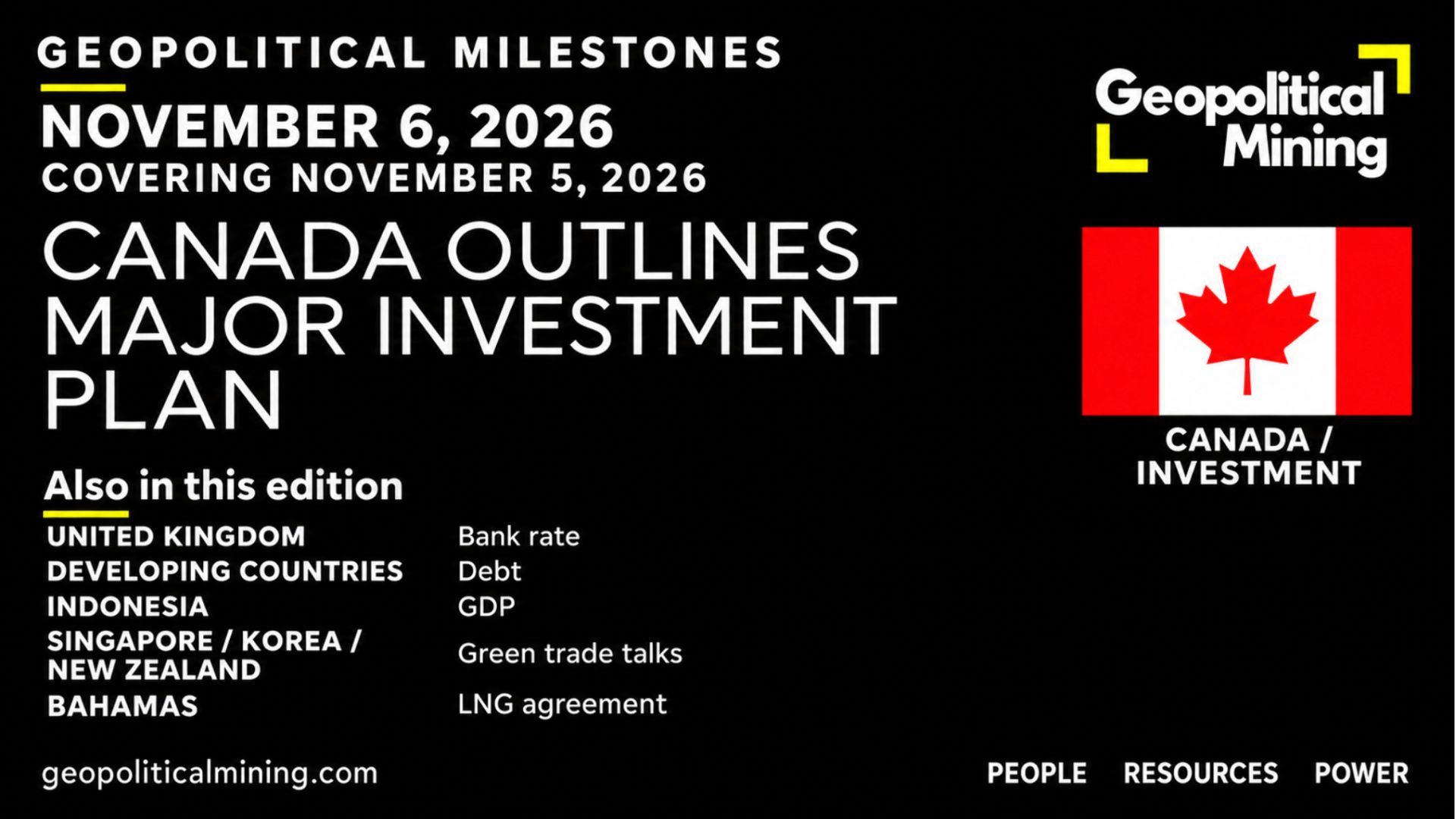
Also in this edition: United Kingdom interest rates and inflation; developing countries’ external debt; Indonesia’s economic growth; Singapore, South Korea and New Zealand’s green economy negotiations; and a Bahamas LNG supply agreement.
Milestone 01
Canada Sets Out C$400 Billion Capital Investment Plan
Canada’s Budget 2026, released on November 5, sets out approximately C$400 billion in federal capital investment over six fiscal years. The fiscal overview projects C$403.9 billion on an accrual basis from fiscal 2025/26 through 2030/31. This is the total projected capital investment across that period, rather than an entirely new spending package.
The budget includes more than C$50 billion in measures to expand electricity systems, support clean technology and attract private capital. It also reaffirms plans for the proposed Productivity Mega Deduction, whose legislative and regulatory proposals were released on September 15. The government estimates that the measure would lower the marginal effective tax rate on new investment from 13% to 6.4%.
Geopolitical Mining reading:
Canada’s budget arrives as the U.S. election result opens a new debate over tariffs. Public investment and the proposed tax deduction could lower the cost of building industrial capacity in Canada. Wyden’s call to reverse U.S. tariffs raises a separate question about market access.
If restrictions are eased, better access to U.S. customers could improve expected returns on some Canadian projects. Domestic investment support and tariff relief could therefore reinforce each other, although any trade changes still depend on the U.S. political process.
Sources
Department of Finance Canada: Budget 2026 key measures, November 5
Department of Finance Canada: fiscal overview and capital investment totals, Budget 2026
Department of Finance Canada: proposed tax measures and the Productivity Mega Deduction
Department of Finance Canada: Budget 2026 release and capital investment headline, November 5
U.S. Senate Finance Committee: Wyden’s proposed trade agenda, November 4
Milestone 02
United Kingdom Raises Bank Rate to 4% as Inflation Pressures Rise
The Bank of England raised Bank Rate by 25 basis points to 4%, according to the monetary policy decision published on November 5. At its meeting ending November 4, eight Monetary Policy Committee members supported the increase. One member preferred a larger rise of 50 basis points to 4.25%.
The Bank’s forecast projects inflation reaching around 5% in the second quarter of 2027. That outlook follows annual CPI inflation of 3.5% in September and places future price pressure at the centre of the decision to tighten monetary policy.
Geopolitical Mining reading:
Raising rates while forecasting higher inflation leaves British businesses facing pressure on both financing and operating costs. The increase reaches firms through new loans and debt that reprices, while the inflation outlook complicates budgets for energy, equipment and wages.
For projects that take years to build, borrowing costs accumulate before production generates revenue. Higher financing costs therefore raise the hurdle for expansion, particularly where sales prices are fixed in contracts or customers resist increases. The Bank’s decision adds that pressure before the forecast inflation peak.
Milestone 03
Developing Countries’ External Debt Reaches US$9.4 Trillion
Developing countries’ external debt reached a record US$9.4 trillion in 2025, an increase of 5.5%, according to a World Bank release published on November 5. It was the fastest annual rise since 2021.
Debt in countries eligible for financing from the International Development Association rose 8.1% to US$1.3 trillion. Meanwhile, the average interest rate on new borrowing from private creditors reached 8.2%, the highest since 1989. These figures describe the 2025 debt stock and financing conditions, reported in 2026.
Geopolitical Mining reading:
The rise in debt comes with a higher price for new borrowing from private creditors. At 8.2%, financing costs can absorb more of the income that new infrastructure or industrial projects are expected to generate.
For governments already servicing external debt, that narrows the room to borrow for electricity, transport and other investment. Resource exporters also face a mismatch between scheduled repayments and commodity revenues that fluctuate. The combination can delay productive projects even where the need for infrastructure and the potential demand for their output are substantial.
Milestone 04
Indonesia Reports 5.47% Growth as Investment Expands
Indonesia reported economic growth of 5.47% in the third quarter of 2026 compared with a year earlier, according to the government’s November 5 account. That was above the 5.04% growth recorded in the same quarter of 2025.
Investment increased by 6.06%, household consumption by 5.04% and government consumption by 8.95%. Exports rose 4.59%. The figures place domestic demand and capital formation alongside trade as sources of activity in a country with a large internal market and an important role in commodity and manufacturing supply chains.
Geopolitical Mining reading:
Investment growth alongside stronger household spending gives Indonesia’s expansion a domestic base. Investment is rising while households provide demand for goods and services. Domestic activity therefore sits alongside export growth in the case for new capacity.
Government consumption adds further support, although it reaches the economy through different channels from private investment. For industrial producers, demand and investment are growing together. That can improve the commercial case for capacity serving the domestic market, while a larger production base could also support Indonesia’s position in regional supply chains.
Milestone 05
Singapore, South Korea and New Zealand Advance Green Economy Negotiations
Singapore, South Korea and New Zealand welcomed significant progress in negotiations on a Green Economy Partnership Agreement in a joint statement issued on November 5. Talks began on October 31, 2025, and the partners expect their next negotiating round in early 2027.
The work includes climate related trade measures, low emissions goods, environmental attributes, sustainability reporting, aviation, construction and food systems. The statement records ongoing negotiations rather than a signed agreement or provisions entering into force.
Geopolitical Mining reading:
The talks address how businesses measure and report the environmental qualities of their products. Greater agreement on those rules could make it easier to sell low emissions goods across the three markets.
The commercial value would come from clearer requirements for suppliers and fewer differences in how their products are assessed. Work on aviation, construction and food systems gives the negotiations specific industries to address. The next round in early 2027 will continue the effort to turn that agenda into agreed terms.
Milestone 06
Bahamas LNG Plan Gains an 11 Year Supply Agreement
Excelerate Energy and AxDo Bahamas announced an 11 year LNG supply agreement on November 5, providing for up to 16 trillion British thermal units annually. AxDo, a joint venture between Axpo and Domicisle LNG established in October 2026, is the anchor customer for a planned LNG terminal near Grand Bahama.
Initial deliveries are expected in 2027 using Excelerate’s existing platform in Jamaica. A floating storage unit is expected in 2028, subject to final permitting, construction timelines and other contractual provisions. The signed supply contract supports a hub that is still being developed.
Geopolitical Mining reading:
The 11 year contract gives the planned Bahamas hub a defined supply relationship and an anchor customer. Those commitments can support financing by giving investors a clearer view of how LNG will be bought and delivered over time.
Using Excelerate’s Jamaica platform for initial deliveries allows supply to begin before the planned floating storage unit arrives. The project therefore develops in stages, with the 2028 unit intended to add local storage capacity. Permits and construction will determine when that second phase becomes available.
Continue reading Geopolitical Mining. Explore our daily mining coverage, weekly reviews and country analysis.