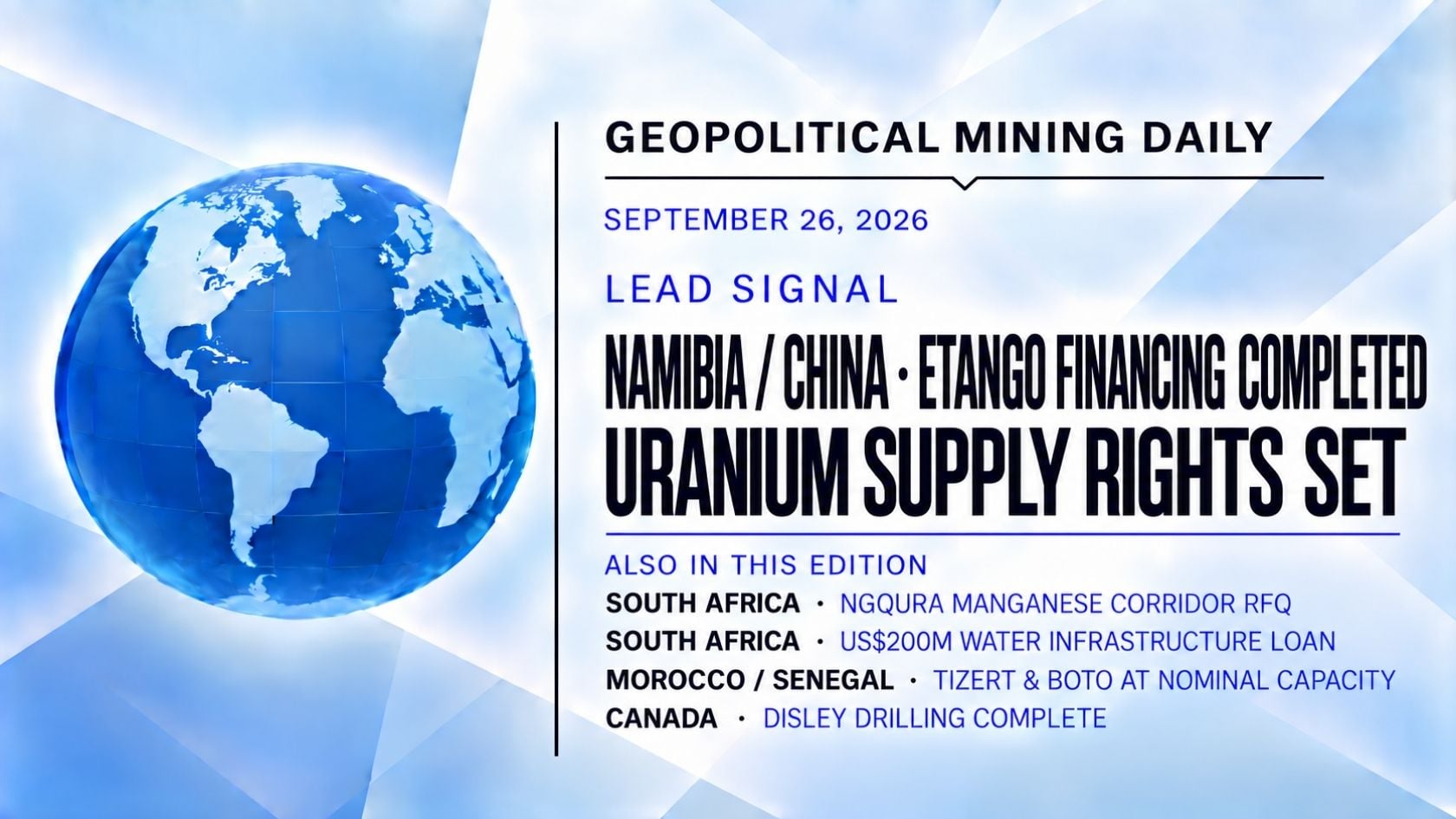

Geopolitical Mining Daily · September 26, 2026
Namibia/China: Etango Financing and Uranium Supply Arrangement
Bannerman has completed the US$320.4 million CNOL transaction for Etango, connecting project funding, joint venture governance and rights to future uranium production. The wider edition follows manganese export infrastructure, shared water investment, two African mines reaching nominal capacity and the transition at Disley from installed wells toward operating tests.
Etango moves from a strategic financing agreement to cash received and an operating joint venture structure, while its final investment decision remains ahead. South Africa opens a partner selection process for its manganese export corridor and signs a sovereign loan for shared water infrastructure. Managem reports that Tizert and Boto reached nominal production capacity during the first half of 2026. Buffalo completes Disley drilling, with brine circulation still to test the operating concept. The GM reading asks what each investment actually secures: ownership, infrastructure, product rights or demonstrated operating capability.
The GM observation framework
The ten Signals
Each Daily uses the same ten strategic lenses. The highlighted dimensions connect today’s five developments with the wider mining system.
Today’s direction of travel
Capital becomes strategically meaningful through the rights and capabilities it creates. Today’s evidence ranges from ownership and future uranium supply to export logistics, shared water infrastructure and operating tests. The useful question is what has become available in practice, and what still has to be built, demonstrated or decided.
Lead development
Bannerman completes Etango financing and uranium supply arrangement with CNOL
What happened
Bannerman Energy announced on September 25 that its strategic investment and joint venture transaction with CNNC Overseas Limited (or CNOL; CNNC: China National Nuclear Corporation), had completed on September 24. CNOL paid aggregate cash proceeds of US$320.4 million: US$294.5 million into Bannerman Energy UK, the joint venture company, and US$25.9 million to Bannerman as reimbursement for eligible Etango expenditure. [1]
CNOL now owns 45% of the joint venture company, which owns 95% of Etango. On the project’s economic ownership, Bannerman reports 52.25% for itself, 42.75% for CNOL and 5% for the One Economy Foundation on a loan carried basis. CNOL is entitled to purchase 60% of actual lifetime yellowcake production on market based terms, while Bannerman markets the remaining 40%. A full form offtake agreement remains to be completed before production. [1]
The governance structure is not identical to the ownership split. Bannerman appoints three of the five joint venture directors, while specified strategic decisions require unanimous approval. Future funding obligations are generally shared according to the partners’ 55% and 45% interests. Bannerman continues to target a final investment decision and commencement of full scale construction in Q4 2026. Those decisions have not yet occurred. [1]
Signal reading
Etango shows how a financing transaction can allocate several different forms of control at once. Economic ownership, board representation, veto rights over major decisions and access to future production do not sit in exactly the same proportions. The strategic significance therefore lies in the complete arrangement rather than the investment amount alone. Funding has reached the project structure, but the next threshold is whether the partners formally commit that capital to full scale construction and then convert it into operating uranium supply.
The GM questions
Control and future supply. Which decisions require unanimity and how would those rights operate if costs, timing or the development plan change? How much commercial flexibility remains around the 40% of production marketed by Bannerman? The offtake structure should also be followed through product specifications, delivery points, pricing mechanics and customer obligations once the full agreement is documented.
Capital after completion. What expenditure is covered by the cash now inside the joint venture, and what additional funding could still be required through construction, ramp up and working capital? How will future calls be allocated between the partners? Completion resolves a major funding step, but construction readiness still depends on the final investment decision, contracts, procurement and execution.
Next proof point: Etango FID, full scale construction commitments, major contract awards, the full form offtake agreement, updated funding requirements and evidence that the project remains funded through ramp up.
[1] Bannerman Energy: exchange announcement · September 25, 2026
Completion of CNOL strategic financing transaction, ownership, governance and offtake terms.Infrastructure and market access
Transnet opens partner selection for the Ngqura manganese export corridor
What happened
Transnet’s official media register lists a September 25 announcement that the state owned logistics group had issued a Request for Qualification to begin selecting a private sector partner for the Ngqura Manganese Export Corridor project. The corridor connects the Hotazel mining area in the Northern Cape with the ports serving the Eastern Cape and is the principal export route for South African manganese. [2] [3]
The new milestone is the start of partner selection. It is not a signed concession, completed financing or additional export capacity already in service. In this edition, GM does not reproduce capital cost, concession duration or capacity estimates from secondary reporting because the detailed RFQ document was not recovered for direct review. [2]
Signal reading
A mineral resource becomes commercially accessible through the infrastructure that moves product from mine to customer. The partner selection therefore matters because financing, operating responsibility and access terms can affect how much manganese reaches export markets and at what cost. The strategic question is not only whether capacity expands, but how the corridor is governed and which producers can use it.
The GM questions
Access and commitments. What long term volume commitments would a partner or producers need to make? How would rail and terminal capacity be allocated between established exporters and smaller producers? Which performance obligations would connect mine dispatch, railway availability and port handling?
Infrastructure and value capture. Who finances construction and rehabilitation, who operates the assets and how are costs recovered? Does the project principally improve bulk ore exports, or could its design accommodate additional product forms over time? Those questions require the procurement documents and eventual proposal terms, rather than inference from the existence of the corridor.
Next proof point: The detailed RFQ and bidder requirements, qualified participants, proposal stage, funding structure, access and performance rules, final partner selection and signed implementation agreements.
[2] Transnet: official media centre · September 25, 2026
Official listing of the Ngqura Manganese Export Corridor strategic partner RFQ.[3] Transnet Freight Rail: official corridor background
Cape Corridor and manganese export route background.Shared infrastructure and development finance
South Africa signs US$200 million loan for shared Olifants water infrastructure
What happened
South Africa’s National Treasury announced on September 25 that the government and the New Development Bank had signed a US$200 million sovereign loan agreement for Stage 1 of the Olifants Management Model Program. The loan finances the public sector contribution to a public private water infrastructure programme in Limpopo. Its disclosed terms are an 11 year tenor, including a three year grace period, at daily SOFR plus 0.985%. [4]
The scheme will abstract water from Flag Boshielo Dam and provide bulk raw water to industrial users while feeding treatment works that supply potable water to communities in Mogalakwena Local Municipality. National Treasury identifies private sector industrial users as participants represented by the Badirammogo Water User Association. The sovereign loan is therefore not a US$200 million payment to mining companies. [4]
NDB’s project documentation identifies pipelines, pump stations, storage infrastructure and two water treatment works with combined design capacity of 49 million litres per day. It lists the Department of Water and Sanitation and Badirammogo Water User Association as implementing entities and targets project completion by the end of 2028. [5]
Signal reading
This project provides a useful case of infrastructure serving productive activity and public needs through the same system. The mining relevance does not come from treating community water as an input to industry. It comes from understanding how a shared network allocates capital, capacity, operating responsibility and service obligations between users with different needs.
The GM questions
Allocation and resilience. How are construction costs, tariffs and long term commitments divided between the public contribution and industrial users? What priority rules apply in periods of water scarcity, and how are those rules reflected in contracts, system design and reporting?
From bulk infrastructure to service. Which entities operate and maintain the raw water network and which are responsible for potable water delivery? What must be funded after construction to maintain reliability, treatment quality and pumping capacity? The strategic test is whether both industrial supply and community service can be sustained after the assets are commissioned.
Next proof point: Financial close mechanics, procurement and construction awards, tariff and user commitments, progress on the treatment works and pipelines, and measurable service performance as the system is commissioned.
[4] South African National Treasury: media statement · September 25, 2026
Signed US$200 million loan, programme purpose and financing terms (PDF).[5] New Development Bank: project documentation
Project components, implementing entities and completion target.Operating delivery
Managem reports Tizert and Boto at nominal production capacity
What happened
Managem’s September 25 half year results report says that the Tizert copper mine in Morocco and the Boto gold mine in Senegal reached nominal production capacity during the first half of 2026. Both projects had entered production previously, so the new evidence is the company’s reported operating threshold during the reporting period rather than first production on September 25. [6]
The company attributes the increase in group revenue and earnings partly to the contribution from the two mines and partly to stronger metal prices. It also reports lower silver production at Imiter and lower gold production at Tri K due to operating difficulties. The group level improvement therefore should not be treated as uniform operating progress across every asset. [6]
Signal reading
Reaching nominal capacity is more informative than announcing a first pour or first concentrate, but it still needs definition. A credible operating assessment asks what rate was achieved, for how long, with what recovery, product quality and unit cost. It should also distinguish the contribution of additional physical output from the effect of commodity prices on reported financial performance.
The GM questions
Operating credibility. What does nominal capacity mean at each mine and how long was that level sustained? How do actual throughput, recovery, grade reconciliation, maintenance and costs compare with the development plan? Which metrics show that the operations can repeat the performance rather than achieve it briefly?
Capability across the portfolio. Which commissioning and operating practices from Tizert and Boto can be transferred elsewhere, and which are site specific? The same results release reports difficulties at other operations, providing a useful reminder that portfolio scale does not eliminate asset level execution risk.
Next proof point: Asset level production, recovery, unit cost and maintenance metrics, sales volumes and subsequent quarterly evidence that nominal performance is being sustained.
[6] Managem: half year results release · September 25, 2026
H1 2026 results and operating update for Tizert, Boto and the wider portfolio (PDF).Technology and commissioning development
Disley completes drilling and moves toward brine circulation tests
What happened
Buffalo Potash announced on September 25 that it had completed the third and final horizontal well at the Disley Initial Production Module. All five wells are now drilled: two vertical wells and three horizontal wells. Each horizontal lateral made contact with approximately 95% of the target clay seam, with packer systems installed as planned. That percentage measures placement within the target pathway; it is not a potash recovery result. [7]
The next phase is completion and equipping of the wells, well clean up and testing communication between the packers before brine circulation. Buffalo then intends to establish pressure communication and create the solution mining plane before moving into site development and surface processing. The initial module is designed for 125,000 tonnes per year and targets first production in Q1 2027. [7]
The company again cautions that its production decision is not based on a feasibility study establishing mineral reserves and economic and technical viability. Its Horizontal Line Drive method has not operated at commercial scale. Completion of drilling therefore demonstrates installed subsurface infrastructure, not commercial performance. [7]
Signal reading
Disley is moving from construction evidence into operating evidence. The important transition is whether the installed wells can communicate hydraulically, create the intended dissolution surface and deliver brine with the concentration and flow required by surface processing. Those results will determine whether the physical system behaves as the development concept assumes.
The GM questions
From placement to performance. What pressure, flow and communication results will define a successful circulation phase? What brine concentration and production rate are necessary to support the surface plant? How quickly can those conditions be established and repeated?
Scaling the method. What data from the initial module are required before committing capital to subsequent modules? How would water, energy, disposal and processing requirements change if the project moves toward the larger development concept? The first production target should be followed through measured operating data rather than design capacity alone.
Next proof point: Well clean up, pressure communication, brine circulation data, potassium concentration, flow rates, surface processing installation and measured performance during initial production.
[7] Buffalo Potash: company release · September 25, 2026
Final horizontal well, complete drilling programme and next brine circulation phase.The system reading
What today’s evidence tells us
Today’s five developments show that access to a mineral system is built through different instruments. Etango combines capital, governance and long term product rights, but still awaits the decision that commits the project to full scale construction. The Ngqura corridor moves export infrastructure into partner selection, where access and operating terms will matter as much as nominal capacity. The Olifants programme finances a shared water system whose credibility will depend on sustained service to both communities and industry. Managem reports operating thresholds at two mines, while Disley moves into tests that must show whether installed infrastructure can perform as designed. These developments should not be counted on one scale of progress. The GM reading follows what each step makes available: money, authority, logistics, water, operating output or technical evidence. Durable supply emerges only when enough of those capabilities work together.
The GM Signals provide the framework. The Daily follows evidence across mining, capital, institutions and industrial supply, separating announced steps from the outcomes that still need to be established.