
Geopolitical Mining · Geopolitical Milestones
Arsenal-2 Submarine Shipyard Expands U.S. Industrial Base
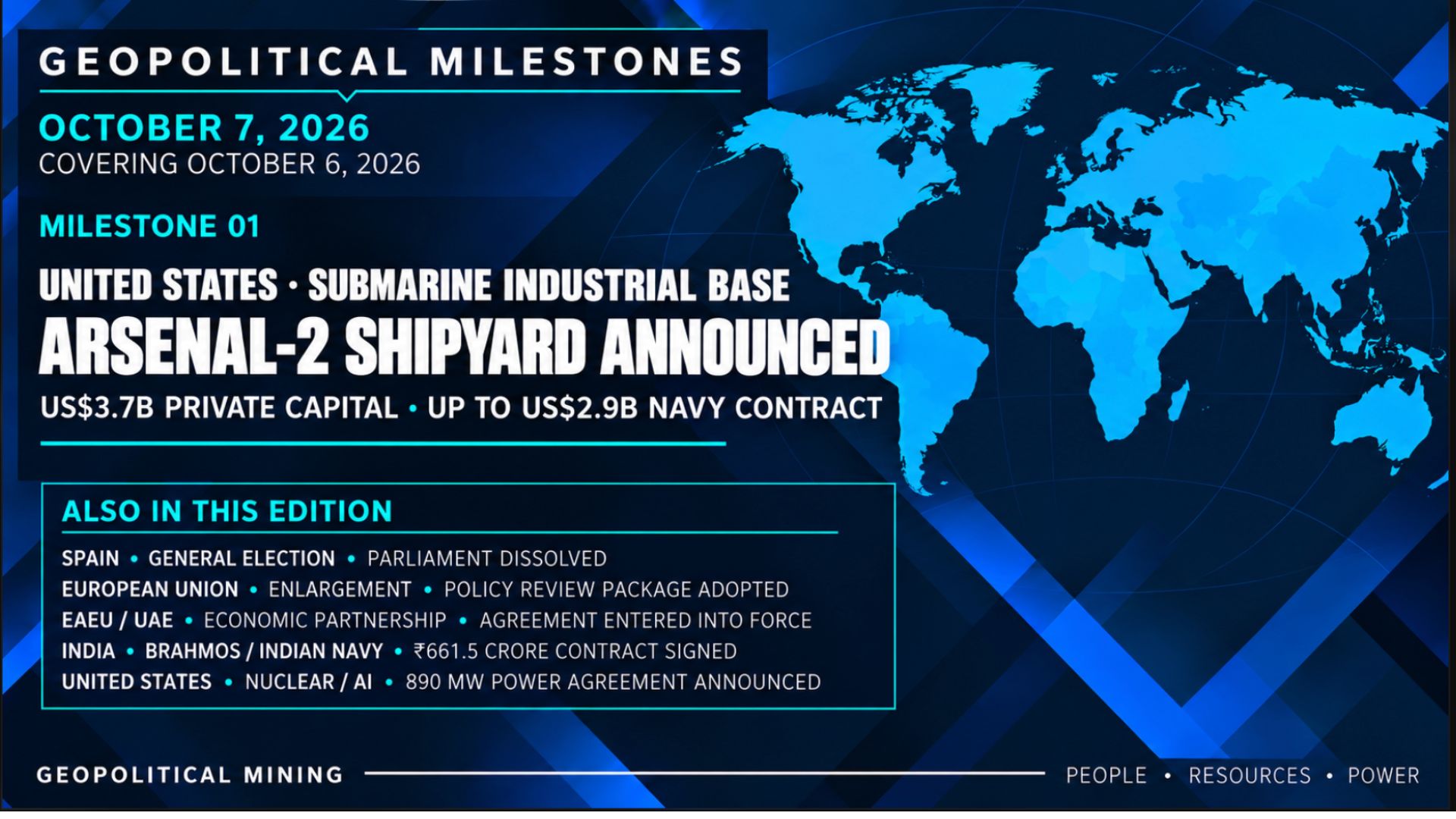
The Arsenal-2 submarine shipyard was announced on October 6 with US$3.7 billion of private capital from Anduril and a separate U.S. Navy contract worth up to US$2.9 billion to expand Virginia-class submarine production capacity. Also in this edition: Spain’s parliament was formally dissolved for a November election, the European Commission adopted its pre-enlargement policy review package, the EAEU-UAE Economic Partnership Agreement entered into force, India signed a BrahMos naval procurement contract and Google and Constellation agreed a major nuclear-power expansion tied to AI and grid demand.
Also in this edition: Spain’s formal election call, the EU’s pre-enlargement policy package, the EAEU-UAE economic partnership entering into force, India’s BrahMos naval procurement and an 890 MW U.S. nuclear uprate agreement linked to growing digital and AI demand.
Defence industrial capacity, shipbuilding and undersea power
Arsenal-2 adds new capacity to the U.S. submarine industrial base
President Donald Trump announced Arsenal-2 on October 6, a planned software-defined shipyard at Sparrows Point in Baltimore County, Maryland. Anduril Industries committed US$3.7 billion in private capital to the project. Maryland officials said the two million-square-foot facility is expected to support more than 14,000 jobs, including more than 3,100 permanent positions.
Separately, Anduril said the U.S. Navy awarded the company a contract worth up to US$2.9 billion, with payments tied to demonstrated production outcomes. Arsenal-2 is designed to manufacture critical components and large-scale assemblies for Virginia-class submarines and deliver them to General Dynamics Electric Boat and Huntington Ingalls Industries’ Newport News Shipbuilding for final assembly. Permitting and site preparation are due to begin immediately, with initial operations expected in 2030.
Electoral transition, parliamentary dissolution and political continuity
Spain dissolves parliament and formally calls a November general election
Spain’s Official State Gazette published Royal Decree 806/2026 on October 6. The decree dissolved the Congress of Deputies and the Senate elected in July 2023 and formally called elections to both chambers for Sunday, November 29, 2026. The decree entered into force on the day of publication.
The legal timetable sets a 15-day campaign from November 13 through November 27 and schedules the constitutive sessions of the new chambers for December 23. Prime Minister Pedro Sánchez had announced the early election on October 5; October 6 is the date on which the dissolution and election call acquired legal effect through publication in the BOE.
Boletín Oficial del Estado · Head of State
Royal Decree 806/2026 dissolving the Cortes and calling elections · October 6, 2026Enlargement, institutional reform and strategic governance
European Commission adopts pre-enlargement policy review package
The European Commission adopted a package of pre-enlargement policy reviews on October 6 to prepare EU governance, policies and the budget for future accessions. The package proposes stronger sectoral safeguards and a new institutional safeguard clause for future accession treaties. It also sets out a more structured model for candidate countries to participate in selected EU policies before membership, with participation remaining merit-based, conditional and reversible.
The Commission also advocates wider use of qualified-majority voting, including for opening negotiating clusters and other intermediary accession decisions, and continued use of passerelle clauses in areas such as sanctions, tax fraud and fiscal measures in energy policy. For Ukraine, the review says targeted arrangements should significantly limit financial support and market access for sensitive agricultural products while supporting access to traditional third-country export markets.
European Commission · Enlargement and Eastern Neighbourhood
Preparing for a wider Union · October 6, 2026Trade architecture, Eurasian integration and Gulf connectivity
EAEU-UAE Economic Partnership Agreement enters into force
The Economic Partnership Agreement between the Eurasian Economic Union, its member states and the United Arab Emirates entered into force on October 6, 2026. The agreement had been signed on June 27, 2025 in Minsk. According to Emirates News Agency (WAM), preferential treatment will apply to more than 86% of tariff lines, representing roughly 96% of existing bilateral goods trade.
The framework includes cooperation on customs and economic matters, online commerce and support for smaller businesses trading internationally. WAM described measures to simplify trade processes and remove needless obstacles, with opportunities spanning manufacturing, agriculture, logistics, vehicles, technology and precious metals.
Emirates News Agency (WAM) · EAEU-UAE Economic Partnership
EAEU-UAE Economic Partnership Agreement enters into force · October 6, 2026Naval capability, defence indigenisation and industrial capacity
India signs BrahMos fire-control and launcher contract for naval ships
India’s Ministry of Defence signed a ₹661.50 crore contract with BrahMos Aerospace on October 6 for BrahMos fire-control systems and launchers for Indian Navy ships. The procurement is being made under the Buy (Indian-IDDM) category and carries a minimum indigenous-content requirement of 68%.
The ministry describes BrahMos as the Indian Navy’s primary surface-to-surface missile system on frontline warships for maritime strike missions against land and sea targets. The new contract therefore extends procurement of the launch and fire-control architecture around an established naval weapon system while directing a large share of the industrial content to Indian suppliers, including smaller manufacturers.
Government of India · Ministry of Defence
MoD signs ₹661.50 crore BrahMos fire-control and launcher contract · October 6, 2026Nuclear power, AI infrastructure and grid capacity
Google and Constellation link AI growth to 890 MW of new nuclear capacity
Google and Constellation Energy announced a 20-year power purchase agreement on October 6 designed to enable 890 MW of additional nuclear capacity across 11 existing Constellation units in Illinois, Pennsylvania and New Jersey. The companies said the uprates would support more than US$4.3 billion of new investment by Constellation, with the first incremental capacity expected in 2028.
The wider arrangement also includes a 15-year energy-supply agreement covering an additional 2,700 MW in the PJM fleet and an expanded five-year technology alliance. Constellation plans to deploy Google Cloud and Gemini Enterprise in areas including site selection, power-flow modelling, outage management and protection of operational-technology networks. The structure links hyperscale digital demand with investment in existing nuclear assets and grid operations.
Google Cloud · Constellation Energy
Google and Constellation announce 890 MW nuclear capacity agreement · October 6, 2026Continue reading Geopolitical Mining. Explore our daily mining coverage, weekly reviews and country analysis.