Geopolitical Mining · Geopolitical Milestones
Abu Dhabi Declaration, Canada Strategic Autonomy and Gulf Security at UNGA
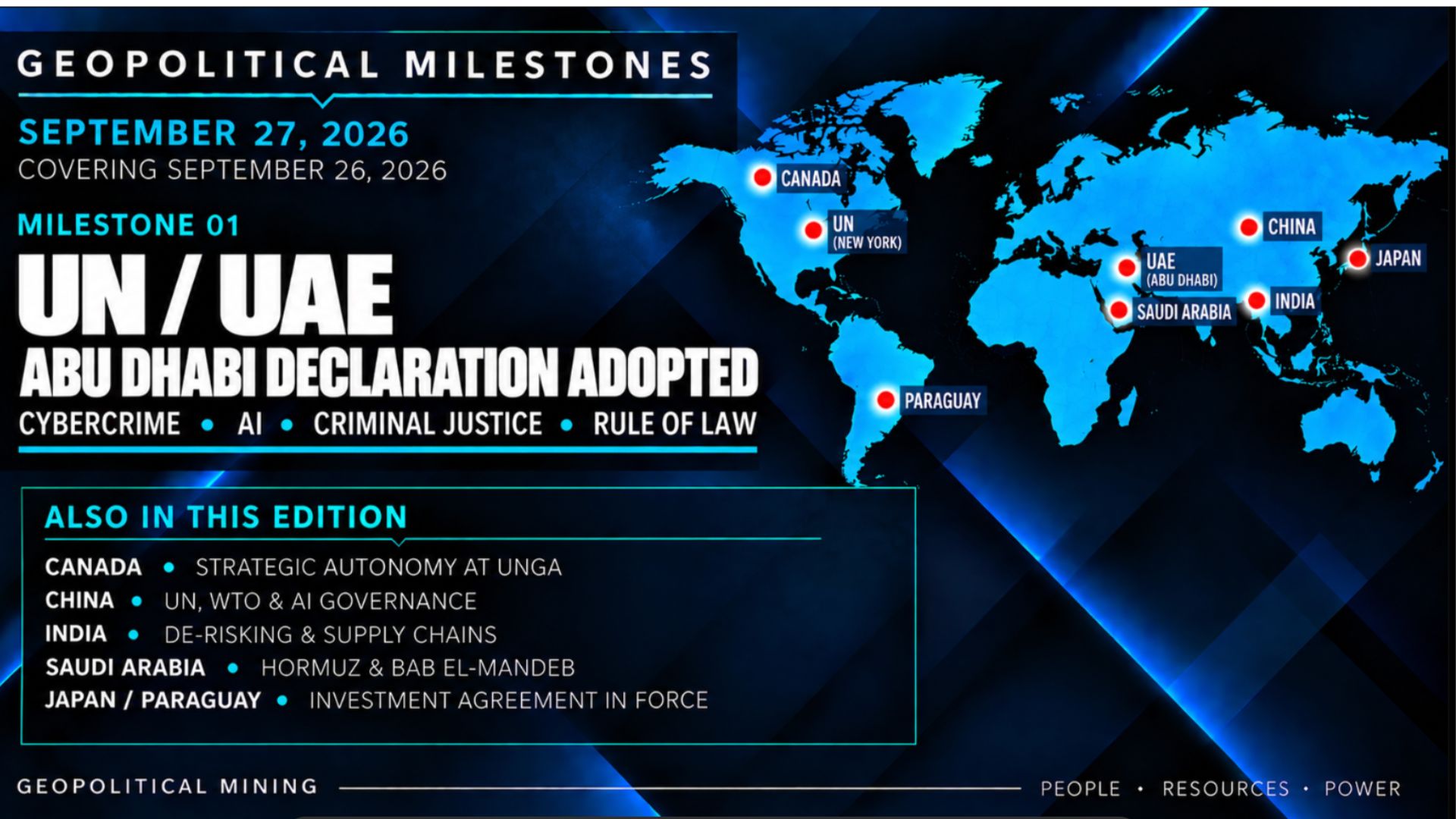
September 26 brought adoption of the Abu Dhabi Declaration on crime and justice in the digital age, national statements from Canada, China, India and Saudi Arabia that set out competing approaches to strategic autonomy, multilateralism, supply chains and maritime security, and the entry into force of the Japan-Paraguay Investment Agreement.
Also in this edition: Canada’s strategic-autonomy doctrine, China on UN and WTO reform, India on de-risking and supply chains, Saudi Arabia on Hormuz and Bab el-Mandeb, and the Japan-Paraguay investment treaty entering into force.
Global crime governance and digital security
UN Crime Congress adopts Abu Dhabi Declaration for the digital age
Member States adopted the Abu Dhabi Declaration by acclamation on September 26 at the opening of the 15th United Nations Congress on Crime Prevention and Criminal Justice. The framework addresses cybercrime, fraud, organised crime and the growing criminal exploitation of digital services, infrastructure and emerging technologies.
The declaration also supports greater use of digital tools and artificial intelligence in justice systems while calling for safeguards including human oversight, transparency, due process and data protection. UNODC is to support implementation, including through the voluntary Pledge4Justice initiative for concrete and time-bound national actions through 2031.
United Nations · UN Crime Congress
Countries adopt global blueprint to tackle fast-evolving crime in digital age · September 26, 2026Foreign policy, strategic autonomy and multilateralism
Canada sets out strategic-autonomy doctrine and issue-based coalition approach at UNGA
Foreign Minister Anita Anand used Canada’s September 26 national statement to the UN General Assembly to describe the international order as undergoing a rupture and to set out a strategy of greater strategic autonomy, economic and diplomatic diversification, and issue-based coalitions among small states, middle powers and major powers.
The statement linked that approach to stronger Canadian capabilities in emerging technologies, critical minerals, defence production and energy. Anand also highlighted the Partners for Multilateralism initiative, Arctic security, support for Ukraine, responsible artificial intelligence, maritime security and Canada’s effort to diversify relationships across Europe, the Indo-Pacific, the Gulf, Africa and Latin America.
United Nations General Debate · Canada
Canada national statement to the 81st UN General Assembly · September 26, 2026Global governance, trade and technology
China backs UN-centred order, WTO system and inclusive AI development at UNGA
Vice President Han Zheng told the UN General Assembly on September 26 that China supported the UN-centred international system and called for disputes to be managed through dialogue, stronger representation for the Global South and reform that strengthens rather than simply reduces UN bodies and mandates.
Han also defended the WTO-centred trading system, rejected protectionism and called for people-centred artificial intelligence that narrows the digital divide. On development, he pointed to the Global Development Initiative and called for greater attention to poverty reduction, food security and energy transition.
United Nations General Debate · China
China national statement to the 81st UN General Assembly · September 26, 2026Economic security, supply chains and multipolarity
India warns that finance, market access, supply chains and technology are being weaponised
External Affairs Minister Subrahmanyam Jaishankar told the UN General Assembly on September 26 that conflict and geopolitical pressure were imposing costs on countries far from the battlefield and argued that finance, market access, supply chains and technology were increasingly being used as instruments of competition and coercion.
India linked that environment to growing emphasis on de-risking and diversification and highlighted the burden on the Global South from food, fuel, fertiliser and financing shocks. Jaishankar also called for uninterrupted energy and commercial flows through Gulf waterways, a two-state solution in the Middle East and adjustment of global institutions to a more multipolar distribution of power.
United Nations General Debate · India
India national statement to the 81st UN General Assembly · September 26, 2026Gulf security, energy and strategic waterways
Saudi Arabia links Gulf security to global energy, trade and supply chains
Saudi Foreign Minister Prince Faisal bin Farhan told the UN General Assembly on September 26 that the security of the Gulf was inseparable from international stability, global energy security, trade and supply chains. He highlighted the Strait of Hormuz, Bab el-Mandeb, the Red Sea and Gulf of Aden as vital international waterways.
Saudi Arabia called for freedom of navigation and for conditions in Hormuz to return to those prevailing before February 28 without additional fees or restrictions. The minister also backed regional de-escalation, a region free of weapons of mass destruction and an energy transition that combines security of supply with climate objectives.
United Nations General Debate · Saudi Arabia
Saudi Arabia national statement to the 81st UN General Assembly · September 26, 2026Investment protection and bilateral economic relations
Japan-Paraguay Investment Agreement enters into force
The Agreement between Japan and Paraguay for the Promotion and Protection of Investment entered into force on September 26 after both governments completed the required domestic procedures. The agreement had been signed on December 5, 2025.
Japan’s Ministry of Foreign Affairs said the agreement establishes comprehensive rules for the promotion and protection of bilateral investment and is intended to support greater investment flows and broader economic relations between the two countries.
Ministry of Foreign Affairs of Japan · Investment agreement
Entry into Force of the Japan-Paraguay Investment Agreement · September 26, 2026Continue reading Geopolitical Mining. Explore our daily mining coverage, weekly reviews and country analysis.