Geopolitical Mining · Article
When Mining Becomes Geopolitical, the State and Diplomacy Must Change
Authors: Marta Rivera and Eduardo Zamanillo
The mining we once knew is no longer enough to explain the present. For a long time, mining was treated as an extractive activity that supported the real centres of economic life from the background. It supplied materials, generated exports, and fed industrial systems that were discussed elsewhere in the language of finance, trade, energy or technology. Even where mining was recognised as important, it was rarely placed near the core of strategic thinking.
That has changed. What has returned to the centre of world politics is something more basic and more demanding: material power. States are once again being forced to think not only about markets, innovation and capital, but about the physical systems that sustain industrial life, minerals, energy, infrastructure, logistics, processing capacity and territorial continuity. Once that shift takes place, mining can no longer remain a sectoral issue. It becomes part of statecraft.
That is the transition we describe through the idea of Geopolitical Mining.
The real shift is not only in the mine
The turning point did not come simply from rising demand for critical minerals. It came from the growing recognition that extraction alone no longer defines power. The decisive issue is who can process, refine, standardise and move materials through the chain at scale. Once these capabilities become highly concentrated, minerals stop behaving like ordinary commodities. They become leverage.
This is why mining has become geopolitical. In practical terms, the shift produces three consequences. First, it creates structural vulnerability in countries that depend on materials they do not control. Second, it gives whoever dominates the midstream the power to shape timing, standards and market rhythm. Third, it creates political leverage, because strategic materials can now be managed through quotas, licensing, export restrictions and other instruments of policy. What recent years have done is make this structure visible.
China anticipated the shift
In many ways, China understood this earlier than the rest. While much of the world still thought of mining as a sector and of power in terms of oil, trade or finance, China treated minerals as part of state strategy. It did not separate extraction from refining, refining from manufacturing, or manufacturing from national positioning. It built an integrated architecture around them.
This is what makes the Chinese case so revealing. The key was not geology alone. It was strategic coherence. China understood that the real advantage would depend less on having ore in the ground than on controlling the industrial and chemical capabilities built around it. That insight, sustained over time, helped place China at the centre of multiple critical mineral chains.
There is also another dimension to the Chinese case that matters: adaptability. In its relations with countries in Africa and Latin America, China has often shown a strong ability to adjust to what counterparties are actually asking for, whether that means infrastructure, financing, processing capacity or technology transfer. This matters because it shifts part of the question back to the producing country itself. The terms of the relationship are shaped not only by what China wants, but by what the producing country is able and willing to negotiate.
China’s advantage, then, has not only been scale. It has been continuity and adaptability within a coherent strategic frame.
The West lost coherence before it lost relevance
The Western problem is deeper than dependence alone. The West did not lose ground because it lacked minerals, technology or capital. It lost coherence. Mining gradually lost symbolic weight, strategic urgency and political clarity. Regulation multiplied, permitting slowed, narrative weakened, and industrial depth moved elsewhere. In that environment, mining became harder to defend, slower to build, and less attractive to capital and talent.
That is why the issue today cannot be reduced to supply risk alone. It is also a question of strategic disconnection. The same societies that speak about energy transition, technological leadership and industrial resilience often remain uneasy about the extractive and industrial foundations that make those ambitions possible.
This is where the United States becomes especially revealing.
The United States is making the shift explicit
More recently, the United States has made this logic explicit and institutional. Under President Trump, and with figures such as Marco Rubio giving it unusually clear political expression, critical minerals have moved from being recognised as a vulnerability to becoming part of a broader organising principle for industrial policy, economic security and alliance architecture. More than that, the pace of the American response has become a signal in itself. Strategy, capital, policy tools, stockpiles, trade design and alliance building have begun to align with unusual speed.
So if China anticipated the shift, the United States is now helping to consolidate it in strategic language and public policy.
This matters because it makes visible a broader historical transition: the return of material power to the centre of strategy. Once that happens, mining enters a different category. It becomes part of how states think about sovereignty, resilience, industrial capacity and geopolitical position. That is why the role of the State has to change.
Strategic mining requires a strategic State
If mining is now geopolitical, then the State can no longer remain a spectator. This does not mean that the State must necessarily become the direct operator of mines. The more important role lies elsewhere. In this new context, the State acts as a strategic enabler of mining. It coordinates, facilitates, accelerates, de-risks and legitimises. It creates the conditions under which formal mining can actually move forward.
That involves more than regulation. It means workable permitting systems, infrastructure support, financial alignment, institutional coordination and a clearer connection between mining policy and broader industrial priorities. It means treating mining as part of a national development architecture rather than as a narrow extractive file.This also changes diplomacy.
Diplomacy now has to understand mining differently
As mining moves closer to the centre of industrial resilience, technological competition and alliance building, diplomats can no longer treat it as a narrow sectoral topic. Mining is increasingly part of how states think about supply security, strategic autonomy, industrial depth and long term resilience. Once that happens, diplomacy also has to change its lens.
For a long time, mining sat outside the main language of foreign policy. It was often treated as a commercial or technical issue, relevant to trade ministries, sector specialists or investors, but not always to the broader architecture of statecraft. That separation is becoming harder to sustain. Today, minerals sit inside a much wider strategic field: they shape defence systems, data infrastructure, energy security, manufacturing capacity and the resilience of allied industrial networks. When those systems become exposed, mining stops being a background issue and enters the front line of diplomacy.
This changes the practical work of diplomacy in several ways. First, diplomacy is increasingly involved in securing access not only to deposits, but to the full architecture around them: processing capacity, logistics corridors, ports, infrastructure reliability, refining partnerships and long term supply agreements. The strategic question is no longer simply where the resource is located. It is whether the wider chain around it is politically stable, technically viable and institutionally reliable.
Second, diplomacy now plays a larger role in shaping the alliances through which mining systems operate. No country controls the full chain alone. Strategic resilience depends on trusted networks across extraction, refining, transport, technology, finance and standards. This means mineral diplomacy is no longer only about securing raw material flows. It is also about building aligned ecosystems: who processes, who finances, who provides technology, who hosts infrastructure, and under which rules the chain will function.
This also has implications for the composition of diplomacy itself. Because mining is a technically complex industry, states increasingly need diplomatic capacity that is not only political, but also technical. Mining diplomacy cannot rest on general language alone. It requires closer interaction with engineers, geologists, processing specialists and other experts who understand how projects are built, where bottlenecks emerge, how infrastructure and permitting interact, and how mineral systems connect to industrial strategy in practice. In this setting, effective diplomacy depends not only on negotiation, but on the ability to integrate technical depth into strategic decision-making.
Third, diplomacy increasingly intersects with legitimacy. Mining is no longer discussed only in terms of output and investment. It is now discussed in terms of traceability, environmental credibility, social licence, territorial stability and community acceptance. That means diplomats need to understand not only what minerals are needed, but under what political, social and institutional conditions projects can actually endure. In this new setting, legitimacy is not a reputational accessory. It is part of strategic reliability.
Fourth, diplomacy also has to respond to new forms of strategic vulnerability. Concentrated supply chains, export restrictions, unstable corridors, illicit extraction, weak territorial control and opaque midstream arrangements are no longer peripheral concerns. They are becoming part of economic statecraft. A mineral chain is only as secure as the legal, territorial and political order that sustains it. This is why diplomacy increasingly needs to read mining not only through trade and investment, but also through risk, governance and strategic exposure.
This is especially important for the wider producing world. As minerals move closer to the centre of strategy, producer countries are no longer approached only as exporters of raw materials. They are increasingly read through a broader lens: regulatory coherence, institutional capacity, infrastructure readiness, standards, reliability and political continuity. In that sense, mining diplomacy is also becoming a diplomacy of positioning. Countries are not only negotiating over resources. They are negotiating over the role they will occupy inside a more contested industrial order.
This is one reason why the current moment matters so much. It is forcing states and institutions to think together about issues that had often been separated: extraction, industrial policy, supply security, legitimacy, infrastructure and alliances.
Still, even when the State understands the strategic importance of mining, a further question remains: what makes this new phase viable in practice?
Narrative, legitimacy and speed
This new phase only works if three conditions move together: narrative, social legitimacy and speed.
The first is narrative. Once mining becomes strategic, it also becomes political and symbolic. Societies need to understand what mining sustains and why it matters. In many countries, especially across parts of Europe and the broader West, the public understanding of mining has become narrower and weaker over time. Mining is often associated only with extraction, environmental cost, or, at best, with the energy transition.
The reality is broader. Mining is the material base of the life we already know. It underpins infrastructure, housing, transport, electricity networks, healthcare, manufacturing, telecommunications, food systems and education. Without formal mining, modern life cannot be sustained in any serious material sense.
The second is social legitimacy. This operates at two levels. One is broad social legitimacy: the extent to which society understands why mining matters at all. The other is territorial legitimacy: the level at which mining is actually lived. If a mine is present in a community, people will inevitably ask what it means for them, for their children and for the long term development of that place. They need to see that the benefits are real, visible and shared.
This is where our own Chilean experience has mattered to our thinking. When formal mining operates under serious structures, strong standards and long term investment, it can contribute not only to national growth, but also to local development and social mobility. Communities can see opportunity where otherwise there might only have been extraction.
The third condition is speed. In geopolitical mining, speed is not just an operational issue. It is a strategic variable. Countries now compete not only on geology, but on their ability to move from geology to permits, from permits to projects, and from projects to industrial capacity within a strategically relevant timeframe.
This is where much current rhetoric still collides with institutional reality. Many states now speak about critical minerals. Far fewer are able to align regulation, institutions, finance, infrastructure and social legitimacy quickly enough to build meaningful capacity.
When those conditions fail, disorder expands
If narrative is weak, legitimacy is fragile, and the State cannot move with enough clarity and speed to enable formal mining, the space rarely remains empty.
This is why illegal, highly informal and what we call anomic mining matter so much. By this we mean forms of extraction where legality, traceability, accountability and institutional control are weak or absent. Anomic mining is not only about illegality. It is also about institutional weakness.
It often expands where formal mining has not been made viable, legitimate and governable. In that sense, it is a warning sign. It signals that territorial control, public authority, legal pathways or social legitimacy are under strain.
This extends well beyond domestic governance. A supply chain is not truly secure if it rests on weak legality, unstable territorial conditions or persistent conflict around extraction. Once critical minerals become part of economic security and industrial resilience, anomic mining also becomes part of strategic vulnerability.
Different countries, different responses
What the current landscape shows is not one single model, but a field of strategic differentiation.
China reflects continuity and adaptability. The United States reflects speed and institutional consolidation. Indonesia shows what a more strategic producer can do when it negotiates for value capture rather than settling for raw material dependence. Argentina shows how geological opportunity becomes more strategically relevant when the State starts to accelerate the conditions for execution.
The deeper question, then, is no longer simply who has the minerals. It is which states are able to turn minerals into strategic relevance through institutions, negotiation, legitimacy and execution.
Mining, diplomacy and the new strategic moment
What is emerging is a world in which mining can no longer be treated as a background activity of the industrial economy. It is moving closer to the centre of strategic thought because the material foundations of modern life have become inseparable from questions of power, resilience, sovereignty and long term capacity.
That is why this moment matters beyond the mineral sector itself. It is not only changing how states think about extraction, processing and industrial policy. It is also changing how they think about diplomacy.
As minerals become more entangled with security, industrial depth, infrastructure, standards, logistics and legitimacy, diplomacy can no longer remain at a distance from mining. It increasingly becomes one of the arenas through which access is negotiated, alliances are shaped, trust is built, strategic exposure is managed and national positioning is defined.
In that sense, the real question is no longer simply whether mining matters. That part is becoming increasingly clear. The deeper question is whether states are prepared to treat mining as a strategic domain; whether diplomacy is prepared to engage with it as part of statecraft; and whether societies are prepared to understand that modern life, industrial resilience and geopolitical relevance all depend, at some level, on making formal mining viable, legitimate and governable.
This is why the shift matters so much. When mining becomes geopolitical, the State cannot remain passive, and diplomacy cannot remain external to the problem.
That, in our view, is the real significance of this new moment.
For board-level insight and decision support on mining, legitimacy and industrial strategy, visit Geopolitical Mining Advisory .
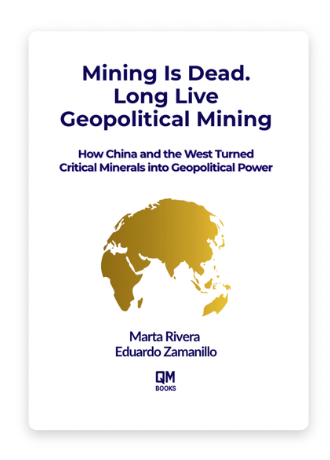
For the full Geopolitical Mining framework behind this article, see our book Mining Is Dead. Long Live Geopolitical Mining .