
Geopolitical Mining · Article
USA and Aligned Trading Partners, USTR Maps a Plurilateral Critical Minerals Deal
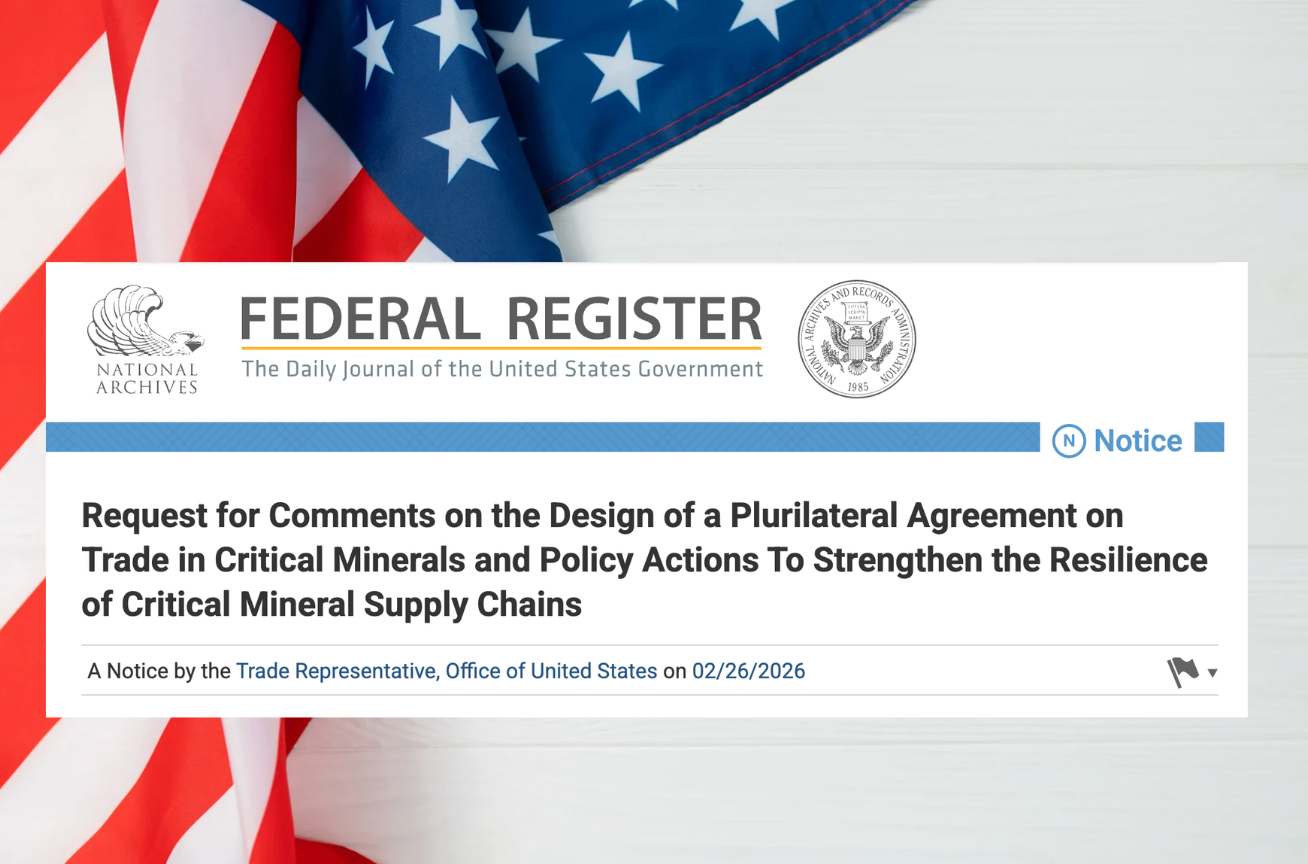
A new notice from the Office of the United States Trade Representative (USTR) invites public comments on a plurilateral agreement for critical minerals. It does more than call for technical input, it sketches how the United States is starting to redraw the rules of the game for the global minerals market.
1. What this notice actually says
In the Summary, USTR invites comments to inform the development of trade policy that supports and enhances the resilience of critical mineral supply chains and downstream industries that depend on them. The path to that resilience is framed in two steps: generating demand for market based production, and accelerating the build out of market based supply.
To get there, USTR asks for views on trade policies that would:
- increase the domestic availability of mined, refined and processed critical minerals,
- incentivise reshoring of mining, processing, refining and production of derivatives, and
- diversify sources of those minerals and their derivatives among like minded trading partners.
The notice then goes a step further. It explicitly raises the idea of a legally binding plurilateral agreement among aligned partners, and says USTR anticipates that such an agreement would include: a commitment by all parties to implement minimum prices or other price mechanisms, with appropriate border measures, to ensure secure and fairly priced markets among the parties to the agreement, in order to generate demand for critical minerals produced for market based investments.
It also asks for comment on which price mechanisms could enable investment and appropriate financial returns in mining, processing and refining, and on efforts to accelerate the build out of market based supply, including making sure that scrap flows into domestic production and that policies abroad do not undermine investment at home.
The Background section then situates this in a broader policy trajectory. It lists Executive Orders 14241, 14272 and 14285, plus Proclamations 10987 and 11001, all of which emphasise the vulnerabilities associated with U.S. dependence on foreign sources of critical minerals. It recalls that in Proclamation 11001 the President agreed with the Secretary of Commerce’s Section 232 finding that processed critical minerals and their derivatives are being imported in such quantities and under such circumstances as to threaten to impair the national security of the United States.
On that basis, the President directed the Secretary of Commerce and the U.S. Trade Representative to negotiate agreements with trading partners to adjust imports so that they no longer threaten to impair national security.
The notice then offers a compact diagnosis:
- Critical minerals include those essential for defence systems and for advanced technologies and applications across U.S. industrial sectors.
- The limited scope of domestic mining, processing, refining and production has created considerable U.S. import dependencies at every stage of critical mineral supply chains.
- The United States, like minded partners and private investors have already tried to increase production, but non market policies and practices have thwarted the financial viability of many projects, preventing them from becoming secure, market based sources of supply.
From there, USTR explains why it is evaluating new policy actions. One possible approach is precisely the plurilateral agreement floated in the Summary: an agreement on trade in critical minerals and downstream products with like minded partners, designed to:
- create investment incentives for expanding supply chains for selected minerals,
- determine pricing mechanisms that reflect market economy costs of production,
- reduce the coercive impact of non market policies and practices,
- and set standards that narrow or neutralise unfair regulatory arbitrages that reduce the competitiveness and attractiveness of projects in the parties’ jurisdictions.
The notice underlines a final point: each critical mineral has its own supply chain and market dynamics. Understanding those nuances is presented as a condition for any effective resilience policy. USTR also mentions that it is considering additional measures to improve price transparency, and that it is interested not only in non market policies, but also in other monopolistic and monopsonistic practices.
2. The questions USTR is putting on the table
After setting that context, the notice turns to “Topics on Which USTR Seeks Information”. The list is long, but it can be organised into a few core themes.
Scope and membership (Section A).
USTR asks how to prioritise which critical minerals (as defined by the U.S. Geological Survey) should fall within the scope of a plurilateral agreement, how they might be grouped (by market dynamics, supply chain structure, common participants, co-occurrence, geography), and how to avoid undermining the agreement when minerals co-occur but have different market structures. It also asks which trading partners should be considered for participation and what qualities they should exhibit.
Reference prices and price floors (Section B).
Here, USTR asks how target or reference prices should be calculated, how often they should be adjusted, how far they should reflect cost differences across markets, and how to ensure they support a reasonable, risk adjusted return.
Price enforcement and border measures (Section C).
This section explores the mechanisms by which parties could set minimum prices or otherwise secure a market price, and how to enforce those minimums for imports. USTR explicitly mentions tariffs (ad valorem, specific, compound), quotas and tariff rate quotas, price undertakings and other lawful mechanisms, and asks how to segment the value chain (mined, processed, finished products), how to treat downstream products, and how to restrict imports from non parties to establish a market based supply among members.
Regulatory arbitrage and standards (Section D).
USTR asks how a plurilateral should address regulatory arbitrage among parties and between parties and non parties, and whether there are specific regulatory requirements or standards that must be tackled to stabilise markets.
Investment rules and ownership (Section E).
This section asks whether there should be commitments on investment screening, investment policies and procedures (such as transparency, notification requirements, right of first refusal), and how to treat critical mineral assets and facilities that are located in a party’s territory but fully or partly owned by a non party, and vice versa.
Implementation, enforcement and circumvention (Section F).
Here USTR looks at how to decide on phase in periods for different minerals, how to address the development of grey or black markets for raw minerals and products that contain them, how to protect against circumvention, and how parties should monitor and enforce any breaches.
Coordination mechanisms (Section G).
The notice asks how to design mechanisms that allow parties to respond to externalities, dynamic market changes and crises; how to coordinate public and private scale up support (offtake agreements, financing); and how to mitigate disruptions or instability arising from natural disasters, geology, technological changes or other factors.
Reference agreements (Section H).
USTR invites examples of existing or historical plurilateral measures or agreements that could serve as useful references, explicitly mentioning the International Tin Agreement (1956) and asking whether its features and impact could inform the design of a critical minerals agreement.
Legal authorities of potential parties (Section I).
This section asks what legal procedures, tools or authorities other jurisdictions could use to implement price mechanisms or other measures, or to replicate the economic effects of such mechanisms.
Additional considerations (Section J).
Finally, USTR asks what other factors parties should take into account to create a resilient and non distorted marketplace among aligned trading partners, and what other trade related measures might be necessary to ensure adequate supply of all forms of critical minerals (including scrap and recyclable materials) and to prevent non market policies and practices from undermining that supply.
The notice closes by stressing that USTR welcomes ongoing engagement and that this request for comment should not be understood as the sole opportunity for interested parties to provide information.
3. How this reads from a geopolitical mining perspective
Taken together, the Summary, the Background and the list of questions do three things at once.
They anchor critical minerals firmly in a national security frame, using Section 232 language about a threatened impairment and linking it directly to imports of processed critical minerals and their derivatives. They normalise the idea that a subgroup of countries could coordinate prices and border measures among themselves, rather than relying solely on global market signals. And they acknowledge that the architecture is still being designed, by setting out the areas where USTR sees open questions and potential fault lines.
For anyone looking at mining through a geopolitical lens, this is striking. The notice is not about a single project, a single mineral or a single bilateral lane. It is about the possibility that critical minerals will move into a regime where:
- a subset of countries is treated as like minded and aligned,
- prices for certain minerals are anchored by reference mechanisms or minimums,
- border tools are used to enforce those price signals, and
- standards, investment rules and enforcement practices are coordinated to reduce arbitrage and instability.
In other words, it is about the early contours of a critical minerals club, even if that word never appears on the page.
4. How the United States is reading the critical minerals map
The way the notice is written also tells us a lot about how the United States currently sees the critical minerals landscape.
It sees a system where domestic capacities are limited and import dependencies are deep, precisely in minerals that are central to defence and advanced technologies. It sees a pattern in which projects in the United States and in other like minded jurisdictions struggle to become viable when they have to compete against output shaped by non market policies and practices. It sees a global price formation process that can be coercive and that can push market based projects out before they reach maturity.
It also sees that the problem is not only about tonnes, but about the conditions under which those tonnes are produced and traded. The repeated references to non market policies, unfair regulatory arbitrage, monopolistic and monopsonistic practices, and grey and black markets point to a picture where the difficulty is as much about how the game is played as about who has geological endowment.
Finally, it sees that not all critical minerals look the same. By explicitly noting that each mineral has its own supply chain and market dynamics, and by asking how to group them, how to segment value chains and where to apply price mechanisms, USTR is admitting that any future architecture will be messy, mineral by mineral, node by node. There will not be a single switch that can be turned on for critical minerals as a block.
From a geopolitical mining standpoint, this is the beginning of a new map. It is a map in which the coordinates are not only geography and geology, but also alignment, market structure, regulatory design, ownership and enforcement capacity. The notice is a first attempt to put those coordinates on paper and to ask others if they see the same fault lines, or different ones.
5. An open channel, and a moment to watch
Comments on this notice are due by 19 March 2026 and can be submitted through the USTR online portal under docket USTR-2026-0034 (“Request for Comments on the Design of a Plurilateral Agreement on Trade in Critical Minerals and Policy Actions to Strengthen the Resilience of Critical Mineral Supply Chains”). In the text, USTR refers broadly to interested persons and any interested party, and notes that this request for comments should not be understood as the sole opportunity to provide information, a deliberately open formula that signals an ongoing process and an invitation to contribute experience on critical mineral supply chains and markets.
From a geopolitical mining perspective, that openness is part of the signal. On one side, the notice makes clear that the United States is exploring a plurilateral framework with aligned trading partners, built around price mechanisms, border measures, standards and investment rules for critical minerals. On the other, it leaves room for those who work with these minerals every day (in projects, institutions and markets) to describe how this emerging framework looks from where they stand, while the design is still in motion.
The notice does not close the architecture of critical minerals; it begins to map the terrain: dependence, non market practices, price formation, regulatory gaps, ownership questions, grey markets, coordination in crises. How industry, producing countries and communities choose to respond to that map, by engaging with it or watching from a distance, will help determine how present their realities are when the next layer of this architecture is drawn.
https://www.govinfo.gov/content/pkg/FR-2026-02-26/pdf/2026-03868.pdf
For board-level insight and decision support on mining, legitimacy and industrial strategy, visit Geopolitical Mining Advisory .
For the full Geopolitical Mining framework behind this article, see our book Mining Is Dead. Long Live Geopolitical Mining .