
Geopolitical Mining · Davos 2026
Sixth Axis of Analysis. Fink and Musk: Legitimacy, AI and the Clock of Execution
Authors: Marta Rivera | Eduardo Zamanillo
This piece is part of our Davos 2026 analysis series at Geopolitical Mining. For the full framework behind our reading of these speeches, see “Davos 2026: Coordinates of the New Geopolitical Era” .
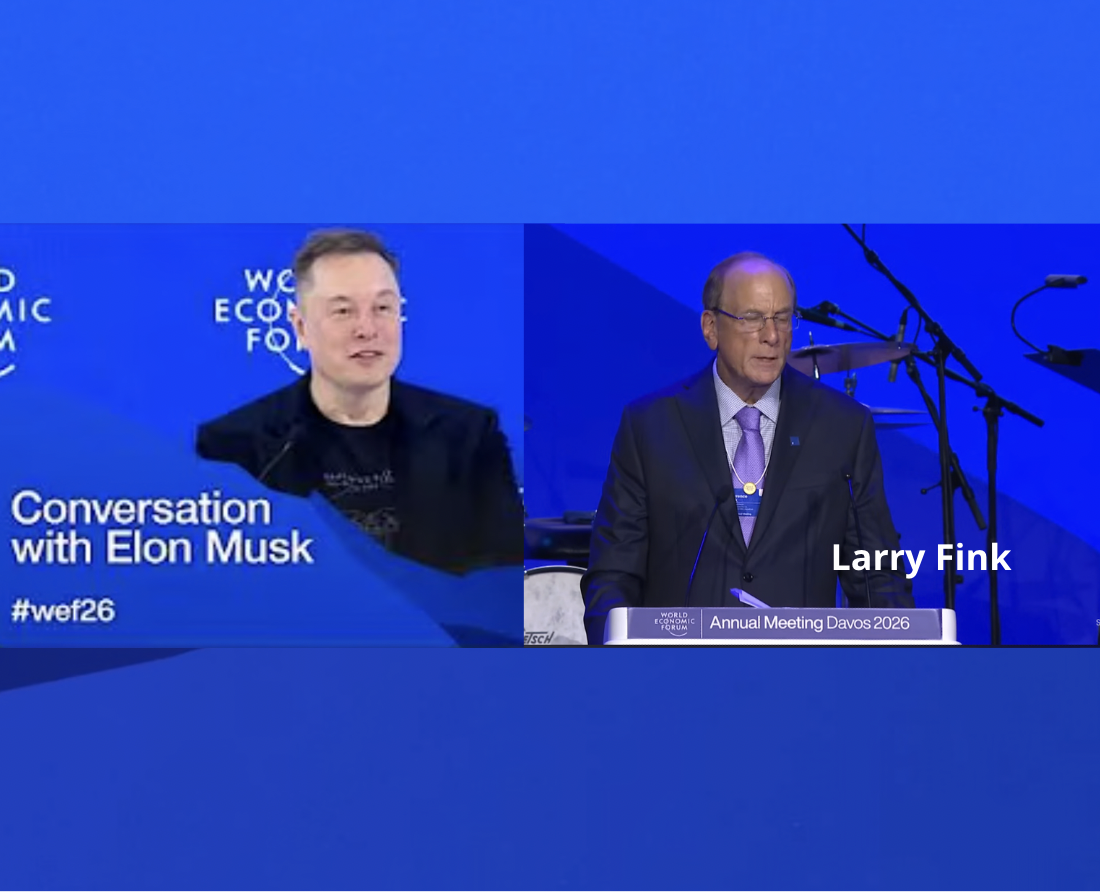
At Davos 2026, the duo Larry Fink – Elon Musk introduces a different layer into the conversation: what technology can do over the next decade and how prepared the system is to absorb that change without breaking.
Fink speaks from the perspective of legitimacy, distribution and the stability of democratic capitalism. Musk speaks from engineering, scale and expanding capabilities. Together they sketch the clash between two clocks: the clock of technology (able to advance exponentially) and the clock of institutions (constrained by political time, bureaucracies and social resistance).
This axis looks first at how Fink turns AI into a stress test for capitalism and democracy; then at how Musk describes a future of technological abundance where electricity and infrastructure become the real bottleneck. Finally, it reads them together as a central piece for understanding the new geopolitics: a system in which it is no longer enough to innovate, but where it is necessary to execute and distribute at the speed at which the technological frontier moves.
1. Larry Fink: Legitimacy, Inequality and AI as a System Stress Test
In his remarks as co-chair of the Forum, Fink starts with a finding that is not technical, but political: the institutions that gather in Davos carry a crisis of trust. He recognises that many of those who will be most affected by decisions on AI, climate or finance “will never be in this room,” and that there is a widespread perception that the benefits of globalisation have been concentrated in very few hands.
From there he builds three ideas:
1. Inequality as a repeated error
Fink links the discussion on AI to what happened after the Cold War: financial liberalisation, trade integration and a significant share of new wealth ending up with the top 1% of the distribution. He points out that if AI boosts productivity without distribution mechanisms, the result may be the same pattern: aggregate growth but extreme concentration.
He does not frame this only as a moral judgement. He presents it as a stability risk: societies with very wide gaps end up producing political responses that question the foundations of the economic system.
2. “Being in the room” vs “being on the ground”
In his speech, Fink insists that Davos “must do something new: show up and listen in the places where the modern economy is actually built.” It is a direct critique of the idea that policy design can be done only from elite forums, without incorporating the experience of those who operate supply chains, industrial platforms and basic services in day to day life.
This shift (moving from talking about the economy to listening to those inside it) is also an attempt to rebuild legitimacy: to show that decisions on AI, the energy transition or finance are informed by the reality of companies, workers and communities, not just by abstract models.
3. AI as a stress test for capitalism and democracy
Fink does not present AI only as an opportunity nor only as a threat. He describes it as a multiplier: it can increase productivity, create new sectors and improve public services, but it can also amplify inequalities and disconnect people from any sense of “fair play.”
His central question is: if we allow the benefits of AI to accumulate in a handful of firms and fortunes, what happens to everyone else? The answer he suggests is not to halt technology, but to design investment, regulatory and education frameworks that avoid repeating the “distribution error” of financial globalisation.
In sum, Fink turns the conversation about AI and capitalism into a matter of social licence: if the system does not show it can distribute the benefits of the new technological wave more effectively, the very legitimacy of the model comes into question.
2. Elon Musk: Technological Abundance and Electricity as Bottleneck
Musk’s conversation with Fink, in “Meet the Leader” format, starts from a completely different point: what technology enables today and what it could enable in 10 – 20 years.
Three blocks structure his narrative:
1. AI and robots as an engine of abundance
Musk argues that AI will be “smarter than any human” within a very short time frame and that, combined with humanoid robotics, it could lead to a situation of “material abundance” that is hard to imagine today.
He talks about fleets of autonomous robotaxis, humanoid robots like “Optimus” performing physical work, increasingly automated factories and a productivity jump that could expand the size of the global economy in radical ways. Here the focus is on the potential for expansion: more goods and services produced with less direct human labour, which theoretically opens space for more people to live better with less physical effort.
2. Electricity as a structural bottleneck
One of the most relevant points for your framework is when Musk identifies electricity as the central limiting factor for scaling AI: training and running large models requires huge amounts of energy; deploying robots and autonomous vehicles at scale also depends on robust grids and sufficient generation; current infrastructures are not dimensioned for that leap.
He proposes two lines of solution: massive deployment of solar and storage on Earth, and, over the longer term, even solar power in space combined with reusable rockets to lower the cost of orbital access. In geopolitical terms, he is saying: the bottleneck of the coming decade will not be the algorithm, but the energy and physical infrastructure that sustain AI.
3. Tension between technological speed and industrial policy frictions
At several points, Musk criticises tariffs and barriers that make technologies such as solar energy more expensive or slower to deploy. He does so from a simple logic: if we want to decarbonise quickly and power AI, it makes little sense (in his view) to slow down the installation of efficient technologies in the name of protecting existing industries.
This puts him in tension with “orderly reindustrialisation” policies that aim to protect jobs or local industries but can, at the same time, delay the rollout of the infrastructure needed to support the new technological wave.
In summary, Musk sketches a future in which the main constraint is no longer knowledge, but the ability to deploy physical infrastructure at the required speed: power generation, grids, data centres, robot factories, logistics corridors.
3. What They Reveal Together About Legitimacy, AI and the Clock of Execution
Viewed as a pair, Fink and Musk show two sides of the same phenomenon:
- Musk focuses on the potential for abundance, on how the combination of AI, robotics, solar energy and reusable space launch can multiply the capacity to produce goods and services and, in theory, reduce the cost of living well.
- Fink focuses on distribution and trust, on whether that abundance will translate into improved well-being for a majority or into a new layer of concentration that is even harder to manage than the previous one.
There are three points where their speeches intersect directly with your framework:
1. AI and robotics force us to see the system as a material system
Musk shifts the conversation from models to infrastructure: electricity, grids, hardware, factories, logistics. Fink shifts it from innovation to social structure: who has a job, who participates in the gains, who feels included or excluded.
Together they force us to see that the next cycle is not only digital; it is deeply physical and deeply social at the same time.
2. Time becomes a political variable, not just a technical one
From Musk’s perspective: if technology can advance very quickly, slow decisions (permits, grids, regulations, investment in generation) become the real limit of the system. From Fink’s: if redistribution and institutional adaptation move too slowly relative to technological change, legitimacy erodes.
That mismatch between the clock of technology and the clock of institutions is the space where political and market tensions accumulate.
3. Sustainability shifts from the declarative plane to the operational plane
In this intersection, sustainability is no longer only about “climate targets” or “ESG criteria,” but a hard design question: are we capable of building the energy and data infrastructure needed without destroying environmental and social balances? Can we make that transition at a speed that is compatible with climate goals and social stability?
Where are the materials that make that infrastructure possible obtained and processed, and under what standards?
Fink and Musk, from different positions, are saying the same thing at the structural level. The time for announcements is running out; the focus shifts to execution: who manages to deploy energy, infrastructure, robots, data centres, standards and distribution policies in the real world, within reasonable timeframes. And mining, because of its physical nature and symbolic weight, becomes one of the test grounds for this new phase.
4. How This Axis Feeds the Overall Framework
The Fink–Musk axis completes the overall framework from two fronts that had so far appeared separately: the technological frontier and the social licence to sustain it.
It confirms that the next cycle is not only digital; it is deeply material. When Musk says that the real limit of AI will be available electricity, grids, data centres, robot factories and logistics corridors, he is translating the technological revolution into the language of infrastructure and physical resources. Innovation stops being only algorithms and becomes power plants, cables, steel, copper, rare earths, water, permits and construction timelines. This fits directly with the first insight of the main article: the power of the next stage will be measured by the ability to deploy material systems (energy, data, industry) at scale and on time.
It deepens the idea that time is a political and legitimacy variable. Musk shows the clock of technology: increasingly powerful models, more autonomous robots, shorter product cycles. Fink shows the clock of institutions: decisions on regulation, investment, training, distribution of gains, response to inequality.
When those clocks fall out of sync (technology advancing very fast, institutions moving very slowly) strong political tensions emerge: fear of job displacement, perceptions of system capture, backlash against technological and financial elites. This axis reinforces the second insight: sovereignty of speed is not only administrative capacity; it is also the ability to adapt rules, investment and distribution mechanisms to the pace of technological change without losing social legitimacy.
It grounds the sustainability conversation in the hardest plane: who provides the matter, and under what conditions. In the general framework we talk about moving from the age of form to the age of substance. Fink and Musk give that phrase content: the energy transition and the expansion of AI are not decided in ESG communications, but in whether we can build, in the real world, the infrastructure required without breaking environmental and social balances.
That brings us back to the third insight: mining, supply chains and sustainability as a central board. Every additional gigawatt, every data centre, every transmission line and every battery plant implies decisions on extraction, processing, transport and standards. AI and robotics do not float in the air; they are supported by layers of matter whose origin and conditions will be increasingly scrutinised by citizens, regulators and investors.
Taken together, the Fink – Musk axis shows the point where the three major threads of the book Mining Is Dead. Long Live Geopolitical Mining and the main article intersect: the shift from finance to matter, the demand for legitimacy and a renewed social contract, and the reorganisation of sectors like mining in a world where execution speed and the quality of distribution are no longer optional.
If the new geopolitics is played at the intersection of technology, legitimacy and execution capacity, this axis is a reminder that the outcome will not be decided only in forums like Davos, but in something much more concrete: who manages to deploy energy, infrastructure, data and rules of the game in specific territories, with societies that feel part of that process rather than mere spectators. That is where geopolitical mining ceases to be a concept and becomes a real-time test.
This axis connects with the other five we analyse for Davos 2026. To see how they all fit into a single framework, you can read the full article: “Davos 2026: Coordinates of the New Geopolitical Era” .

For the full Geopolitical Mining framework behind this article, see our book Mining Is Dead. Long Live Geopolitical Mining .