Geopolitical Mining · Geopolitical Milestones
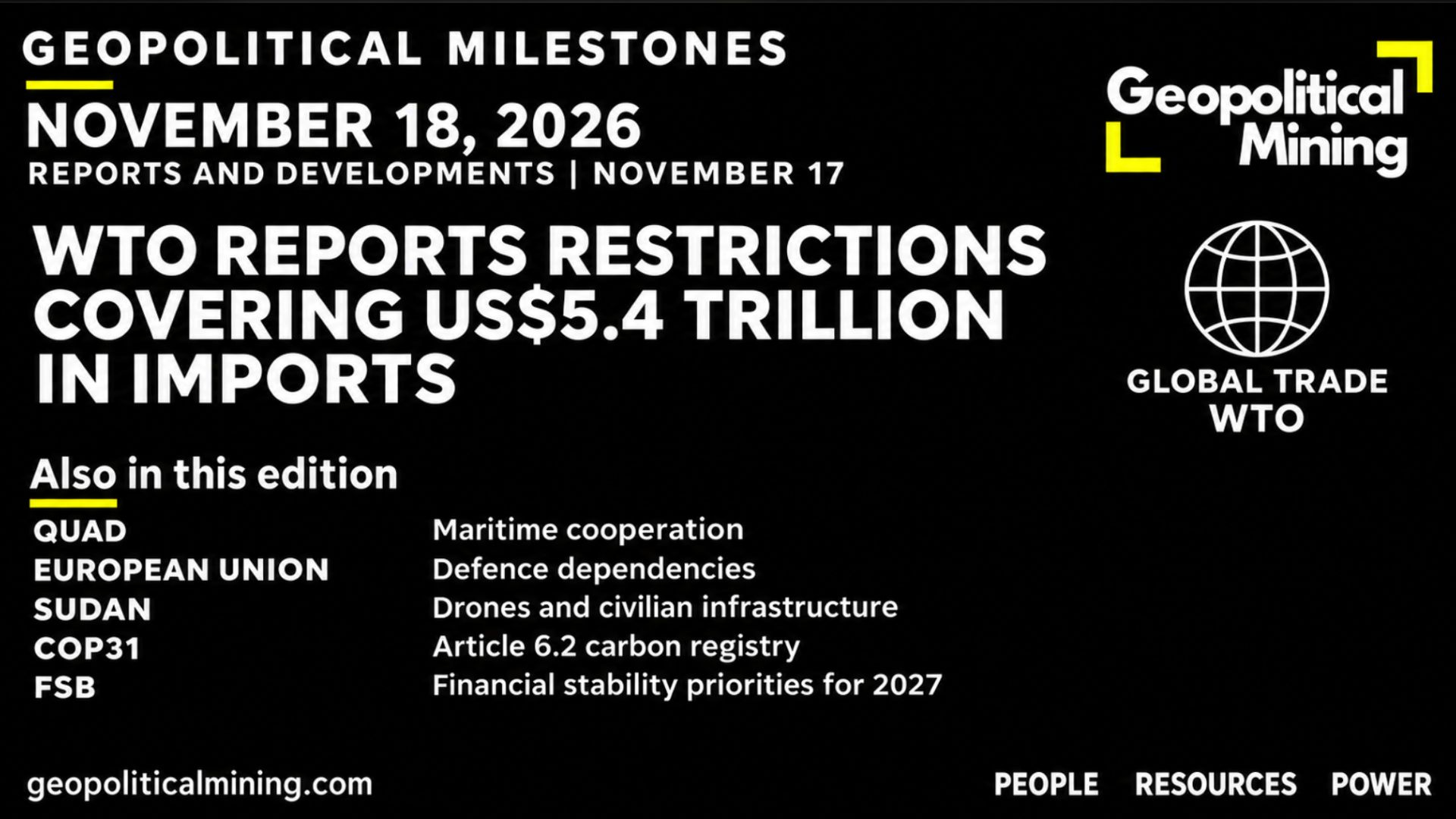
Global Trade: WTO Reports Import Restrictions Covering US$5.4 Trillion
The WTO reports growing trade restrictions, Quad leaders expand cooperation in the Philippines, EU ministers review defence dependencies, and the UN documents civilian harm in Sudan. In Türkiye, UN Climate Change reports on its carbon registry launch, while the FSB sets financial priorities in Switzerland.
Geopolitical Milestones is a daily briefing for senior executives, investors and policymakers. It examines significant international developments and, in particular, their implications for investment, business strategy and public policy.
In focus: Trade rules, maritime capabilities, industrial supply and financial oversight shape how activity moves across borders. These developments concern different stages of action: reported evidence, approved institutional work and plans whose delivery still lies ahead.
Milestone 01
Global Trade: WTO Reports Import Restrictions Covering US$5.4 Trillion
The World Trade Organization’s November 17 report shows that import restrictions and other measures limiting trade covered US$5.4 trillion, or 21.3% of world imports, as of June 30. In other words, the total covers measures that members and observers introduced from 2009 onwards and still maintained on June 30, rather than new restrictions announced on November 17.
During the first half of 2026, members and observers introduced 333 restrictive and other measures that did not facilitate trade. At the same time, they introduced 466 measures facilitating trade. The report therefore describes two simultaneous developments: a growing stock of restrictions and actions that help goods continue moving across borders.
Geopolitical Mining reading:
For companies, the relevant question is how these measures apply to their products, origins and destinations. For example, a global total cannot reveal whether a particular input faces a tariff, a restriction or an exemption. Procurement and investment decisions consequently require a closer reading of the rules affecting each supply route, even where overall trade remains resilient.
Milestone 02
Philippines: Quad Leaders Expand Maritime and Infrastructure Cooperation
The leaders of Australia, India, Japan and the United States met in Manila on November 17. At the meeting, their Quad statement announced a business leaders’ forum for early 2027 and welcomed a new initiative for sharing maritime information and improving awareness of activity at sea.
In addition, the four countries plan an exercise involving P-8 and P-3C patrol aircraft in 2027, the first in a Quad context. Meanwhile, Australia’s contribution to the cable connectivity partnership will extend to electricity cables. The leaders separately expressed concern about economic coercion through arbitrary export restrictions.
Geopolitical Mining reading:
The announcements connect maritime access with the infrastructure and commercial relationships that support regional activity. Surveillance cooperation addresses information and security, while electricity cables and business partnerships address connectivity and investment. These functions can reinforce one another. However, the partners must first deliver the planned forum and exercise before businesses can assess their practical results.
Milestone 03
European Union: Defence Ministers Review Supply Dependencies and Support for Ukraine
EU defence ministers discussed relations with China on November 17, including critical dependencies and ways to strengthen supply chain resilience. Meanwhile, Ukraine’s defence minister briefed them on urgent needs, particularly air defence. The Council also considered industrial cooperation following a Commission proposal for a memorandum on a defence industry partnership with Ukraine.
In a separate meeting, the European Defence Agency’s ministerial steering board approved the 2026 Coordinated Annual Review on Defence, endorsed a joint statement on security of supply and agreed to increase the agency’s budget. However, those decisions concern agency work, whereas the Council discussed the proposed Ukraine memorandum.
Geopolitical Mining reading:
Defence readiness depends on the capacity to obtain, manufacture and deliver equipment, as well as on political support. Accordingly, the meetings bring supply dependencies and industrial cooperation into that assessment. For suppliers, however, a discussion or planning document is not a purchase order. They must therefore trace actual demand through subsequent agreements, budgets and procurement decisions.
Milestone 04
Sudan: UN Documents Drone Attacks on Civilians and Essential Infrastructure
The UN Human Rights Office published a report on November 17 documenting at least 1,390 civilian deaths in Sudan between January and June 2026. More than 80% resulted from drone strikes. In addition, its accompanying update brought confirmed deaths from January through October to over 2,230, including more than 1,630 from drones. Because these totals overlap, adding them would count some deaths twice.
The UN also described attacks on electricity and fuel facilities that disrupted medical treatment, clean water and food production far from the front lines. However, the confirmed casualty figures represent minimum counts; the actual toll is likely higher.
Geopolitical Mining reading:
Electricity and fuel supply connect services that civilians need to survive. Damage to one facility can therefore interrupt treatment, water supply or food production beyond the immediate area of a strike. Consequently, the report makes protection of these systems, humanitarian access and continuity of essential services central to understanding the conflict’s wider effects.
Milestone 05
Türkiye: UN Climate Change Reports Launch of Article 6.2 Registry
UN Climate Change reported on November 17 on the launch of the first version of the Article 6.2 international registry at COP31 in Antalya. The launch event demonstrated its functions on November 16. The system serves countries without a registry of their own, or access to one, for recording and tracking internationally transferred mitigation outcomes.
Available functions include opening accounts, recording mitigation activities, issuing outcomes linked to authorisations and recording transfers, use and cancellation. However, countries will gain access in stages. UN Climate Change expects a workshop in early 2027, followed by training and testing before countries access the live system.
Geopolitical Mining reading:
The registry supplies accounting infrastructure for cooperation under the Paris Agreement. However, its practical use also depends on countries completing the access process and applying the relevant authorisations. Investors must therefore distinguish the launch from participation in the live system or approval of a particular transaction. The infrastructure and the individual activity require separate assessment.
Milestone 06
Switzerland: Financial Stability Board Sets Priorities for 2027
After meeting in Basel on November 16 and 17, the Financial Stability Board set out priorities for 2027 covering artificial intelligence, global stablecoins, financial activity outside banks and international payments. Members discussed rising debt service costs, leverage in sovereign bond markets and risks from borrowing supporting investment in artificial intelligence.
They also considered further work on stablecoin regulation across jurisdictions and vulnerabilities in financial intermediation outside banks. The FSB will publish its final work programme in early 2027. For now, the announcement establishes areas of attention, rather than a new set of binding global regulations.
Geopolitical Mining reading:
Borrowers, investors and payment providers can connect markets that different national authorities oversee. Coordination matters because leverage and funding pressures may transmit stress beyond the institution or jurisdiction where it begins. The FSB’s priorities therefore indicate where that oversight will concentrate, while the detailed programme and implementation by authorities remain separate steps.
Continue reading Geopolitical Mining. Explore our daily mining coverage, weekly reviews and country analysis.