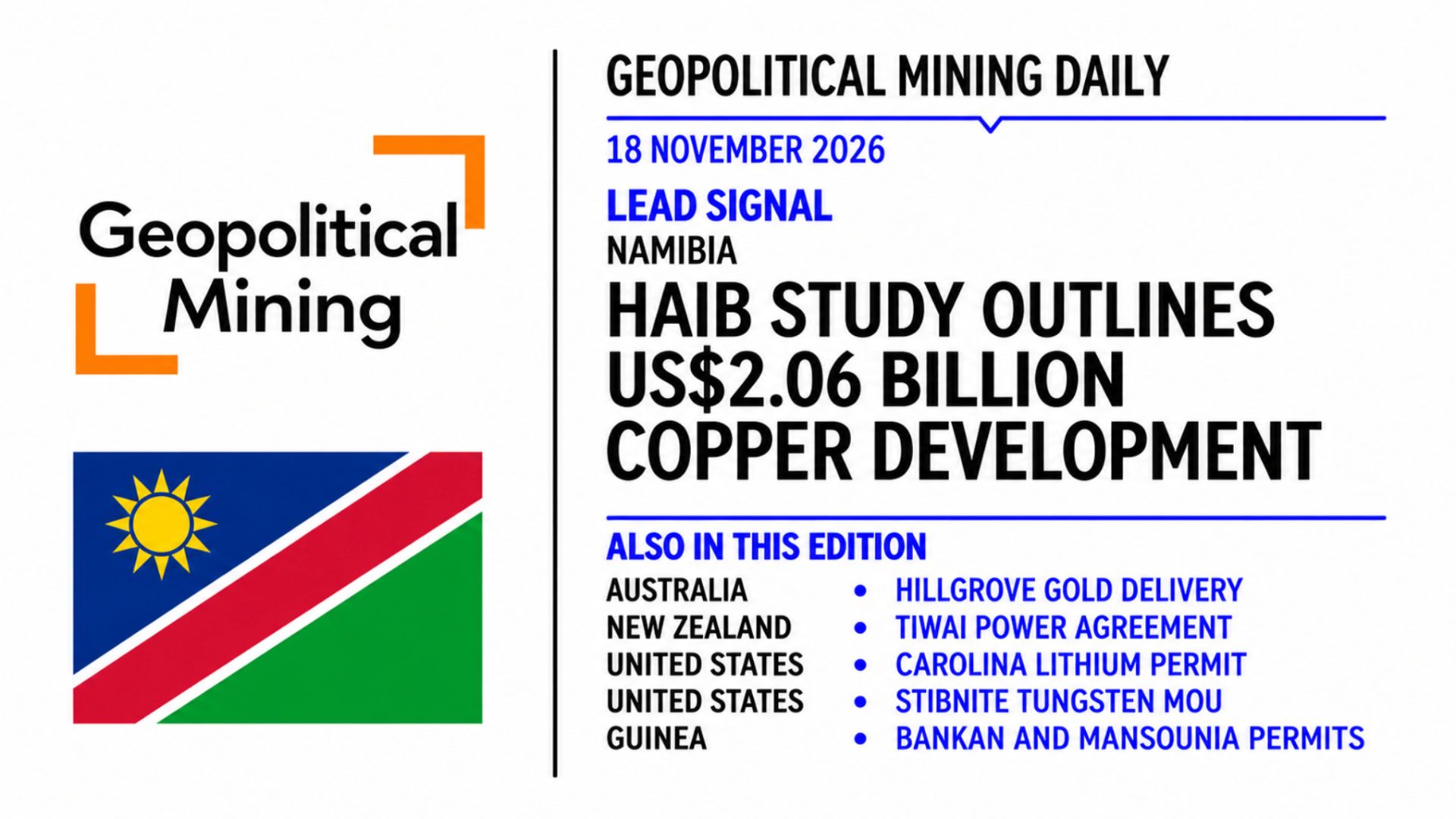

Geopolitical Mining Daily · November 18, 2026
Namibia: Haib Study Outlines US$2.06 Billion Copper Development
Koryx Copper’s Haib study outlines the scale and capital requirements of a proposed copper mine in Namibia, with further technical work, approvals and financing still ahead.
Elsewhere, Hillgrove delivers gold concentrate in Australia, Contact and Rio Tinto sign a power agreement in New Zealand, Elevra receives a US lithium permit, Perpetua evaluates tungsten funding, and Guinea grants gold exploitation permits.
The GM observation framework
The ten Signals
Each Daily uses the same ten strategic lenses. The highlighted dimensions classify the developments in this edition.
Namibia · Project economics and development preparation
Namibia: Haib study outlines US$2.06 billion copper development
What happened
Koryx Copper released prefeasibility results for its Haib copper project in southern Namibia on November 17. The study estimates initial capital of US$2.06 billion and a mine life of 24 years. At a copper price of US$5.00 per pound, its base case gives a net present value after tax of US$2.5 billion at an 8% discount rate and an internal rate of return of 25%.
Average annual payable copper production is estimated at 130,000 tonnes during the first ten years and 105,000 tonnes over the mine life. Koryx plans to begin a definitive feasibility study in early 2027 to support financing and a construction decision. Mining and environmental approvals are targeted for the middle of 2027.
The study connects the proposed production scale with the capital needed to develop it. However, those estimates still need to be supported by further engineering, approvals and financing. The investment case therefore rests on bringing the technical plan and its delivery requirements together, rather than on the modelled return alone.
Primary announcement
Koryx Copper · Haib prefeasibility results · November 17, 2026Australia · Mine production and product delivery
Australia: Hillgrove delivers first gold concentrate to Glencore
What happened
Larvotto Resources announced on November 17 that its Hillgrove mine in New South Wales had delivered its first gold concentrate to Glencore. The shipment comprised 136 bags, each weighing one tonne, sent to the offtake partner’s Brisbane warehouse. It follows the first antimony concentrate shipment in October.
The company expects a partial payment under the offtake agreement. First gold doré production is planned for late November as the processing plant increases output. Larvotto forecasts annual production of 40,500 ounces of gold and 4,900 tonnes of antimony. These figures describe expected production, not output already achieved.
Gold concentrate adds a second product to Hillgrove’s revenue mix alongside antimony. Further deliveries and payments will show how the initial shipment translates into recurring revenue. Potential tungsten production in 2027 remains separate from that operating progress, with testwork and processing design still underway.
Primary announcement
Larvotto Resources · First Hillgrove gold concentrate delivery · November 17, 2026New Zealand · Industrial electricity and smelting capacity
New Zealand: Contact and Rio Tinto sign power agreement for Tiwai Line 4 restart
What happened
Contact Energy announced on November 17 that it had signed an electricity agreement with Rio Tinto to support restarting Line 4 at the Tiwai Point aluminium smelter. The agreement provides 50 MW, reducing to 25 MW during the second and third quarters to support electricity security during winter demand peaks.
Line 4 has been idle since the pandemic. Restart is expected in October 2027, followed by full production in December. Contact estimates annual output of around 30,000 tonnes of aluminium at full capacity. The companies are also developing a power purchase agreement that could support operation for two decades.
The seasonal reduction in contracted power links the smelter’s operating plan to the requirements of the wider electricity system. The signed agreement supports the proposed restart, while the longer operating horizon depends on a further agreement still under development. The additional aluminium remains planned capacity rather than current supply.
Primary announcement
Contact Energy · Rio Tinto power agreement · November 17, 2026United States · Permitting and project definition
United States: Elevra receives Carolina Lithium air permit
What happened
Elevra Lithium announced on November 17 that Carolina Lithium in Gaston County, North Carolina, had received its statutory air permit. The state’s Division of Air Quality granted it after a public comment period. Elevra describes this as the project’s final statutory permit, covering mining and processing spodumene into lithium chemicals at an integrated site.
A construction decision remains subject to a scoping study, rezoning, financing and partnering activities. The study is expected in the second half of 2027 and will help determine the development approach. Elevra also says a partner with the technical and financial capability to deliver the downstream component will be needed.
The permit and the industrial partnership address different requirements. One authorises the proposed activity; the other must bring the capability and capital needed for chemical processing. The next stage therefore involves defining how the mine and conversion facilities will be developed together, alongside the remaining land use and financing decisions.
Primary announcement
Elevra Lithium · Carolina Lithium air permit · November 17, 2026United States · Industrial demand and conditional funding
United States: Perpetua signs non-binding framework to evaluate tungsten supply
What happened
Perpetua Resources announced on November 17 a non-binding memorandum of understanding with an unnamed major American aerospace and defence company. It considers potential funding of up to US$55.5 million without equity issuance, at the prospective funder’s sole discretion, and possible rights to acquire up to 50% of future tungsten production.
Neither party is committed to funding, purchasing or selling tungsten, or granting supply rights. Binding arrangements require definitive agreements, due diligence and applicable approvals. The proposed programme would evaluate tungsten opportunities in Idaho’s historic Stibnite district through technical and development work.
The framework places potential industrial demand alongside the work needed to assess a domestic tungsten source. However, that relationship has not yet become committed finance or offtake. Any tungsten development would remain separate from the approved gold and antimony mine plan and require additional environmental review and permitting. Commercial viability and future production are still to be established.
Primary announcement
Perpetua Resources · Non-binding tungsten MOU · November 17, 2026Guinea · Regulatory approvals and development execution
Guinea: PDI Gold receives Bankan and Mansounia exploitation permits
What happened
PDI Gold announced on November 17 that Guinea had granted exploitation permits for Bankan and the Mansounia deposit at Kiniéro under decrees dated November 16. The company describes these as the final key regulatory approvals needed to begin construction at Bankan and mining at Mansounia.
The board has endorsed accelerated procurement, detailed engineering and compensation activities for Bankan. An updated execution schedule, capital estimate and production profile are being prepared for early 2027. Preparations are also underway to begin mining at Mansounia as soon as practicable. Bankan’s existing study envisages annual gold production of about 250,000 ounces over a mine life of 12 years.
The approvals support two different stages of delivery: building Bankan and preparing Mansounia for mining at Kiniéro. For Bankan, engineering, procurement and compensation work must now be coordinated within the updated execution plan. That plan will provide the next reference for assessing the timing and cost of development; the study’s production figures remain future expectations.
Primary announcement
PDI Gold · Bankan and Mansounia exploitation permits · November 17, 2026The Daily records verified changes. The Signals provide the classification map. The Weekly brings the developments together for the deeper system reading.