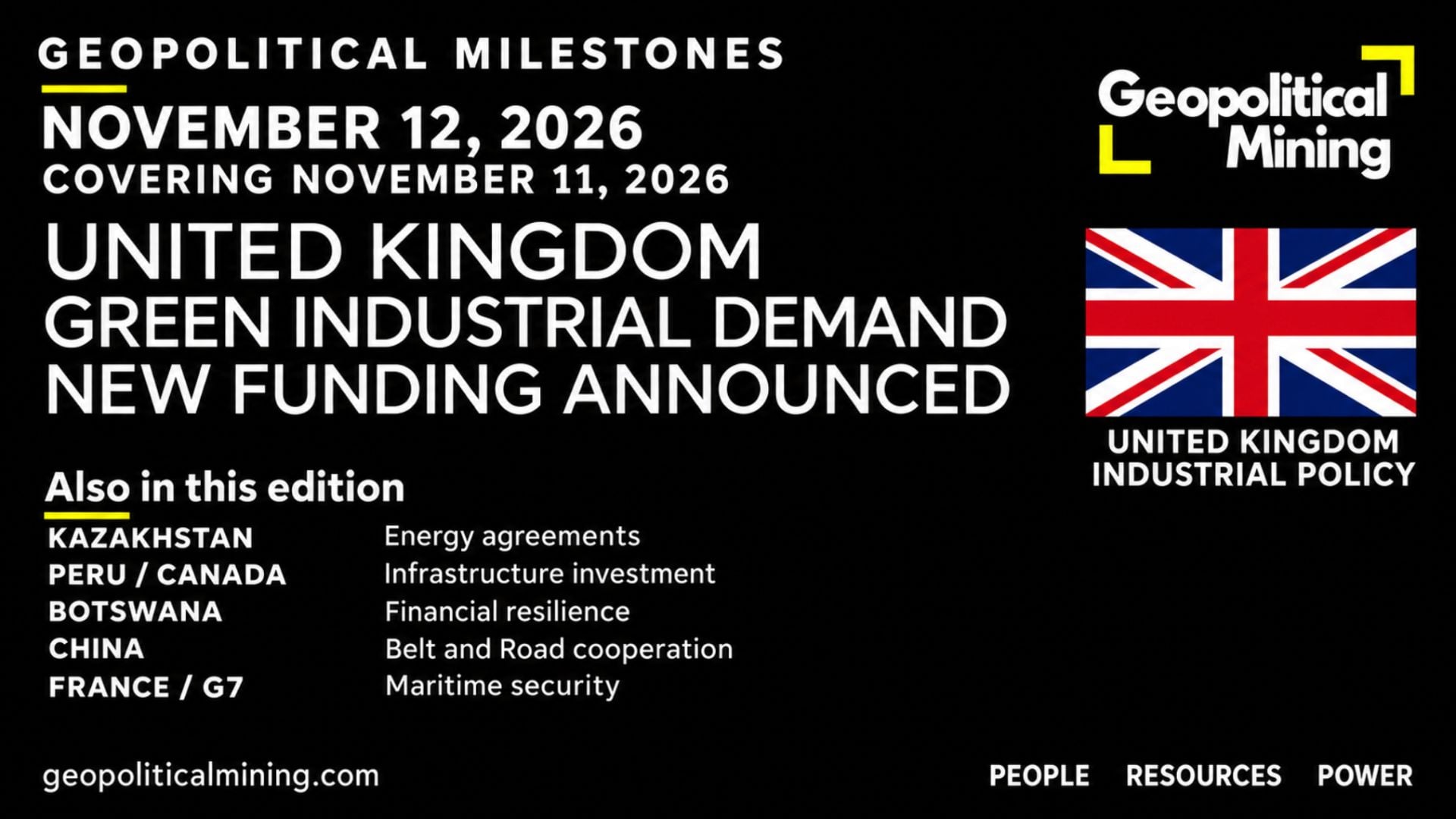

Geopolitical Mining · Geopolitical Milestones
United Kingdom Launches Green Industrial Demand Accelerator
The United Kingdom has announced funding to develop green industrial demand and support infrastructure investment. Elsewhere, energy agreements in Kazakhstan and Peru’s outreach to Canadian investors connect public policy with project development. Botswana’s financial assessment, China’s Belt and Road briefing and a G7 declaration complete the edition.
Geopolitical Milestones is a daily briefing for senior executives, investors and policymakers. Each edition examines significant international developments and their implications for investment, business strategy and public policy.
Also in this edition: Kazakhstan’s energy agreements; Peru and Canadian infrastructure investors; Botswana’s financial resilience; China’s Belt and Road cooperation; and the G7’s maritime security and energy priorities.
Milestone 01
United Kingdom Launches Green Industrial Demand Accelerator
At COP31 on November 11, the United Kingdom announced a Green Industrial Demand Accelerator backed by £90 million. Foreign Secretary Ed Miliband said the initiative would help develop markets for green industry in developing countries. He also announced £45 million to pilot new technologies.
In a separate speech that day, Miliband announced £200 million over four years through the Private Infrastructure Development Group. This support is intended for climate resilient infrastructure in Africa and Asia. The government estimates that it will help mobilise US$1 billion a year in private capital. These figures describe announced support and an expected mobilisation effect, rather than completed investment.
Geopolitical Mining reading:
Green industrial investment depends on demand as well as technology. A market for cleaner production gives new capacity a commercial basis, while infrastructure finance helps connect that capacity to reliable energy and services. Together, these instruments show how public policy can shape the conditions for industrial development. Their economic value will emerge through the projects and markets they support.
Milestone 02
Kazakhstan Signs Energy Agreements Worth About US$1.2 Billion
Kazakhstan’s government reported on November 11 that its COP31 delegation signed agreements worth about US$1.2 billion for renewable energy and gas infrastructure. The documents cover wind projects of 150 MW in Turkestan and 1 GW in Kostanay, alongside the Aqyl Energy project to install 1.35 million smart gas meters.
The government presented the agreements as part of its wider energy transition agenda. However, the announcement does not establish that the proposed wind capacity is operating or that all project finance has been disbursed.
Geopolitical Mining reading:
Generation capacity and better measurement address different parts of the energy system. Wind projects expand the potential supply of electricity, while smart meters improve the information available for managing gas networks. For industry, the significance lies in how investment strengthens the reliability and efficiency of energy services. These connections develop through construction and implementation over time.
Milestone 03
Peru Seeks Canadian Capital for Infrastructure Projects
Peru’s investment agency, ProInversión, reported on November 11 on meetings held in Toronto on November 10 and 11. The mission promoted public private partnerships and asset projects to Canadian institutions, investors and infrastructure companies. Meetings included Infrastructure Ontario, Canadian Commercial Corporation and Transport Canada.
The agency’s wider portfolio contains 87 projects and eight contract amendments, representing more than US$50 billion for 2026 to 2030. That portfolio was presented in October. The Toronto mission sought participation in those opportunities; the release does not announce Canadian commitments of that value.
Geopolitical Mining reading:
Infrastructure development connects a country’s investment pipeline with the institutions capable of financing and delivering it. Canada’s experience in long duration assets is relevant to that relationship. For Peru, transport and energy projects can strengthen the networks linking resources, production and markets. The economic contribution depends on how investor interest becomes workable projects and sustained services.
Milestone 04
Botswana Reviews Financial Resilience and Funding Risks
Botswana’s Financial Stability Council concluded on November 11 that the financial system remained resilient despite difficult operating conditions. Its assessment cited sound financial institutions and improving liquidity and foreign exchange reserves.
At the same time, the council identified subdued economic activity, an uncertain global outlook and funding concentration as continuing risks. It said fiscal consolidation and timely budget financing were addressing earlier pressures on liquidity and funding costs. This is the council’s assessment, rather than an announcement of a new interest rate decision.
Geopolitical Mining reading:
Financial resilience supports the connections between public finances, business funding and investment. In a resource economy, those connections influence how changes in export income reach the wider productive base. Improving liquidity can ease pressure, while concentrated funding sources leave institutions exposed to shifts in a small number of financial flows. The assessment therefore brings the structure of finance into the discussion of economic resilience.
Milestone 05
China Reviews Belt and Road Cooperation Priorities
China’s National Development and Reform Commission held a policy briefing on November 11 on Belt and Road cooperation under the 15th Five Year Plan. Officials from the commission and the commerce, environment and education ministries took part.
According to the commission’s official account, the discussion covered cooperation in emerging fields, China Europe freight trains, economic and trade relations, international trade rules and the Green Silk Road. It also addressed education and technical training. The account records a policy briefing, rather than the signing or financing of individual projects.
Geopolitical Mining reading:
The subjects brought together in this briefing place physical connections alongside trade rules and skills. Rail links create routes, but their commercial role also depends on the institutions and capabilities around them. This broader approach matters for how participating economies connect production with markets. Its practical significance will take shape through the agreements, services and projects that follow.
Milestone 06
France: G7 Sets Out Maritime Security and Energy Priorities
A G7 foreign ministers’ declaration published by Japan’s foreign ministry on November 11 sets out positions agreed after meetings in Paris on November 9 and 10. It addresses maritime security in the Strait of Hormuz and the Red Sea, alongside support for Ukraine’s energy resilience.
The ministers reiterated support for safe maritime passage and increased financial and material assistance for Ukraine through the winter. Their statements on responsibility for attacks represent the G7’s diplomatic position. The declaration does not itself confirm restored navigation, a ceasefire or completed infrastructure repairs.
Geopolitical Mining reading:
Maritime routes and energy infrastructure connect security conditions with the movement of goods and the continuity of production. Diplomatic coordination can influence the resources and arrangements available to protect those connections. However, its commercial effect depends on what changes in shipping conditions and infrastructure performance. The declaration is relevant as a statement of priorities within that process.
Continue reading Geopolitical Mining. Explore our daily mining coverage, weekly reviews and country analysis.