
Geopolitical Mining · Geopolitical Milestones
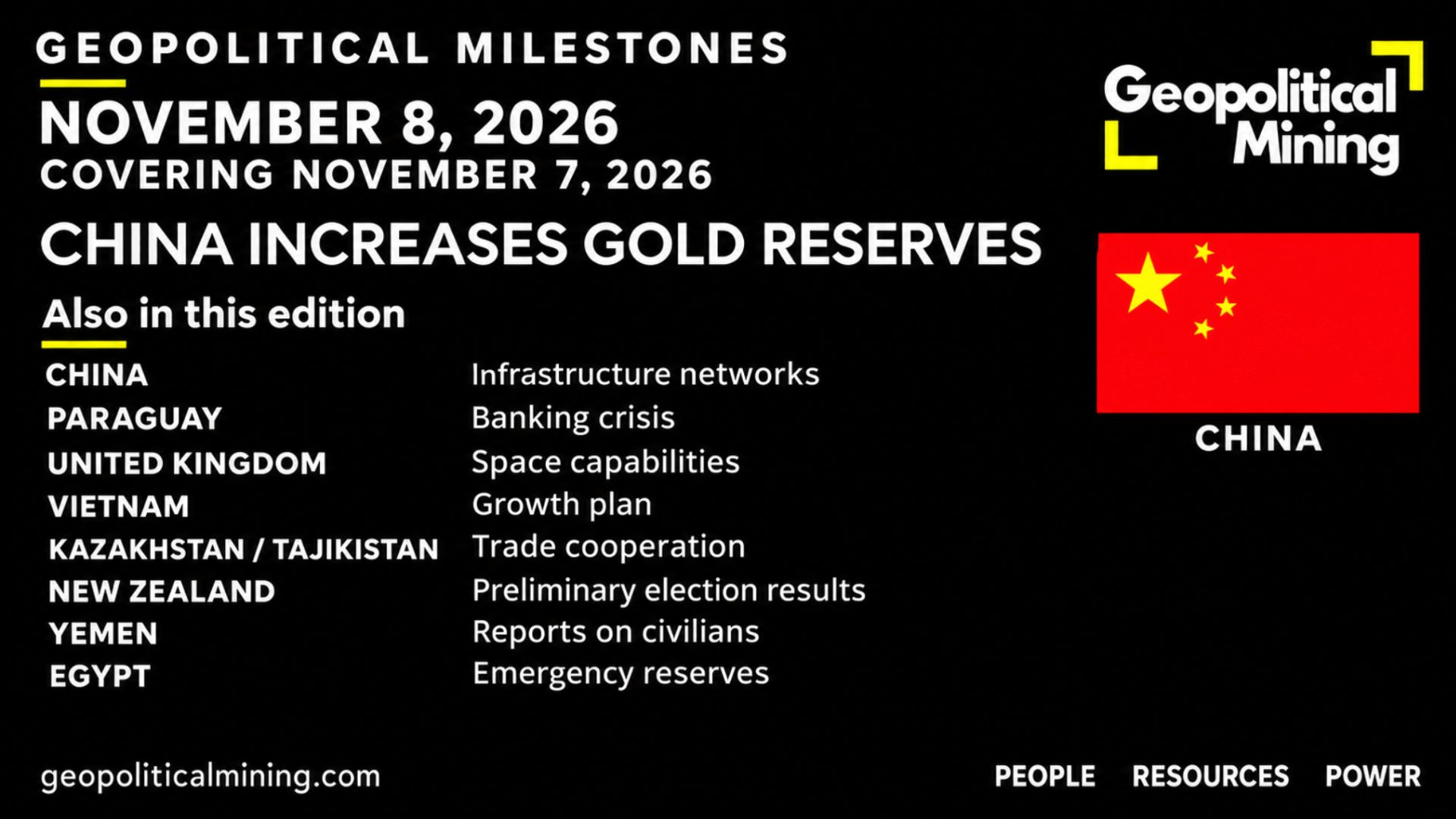
China Adds 830,000 Ounces to Its Gold Reserves
China’s latest gold reserve figures lead nine developments connecting financial assets, public institutions and productive investment. Infrastructure, space capabilities, economic plans and regional trade feature alongside elections, emergency preparedness and conflict in Yemen.
Geopolitical Milestones is a daily briefing for senior executives, investors and policymakers. Each edition examines significant international developments and their implications for investment, business strategy and public policy.
Also in this edition: China’s infrastructure priorities; Paraguay’s political and legal developments; UK space capabilities; Vietnam’s 2027 plan; Kazakhstan and Tajikistan’s trade roadmap; New Zealand’s election; Egypt’s emergency reserve study; and reported civilian casualties in Yemen.
Milestone 01
China Adds 830,000 Ounces to Its Gold Reserves
China’s official gold holdings reached 78.30 million ounces at the end of October, up from 77.47 million in September, according to data published by the State Administration of Foreign Exchange on November 7. In physical terms, the increase of 830,000 ounces is equivalent to approximately 25.8 tonnes.
Foreign exchange reserves stood at US$3.4052 trillion, an increase of 0.14% over September. Alongside those financial assets, the larger gold holdings extend the role of physical metal in China’s official reserve portfolio.
Geopolitical Mining reading:
Central bank purchases connect the gold industry to decisions about sovereign wealth and financial security. Unlike demand tied to manufacturing, this demand reflects gold’s role as a reserve asset. China’s addition therefore matters beyond the management of its own portfolio: it brings an institutional source of demand into a market also shaped by jewellery, technology and private investment. For mining, that connection places the metal within both the resource economy and the international financial system.
Milestone 02
China Calls for Faster Progress on Six Infrastructure Networks
China’s State Council called for faster delivery of major projects and six infrastructure networks at a meeting on November 6, reported by the government on November 7. The priorities cover water, electricity, computing, communications, urban underground pipelines and logistics.
Alongside these projects, the meeting called for equipment investment, timely payments to local authorities and enterprises, and closer coordination of fiscal and financial policies. The focus was therefore on implementation and the use of policy funds, rather than a new quantified spending package.
Geopolitical Mining reading:
Infrastructure investment brings domestic demand and industrial capacity into the same policy programme. Construction and equipment purchases create demand for materials, while power, water and transport networks support production over a longer horizon. Computing and communications add the systems through which that capacity is managed. Public funding and payments connect these objectives to project delivery, making the flow of finance as important as the physical networks in translating policy priorities into investment.
Milestone 03
Paraguay Prosecutors Charge Former President Following Political Transition
Paraguay’s Public Ministry listed a November 7 notice stating that prosecutors had charged Santiago Peña and Carlos Carvallo and requested preventive detention and measures concerning their assets. The announcement concerns prosecutorial action, not a conviction or a final determination of responsibility.
The development follows Pedro Alliana’s swearing in as president on November 6, recorded by the Senate. Together, the presidential transition and the legal proceedings place institutional continuity and public accountability at the centre of the country’s immediate political agenda.
Geopolitical Mining reading:
Financial governance connects public confidence with the institutions responsible for oversight and accountability. When legal proceedings coincide with a presidential transition, the economic significance extends beyond the individuals involved. Administrative continuity, credible supervision and the handling of public obligations help shape confidence in the wider institutional framework. For investment, these relationships matter because contracts and capital commitments depend on institutions that can function through political change.
Milestone 04
United Kingdom Confirms New Satellite and Space Monitoring Capabilities
The United Kingdom’s Ministry of Defence announced on November 7 that the Titania satellite had reached orbit following a launch in October. Developed under a £9.5 million contract involving Dstl and BAE Systems, the satellite supports work on space communications within the ISTARI programme.
Alongside Titania, the ministry reported the Inaros monitoring trial, using sensors in the United Kingdom, Australia and Cyprus. These developments form part of wider commitments of more than £3 billion over four years for defence space capabilities, rather than a £3 billion investment in the satellite alone.
Geopolitical Mining reading:
Space systems have become part of the infrastructure supporting activity on the ground. Navigation and communications connect transport, logistics and dispersed operations, while monitoring capabilities help protect the satellites behind those services. Defence spending therefore also develops industrial capabilities in sensors, communications and engineering. The programme links strategic autonomy with the reliability of infrastructure used across the wider economy, extending the significance of space investment beyond the military platform itself.
Milestone 05
Vietnam Adopts 2027 Economic Plan with Growth Target of at Least 10%
Vietnam’s National Assembly approved the 2027 socioeconomic development plan on November 7, with 467 of 469 participating lawmakers voting in favour. The resolution sets a GDP growth target of at least 10%, alongside macroeconomic stability and inflation control.
To support that objective, the plan promotes public and private investment, foreign capital and reinvested profits. It also calls for faster public investment delivery, stronger capital markets and reliable energy supplies. Funding allocation is linked to implementation, including shifting resources towards projects better able to use them.
Geopolitical Mining reading:
The growth ambition brings energy, capital and institutional execution into a single development agenda. Expanding production requires more than investment approvals: electricity supply, infrastructure and access to finance determine how quickly new capacity becomes usable. Vietnam’s emphasis on public investment delivery therefore connects its industrial ambitions with the practical allocation of resources. For companies participating in regional production networks, that combination shapes the conditions for expansion and the demand for equipment and materials.
Milestone 06
Kazakhstan and Tajikistan Adopt Trade Roadmap Through 2030
Kazakhstan and Tajikistan adopted a roadmap to increase trade through 2030 during presidential talks reported on November 7. Kazakhstan’s presidency said bilateral trade was approaching US$2 billion and identified further opportunities in energy, mining, metallurgy and processing.
The presidents also discussed transport links and digitalisation. A working group involving the national railway companies is to develop proposals, while cooperation on water accounting and monitoring forms another part of the agenda. These plans set out areas for cooperation rather than investments already financed.
Geopolitical Mining reading:
Regional trade depends on the networks that connect production with markets. In Central Asia, rail capacity, energy links and water management are closely related to the location and viability of industrial activity. The roadmap brings these relationships into a shared political framework. Its economic value will emerge as trade objectives translate into transport arrangements and productive investment, linking national development priorities with the practical conditions for a more integrated regional economy.
Milestone 07
New Zealand Election Gives Governing Coalition a Narrow Preliminary Majority
New Zealand’s November 7 election left National, ACT and New Zealand First with a combined 67 of 131 projected parliamentary seats in the Electoral Commission’s preliminary count. The three parties held 42, 13 and 12 seats respectively, against the 66 required for a majority in that projected parliament.
Labour narrowly led the party vote, while National held more projected seats under the country’s mixed electoral system. Meanwhile, the Commission expects to release the official result on November 27. Special votes and the final count can change the allocation, so the preliminary figures do not settle the final parliamentary balance.
Geopolitical Mining reading:
A narrow parliamentary margin places greater weight on coalition coordination and the passage of individual measures. For businesses, that balance therefore matters for decisions on infrastructure, public expenditure and regulation. The final result will establish the votes available to sustain a government and its programme. Until then, the election points to a closely divided political environment rather than a settled mandate for a new economic direction.
Milestone 08
Egypt Orders Study of National Emergency Reserve
Egypt’s President Abdel Fattah El-Sisi directed state institutions on November 7 to accelerate the entry of their data into the National Authority for Crisis and Emergency Management system. He stressed the accuracy and confidentiality of the information used to support decisions.
The president also instructed the authority to examine the provision of a strategic national reserve for emergency needs, in coordination with state agencies. The directive initiates that examination; the statement does not announce a reserve already established or a funded procurement programme.
Geopolitical Mining reading:
Emergency preparedness links material availability with the information needed to deploy it. A reserve can support continuity only when institutions understand needs, locations and responsibilities across the state. Egypt’s directive brings those elements into the same planning process. For the wider economy, this connection matters because disruption can spread through public services and supply networks. The proposed approach places administrative coordination alongside physical resources in the management of national resilience.
Milestone 09
Yemen Authorities Report Civilian Deaths in Alleged Saudi Air Strikes
The health ministry in Houthi controlled Sana’a said on November 7 that air strikes attributed to Saudi Arabia had hit homes in Al Shariya, in the Bani Hushaysh district of Sana’a governorate. Its initial account reported 22 people killed and 30 injured.
The statement was carried by the Houthi run Saba news agency. The casualty figures and attribution come from those authorities and have not been independently verified for this edition.
Geopolitical Mining reading:
Civilian losses are the immediate concern. More broadly, conflict in Yemen connects local insecurity with the stability of a region central to energy production and international trade. Further escalation could affect the security assumptions behind transport and investment decisions. However, this report alone does not establish a change in shipping conditions or energy supply. Its wider economic significance lies in the course of the conflict and the regional responses that follow.
Continue reading Geopolitical Mining. Explore our daily mining coverage, weekly reviews and country analysis.